
Explanations for differences in educational success Outside school


- Slides: 17
Explanations for differences in educational success. (Outside school factors contd. ) CULTURAL DEPRIVATION Topic 04 Adapted from S. Moore, M Haralambos and GE
Issues in the Cultural deprivation debate n Working class culture is deprived n The working classes use a different language code n Middle class children have cultural capital
Cultural Deprivation issue n Culture includes phenomena such as values and norms, it is everything that is learned n Culture is transmitted by primary socialisation where parents pass on society’s culture to their children (the next generation)
n It is argued that culture varies between social classes n It is this cultural difference between classes which accounts for either the success or failure in education
Cultural Deprivation (Sugarman) Cultural attitudes of the working class account for their lack of educational success. n. The working class has a preference for immediate gratification (to enjoy things straight away) n. Thus working class pupils are more likely to leave school as soon as possible to get a job for money now
Criticisms of Sugarman idea that working class culture is deprived I. He was writing at a time when it was more common for working class children to bring home money for disadvantaged households II. High unemployment makes it pointless to leave school as soon as possible
Differences in parental Interest Douglas) Class cultural differences in the degree of interest show by parents in their children’s education accounted for the lack of success nworking class parents were less likely to attend school functions, for example parents’ evenings and open-days
Criticism of Douglas’ parental interest argument I. Many working class parents may be unable to attend these school functions, e. g. because of shift work or long hours II. Working class parents may feel uncomfortable in the middle class atmosphere of schools, especially if they did not achieve well themselves.
Middle and working class differences in Language (Bernstein) n There are two ways or codes of talking – (i) In Restricted code and (ii) In elaborated code
i) The Restricted code n This is used by the working class; it is a “shorthand” way of speaking and it tends to be used between people who share the same meanings, e. g. close friends Thus it is not generally understood by everyone in all situations. (It is restricted and particular)
ii) Elaborated code – This is used by the middle class n It is not restricted or particular to whether or not a person already knows what one are talking about n It is a more detailed way of talking, everyone can understand what one means because one explains oneself very clearly. (It is general and universal)
n Bernstein says middle class children use the elaborated code and thus achieve more in school because teachers use the same way of speaking n Working class children start off with a disadvantage because they do not speak in the same way as teachers as the restricted code is not used in education
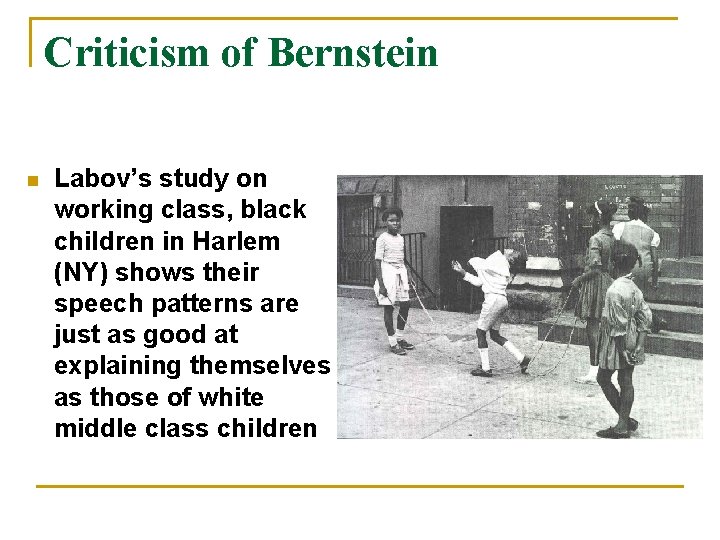
Criticism of Bernstein n Labov’s study on working class, black children in Harlem (NY) shows their speech patterns are just as good at explaining themselves as those of white middle class children
n Labov claims that black working class children achieve badly at school because they speak a different dialect from the teacher and teachers often criticise this n The children then see school and the class room as hostile so they do not say much. This makes them look as if they have a restricted code
Cultural Capital (Bordieu) n The idea of cultural capital is used by Marxists to explain cultural influences on educationalsuccess n Bourdieu suggests that middle class culture has a value in educational terms just as material wealth (capital) has a value n He calls this cultural capital
n Schools are middle class institutions run by the middle classes n Thus it is middle class forms of knowledge, values and ways of communicating ideas that are enhanced and rewarded by the education system n Working class children may lack these qualities, so they do not have the same chance to succeed
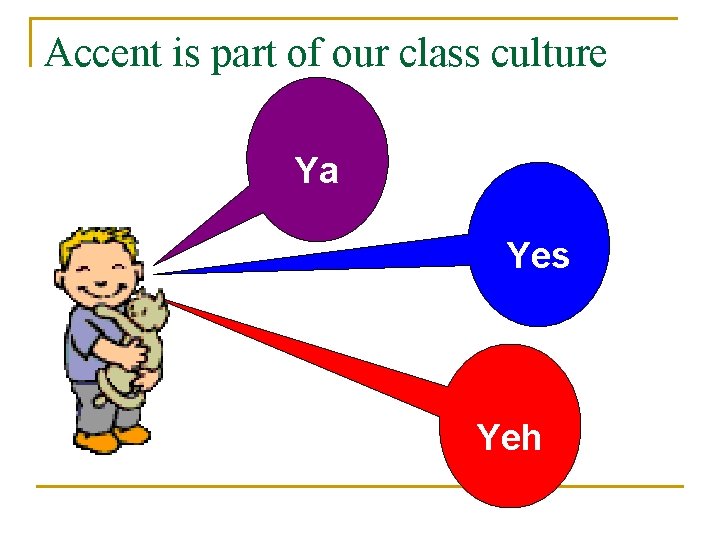
Accent is part of our class culture Ya Yes Yeh