
Explanation of Examples of CPPA V 1 05
![[Service. Binding element] ・Service. Binding element defines Delivery Channels and Packaging by each Action.](https://slidetodoc.com/presentation_image/f979f447fddc6d472eab3cea899bbaa7/image-11.jpg "[Service. Binding element] ・Service. Binding element defines Delivery Channels and Packaging by each Action.")
![[Delivery. Channel element] ・Delivery Channel and Packaging are able to be defined by separately](https://slidetodoc.com/presentation_image/f979f447fddc6d472eab3cea899bbaa7/image-12.jpg "[Delivery. Channel element] ・Delivery Channel and Packaging are able to be defined by separately")
![[Delivery. Channel element] ・Delivery Channel also defines Transport and doc. Exchange. Delivery Channel Transport](https://slidetodoc.com/presentation_image/f979f447fddc6d472eab3cea899bbaa7/image-13.jpg "[Delivery. Channel element] ・Delivery Channel also defines Transport and doc. Exchange. Delivery Channel Transport")
![[doc. Exchange element] ・doc. Exchange element defines characteristics regarding exchange of business documents. ・These](https://slidetodoc.com/presentation_image/f979f447fddc6d472eab3cea899bbaa7/image-14.jpg "[doc. Exchange element] ・doc. Exchange element defines characteristics regarding exchange of business documents. ・These")
- Slides: 17
Explanation of Examples of CPPA V 1. 05 Process-Specification Document CPP-A/B, CPA (draft-cpp-example-company. A-012. xml) (draft-cpp-example-company. B-012. xml) (draft-cpa-example-012. xml) Message Header (V 2. 0) Feb. 3, 2002 1
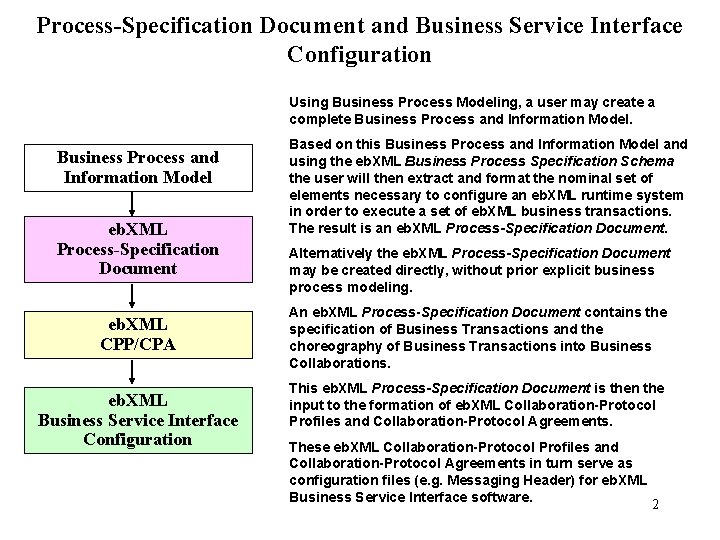
Process-Specification Document and Business Service Interface Configuration Using Business Process Modeling, a user may create a complete Business Process and Information Model eb. XML Process-Specification Document eb. XML CPP/CPA eb. XML Business Service Interface Configuration Based on this Business Process and Information Model and using the eb. XML Business Process Specification Schema the user will then extract and format the nominal set of elements necessary to configure an eb. XML runtime system in order to execute a set of eb. XML business transactions. The result is an eb. XML Process-Specification Document. Alternatively the eb. XML Process-Specification Document may be created directly, without prior explicit business process modeling. An eb. XML Process-Specification Document contains the specification of Business Transactions and the choreography of Business Transactions into Business Collaborations. This eb. XML Process-Specification Document is then the input to the formation of eb. XML Collaboration-Protocol Profiles and Collaboration-Protocol Agreements. These eb. XML Collaboration-Protocol Profiles and Collaboration-Protocol Agreements in turn serve as configuration files (e. g. Messaging Header) for eb. XML Business Service Interface software. 2
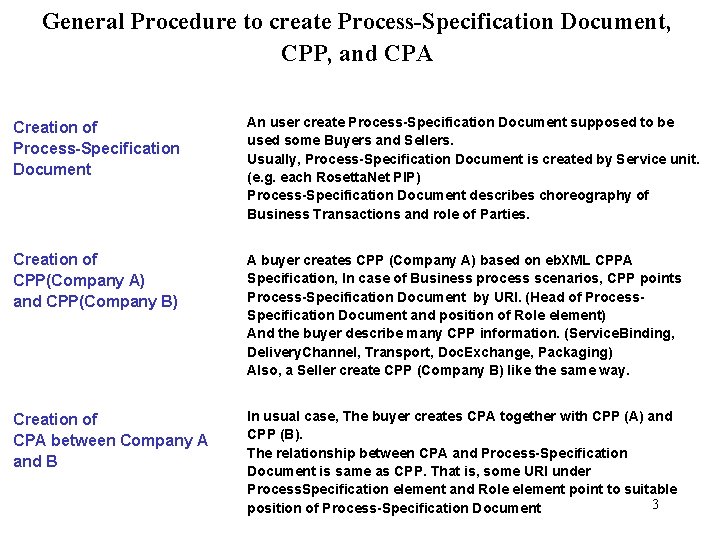
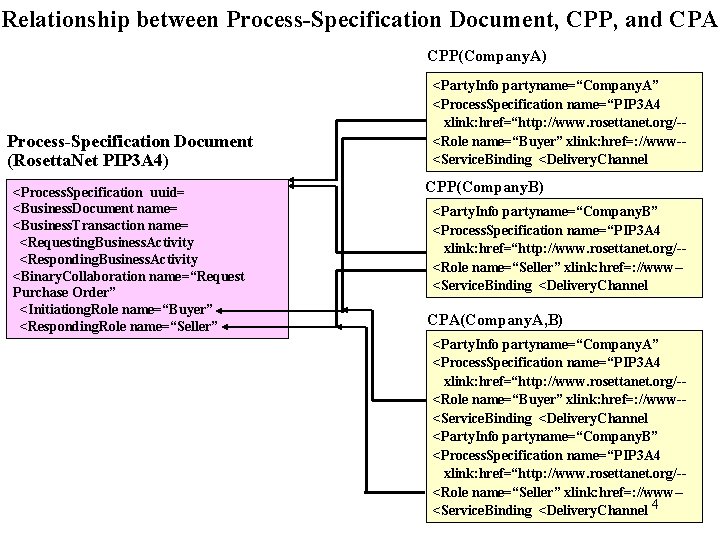
General Procedure to create Process-Specification Document, CPP, and CPA Creation of Process-Specification Document An user create Process-Specification Document supposed to be used some Buyers and Sellers. Usually, Process-Specification Document is created by Service unit. (e. g. each Rosetta. Net PIP) Process-Specification Document describes choreography of Business Transactions and role of Parties. Creation of CPP(Company A) and CPP(Company B) A buyer creates CPP (Company A) based on eb. XML CPPA Specification, In case of Business process scenarios, CPP points Process-Specification Document by URI. (Head of Process. Specification Document and position of Role element) And the buyer describe many CPP information. (Service. Binding, Delivery. Channel, Transport, Doc. Exchange, Packaging) Also, a Seller create CPP (Company B) like the same way. Creation of CPA between Company A and B In usual case, The buyer creates CPA together with CPP (A) and CPP (B). The relationship between CPA and Process-Specification Document is same as CPP. That is, some URI under Process. Specification element and Role element point to suitable 3 position of Process-Specification Document
Relationship between Process-Specification Document, CPP, and CPA CPP(Company. A) Process-Specification Document (Rosetta. Net PIP 3 A 4) <Process. Specification uuid= <Business. Document name= <Business. Transaction name= <Requesting. Business. Activity <Responding. Business. Activity <Binary. Collaboration name=“Request Purchase Order” <Initiationg. Role name=“Buyer” <Responding. Role name=“Seller” <Party. Info partyname=“Company. A” <Process. Specification name=“PIP 3 A 4 xlink: href=“http: //www. rosettanet. org/-<Role name=“Buyer” xlink: href=: //www-<Service. Binding <Delivery. Channel CPP(Company. B) <Party. Info partyname=“Company. B” <Process. Specification name=“PIP 3 A 4 xlink: href=“http: //www. rosettanet. org/-<Role name=“Seller” xlink: href=: //www-<Service. Binding <Delivery. Channel CPA(Company. A, B) <Party. Info partyname=“Company. A” <Process. Specification name=“PIP 3 A 4 xlink: href=“http: //www. rosettanet. org/-<Role name=“Buyer” xlink: href=: //www-<Service. Binding <Delivery. Channel <Party. Info partyname=“Company. B” <Process. Specification name=“PIP 3 A 4 xlink: href=“http: //www. rosettanet. org/-<Role name=“Seller” xlink: href=: //www-<Service. Binding <Delivery. Channel 4
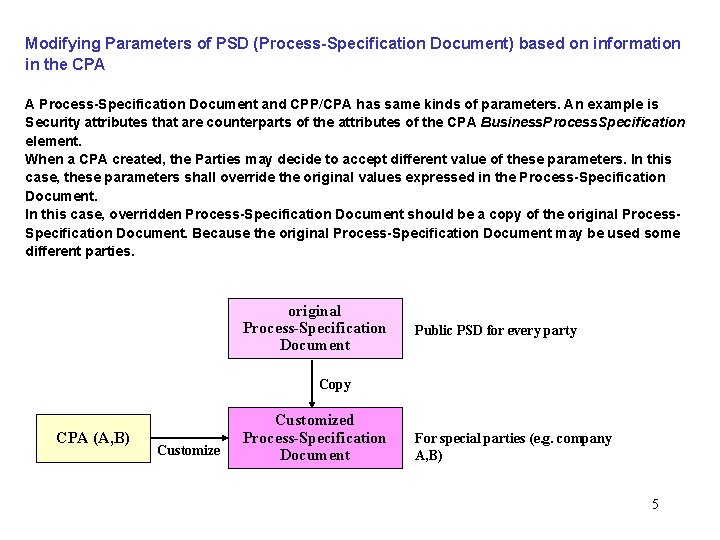
Modifying Parameters of PSD (Process-Specification Document) based on information in the CPA A Process-Specification Document and CPP/CPA has same kinds of parameters. An example is Security attributes that are counterparts of the attributes of the CPA Business. Process. Specification element. When a CPA created, the Parties may decide to accept different value of these parameters. In this case, these parameters shall override the original values expressed in the Process-Specification Document. In this case, overridden Process-Specification Document should be a copy of the original Process. Specification Document. Because the original Process-Specification Document may be used some different parties. original Process-Specification Document Public PSD for every party Copy CPA (A, B) Customized Process-Specification Document For special parties (e. g. company A, B) 5
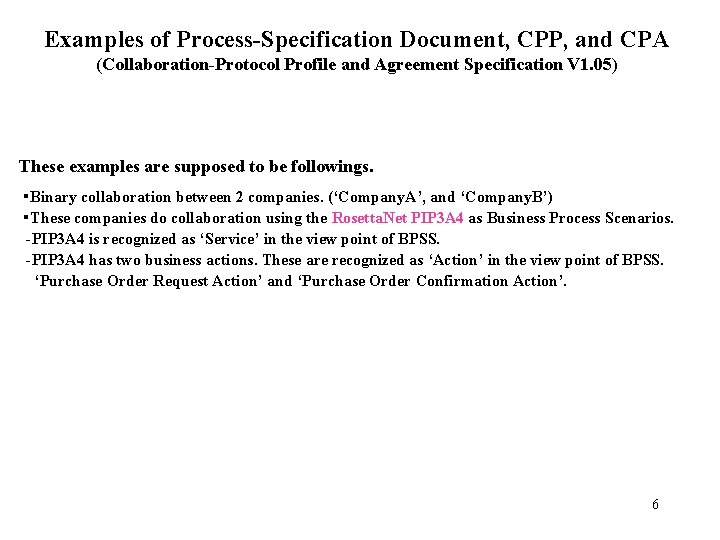
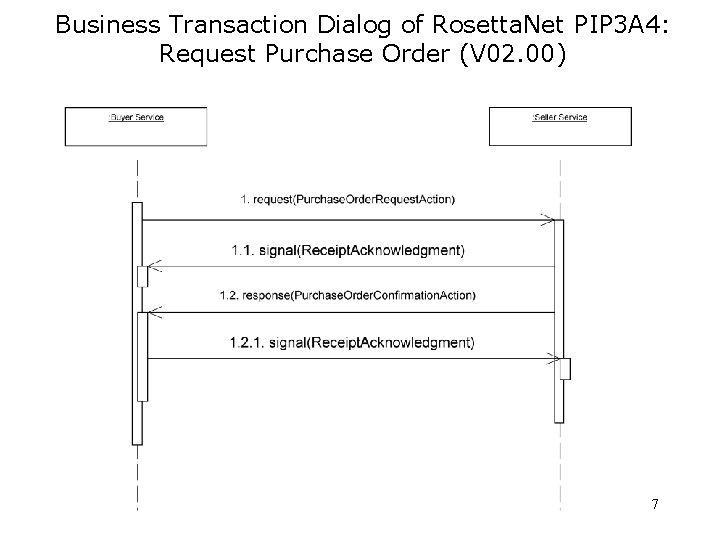
Examples of Process-Specification Document, CPP, and CPA (Collaboration-Protocol Profile and Agreement Specification V 1. 05) These examples are supposed to be followings. ・Binary collaboration between 2 companies. (‘Company. A’, and ‘Company. B’) ・These companies do collaboration using the Rosetta. Net PIP 3 A 4 as Business Process Scenarios. -PIP 3 A 4 is recognized as ‘Service’ in the view point of BPSS. -PIP 3 A 4 has two business actions. These are recognized as ‘Action’ in the view point of BPSS. ‘Purchase Order Request Action’ and ‘Purchase Order Confirmation Action’. 6
Business Transaction Dialog of Rosetta. Net PIP 3 A 4: Request Purchase Order (V 02. 00) 7
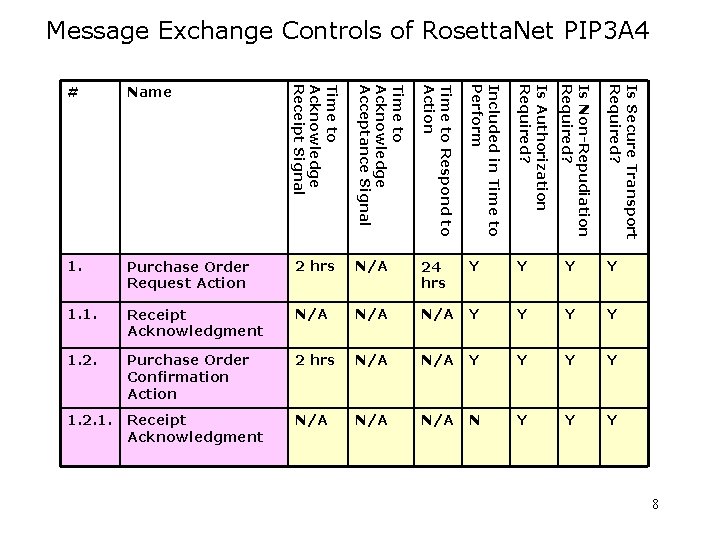
Message Exchange Controls of Rosetta. Net PIP 3 A 4 Time to Respond to Action Included in Time to Perform Is Authorization Required? Purchase Order Request Action 2 hrs N/A 24 hrs Y Y 1. 1. Receipt Acknowledgment N/A N/A Y Y 1. 2. Purchase Order Confirmation Action 2 hrs N/A Y Y 1. 2. 1. Receipt Acknowledgment N/A N/A N Y Y Y Is Secure Transport Required? Time to Acknowledge Acceptance Signal 1. Is Non-Repudiation Required? Name Time to Acknowledge Receipt Signal # 8
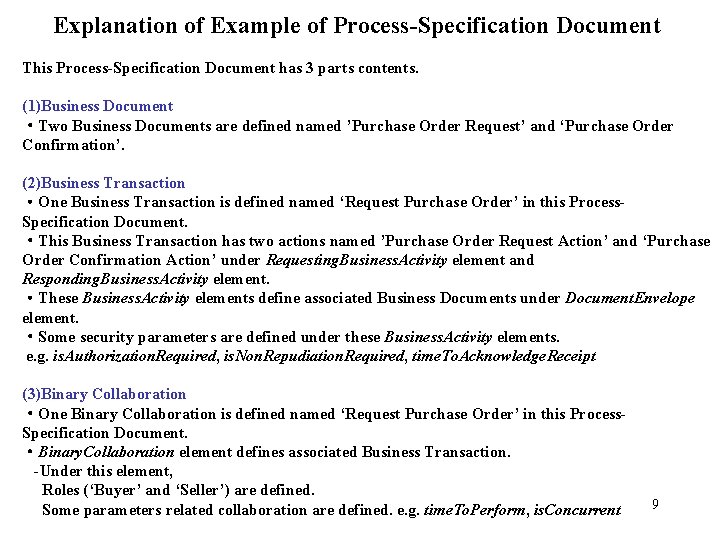
Explanation of Example of Process-Specification Document This Process-Specification Document has 3 parts contents. (1)Business Document ・Two Business Documents are defined named ’Purchase Order Request’ and ‘Purchase Order Confirmation’. (2)Business Transaction ・One Business Transaction is defined named ‘Request Purchase Order’ in this Process. Specification Document. ・This Business Transaction has two actions named ’Purchase Order Request Action’ and ‘Purchase Order Confirmation Action’ under Requesting. Business. Activity element and Responding. Business. Activity element. ・These Business. Activity elements define associated Business Documents under Document. Envelope element. ・Some security parameters are defined under these Business. Activity elements. e. g. is. Authorization. Required, is. Non. Repudiation. Required, time. To. Acknowledge. Receipt (3)Binary Collaboration ・One Binary Collaboration is defined named ‘Request Purchase Order’ in this Process. Specification Document. ・Binary. Collaboration element defines associated Business Transaction. -Under this element, Roles (‘Buyer’ and ‘Seller’) are defined. Some parameters related collaboration are defined. e. g. time. To. Perform, is. Concurrent 9
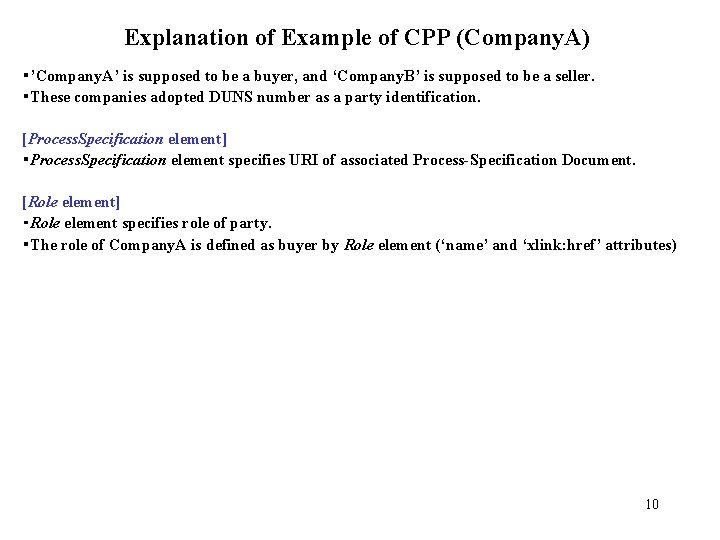
Explanation of Example of CPP (Company. A) ・’Company. A’ is supposed to be a buyer, and ‘Company. B’ is supposed to be a seller. ・These companies adopted DUNS number as a party identification. [Process. Specification element] ・Process. Specification element specifies URI of associated Process-Specification Document. [Role element] ・Role element specifies role of party. ・The role of Company. A is defined as buyer by Role element (‘name’ and ‘xlink: href’ attributes) 10
[Service. Binding element] ・Service. Binding element defines Delivery Channels and Packaging by each Action. And also Delivery Channels and Packaging are specified by sending action or receiving action. e. g. Will. Initiate element (for sending action), Will. Respond element (for receiving action) ・In this example, CPP(A) has two Service. Binding element. One is for asynchronous collaboration, and the other one is for synchronous collaboration. This means Company. A has ability to do both asynchronous collaboration and synchronous collaboration. ・The value of Service element ‘bpid: ican: rosettanet. org: 3 A 4$2. 0’ will be used as the value of the Service element in the eb. XML Message Header. [Certificate element] ・In case of certification under CPPA specification, All Business documents are digitally signed based on XML Digital Signature specification [XMLDSIG]. ・Certification information is defined by Certificate element. These certificate information are referred elsewhere in the CPP. Certificate information is able to be defined independently by using cert. ID or security. Id attributes. ・Trust. Anchors element represents a root certificate trusted by this party. 11
[Delivery. Channel element] ・Delivery Channel and Packaging are able to be defined by separately and independently using Action. Binding element and Delivery. Channel element. ・Delivery. Channel element has a function to determine Business process characteristics and Messaging characteristics. Definition of Delivery Cannel and Packaging by using Action. Binding element Action (Company. A) →(A→B) ←(A ← B) Delivery Channel Packaging Purchase Order Request Action → async. Channel. A 1 Company. A_Request. Package Receive Acknowledgement ← async. Channel. A 1 Company. A_Receipt. Acknowledge ment. Package Purchase Order Confirmation Action ← async. Channel. A 1 Company. A_Response. Package Receive Acknowledgement → async. Channel. A 1 Company. A_Receipt. Acknowledge ment. Package Business. Process. Characteristics (async. Channel. A 1) Messageing. Characteristics (async. Channel. A 1) -is. Non. Repudiation. Required: true -is. Non. Repudiation. Receipt. Required: false -is. Secure. Transport. Required: true -is. Confidential: persistent -is. Authenticated: true -is. Authorization. Required: false -sync. Reply. Mode: none -ack. Requested: always -ack. Signature. Requested: always -dupulicate. Elimination: always 12
[Delivery. Channel element] ・Delivery Channel also defines Transport and doc. Exchange. Delivery Channel Transport Doc. Exchange async. Channel. A 1 transport. A 2 doc. Exchange. A 1 [Transport element] ・Transport element defines the party’s network communication capabilities. ・Communication capabilities are able to be defined by every sending and receiving action. transport. A 2 Transport. Sender Transport. Protocol: HTTP V 1. 1 Transport. Security. Protocol: SSL V 3. 0 Transport. Receiver Transport. Protocol: HTTP V 1. 1 Endpoint: https: //www. Company. A. com/servlets/ebxmlhandler/sync Transport. Server. Secu rity Transport. Security. Protocol: SSL V 3. 0 13
[doc. Exchange element] ・doc. Exchange element defines characteristics regarding exchange of business documents. ・These characteristics are able to be defined by sending and receiving action. doc. Exchange. A 1 Sending. Binding Receiving. Binding Reliable. Messaging Retries Retry. Interval Pursist. Duration Message. Order. Semantics 3 PT 2 H P 1 D Guaranteed Non. Repudiation. Protocol Hash. Function Signature. Algorism Signing. Certificate xmldsig# Xmldsig#sha 1 Xmldsig#dsa-sha 1 Company. A_Signing. Cert xmldsig# Xmldsig#sha 1 Xmldsig#dsa-sha 1 Company. A_Message. Security Digital. Envelop. Protocol Encription. Algorism Encription. Security S/MIME V 2. 0 DES-CBC Company. A_Message. Secu rity S/MIME V 2. 0 DES-CBC Company. A_Encription. Cert [Packaging element] ・Packaging element provides specific information about how the Message Header and payload constituent(s) are packaged for transmittal over the transport. ・The Packaging element provides information about MIME content types, XML namespaces, security parameters, and MIME structure. ・These information are capable to be defined by each sending and receiving action. 14
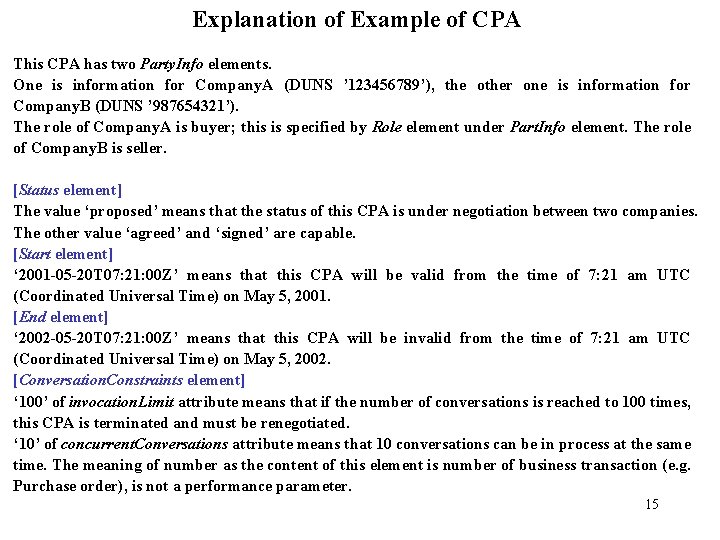
Explanation of Example of CPA This CPA has two Party. Info elements. One is information for Company. A (DUNS ’ 123456789’), the other one is information for Company. B (DUNS ’ 987654321’). The role of Company. A is buyer; this is specified by Role element under Part. Info element. The role of Company. B is seller. [Status element] The value ‘proposed’ means that the status of this CPA is under negotiation between two companies. The other value ‘agreed’ and ‘signed’ are capable. [Start element] ‘ 2001 -05 -20 T 07: 21: 00 Z’ means that this CPA will be valid from the time of 7: 21 am UTC (Coordinated Universal Time) on May 5, 2001. [End element] ‘ 2002 -05 -20 T 07: 21: 00 Z’ means that this CPA will be invalid from the time of 7: 21 am UTC (Coordinated Universal Time) on May 5, 2002. [Conversation. Constraints element] ‘ 100’ of invocation. Limit attribute means that if the number of conversations is reached to 100 times, this CPA is terminated and must be renegotiated. ‘ 10’ of concurrent. Conversations attribute means that 10 conversations can be in process at the same time. The meaning of number as the content of this element is number of business transaction (e. g. Purchase order), is not a performance parameter. 15
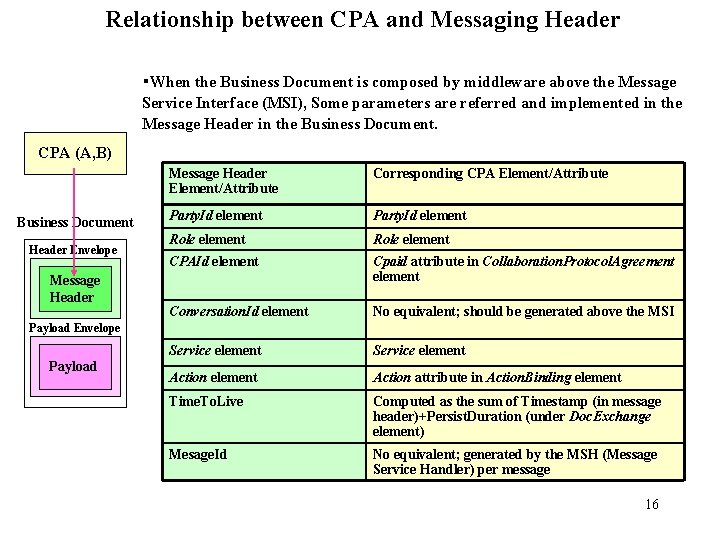
Relationship between CPA and Messaging Header ・When the Business Document is composed by middleware above the Message Service Interface (MSI), Some parameters are referred and implemented in the Message Header in the Business Document. CPA (A, B) Business Document Header Envelope Message Header Element/Attribute Corresponding CPA Element/Attribute Party. Id element Role element CPAId element Cpaid attribute in Collaboration. Protocol. Agreement element Conversation. Id element No equivalent; should be generated above the MSI Service element Action attribute in Action. Binding element Time. To. Live Computed as the sum of Timestamp (in message header)+Persist. Duration (under Doc. Exchange element) Mesage. Id No equivalent; generated by the MSH (Message Service Handler) per message Payload Envelope Payload 16
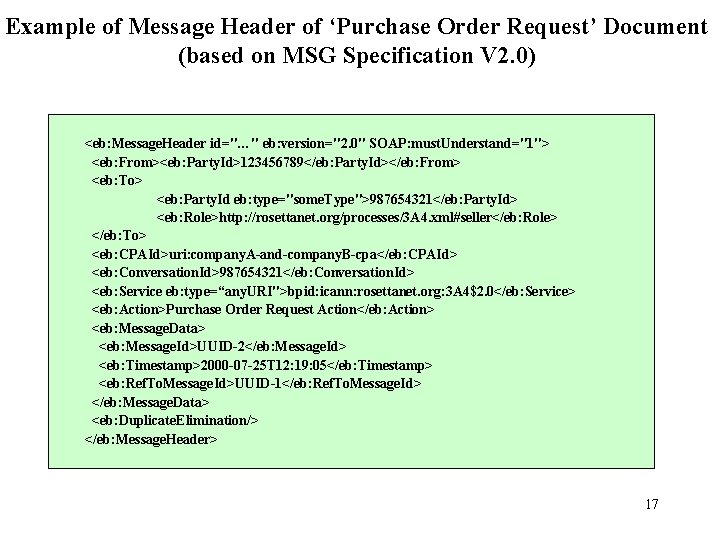
Example of Message Header of ‘Purchase Order Request’ Document (based on MSG Specification V 2. 0) <eb: Message. Header id="…" eb: version="2. 0" SOAP: must. Understand="1"> <eb: From><eb: Party. Id>123456789</eb: Party. Id></eb: From> <eb: To> <eb: Party. Id eb: type="some. Type">987654321</eb: Party. Id> <eb: Role>http: //rosettanet. org/processes/3 A 4. xml#seller</eb: Role> </eb: To> <eb: CPAId>uri: company. A-and-company. B-cpa</eb: CPAId> <eb: Conversation. Id>987654321</eb: Conversation. Id> <eb: Service eb: type=“any. URI">bpid: icann: rosettanet. org: 3 A 4$2. 0</eb: Service> <eb: Action>Purchase Order Request Action</eb: Action> <eb: Message. Data> <eb: Message. Id>UUID-2</eb: Message. Id> <eb: Timestamp>2000 -07 -25 T 12: 19: 05</eb: Timestamp> <eb: Ref. To. Message. Id>UUID-1</eb: Ref. To. Message. Id> </eb: Message. Data> <eb: Duplicate. Elimination/> </eb: Message. Header> 17