
Explainable Machine Learning 2019 May 1 st 2019

Explainable Machine Learning 2019, May 1 st 2019 Flowcast Inc. | Confidential
Outline 1. Introduction to machine learning 2. Brief history of explainable machine learning a. Why are they useful b. Examples 3. How to generate explanations a. Global b. Local 4. Common pitfalls when generating explanations 5. Strategies to make them better
Introduction to Machine Learning 1. Machine learning approximates the world through evidence 2. At low dimensionality, it looks like simple curve fitting 3. Good generalizability is helpful to predict areas where data is sparse. 4. Overfitting is when the model fits to noise. 5. Hyperparameters are parameters of the model 6. Normally there are many inputs (features / dimensions) to a model (100 s, 10 e 4+)
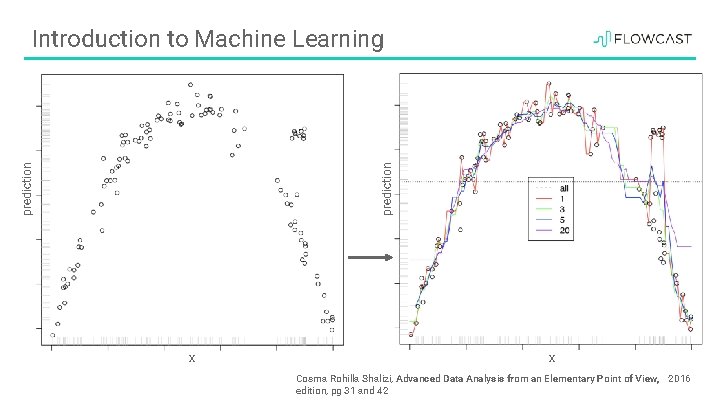
prediction Introduction to Machine Learning x x Cosma Rohilla Shalizi, Advanced Data Analysis from an Elementary Point of View, 2016 edition, pg 31 and 42
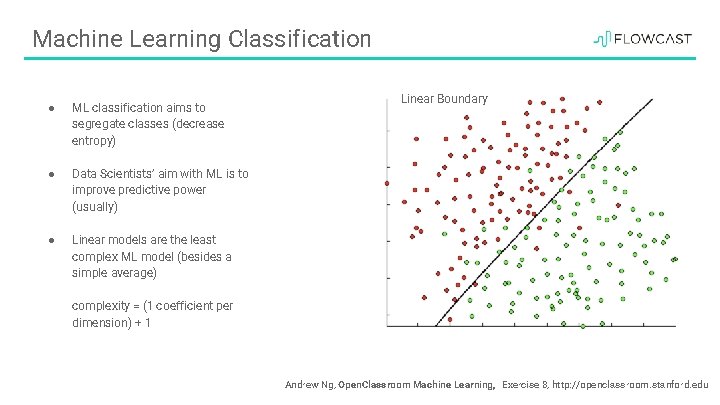
Machine Learning Classification ● ML classification aims to segregate classes (decrease entropy) ● Data Scientists’ aim with ML is to improve predictive power (usually) ● Linear models are the least complex ML model (besides a simple average) Linear Boundary complexity = (1 coefficient per dimension) + 1 Andrew Ng, Open. Classroom Machine Learning, Exercise 8, http: //openclassroom. stanford. edu

Machine Learning Classification ● Non-linear models improve predictive power at the cost of increased complexity ● Non-linear models are called “black-box models” in laymen’s ● complexity = ( >>1 coefficient per dimension) + 1 Non-linear Boundary Andrew Ng, Open. Classroom Machine Learning, Exercise 8, http: //openclassroom. stanford. edu
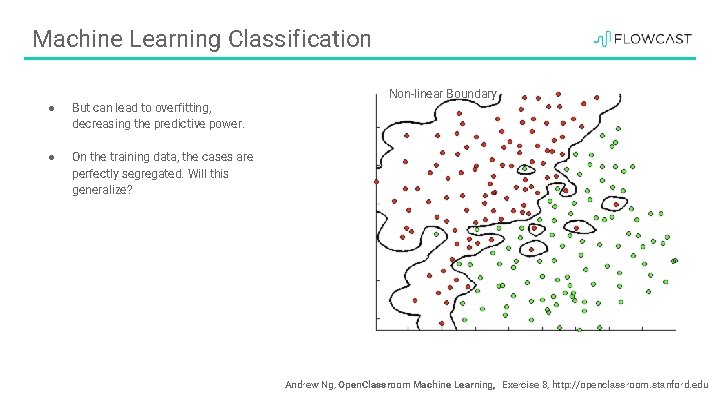
Machine Learning Classification ● But can lead to overfitting, decreasing the predictive power. ● On the training data, the cases are perfectly segregated. Will this generalize? Non-linear Boundary Andrew Ng, Open. Classroom Machine Learning, Exercise 8, http: //openclassroom. stanford. edu
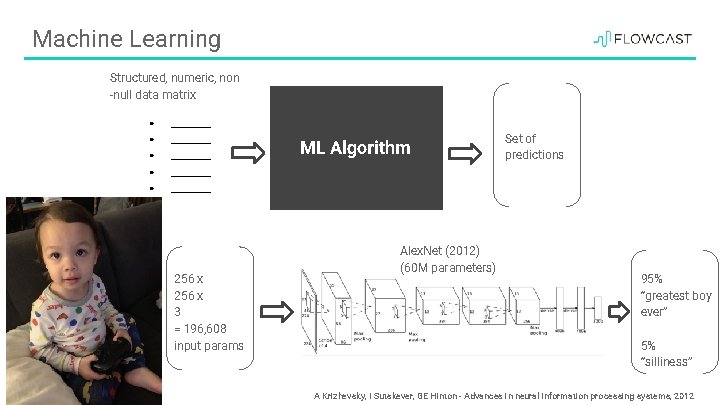
Machine Learning Structured, numeric, non -null data matrix ● ________ ● ____ 256 x 3 = 196, 608 input params ML Algorithm Alex. Net (2012) (60 M parameters) Set of predictions 95% “greatest boy ever” 5% “silliness” A Krizhevsky, I Sutskever, GE Hinton - Advances in neural information processing systems, 2012
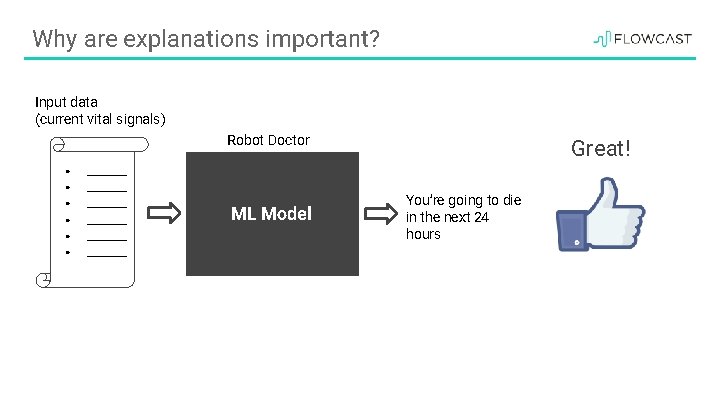
Why are explanations important? Input data (current vital signals) Robot Doctor ● ________ ● ________ ML Model Great! You’re going to die in the next 24 hours
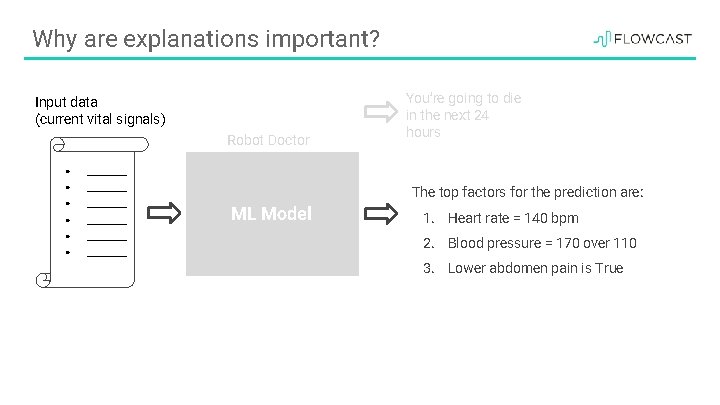
Why are explanations important? Input data (current vital signals) Robot Doctor ● ________ ● ________ You’re going to die in the next 24 hours The top factors for the prediction are: ML Model 1. Heart rate = 140 bpm 2. Blood pressure = 170 over 110 3. Lower abdomen pain is True
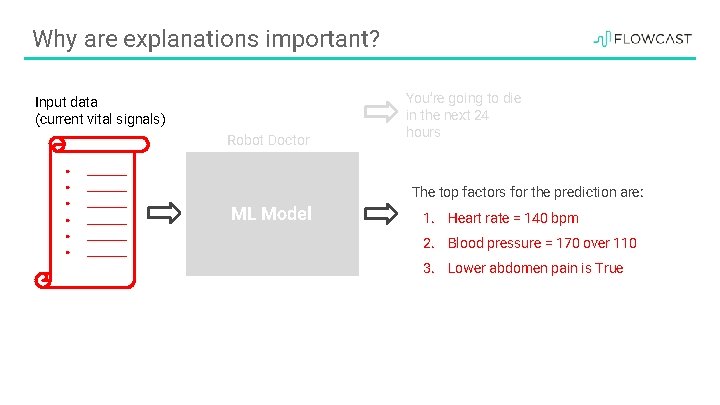
Why are explanations important? Input data (current vital signals) Robot Doctor ● ________ ● ________ You’re going to die in the next 24 hours The top factors for the prediction are: ML Model 1. Heart rate = 140 bpm 2. Blood pressure = 170 over 110 3. Lower abdomen pain is True
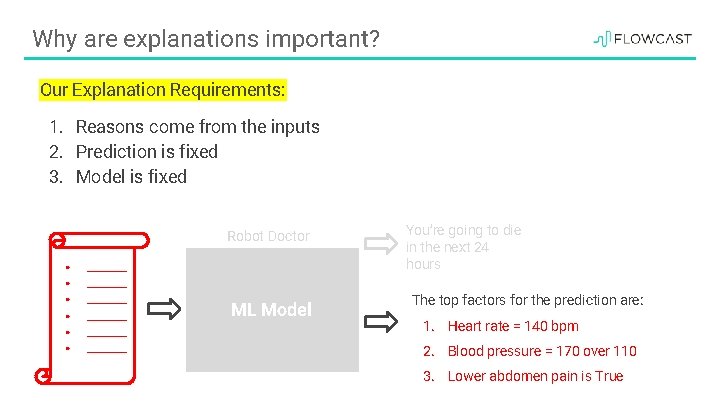
Why are explanations important? Our Explanation Requirements: 1. Reasons come from the inputs 2. Prediction is fixed 3. Model is fixed Robot Doctor ● ________ ● ________ ML Model You’re going to die in the next 24 hours The top factors for the prediction are: 1. Heart rate = 140 bpm 2. Blood pressure = 170 over 110 3. Lower abdomen pain is True
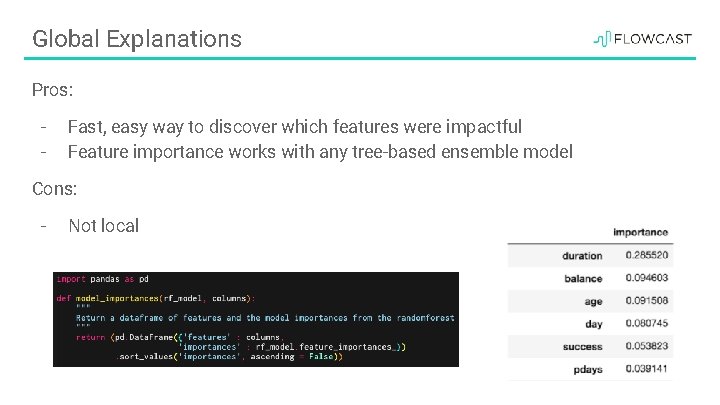
Global Explanations Pros: - Fast, easy way to discover which features were impactful Feature importance works with any tree-based ensemble model Cons: - Not local
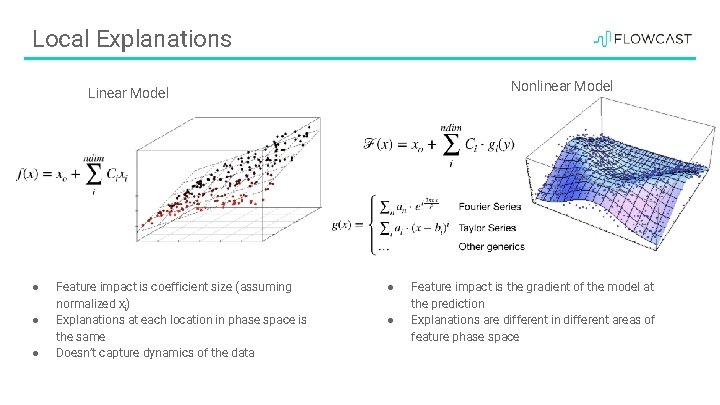
Local Explanations Nonlinear Model Linear Model ● ● ● Feature impact is coefficient size (assuming normalized xi) Explanations at each location in phase space is the same Doesn’t capture dynamics of the data ● ● Feature impact is the gradient of the model at the prediction Explanations are different in different areas of feature phase space
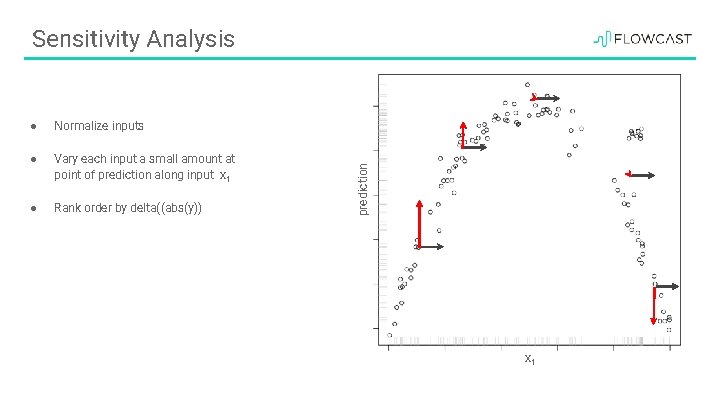
● Normalize inputs ● Vary each input a small amount at point of prediction along input x 1 ● Rank order by delta((abs(y)) prediction Sensitivity Analysis x 1
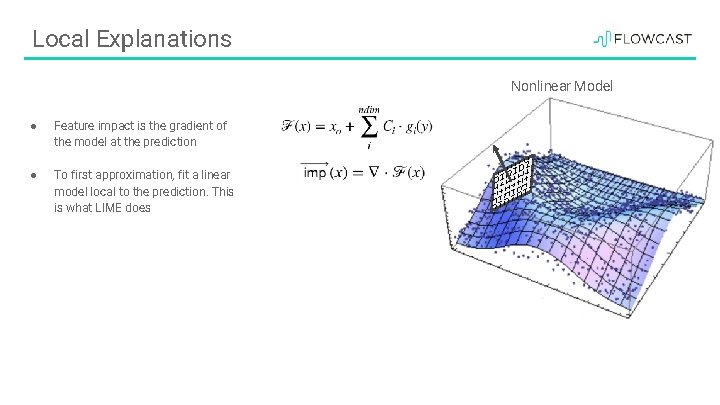
Local Explanations Nonlinear Model ● Feature impact is the gradient of the model at the prediction ● To first approximation, fit a linear model local to the prediction. This is what LIME does
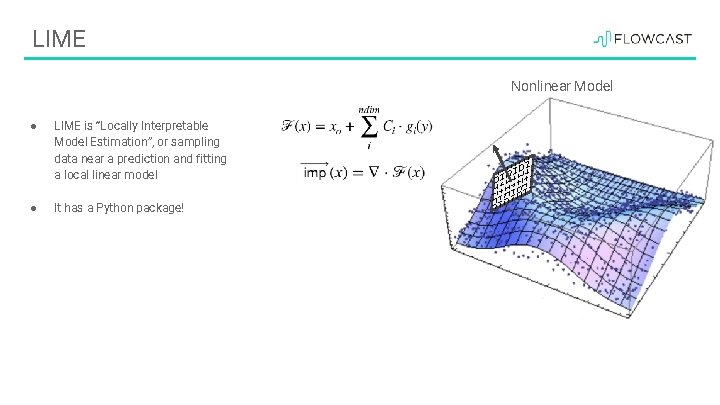
LIME Nonlinear Model ● LIME is “Locally Interpretable Model Estimation”, or sampling data near a prediction and fitting a local linear model ● It has a Python package!

LIME Demo https: //marcotcr. github. io/lime/tutorials/
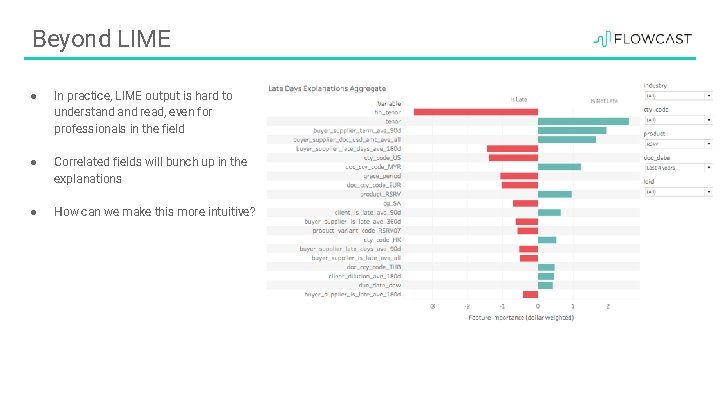
Beyond LIME ● In practice, LIME output is hard to understand read, even for professionals in the field ● Correlated fields will bunch up in the explanations ● How can we make this more intuitive?
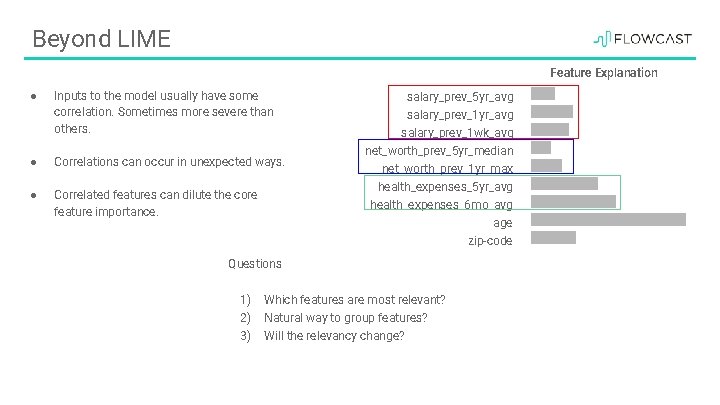
Beyond LIME Feature Explanation ● Inputs to the model usually have some correlation. Sometimes more severe than others. ● Correlations can occur in unexpected ways. ● Correlated features can dilute the core feature importance. salary_prev_5 yr_avg salary_prev_1 wk_avg net_worth_prev_5 yr_median net_worth_prev_1 yr_max health_expenses_5 yr_avg health_expenses_6 mo_avg age zip-code Questions 1) 2) 3) Which features are most relevant? Natural way to group features? Will the relevancy change?
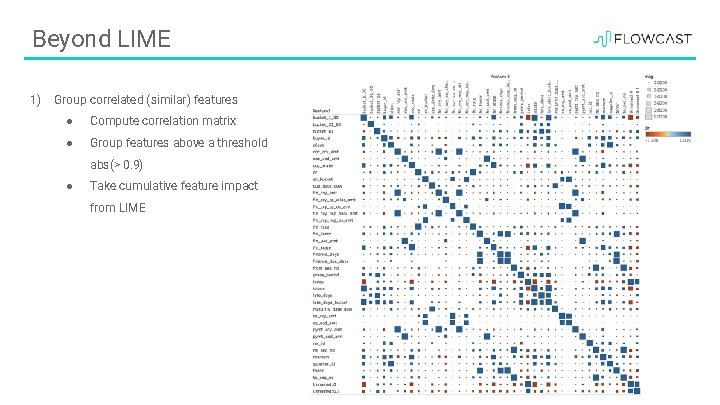
Beyond LIME 1) Group correlated (similar) features ● Compute correlation matrix ● Group features above a threshold abs(> 0. 9) ● Take cumulative feature impact from LIME
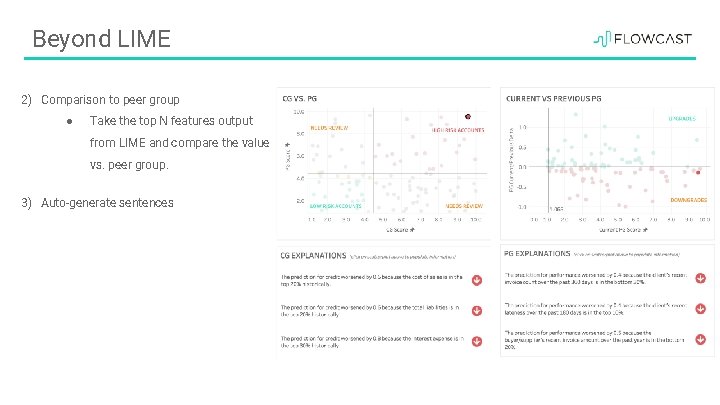
Beyond LIME 2) Comparison to peer group ● Take the top N features output from LIME and compare the value vs. peer group. 3) Auto-generate sentences
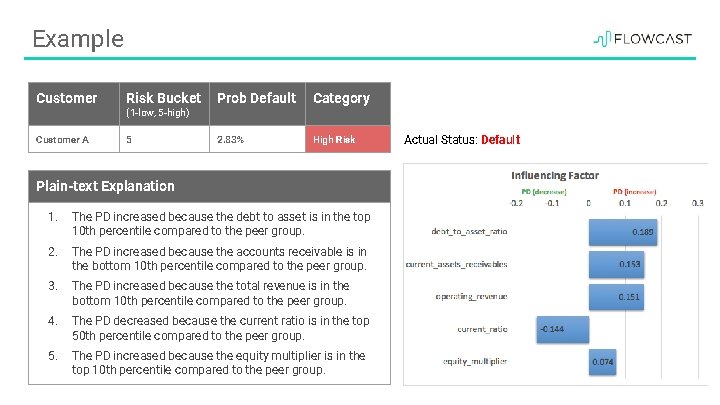
Example Customer Risk Bucket Prob Default Category Customer A 5 2. 83% High Risk (1 -low, 5 -high) Plain-text Explanation 1. The PD increased because the debt to asset is in the top 10 th percentile compared to the peer group. 2. The PD increased because the accounts receivable is in the bottom 10 th percentile compared to the peer group. 3. The PD increased because the total revenue is in the bottom 10 th percentile compared to the peer group. 4. The PD decreased because the current ratio is in the top 50 th percentile compared to the peer group. 5. The PD increased because the equity multiplier is in the top 10 th percentile compared to the peer group. Actual Status: Default
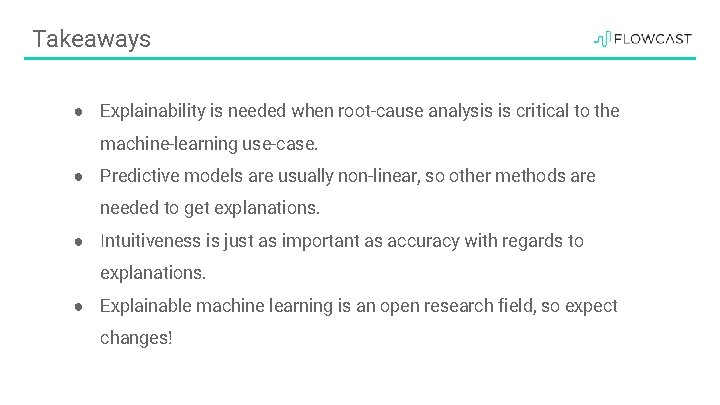
Takeaways ● Explainability is needed when root-cause analysis is critical to the machine-learning use-case. ● Predictive models are usually non-linear, so other methods are needed to get explanations. ● Intuitiveness is just as important as accuracy with regards to explanations. ● Explainable machine learning is an open research field, so expect changes!
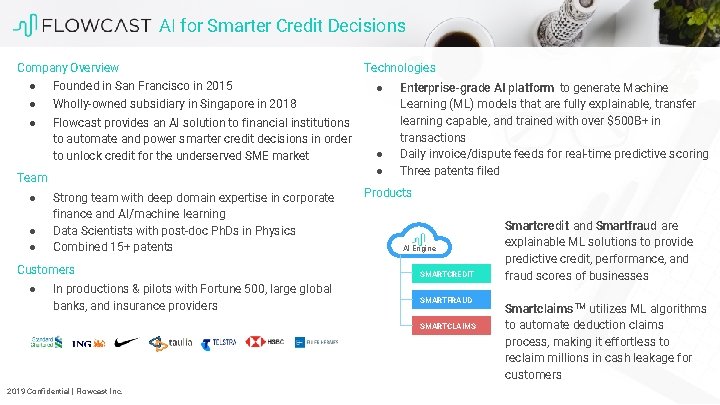
AI for Smarter Credit Decisions Company Overview ● Founded in San Francisco in 2015 ● Wholly-owned subsidiary in Singapore in 2018 ● Flowcast provides an AI solution to financial institutions to automate and power smarter credit decisions in order to unlock credit for the underserved SME market Team ● ● ● Strong team with deep domain expertise in corporate finance and AI/machine learning Data Scientists with post-doc Ph. Ds in Physics Combined 15+ patents Customers ● In productions & pilots with Fortune 500, large global banks, and insurance providers Technologies ● ● ● Enterprise-grade AI platform to generate Machine Learning (ML) models that are fully explainable, transfer learning capable, and trained with over $500 B+ in transactions Daily invoice/dispute feeds for real-time predictive scoring Three patents filed Products AI Engine SMARTCREDIT SMARTFRAUD SMARTCLAIMS 2019 Confidential | Flowcast Inc. Smartcredit and Smartfraud are explainable ML solutions to provide predictive credit, performance, and fraud scores of businesses Smartclaims TM utilizes ML algorithms to automate deduction claims process, making it effortless to reclaim millions in cash leakage for customers
Thanks! We’re hiring! (SF office) ● Python Software Engineer ● Data Scientist ● Data Engineer ● Machine Learning Engineer Please track me down after! Or email directly: eitan@flowcast. ai
Rate today ’s session Session page on conference website O’Reilly Events App
- Slides: 27