
Explain why Jews believe in free will 5
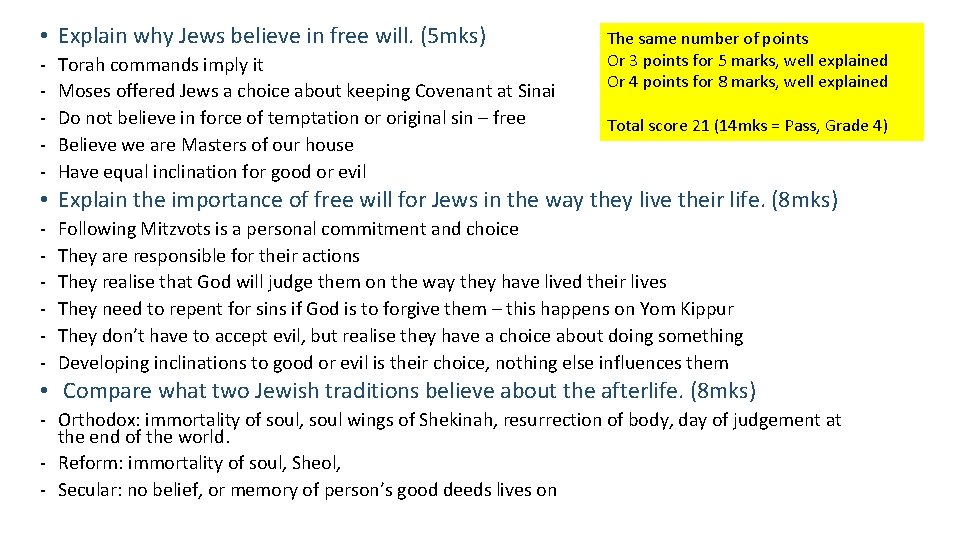
• Explain why Jews believe in free will. (5 mks) - Torah commands imply it Moses offered Jews a choice about keeping Covenant at Sinai Do not believe in force of temptation or original sin – free Believe we are Masters of our house Have equal inclination for good or evil The same number of points Or 3 points for 5 marks, well explained Or 4 points for 8 marks, well explained Total score 21 (14 mks = Pass, Grade 4) • Explain the importance of free will for Jews in the way they live their life. (8 mks) - Following Mitzvots is a personal commitment and choice They are responsible for their actions They realise that God will judge them on the way they have lived their lives They need to repent for sins if God is to forgive them – this happens on Yom Kippur They don’t have to accept evil, but realise they have a choice about doing something Developing inclinations to good or evil is their choice, nothing else influences them • Compare what two Jewish traditions believe about the afterlife. (8 mks) - Orthodox: immortality of soul, soul wings of Shekinah, resurrection of body, day of judgement at the end of the world. - Reform: immortality of soul, Sheol, - Secular: no belief, or memory of person’s good deeds lives on
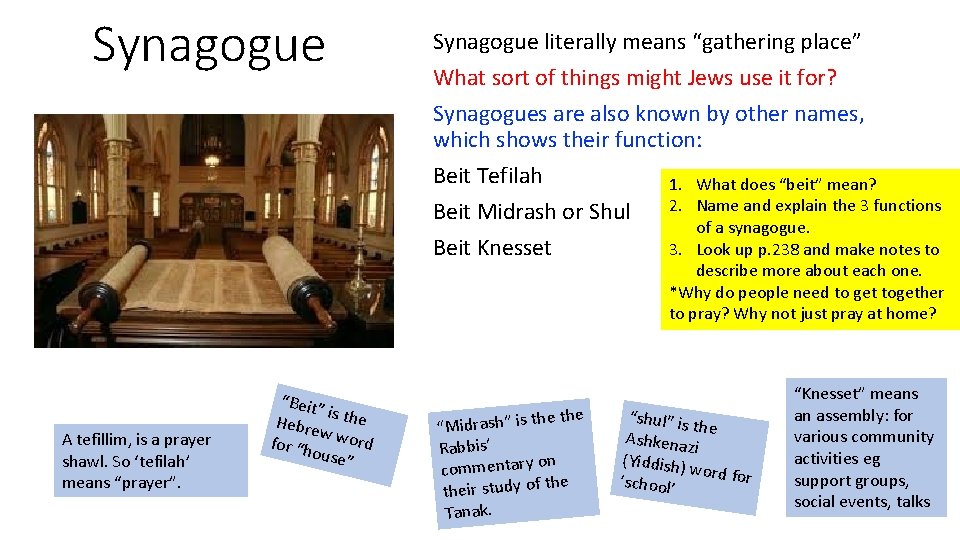
Synagogue literally means “gathering place” What sort of things might Jews use it for? Synagogues are also known by other names, which shows their function: Beit Tefilah 1. What does “beit” mean? 2. Name and explain the 3 functions Beit Midrash or Shul of a synagogue. 3. Look up p. 238 and make notes to Beit Knesset describe more about each one. *Why do people need to get together to pray? Why not just pray at home? A tefillim, is a prayer shawl. So ‘tefilah’ means “prayer”. “Beit” i Hebre s the w for “h word ouse” he the “Midrash” is t Rabbis’ n commentary o their study of Tanak. “shul” is the Ashkenaz i (Yiddish) word for ‘school’ “Knesset” means an assembly: for various community activities eg support groups, social events, talks
Praying in a synagogue What do you find out about praying in the synagogue & features of it, from this video? separation men & women minyan – 10 men present facing Aron (ark) containing Torah scrolls facing Jerusalem at Bimah (platform/ lectern) eternal flame – ner tamid (of Temple) Use the points to summarise the main features of a synagogue, and how Jews pray in it. *What are 3 differences from a Christian church?
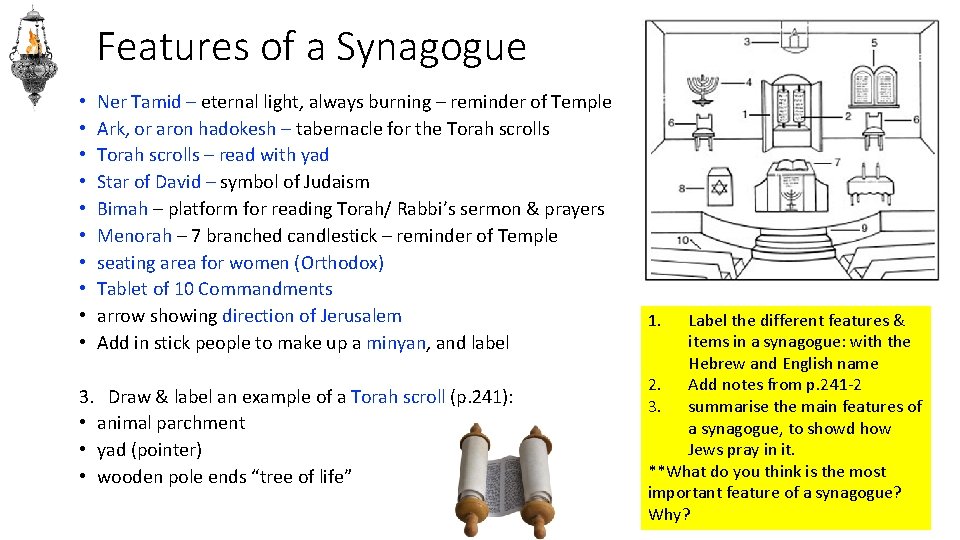
Features of a Synagogue • • • Ner Tamid – eternal light, always burning – reminder of Temple Ark, or aron hadokesh – tabernacle for the Torah scrolls – read with yad Star of David – symbol of Judaism Bimah – platform for reading Torah/ Rabbi’s sermon & prayers Menorah – 7 branched candlestick – reminder of Temple seating area for women (Orthodox) Tablet of 10 Commandments arrow showing direction of Jerusalem Add in stick people to make up a minyan, and label 3. Draw & label an example of a Torah scroll (p. 241): • animal parchment • yad (pointer) • wooden pole ends “tree of life” 1. Label the different features & items in a synagogue: with the Hebrew and English name 2. Add notes from p. 241 -2 3. summarise the main features of a synagogue, to showd how Jews pray in it. **What do you think is the most important feature of a synagogue? Why?
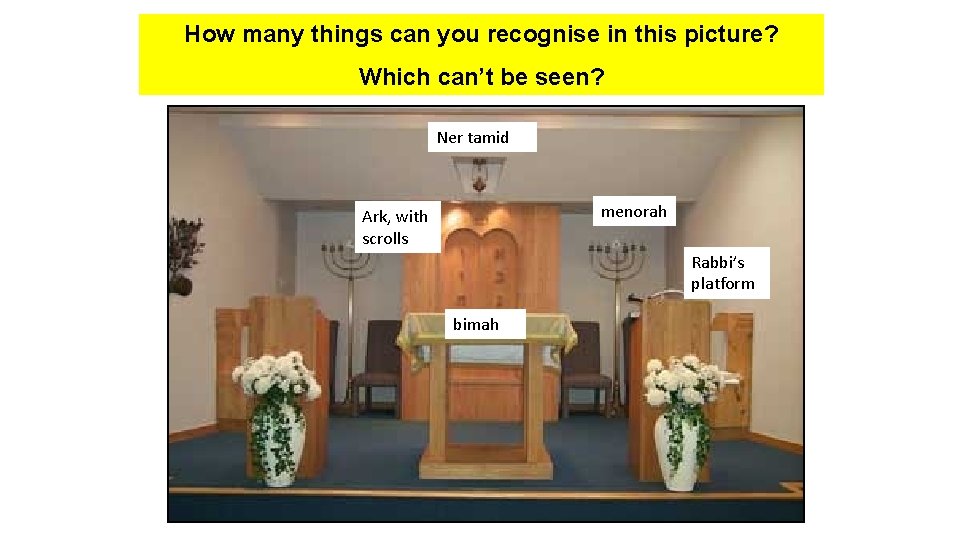
How many things can you recognise in this picture? Which can’t be seen? Ner tamid menorah Ark, with scrolls Rabbi’s platform bimah
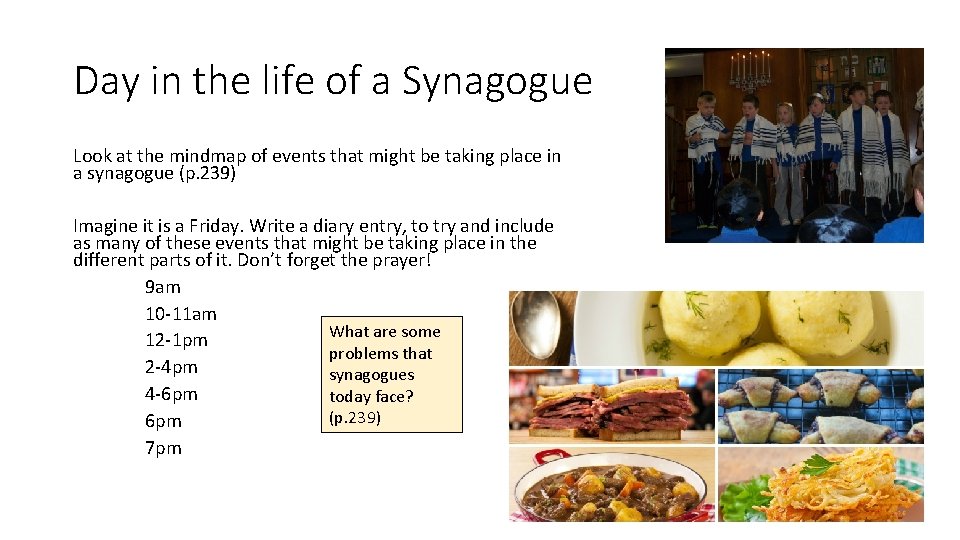
Day in the life of a Synagogue Look at the mindmap of events that might be taking place in a synagogue (p. 239) Imagine it is a Friday. Write a diary entry, to try and include as many of these events that might be taking place in the different parts of it. Don’t forget the prayer! 9 am 10 -11 am What are some 12 -1 pm problems that 2 -4 pm synagogues 4 -6 pm today face? (p. 239) 6 pm 7 pm
Name 3 problems reducing Jewish attendance at synagogues.
- Slides: 7