
Expertise Analysis Sentiment Plus Tom Reamy Chief Knowledge

- Slides: 31
Expertise Analysis Sentiment Plus Tom Reamy Chief Knowledge Architect KAPS Group Knowledge Architecture Professional Services http: //www. kapsgroup. com
Agenda § Introduction – Context Sentiment Analysis – Second Generation – Categorization and Category Theory – § Basic Level Categories – Features and Issues § Basic Level Categories and Expertise Experts prefer lower levels – Categorization of Expertise § Applications – Integration with Text Mining, Search, and ECM – Platform for Information Applications – 2
KAPS Group: General § § § Knowledge Architecture Professional Services Virtual Company: Network of consultants – 8 -10 Partners – SAS, Smart Logic, Microsoft-FAST, Concept Searching, etc. Consulting, Strategy, Knowledge architecture audit Services: – Text Analytics/Taxonomy development, consulting, customization – Technology Consulting – Search, CMS, Portals, etc. – Evaluation of Enterprise Search, Text Analytics – Metadata standards and implementation – Knowledge Management: Collaboration, Expertise, e-learning – Applied Theory – Faceted taxonomies, complexity theory, natural categories 3
Introduction – Sentiment Analysis Sentiment & Categorization – Second Generation § Emphasis on context around positive and negative words Issue of sarcasm, slanguage – “Really great product” – Rules – not just statistical and terms – § Beyond Good and Evil (positive and negative) Taxonomy of Objects and Features to taxonomy of emotions – Addition of focus on behaviors – why someone calls a support center – and likely outcomes – § Social Media Knowledge Base – Wisdom of crowds, crowd-sourcing 4
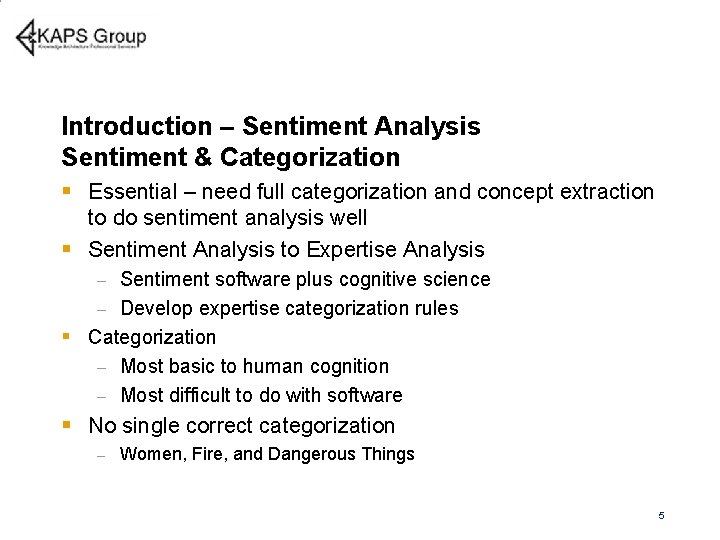
Introduction – Sentiment Analysis Sentiment & Categorization § Essential – need full categorization and concept extraction to do sentiment analysis well § Sentiment Analysis to Expertise Analysis Sentiment software plus cognitive science – Develop expertise categorization rules § Categorization – Most basic to human cognition – Most difficult to do with software – § No single correct categorization – Women, Fire, and Dangerous Things 5
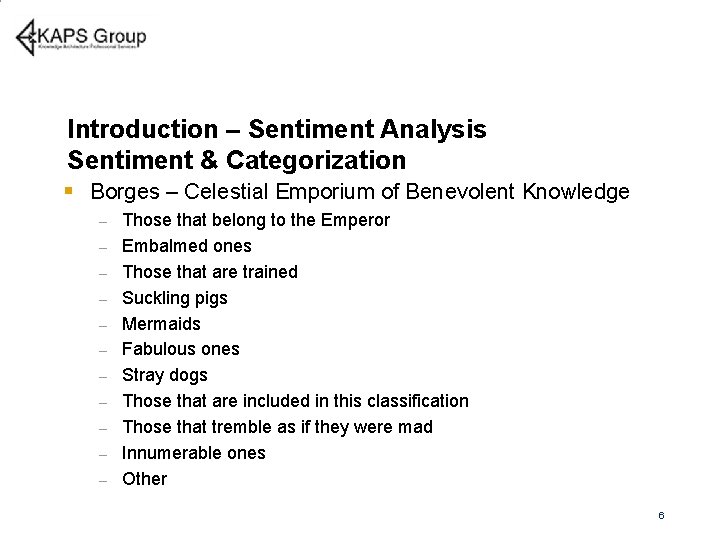
Introduction – Sentiment Analysis Sentiment & Categorization § Borges – Celestial Emporium of Benevolent Knowledge – – – Those that belong to the Emperor Embalmed ones Those that are trained Suckling pigs Mermaids Fabulous ones Stray dogs Those that are included in this classification Those that tremble as if they were mad Innumerable ones Other 6
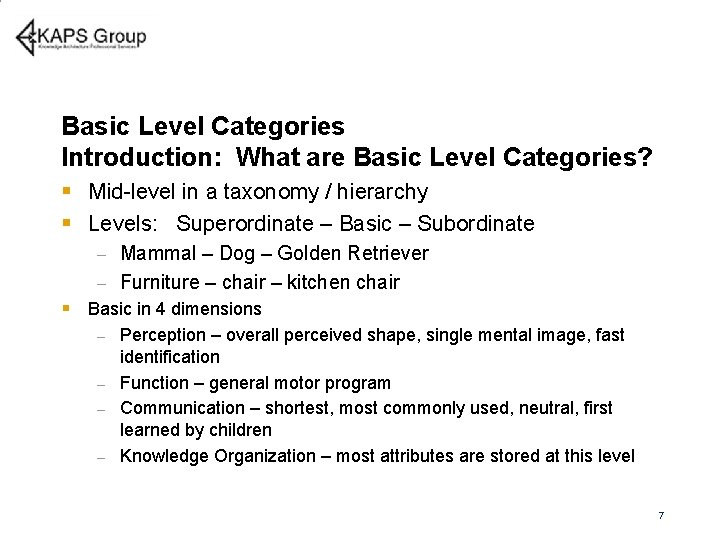
Basic Level Categories Introduction: What are Basic Level Categories? § Mid-level in a taxonomy / hierarchy § Levels: Superordinate – Basic – Subordinate Mammal – Dog – Golden Retriever – Furniture – chair – kitchen chair – § Basic in 4 dimensions Perception – overall perceived shape, single mental image, fast identification – Function – general motor program – Communication – shortest, most commonly used, neutral, first learned by children – Knowledge Organization – most attributes are stored at this level – 7
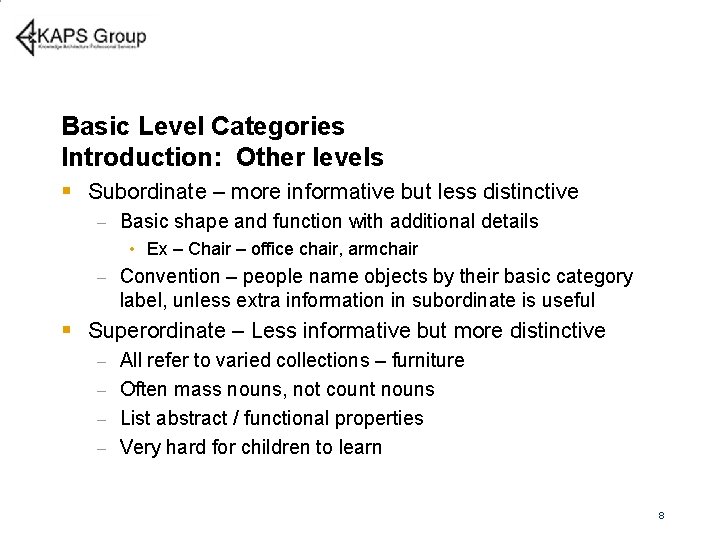
Basic Level Categories Introduction: Other levels § Subordinate – more informative but less distinctive – Basic shape and function with additional details • Ex – Chair – office chair, armchair – Convention – people name objects by their basic category label, unless extra information in subordinate is useful § Superordinate – Less informative but more distinctive All refer to varied collections – furniture – Often mass nouns, not count nouns – List abstract / functional properties – Very hard for children to learn – 8
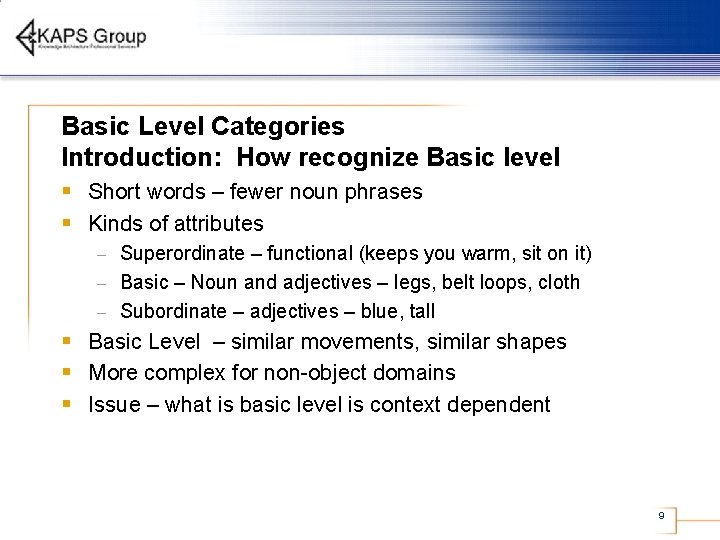
Basic Level Categories Introduction: How recognize Basic level § Short words – fewer noun phrases § Kinds of attributes Superordinate – functional (keeps you warm, sit on it) – Basic – Noun and adjectives – legs, belt loops, cloth – Subordinate – adjectives – blue, tall – § Basic Level – similar movements, similar shapes § More complex for non-object domains § Issue – what is basic level is context dependent 9
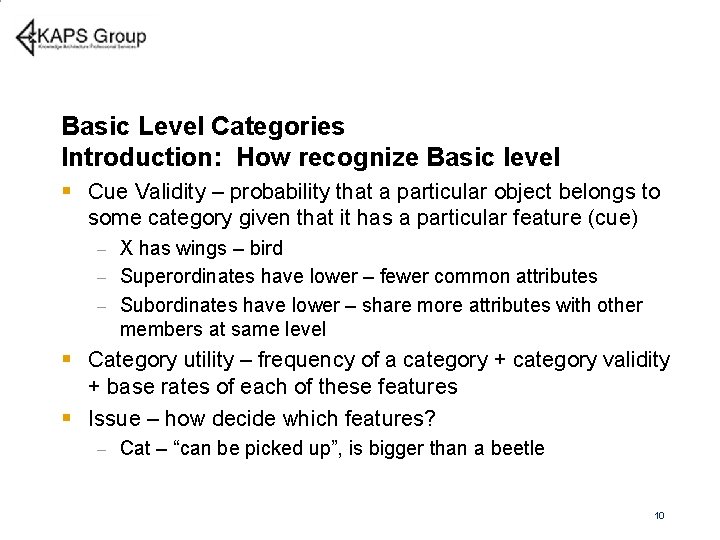
Basic Level Categories Introduction: How recognize Basic level § Cue Validity – probability that a particular object belongs to some category given that it has a particular feature (cue) X has wings – bird – Superordinates have lower – fewer common attributes – Subordinates have lower – share more attributes with other members at same level – § Category utility – frequency of a category + category validity + base rates of each of these features § Issue – how decide which features? – Cat – “can be picked up”, is bigger than a beetle 10
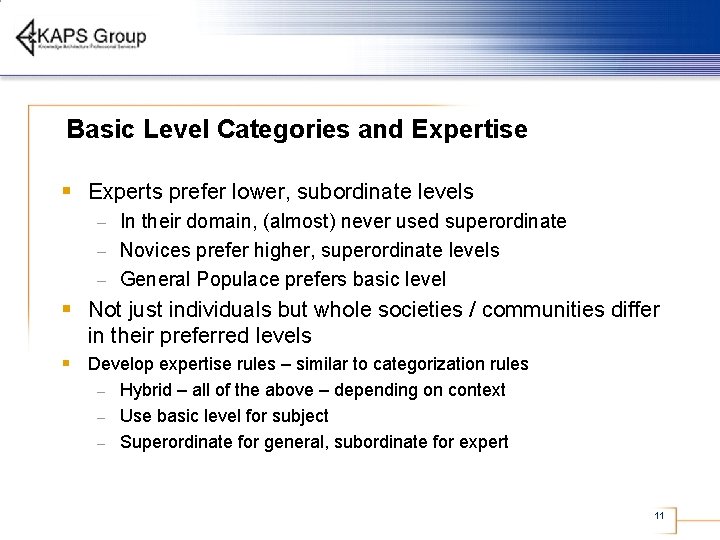
Basic Level Categories and Expertise § Experts prefer lower, subordinate levels In their domain, (almost) never used superordinate – Novices prefer higher, superordinate levels – General Populace prefers basic level – § Not just individuals but whole societies / communities differ in their preferred levels § Develop expertise rules – similar to categorization rules Hybrid – all of the above – depending on context – Use basic level for subject – Superordinate for general, subordinate for expert – 11
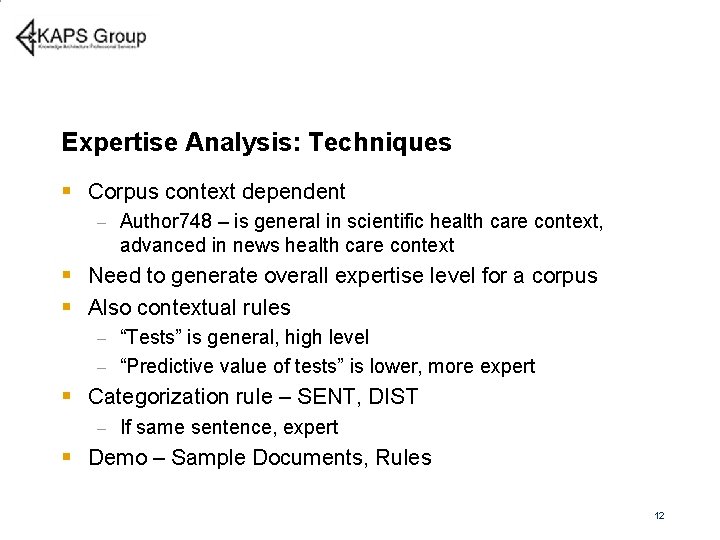
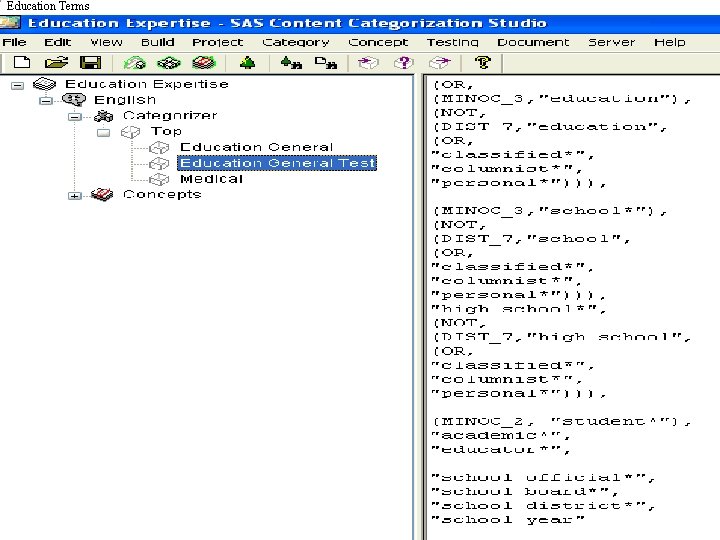
Expertise Analysis: Techniques § Corpus context dependent – Author 748 – is general in scientific health care context, advanced in news health care context § Need to generate overall expertise level for a corpus § Also contextual rules “Tests” is general, high level – “Predictive value of tests” is lower, more expert – § Categorization rule – SENT, DIST – If same sentence, expert § Demo – Sample Documents, Rules 12
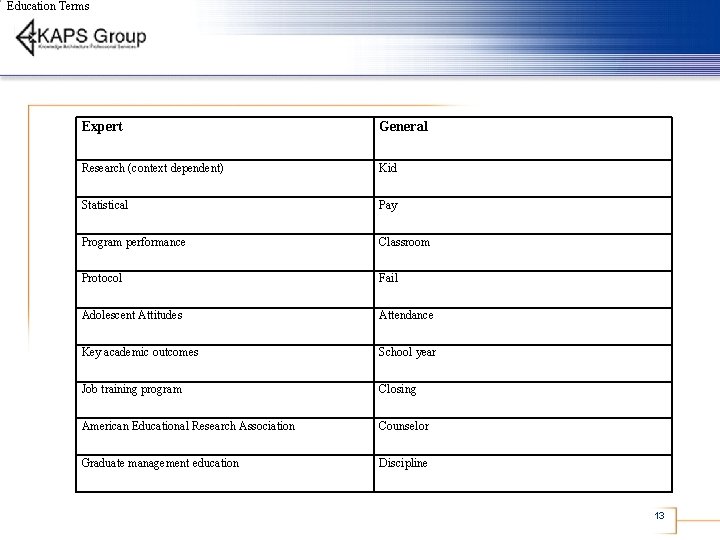
Education Terms Expert General Research (context dependent) Kid Statistical Pay Program performance Classroom Protocol Fail Adolescent Attitudes Attendance Key academic outcomes School year Job training program Closing American Educational Research Association Counselor Graduate management education Discipline 13
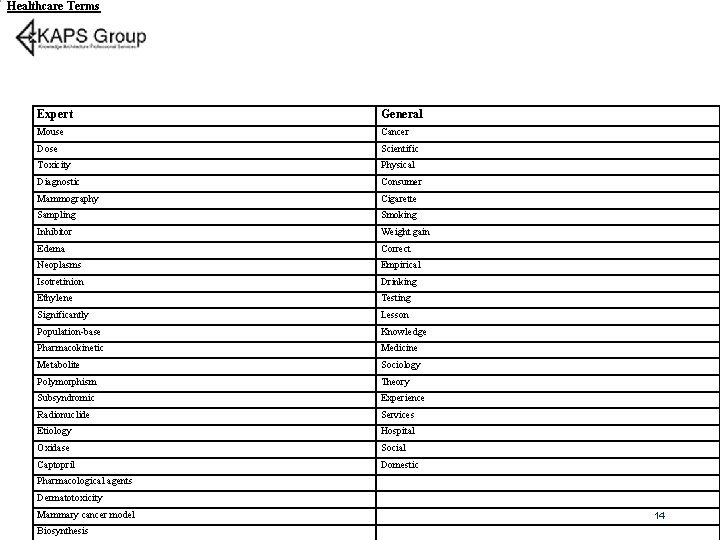
Healthcare Terms Expert General Mouse Cancer Dose Scientific Toxicity Physical Diagnostic Consumer Mammography Cigarette Sampling Smoking Inhibitor Weight gain Edema Correct Neoplasms Empirical Isotretinion Drinking Ethylene Testing Significantly Lesson Population-base Knowledge Pharmacokinetic Medicine Metabolite Sociology Polymorphism Theory Subsyndromic Experience Radionuclide Services Etiology Hospital Oxidase Social Captopril Domestic Pharmacological agents Dermatotoxicity Mammary cancer model Biosynthesis 14
Education Terms 15
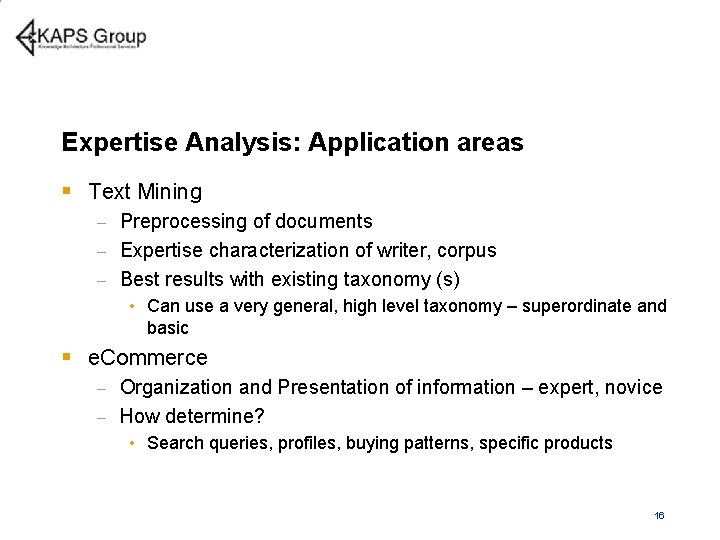
Expertise Analysis: Application areas § Text Mining Preprocessing of documents – Expertise characterization of writer, corpus – Best results with existing taxonomy (s) – • Can use a very general, high level taxonomy – superordinate and basic § e. Commerce Organization and Presentation of information – expert, novice – How determine? – • Search queries, profiles, buying patterns, specific products 16
Expertise Analysis: Application areas § Search – enterprise and/or internet – Query level § Relevance ranking – Adjust documents for novice and expert queries § Information presentation – Tag clouds – match novice and expert § Clustering – Incorporate into clustering algorithms § Presentation – expose basic level & provide up and down browse 17
Expertise Analysis: Application areas § Social Media - Community of Practice Characterize the level of expertise in the community – Evaluate other communities expertise level – Identify experts (and leaders) in the community – § Expertise location – Generate automatic expertise characterization based on authored documents § Expertise of people in a social network – Terrorists and bomb-making 18
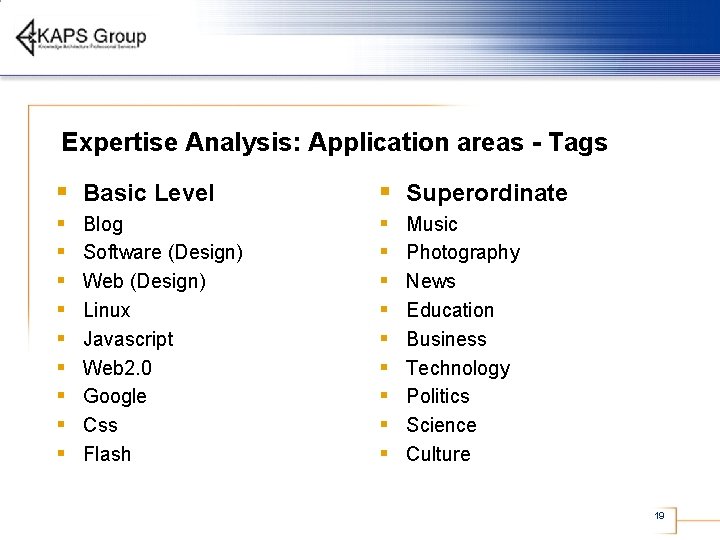
Expertise Analysis: Application areas - Tags § Basic Level § Superordinate § § § § § Blog Software (Design) Web (Design) Linux Javascript Web 2. 0 Google Css Flash Music Photography News Education Business Technology Politics Science Culture 19
Expertise Analysis: Application areas § Business & Customer intelligence – General – characterize people’s expertise to add to evaluation of their comments § Combine with VOC & sentiment analysis – finer evaluation – what are experts saying, what are novices saying – Deeper research into communities, customers § Enterprise Content Management At publish time, software automatically gives an expertise level – present to author for validation – Combine with categorization – offer tags that are suitable level of expertise – 20
Expertise Analysis: Future Directions § Data mining + Text Mining + Expertise-Sentiment New applications – Group Behavior – leaders, decisions – § Predictive Analytics – Adding new dimensions § Neuro-Marketing, Economics, Law, Intelligence – Social forecasting – Twitter and Stock Market § Language & category theory – Metaphor Analysis, etc. § Need an emotion taxonomy? 21
Expertise Analysis: Conclusions § Expertise analysis adds a new dimension to Text Analysis and Sentiment Analysis – Broad range of applications – personalization, customer depth, Social Media, enterprise text analytics § Expertise analysis builds on Basic Level Categories – Plus expertise categorization rules § What is expert / basic level is context dependent § Text & Expertise Analytics builds on Sentiment Analysis and Cognitive Science – Not just library science or data modeling or ontology or sentiment or linguistics – all of the above 22
Questions? Tom Reamy tomr@kapsgroup. com KAPS Group Knowledge Architecture Professional Services http: //www. kapsgroup. com
Resources § Books Affective Neuroscience: The Foundations of Human and Animal Emotions– Jaak Panskeep – Decisions, Uncertainty, and the Brain: The Science of Neuroeconomics – Paul Glimcher – Women, Fire, and Dangerous Things – • George Lakoff – Knowledge, Concepts, and Categories • Koen Lamberts and David Shanks – The Tell-Tale Brain: A Neuroscientist’s Quest for What Makes Up Human – V. S. Ramachandran 24
Resources § Web Sites – Text Analytics News http: //social. textanalyticsnews. com/index. php Text Analytics Wiki - http: //textanalytics. wikidot. com/ – Taxonomy Community of Practice: http: //finance. groups. yahoo. com/group/Taxo. Co. P/ – Linded. In – Text Analytics Summit Group – http: //www. Linked. In. com – 25
Resources § Blogs – SAS- http: //blogs. sas. com/text-mining/ § Web Sites Whitepaper – CM and Text Analytics http: //www. textanalyticsnews. com/usa/contentmanagementm eetstextanalytics. pdf – Whitepapers – Enterprise Content Categorization strategy and development – http: //www. kapsgroup. com – 26
Resources § Articles Malt, B. C. 1995. Category coherence in cross-cultural perspective. Cognitive Psychology 29, 85 -148 – Rifkin, A. 1985. Evidence for a basic level in event taxonomies. Memory & Cognition 13, 538 -56 – Shaver, P. , J. Schwarz, D. Kirson, D. O’Conner 1987. Emotion Knowledge: further explorations of prototype approach. Journal of Personality and Social Psychology 52, 1061 -1086 – Tanaka, J. W. & M. E. Taylor 1991. Object categories and expertise: is the basic level in the eye of the beholder? Cognitive Psychology 23, 457 -82 – 27
Basic Level Categories Introduction: What are Basic Level Categories? § § § § § Short and easy words Maximum distinctness and expressiveness Similarly perceived shapes Most commonly used labels Easiest and fastest to indentify members First level named and understood by children Terms usually used in neutral contexts Level at which most of our knowledge is organized Objects – most studied, most pronounced effects 28
Basic Level Categories Introduction: Basic Level Categories: Non-Object § Basic level effects, but no widespread acceptance of categories and § § § category names Thus a basic level in a category hierarchy but not the category hierarchy that people actually use in everyday life Not just IS-A relationship – messier – more like ontologies Examples: – Scenes – indoors – school – elementary school – Events – travel – highway travel – truck travel – Emotions – positive emotion – joy – contentment – Programming – Algorithm – sort – binary 29
Basic Level Categories and Expertise § Experts chunk series of actions, ideas, etc. Novice – high level only – Intermediate – steps in the series – Expert – special language – based on deep connections – § Types of expert : Technical – lower level terms only – Strategic – high level and lower level terms, special language – 30
Expertise Analysis: Techniques § What is basic level is context(s) dependent § Documents / Tags – analyze in terms of levels of words Taxonomy for high level – Length for basic – short – Length for subordinate – long, special vocabulary Category Utility Develop expertise rules – similar to categorization rules – Hybrid – all of the above – depending on context – Use basic level for subject – Superordinate for general, subordinate for expert – § § 31