
Expert Systems Reasonable Reasoning An Ad Hoc approach
Expert Systems Reasonable Reasoning An Ad Hoc approach
Problems with Logical Reasoning • Brittleness: one axiom/fact wrong, system can prove anything (Correctness) • Large proof spaces (Efficiency) • “Probably” not representable (Representation) • No notion of combining evidence • Doesn’t provide confidence in conclusion.
Lecture Goals • • • What is an expert system? How can they be built? When are they useful? General Architecture Validation: – How to know if they are right

Class News • Quiz dates and homework dates updated: • Extra day for probability hwk/quiz • All homeworks must be typed
Expert System • Attempt to model expert decision making in a limited domain • Examples: medical diagnosis, computer configuration, machine fault diagnosis • Requires a willing Expert • Requires knowledge representable as rules – Doesn’t work for chess • Preponderance of evidence for decision, not proof. (Civil law suits)
Why Bother? • Reproduce Expertise: make available • Record Expertise: experts die • Combine expertise of many – Didn’t work • Teach expertise – Didn’t work • Expand application area of computers – What tasks can computers do?
Architecture • Domain Knowledge as “if-then” rules • Inference Engine – Backward chaining – Forward chaining • Calculus for combining evidence – Construct all proofs, not just one • Explanation Facility: can answer “why? ”

MYCIN: 1972 -1980 • 50 -500 rules, acquired from expert by interviewing. Blood disease diagnosis. • Example rule: if stain of organism is gramneg and morphology is rod and aerobicity is aerobic then strongly suggestive (. 8) that organism is enterocabateriacease. • Rules matched well knowledge in domain: medical papers often present a few rules • Rule = nugget of independent knowledge
Facts are not facts • Morphology is rod requires microscopic evaluation. – Is a bean shape a rod? – Is an “S” shape a rod? • Morphology is rod is assigned a confidence. • All “facts” assigned confidences, from 0 to 1.
MYCIN: Shortliffe • Begins with a few facts about patient – Required by physicians but irrelevant • Backward chains from each possible goal (disease). • Preconditions either match facts or set up new subgoals. Subgoals may involve tests. • Finds all “proofs” and weighs them. • Explains decisions and combines evidence • Worked better than average physician. • Never used in practice. • Methodology used.
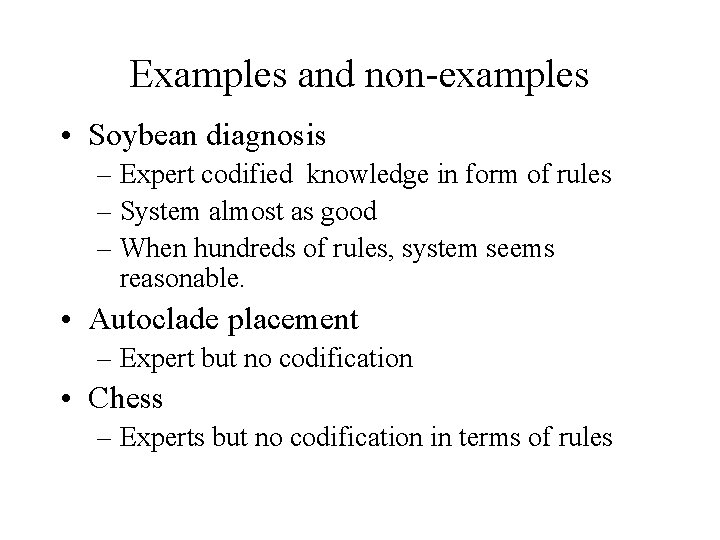
Examples and non-examples • Soybean diagnosis – Expert codified knowledge in form of rules – System almost as good – When hundreds of rules, system seems reasonable. • Autoclade placement – Expert but no codification • Chess – Experts but no codification in terms of rules
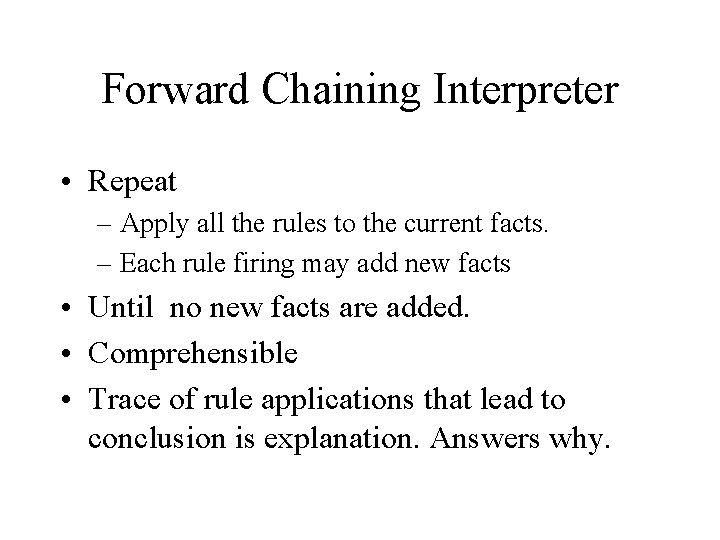
Forward Chaining Interpreter • Repeat – Apply all the rules to the current facts. – Each rule firing may add new facts • Until no new facts are added. • Comprehensible • Trace of rule applications that lead to conclusion is explanation. Answers why.
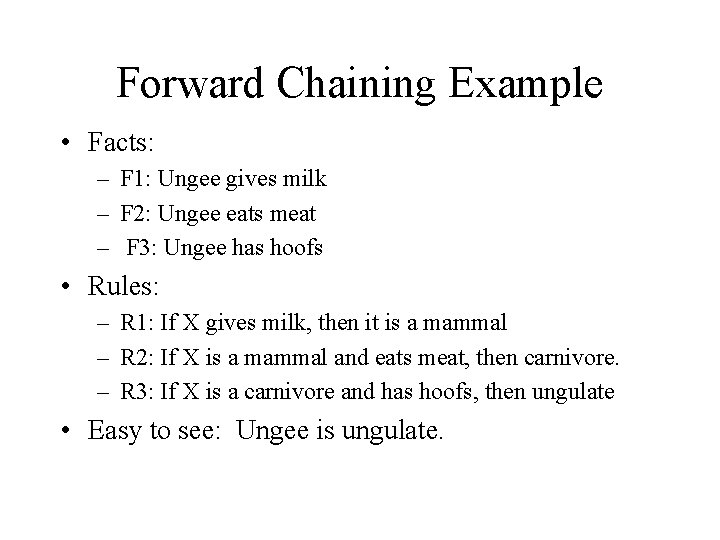
Forward Chaining Example • Facts: – F 1: Ungee gives milk – F 2: Ungee eats meat – F 3: Ungee has hoofs • Rules: – R 1: If X gives milk, then it is a mammal – R 2: If X is a mammal and eats meat, then carnivore. – R 3: If X is a carnivore and has hoofs, then ungulate • Easy to see: Ungee is ungulate.
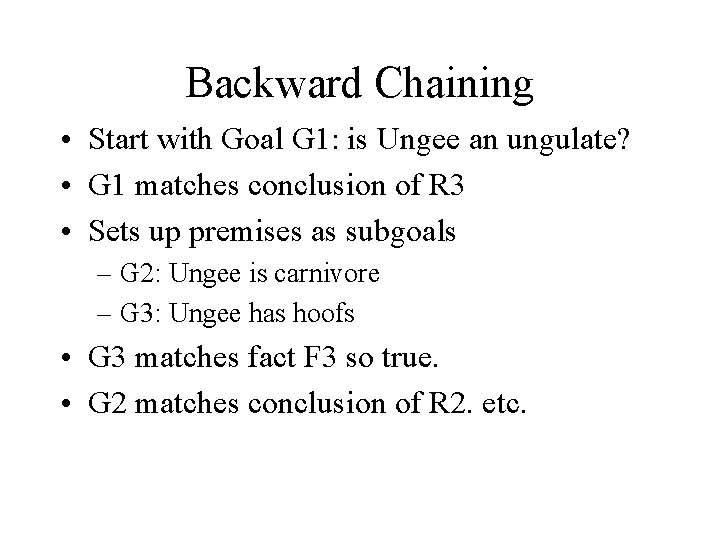
Backward Chaining • Start with Goal G 1: is Ungee an ungulate? • G 1 matches conclusion of R 3 • Sets up premises as subgoals – G 2: Ungee is carnivore – G 3: Ungee has hoofs • G 3 matches fact F 3 so true. • G 2 matches conclusion of R 2. etc.
The good and the bad • Forward chaining allows you to conclude anything • Forward chaining is expensive • Backward chaining requires known goals. • Premises of backward chaining directs which facts (tests) are needed. • Rule trace provides explanation.
Simple Confidence Calculus • This will yield an intuitive degree of belief in system conclusion. • To each fact, assign a confidence or degree of belief. A number between 0 and 1. • To each rule, assign a rule confidence: also a number between 0 and 1.
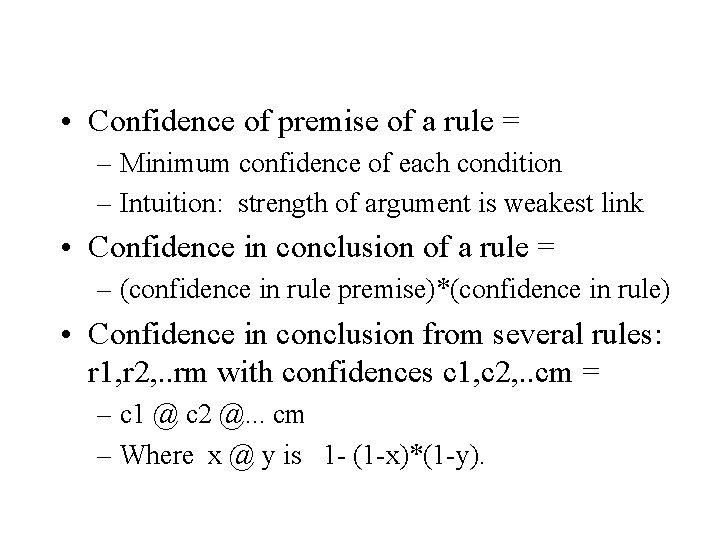
• Confidence of premise of a rule = – Minimum confidence of each condition – Intuition: strength of argument is weakest link • Confidence in conclusion of a rule = – (confidence in rule premise)*(confidence in rule) • Confidence in conclusion from several rules: r 1, r 2, . . rm with confidences c 1, c 2, . . cm = – c 1 @ c 2 @. . . cm – Where x @ y is 1 - (1 -x)*(1 -y).
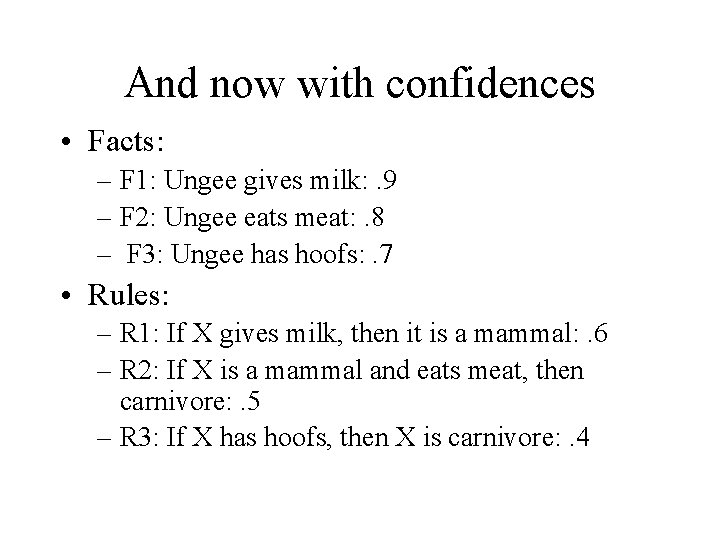
And now with confidences • Facts: – F 1: Ungee gives milk: . 9 – F 2: Ungee eats meat: . 8 – F 3: Ungee has hoofs: . 7 • Rules: – R 1: If X gives milk, then it is a mammal: . 6 – R 2: If X is a mammal and eats meat, then carnivore: . 5 – R 3: If X has hoofs, then X is carnivore: . 4
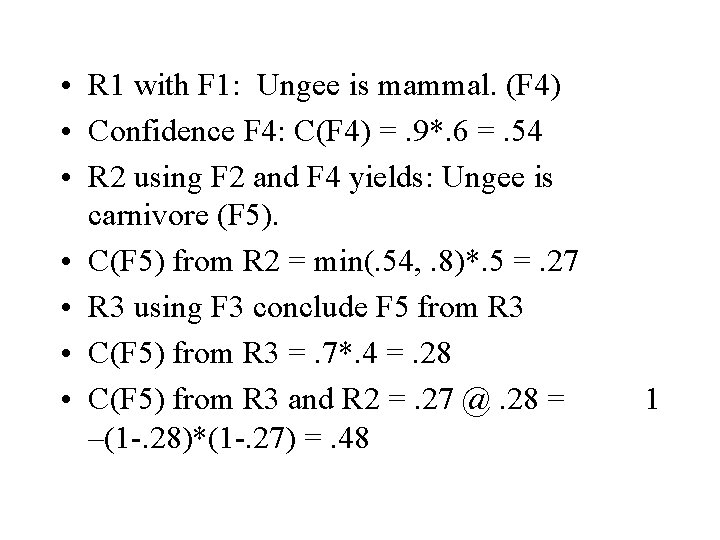
• R 1 with F 1: Ungee is mammal. (F 4) • Confidence F 4: C(F 4) =. 9*. 6 =. 54 • R 2 using F 2 and F 4 yields: Ungee is carnivore (F 5). • C(F 5) from R 2 = min(. 54, . 8)*. 5 =. 27 • R 3 using F 3 conclude F 5 from R 3 • C(F 5) from R 3 =. 7*. 4 =. 28 • C(F 5) from R 3 and R 2 =. 27 @. 28 = –(1 -. 28)*(1 -. 27) =. 48 1
Problems and Counters-Arguments • People forget to say the obvious • Rules difficult to acquire (years) • People don’t have stable or correct estimates of “confidence” • Data insufficient to yield good estimate of true probabilities. • But Feigenbaum: In the knowledge lies the power. • Calculus/confidences not that important
AI Winter • Expert Systems found useful – hundreds of successful systems • Consultants and hype -> – Hundreds of unsucessful systems • Remember: – needs an expert – Knowledge needs to be representable as rules • Now on to Probability based approach
- Slides: 21