
EXPERIMENTS WITH LARGE GAMMA DETECTOR ARRAYS Lecture III






- Slides: 42
EXPERIMENTS WITH LARGE GAMMA DETECTOR ARRAYS Lecture III Ranjan Bhowmik Inter University Accelerator Centre New Delhi -110067 Lecture III SERC-6 School March 13 -April 2, 2006
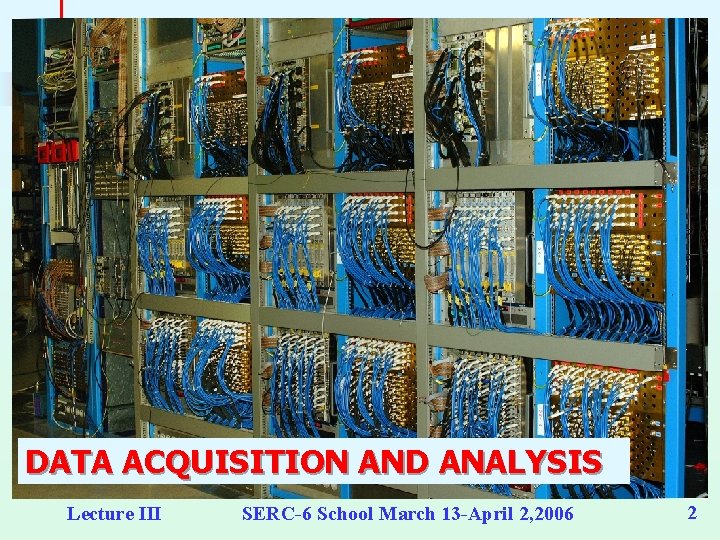
DATA ACQUISITION AND ANALYSIS Lecture III SERC-6 School March 13 -April 2, 2006 2
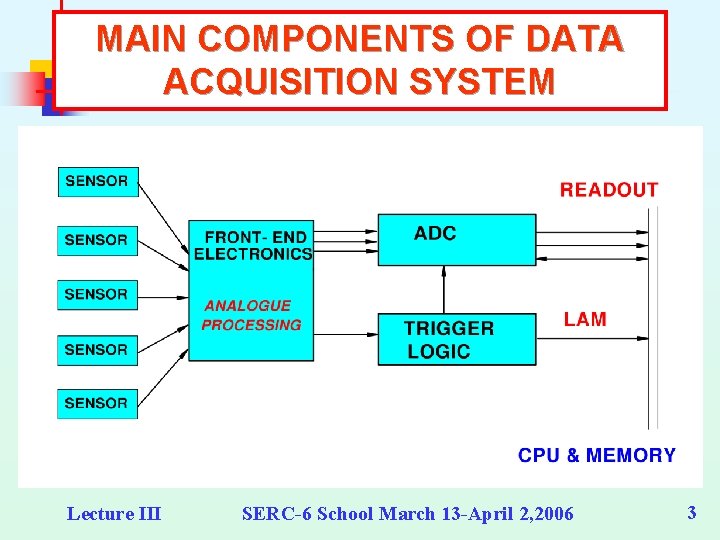
MAIN COMPONENTS OF DATA ACQUISITION SYSTEM Lecture III SERC-6 School March 13 -April 2, 2006 3
Why do we need Advanced Data Acquisition System ? Primary objective is to have the most comprehensive information about the physical process under study. For complex processes, many outgoing channels would require a large number of sensors and the simultaneous collection of data from all the channels. Typical present generation experiments would have: • • • 200 parameters per event 10, 000 events per second > 1012 bytes of data / experiment. Needs high throughput and massive storage requirement. Lecture III SERC-6 School March 13 -April 2, 2006 4
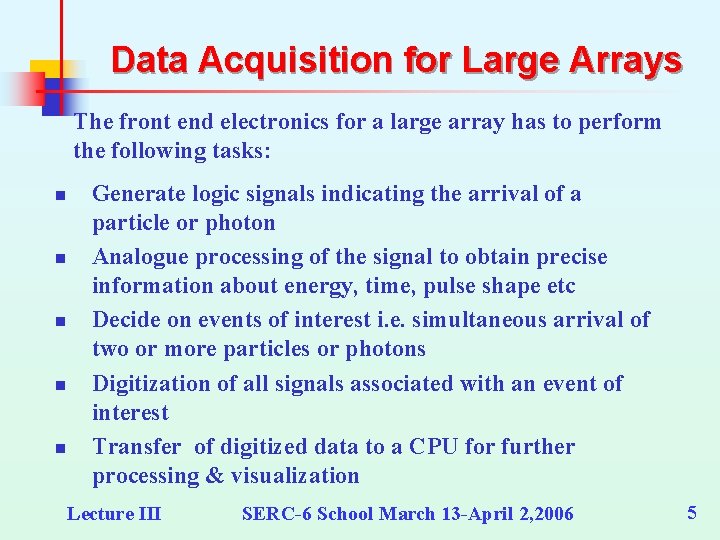
Data Acquisition for Large Arrays The front end electronics for a large array has to perform the following tasks: n n n Generate logic signals indicating the arrival of a particle or photon Analogue processing of the signal to obtain precise information about energy, time, pulse shape etc Decide on events of interest i. e. simultaneous arrival of two or more particles or photons Digitization of all signals associated with an event of interest Transfer of digitized data to a CPU for further processing & visualization Lecture III SERC-6 School March 13 -April 2, 2006 5
SPECIAL REQUIREMENTS · Increased reliability of operation · High degree of integration to minimise the space and power requirement and reduction of inter-connecting cables · Replacement of manual controls by software control · Provision of remote monitoring of data · Faster data handling to support the large event rate and increased number of parameters per event · Modular development to allow integration with data from auxiliary detectors The Data-Acquisition System should ensure that the capabilities of the front-end can be fully utilized ! Lecture III SERC-6 School March 13 -April 2, 2006 6
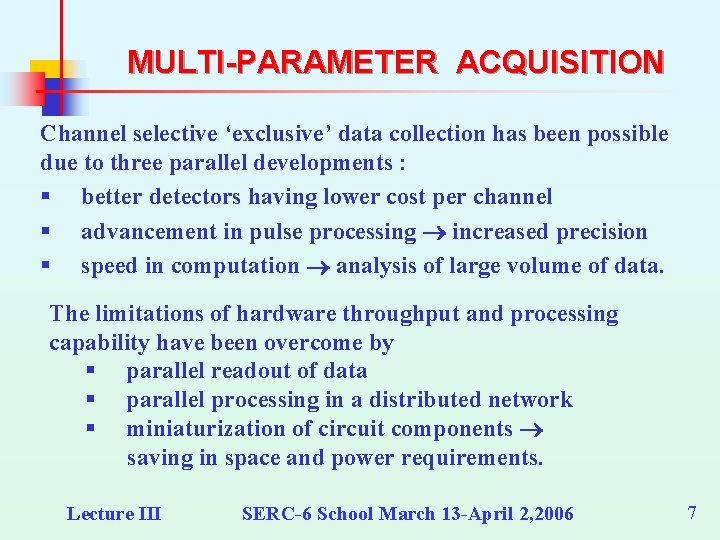
MULTI-PARAMETER ACQUISITION Channel selective ‘exclusive’ data collection has been possible due to three parallel developments : § better detectors having lower cost per channel § advancement in pulse processing increased precision § speed in computation analysis of large volume of data. The limitations of hardware throughput and processing capability have been overcome by § parallel readout of data § parallel processing in a distributed network § miniaturization of circuit components saving in space and power requirements. Lecture III SERC-6 School March 13 -April 2, 2006 7
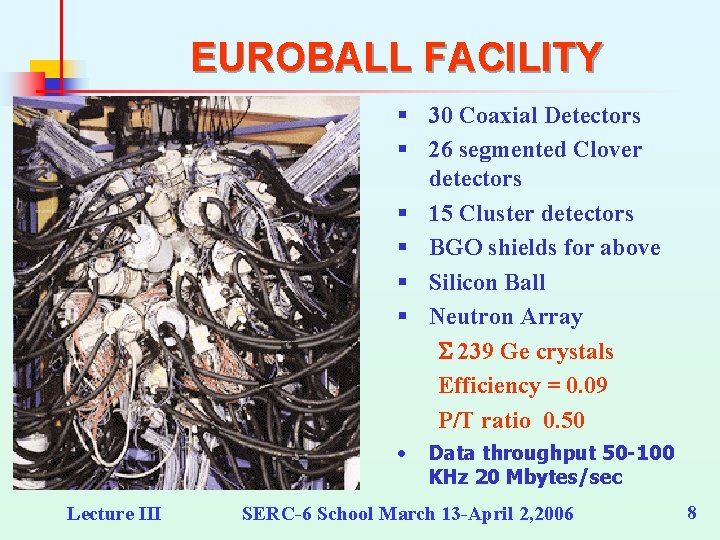
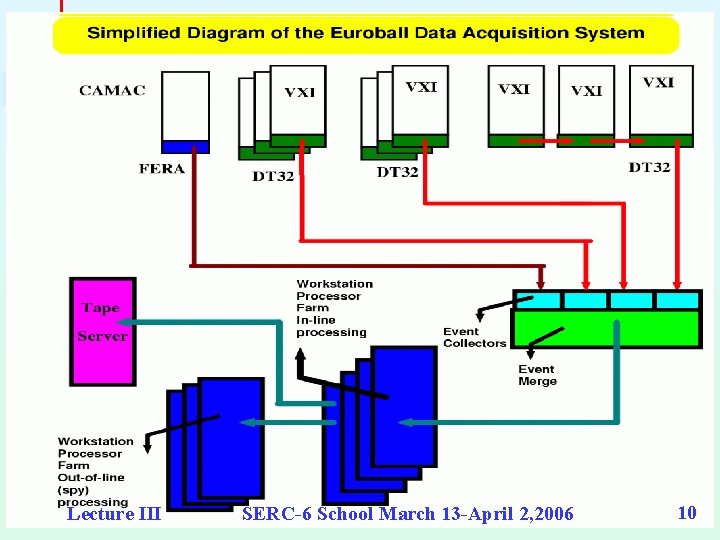
EUROBALL FACILITY § 30 Coaxial Detectors § 26 segmented Clover detectors § 15 Cluster detectors § BGO shields for above § Silicon Ball § Neutron Array 239 Ge crystals Efficiency = 0. 09 P/T ratio 0. 50 • Lecture III Data throughput 50 -100 KHz 20 Mbytes/sec SERC-6 School March 13 -April 2, 2006 8
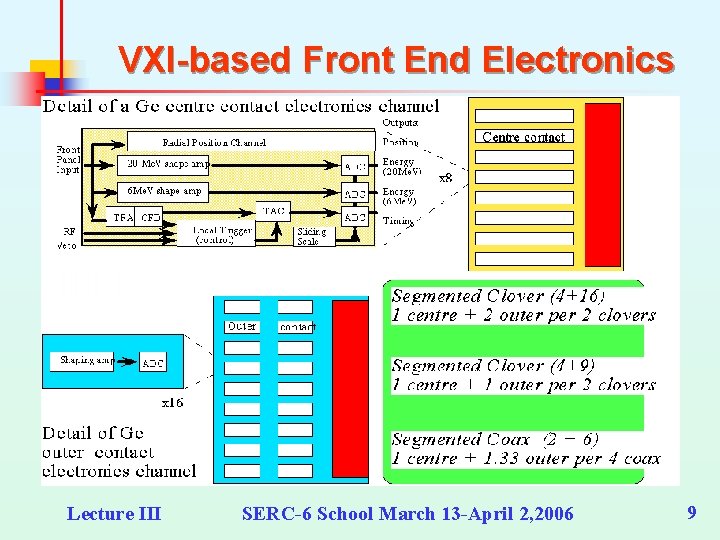
VXI-based Front End Electronics Lecture III SERC-6 School March 13 -April 2, 2006 9
Lecture III SERC-6 School March 13 -April 2, 2006 10
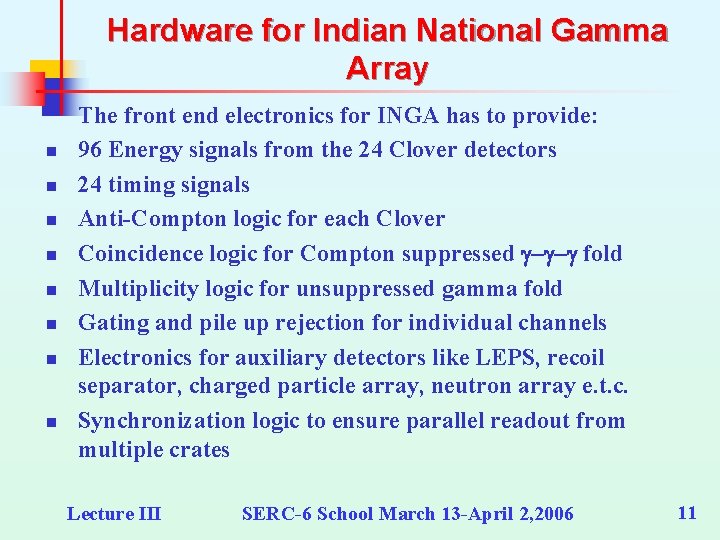
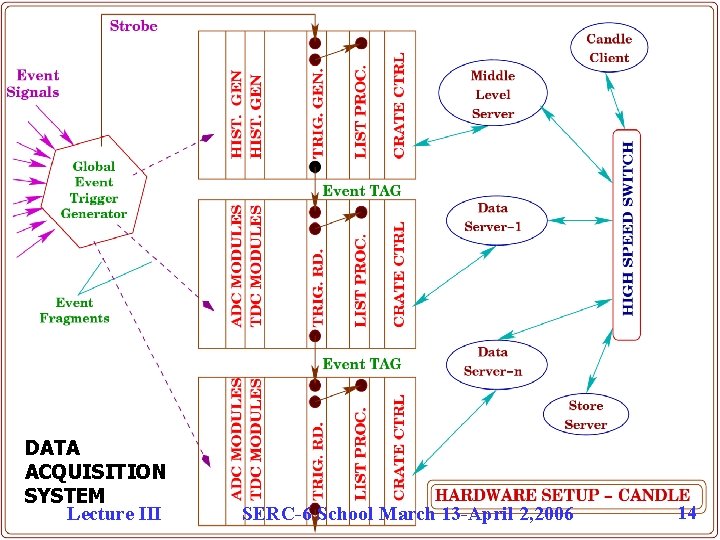
Hardware for Indian National Gamma Array n n n n The front end electronics for INGA has to provide: 96 Energy signals from the 24 Clover detectors 24 timing signals Anti-Compton logic for each Clover Coincidence logic for Compton suppressed g-g-g fold Multiplicity logic for unsuppressed gamma fold Gating and pile up rejection for individual channels Electronics for auxiliary detectors like LEPS, recoil separator, charged particle array, neutron array e. t. c. Synchronization logic to ensure parallel readout from multiple crates Lecture III SERC-6 School March 13 -April 2, 2006 11
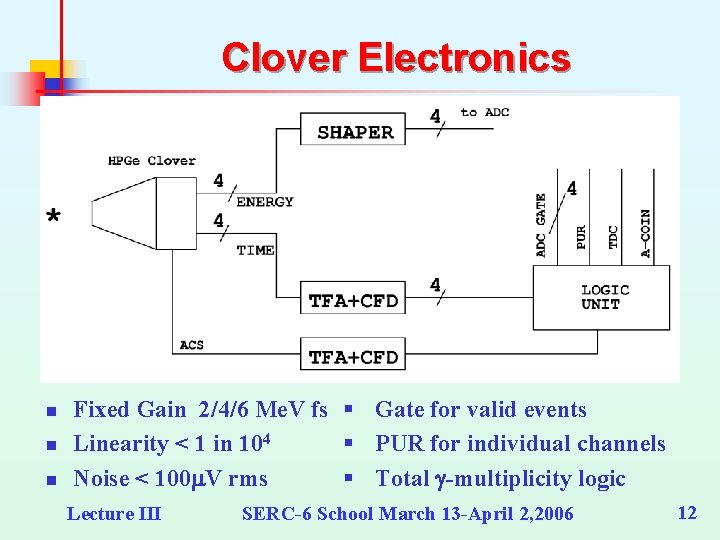
Clover Electronics n n n Fixed Gain 2/4/6 Me. V fs § Gate for valid events Linearity < 1 in 104 § PUR for individual channels Noise < 100 m. V rms § Total g-multiplicity logic Lecture III SERC-6 School March 13 -April 2, 2006 12
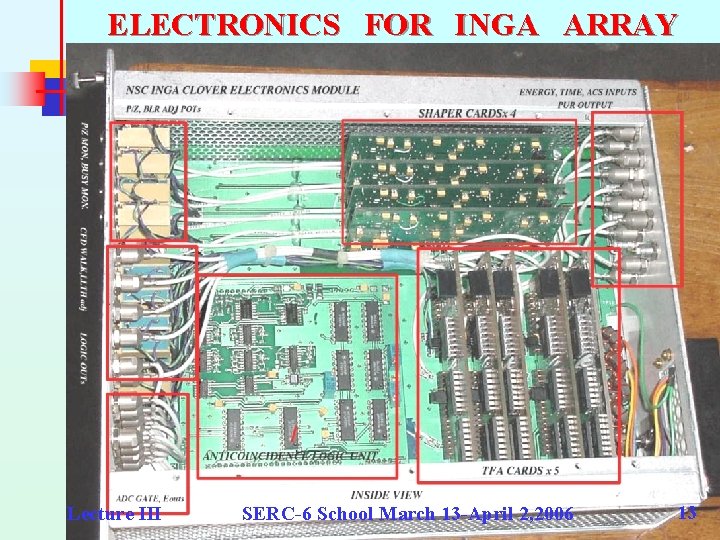
ELECTRONICS FOR INGA ARRAY Lecture III SERC-6 School March 13 -April 2, 2006 13
DATA ACQUISITION SYSTEM Lecture III SERC-6 School March 13 -April 2, 2006 14
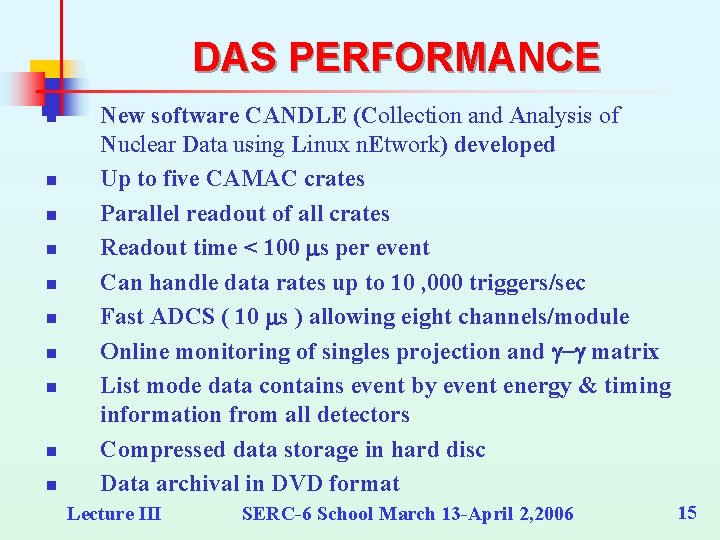
DAS PERFORMANCE n n n n n New software CANDLE (Collection and Analysis of Nuclear Data using Linux n. Etwork) developed Up to five CAMAC crates Parallel readout of all crates Readout time < 100 ms per event Can handle data rates up to 10 , 000 triggers/sec Fast ADCS ( 10 ms ) allowing eight channels/module Online monitoring of singles projection and g-g matrix List mode data contains event by event energy & timing information from all detectors Compressed data storage in hard disc Data archival in DVD format Lecture III SERC-6 School March 13 -April 2, 2006 15
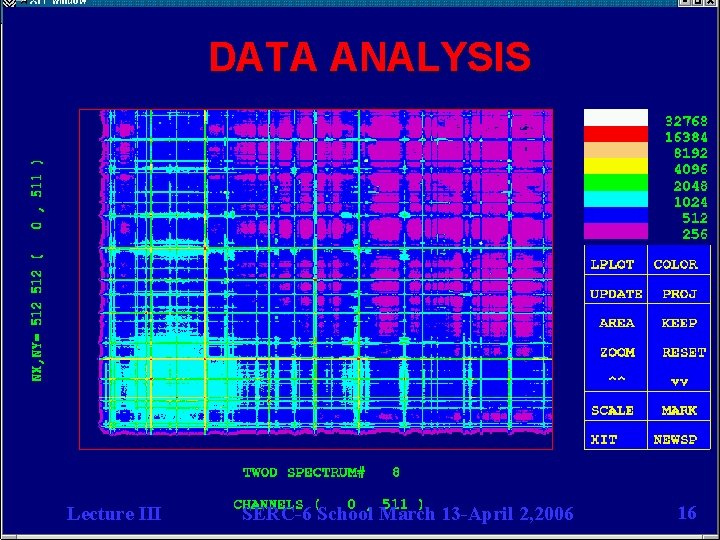
DATA ANALYSIS Lecture III SERC-6 School March 13 -April 2, 2006 16
ANALYSIS OF LIST MODE DATA n n n Main objectives of data analysis in g-spectroscopy are: Look for g-transitions following the nuclear reaction Look for correlations g-g, g-g-g etc. to search for sequence of transitions Measure the intensity of each transition to estimate the population of each level Extract angular distribution, angular correlation and polarization of the gamma transitions Establish the level scheme, spin and parity of each level Additional information like life times of the states can be extracted which gives valuable information about nuclear matrix elements Lecture III SERC-6 School March 13 -April 2, 2006 17
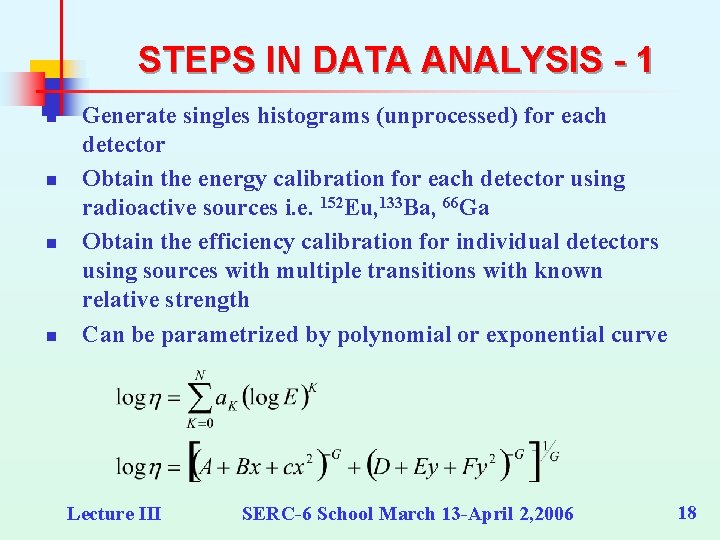
STEPS IN DATA ANALYSIS - 1 n n Generate singles histograms (unprocessed) for each detector Obtain the energy calibration for each detector using radioactive sources i. e. 152 Eu, 133 Ba, 66 Ga Obtain the efficiency calibration for individual detectors using sources with multiple transitions with known relative strength Can be parametrized by polynomial or exponential curve Lecture III SERC-6 School March 13 -April 2, 2006 18
Efficiency Curve Energy in ke. V x = log(E/100) y=log(E/1000) To simplify the procedure, most analysis programs have the option of automated search of peak centroid & area Ø AUTOFIT in INGASORT Lecture III SERC-6 School March 13 -April 2, 2006 19
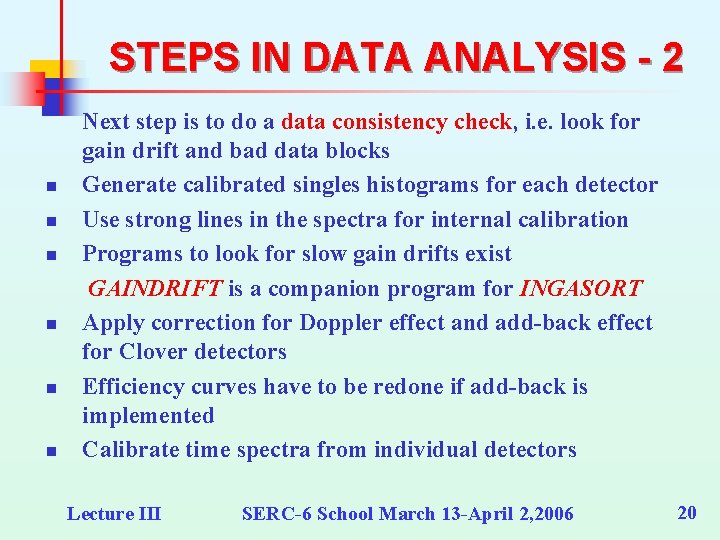
STEPS IN DATA ANALYSIS - 2 n n n Next step is to do a data consistency check, i. e. look for gain drift and bad data blocks Generate calibrated singles histograms for each detector Use strong lines in the spectra for internal calibration Programs to look for slow gain drifts exist GAINDRIFT is a companion program for INGASORT Apply correction for Doppler effect and add-back effect for Clover detectors Efficiency curves have to be redone if add-back is implemented Calibrate time spectra from individual detectors Lecture III SERC-6 School March 13 -April 2, 2006 20
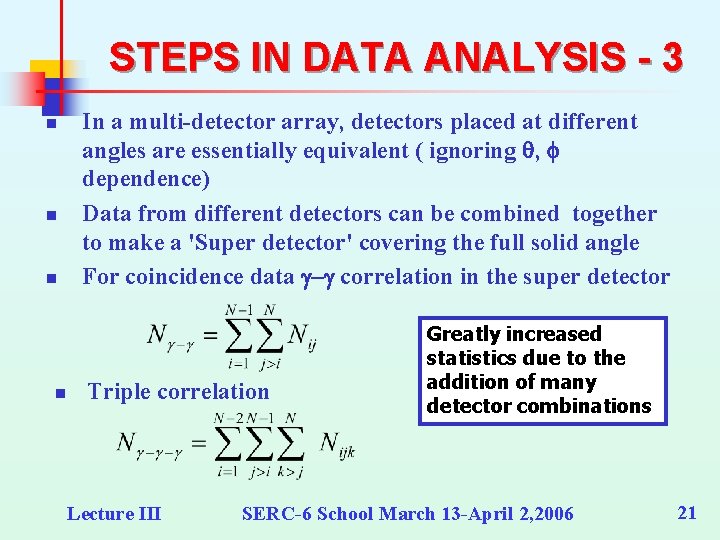
STEPS IN DATA ANALYSIS - 3 n n In a multi-detector array, detectors placed at different angles are essentially equivalent ( ignoring q, f dependence) Data from different detectors can be combined together to make a 'Super detector' covering the full solid angle For coincidence data g-g correlation in the super detector Triple correlation Lecture III Greatly increased statistics due to the addition of many detector combinations SERC-6 School March 13 -April 2, 2006 21
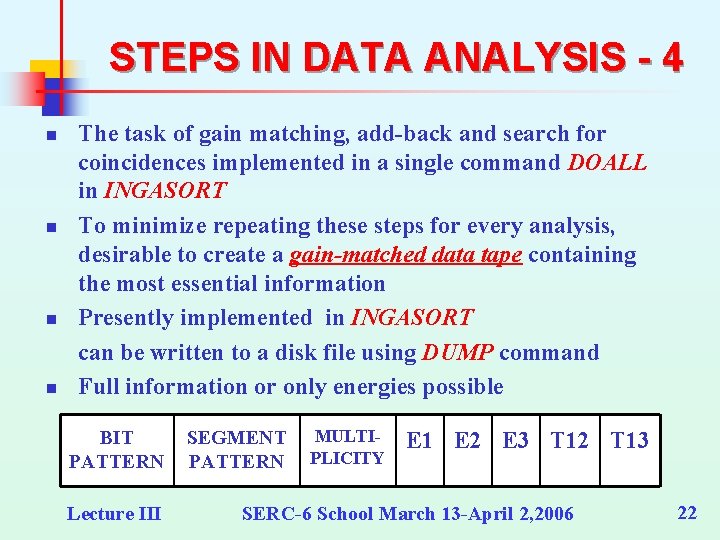
STEPS IN DATA ANALYSIS - 4 n n The task of gain matching, add-back and search for coincidences implemented in a single command DOALL in INGASORT To minimize repeating these steps for every analysis, desirable to create a gain-matched data tape containing the most essential information Presently implemented in INGASORT can be written to a disk file using DUMP command Full information or only energies possible BIT PATTERN Lecture III SEGMENT PATTERN MULTIPLICITY E 1 E 2 E 3 T 12 T 13 SERC-6 School March 13 -April 2, 2006 22
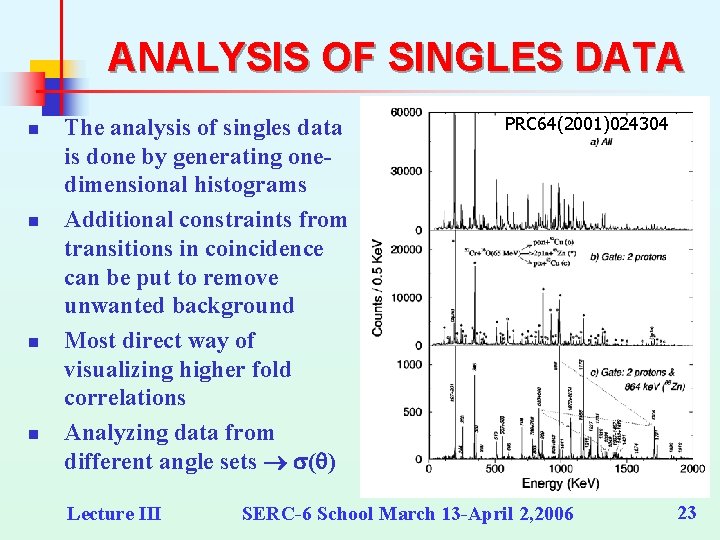
ANALYSIS OF SINGLES DATA n n The analysis of singles data is done by generating onedimensional histograms Additional constraints from transitions in coincidence can be put to remove unwanted background Most direct way of visualizing higher fold correlations Analyzing data from different angle sets s(q) Lecture III PRC 64(2001)024304 SERC-6 School March 13 -April 2, 2006 23
Background Subtraction Background from higher energy photons under a photopeak n Need to be corrected for quantitative yield n Small region : i. Least square peak fit with polynomial background ii. Background estimation in- generation over the whole region Large Region : from piece-wise between peaks Other methods: Iterative search NIMB 34(1988)396 n Lecture III SERC-6 School March 13 -April 2, 2006 24
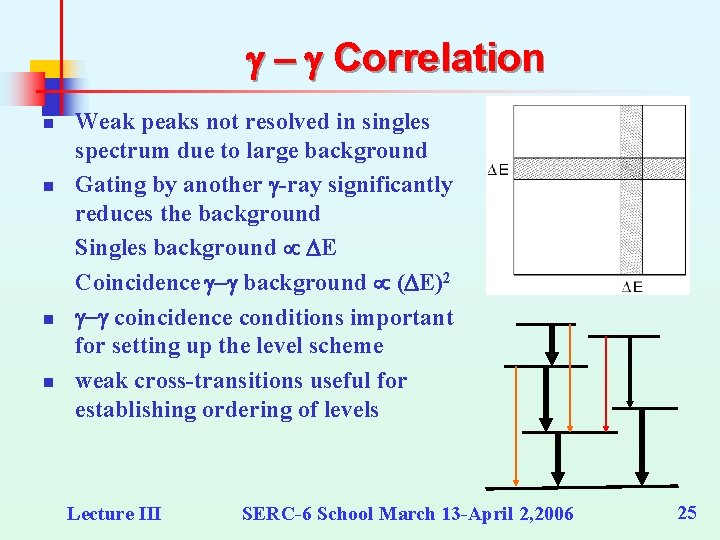
g - g Correlation n n Weak peaks not resolved in singles spectrum due to large background Gating by another g-ray significantly reduces the background Singles background DE Coincidence g-g background (DE)2 g-g coincidence conditions important for setting up the level scheme weak cross-transitions useful for establishing ordering of levels Lecture III SERC-6 School March 13 -April 2, 2006 25
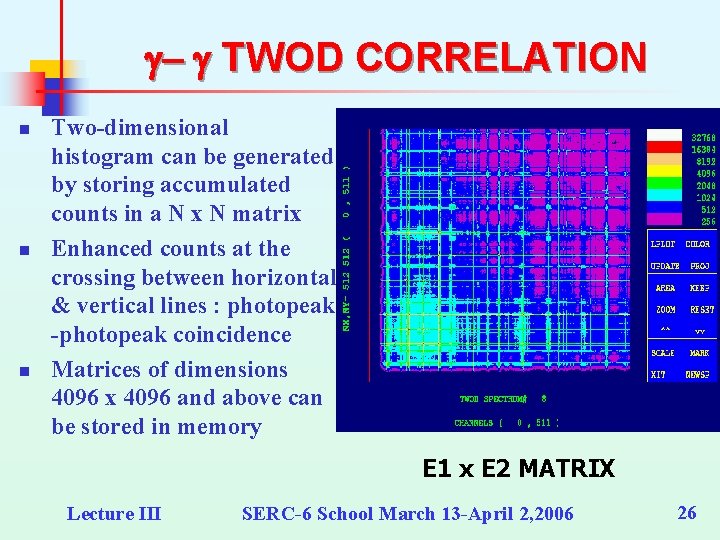
g- g TWOD CORRELATION n n n Two-dimensional histogram can be generated by storing accumulated counts in a N x N matrix Enhanced counts at the crossing between horizontal & vertical lines : photopeak -photopeak coincidence Matrices of dimensions 4096 x 4096 and above can be stored in memory E 1 x E 2 MATRIX Lecture III SERC-6 School March 13 -April 2, 2006 26
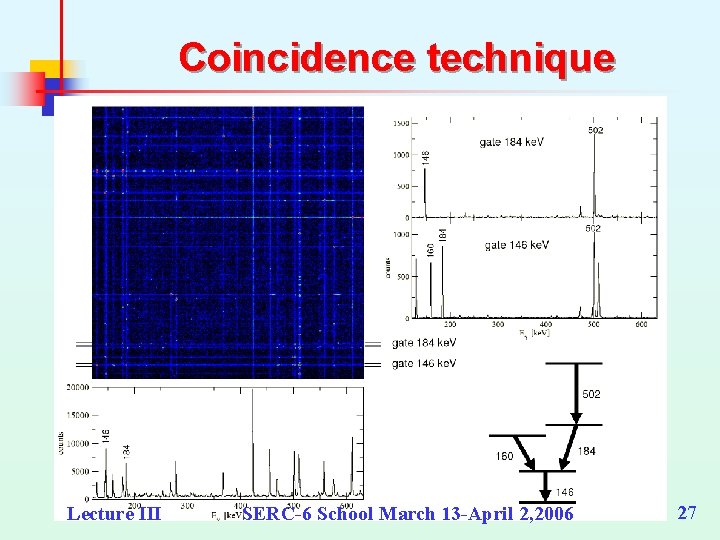
Coincidence technique Lecture III SERC-6 School March 13 -April 2, 2006 27
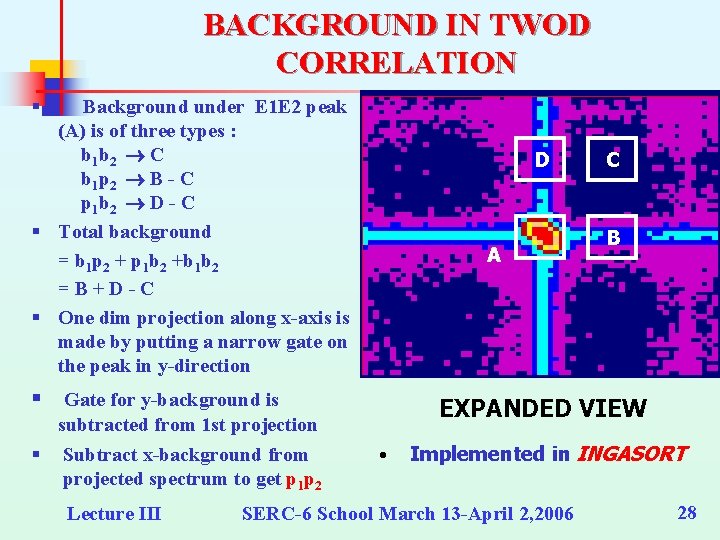
BACKGROUND IN TWOD CORRELATION § Background under E 1 E 2 peak (A) is of three types : b 1 b 2 C b 1 p 2 B - C p 1 b 2 D - C § Total background = b 1 p 2 + p 1 b 2 +b 1 b 2 =B+D-C § One dim projection along x-axis is made by putting a narrow gate on the peak in y-direction D A § Gate for y-background is Subtract x-background from projected spectrum to get p 1 p 2 Lecture III B EXPANDED VIEW subtracted from 1 st projection § C • Implemented in INGASORT SERC-6 School March 13 -April 2, 2006 28
Cubes & hypercubes n n n Many nuclei and many bands populated in one reaction For g-g-g correlation, multiple gates help remove unwanted channels First g selects nucleus Second g selects the band of interest Desirable to have three dimensional matrix 4 k Would not fit into computer memory ! Writing directly on hard disk very inefficient - slow disk access Can be implemented by maintaining a database to minimize disk writes Database BLUE NIMA 462(2001)519 Lecture III SERC-6 School March 13 -April 2, 2006 29
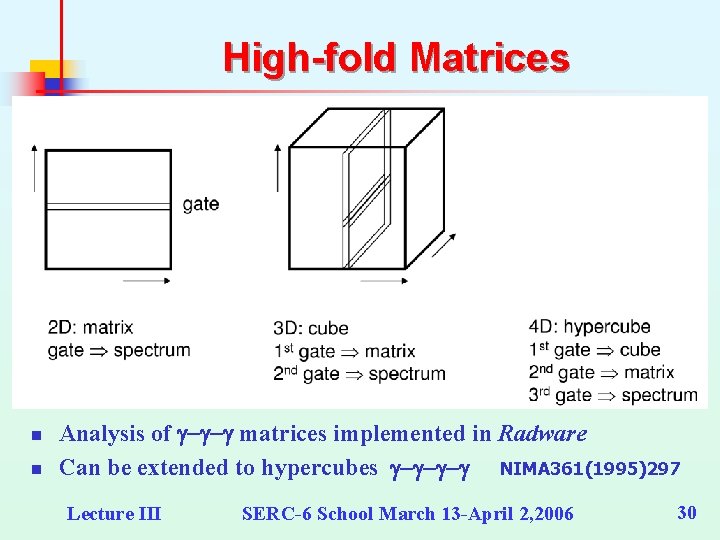
High-fold Matrices n n Analysis of g-g-g matrices implemented in Radware Can be extended to hypercubes g-g-g-g NIMA 361(1995)297 Lecture III SERC-6 School March 13 -April 2, 2006 30
Multi-dimensional gate n n n Correlations in high fold data can be converted to one dim histogram by setting gates on the remaining axes For double-gated g-g-g coincidence, put gate 1 on x, gate 2 on y and project z If all detectors are equivalent, add up all the permutations of energies: 123, 132, 213, 231, 312, 321 Corresponding background gates must be subtracted from each projection Contributions from multiple transitions can be added in parallel to improve statistics High multiplicity events should be analyzed in their native fold : unpacking may lead to wrong intensities Lecture III SERC-6 School March 13 -April 2, 2006 31
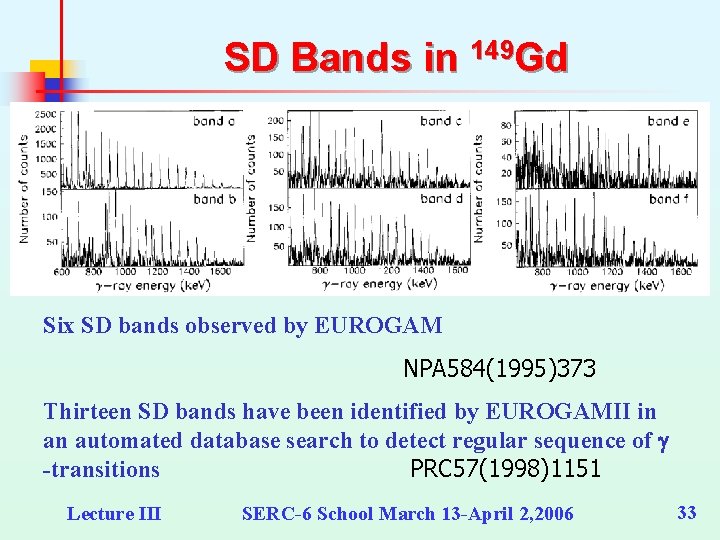
Band Identification from multi-fold data Yrast SD band in 149 Gd (M-1) fold gates on Mfold data improves peak to background ratio as one goes to higher fold. Gates are put on known transitions of the SD band. Six SD bands identified NPA 584(1995)373 Lecture III SERC-6 School March 13 -April 2, 2006 32
SD Bands in 149 Gd Six SD bands observed by EUROGAM NPA 584(1995)373 Thirteen SD bands have been identified by EUROGAMII in an automated database search to detect regular sequence of g -transitions PRC 57(1998)1151 Lecture III SERC-6 School March 13 -April 2, 2006 33
TUTORIAL Lecture III SERC-6 School March 13 -April 2, 2006 34
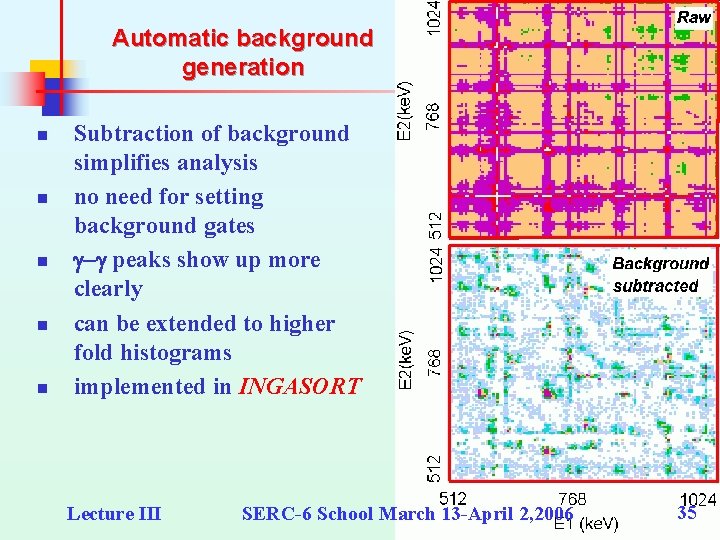
Automatic background generation n n Subtraction of background simplifies analysis no need for setting background gates g-g peaks show up more clearly can be extended to higher fold histograms implemented in INGASORT Lecture III SERC-6 School March 13 -April 2, 2006 35
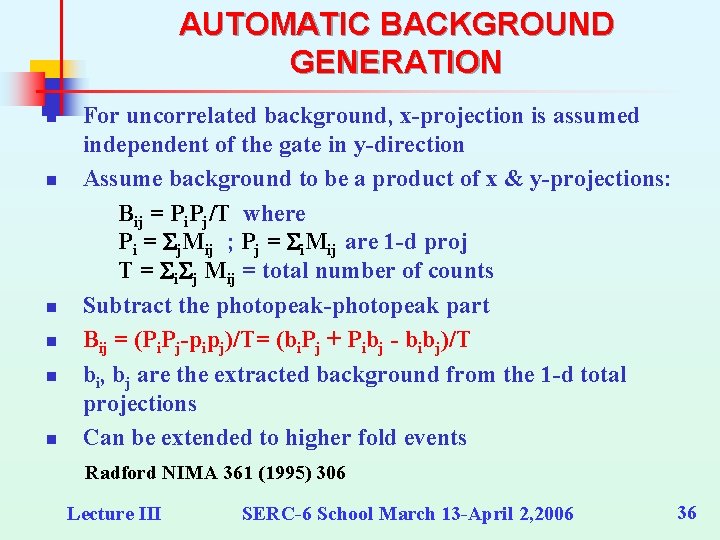
AUTOMATIC BACKGROUND GENERATION n n n For uncorrelated background, x-projection is assumed independent of the gate in y-direction Assume background to be a product of x & y-projections: Bij = Pi. Pj/T where Pi = j. Mij ; Pj = i. Mij are 1 -d proj T = i j Mij = total number of counts Subtract the photopeak-photopeak part Bij = (Pi. Pj-pipj)/T= (bi. Pj + Pibj - bibj)/T bi, bj are the extracted background from the 1 -d total projections Can be extended to higher fold events Radford NIMA 361 (1995) 306 Lecture III SERC-6 School March 13 -April 2, 2006 36
AUTOMATIC BACKGROUND SUBTRACTION Total x-projection Lecture III gated x-projection SERC-6 School March 13 -April 2, 2006 37
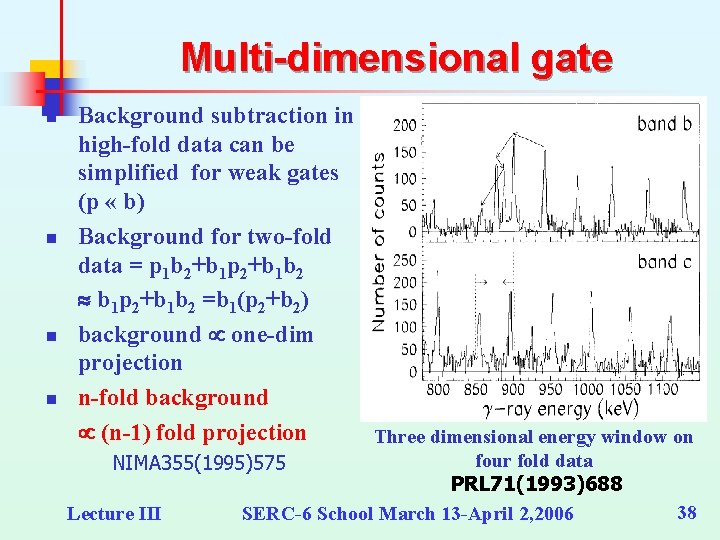
Multi-dimensional gate n n Background subtraction in high-fold data can be simplified for weak gates (p « b) Background for two-fold data = p 1 b 2+b 1 p 2+b 1 b 2 =b 1(p 2+b 2) background one-dim projection n-fold background (n-1) fold projection Three dimensional energy window on four fold data PRL 71(1993)688 SERC-6 School March 13 -April 2, 2006 NIMA 355(1995)575 Lecture III 38
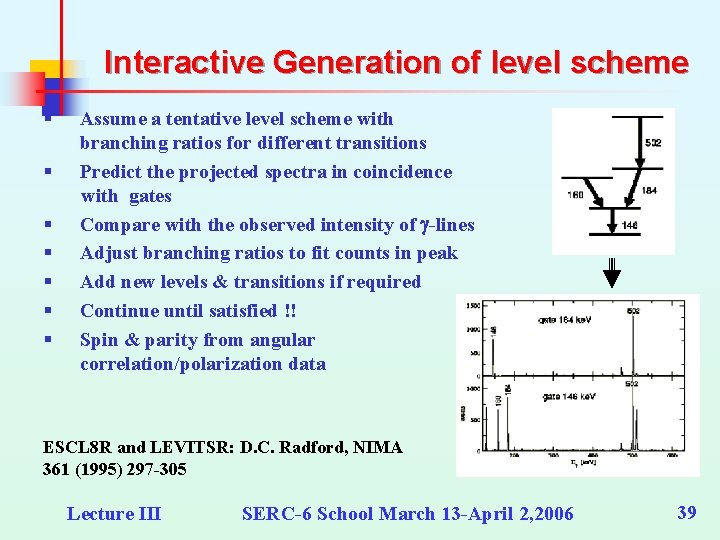
Interactive Generation of level scheme § § § § Assume a tentative level scheme with branching ratios for different transitions Predict the projected spectra in coincidence with gates Compare with the observed intensity of g-lines Adjust branching ratios to fit counts in peak Add new levels & transitions if required Continue until satisfied !! Spin & parity from angular correlation/polarization data ESCL 8 R and LEVITSR: D. C. Radford, NIMA 361 (1995) 297 -305 Lecture III SERC-6 School March 13 -April 2, 2006 39
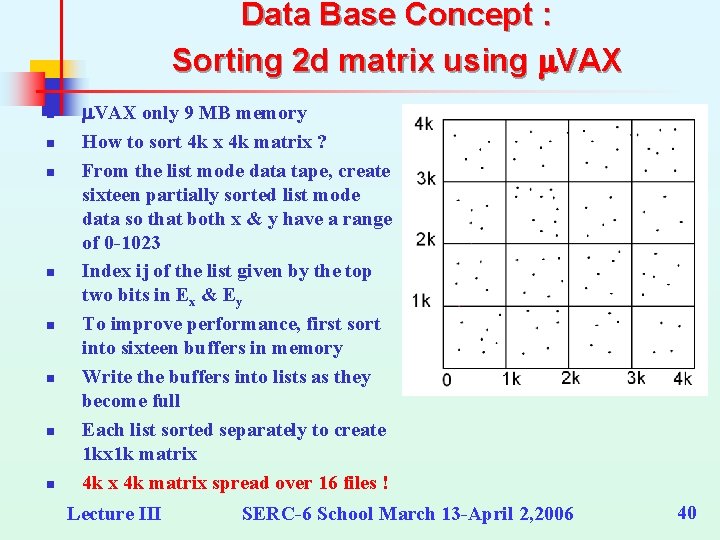
Data Base Concept : Sorting 2 d matrix using m. VAX n n n n m. VAX only 9 MB memory How to sort 4 k x 4 k matrix ? From the list mode data tape, create sixteen partially sorted list mode data so that both x & y have a range of 0 -1023 Index ij of the list given by the top two bits in Ex & Ey To improve performance, first sort into sixteen buffers in memory Write the buffers into lists as they become full Each list sorted separately to create 1 kx 1 k matrix 4 k matrix spread over 16 files ! Lecture III SERC-6 School March 13 -April 2, 2006 40
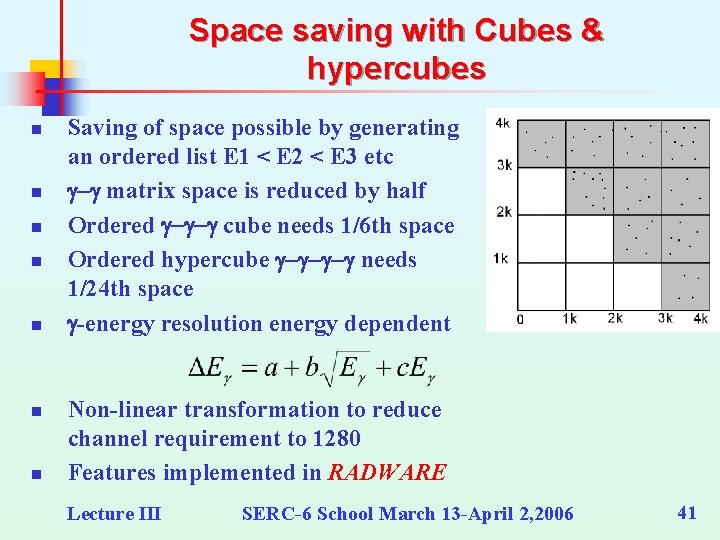
Space saving with Cubes & hypercubes n n n n Saving of space possible by generating an ordered list E 1 < E 2 < E 3 etc g-g matrix space is reduced by half Ordered g-g-g cube needs 1/6 th space Ordered hypercube g-g-g-g needs 1/24 th space g-energy resolution energy dependent Non-linear transformation to reduce channel requirement to 1280 Features implemented in RADWARE Lecture III SERC-6 School March 13 -April 2, 2006 41
Lecture III SERC-6 School March 13 -April 2, 2006 42