
EXPERIMENTS WITH LARGE GAMMA DETECTOR ARRAYS Lecture II
- Slides: 40
EXPERIMENTS WITH LARGE GAMMA DETECTOR ARRAYS Lecture II Ranjan Bhowmik Inter University Accelerator Centre New Delhi -110067 Lecture II SERC-6 School March 13 - April 2, 2006
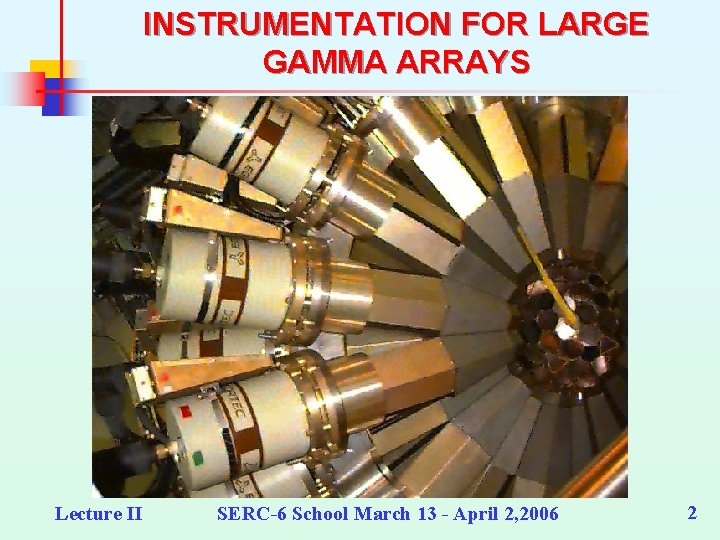
INSTRUMENTATION FOR LARGE GAMMA ARRAYS Lecture II SERC-6 School March 13 - April 2, 2006 2
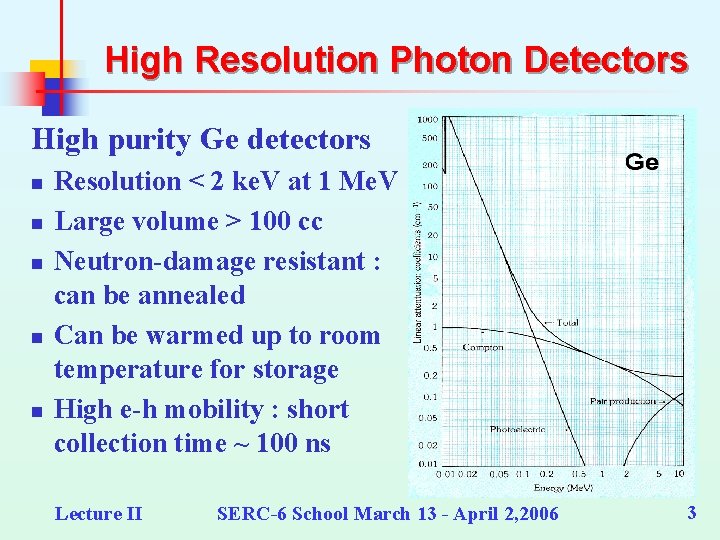
High Resolution Photon Detectors High purity Ge detectors n n n Resolution < 2 ke. V at 1 Me. V Large volume > 100 cc Neutron-damage resistant : can be annealed Can be warmed up to room temperature for storage High e-h mobility : short collection time ~ 100 ns Lecture II SERC-6 School March 13 - April 2, 2006 3
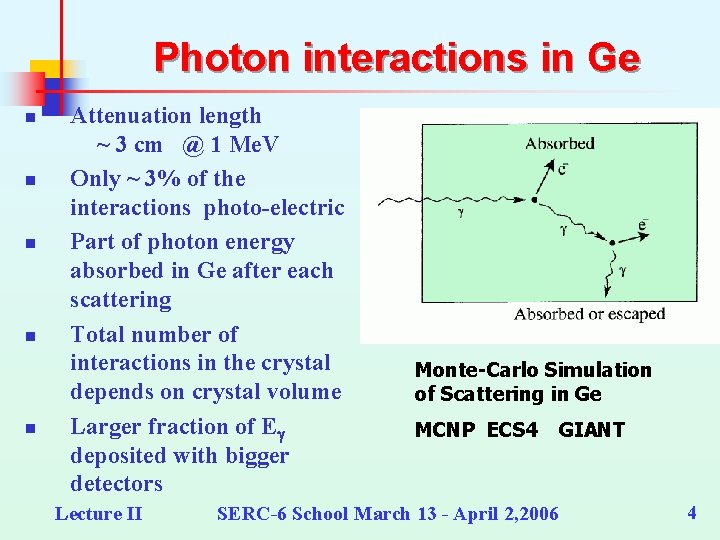
Photon interactions in Ge n n n Attenuation length ~ 3 cm @ 1 Me. V Only ~ 3% of the interactions photo-electric Part of photon energy absorbed in Ge after each scattering Total number of interactions in the crystal depends on crystal volume Larger fraction of Eg deposited with bigger detectors Lecture II Monte-Carlo Simulation of Scattering in Ge MCNP ECS 4 SERC-6 School March 13 - April 2, 2006 GIANT 4
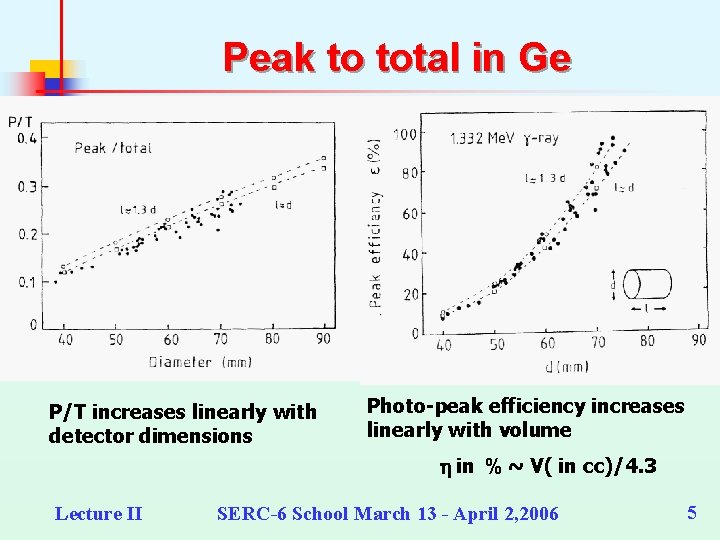
Peak to total in Ge P/T increases linearly with detector dimensions Photo-peak efficiency increases linearly with volume in % ~ V( in cc)/4. 3 Lecture II SERC-6 School March 13 - April 2, 2006 5
Requirement of large P/T n n n 100 cc detectors have P/T ~ 23% at 1. 33 Me. V Nearly 3/4 of events do not have correct energy information In g-g coincidence only 5% of events are useful In g-g-g coincidence only 1% of events are useful Making crystals of intrinsic P/T > 50% prohibitively expensive Electronic removal of bad events by detecting escaping Compton events viable option Lecture II SERC-6 School March 13 - April 2, 2006 6
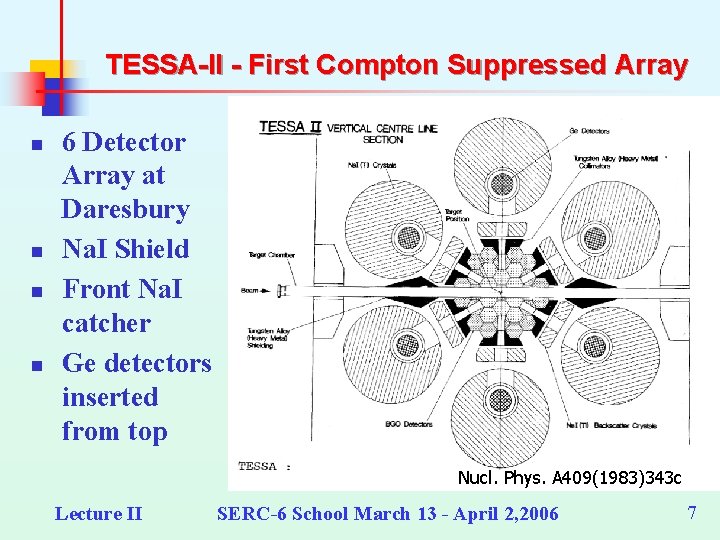
TESSA-II - First Compton Suppressed Array n n 6 Detector Array at Daresbury Na. I Shield Front Na. I catcher Ge detectors inserted from top Nucl. Phys. A 409(1983)343 c Lecture II SERC-6 School March 13 - April 2, 2006 7
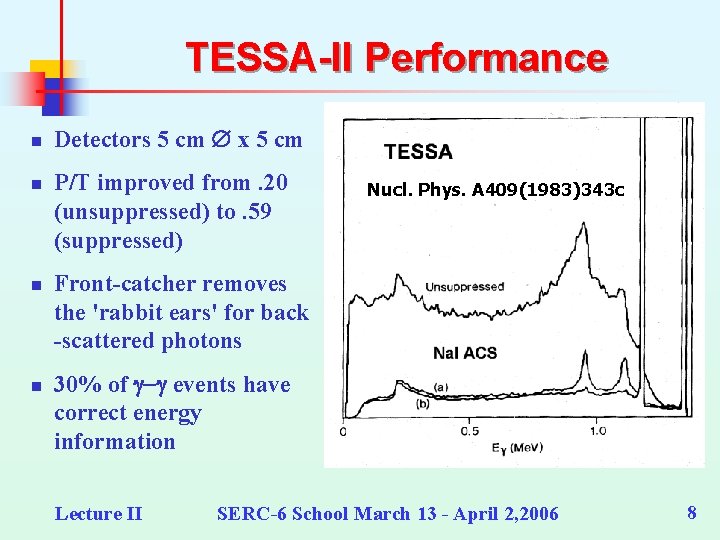
TESSA-II Performance n n Detectors 5 cm x 5 cm P/T improved from. 20 (unsuppressed) to. 59 (suppressed) Nucl. Phys. A 409(1983)343 c Front-catcher removes the 'rabbit ears' for back -scattered photons 30% of g-g events have correct energy information Lecture II SERC-6 School March 13 - April 2, 2006 8
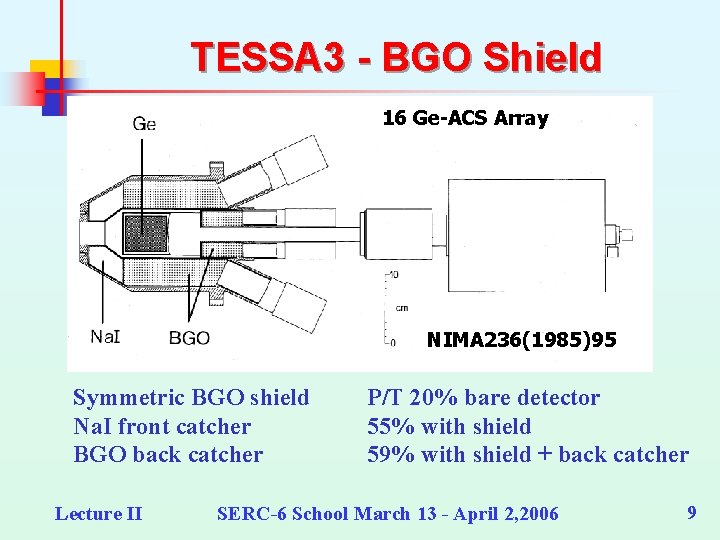
TESSA 3 - BGO Shield 16 Ge-ACS Array NIMA 236(1985)95 Symmetric BGO shield Na. I front catcher BGO back catcher Lecture II P/T 20% bare detector 55% with shield 59% with shield + back catcher SERC-6 School March 13 - April 2, 2006 9
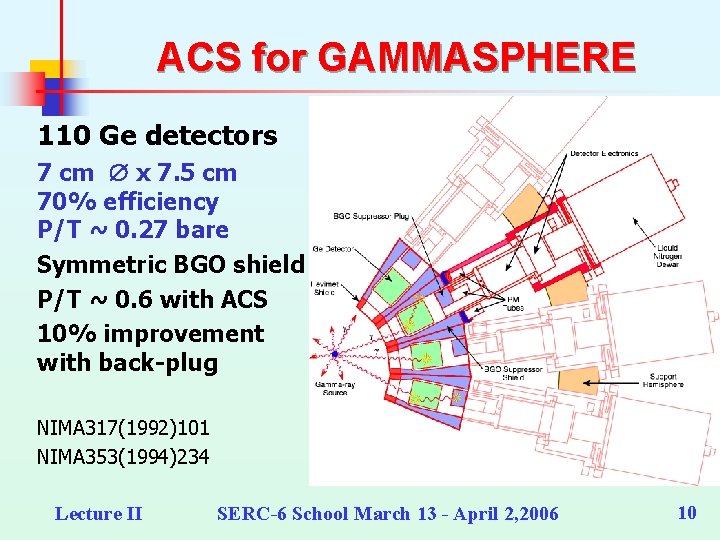
ACS for GAMMASPHERE 110 Ge detectors 7 cm x 7. 5 cm 70% efficiency P/T ~ 0. 27 bare Symmetric BGO shield P/T ~ 0. 6 with ACS 10% improvement with back-plug NIMA 317(1992)101 NIMA 353(1994)234 Lecture II SERC-6 School March 13 - April 2, 2006 10
COMPOSITE DETECTORS Detectors larger than 7 cm difficult to fabricate Large charge collection time & Doppler broadening Increased neutron damage sensitivity Solution : Composite detectors n n n More than one detector within common cryostat and ACS Less dead space due to common ACS Increased solid angle coverage & granularity Scattering from one detector to another increases photopeak efficiency Compton Polarimeter Lecture II SERC-6 School March 13 - April 2, 2006 11
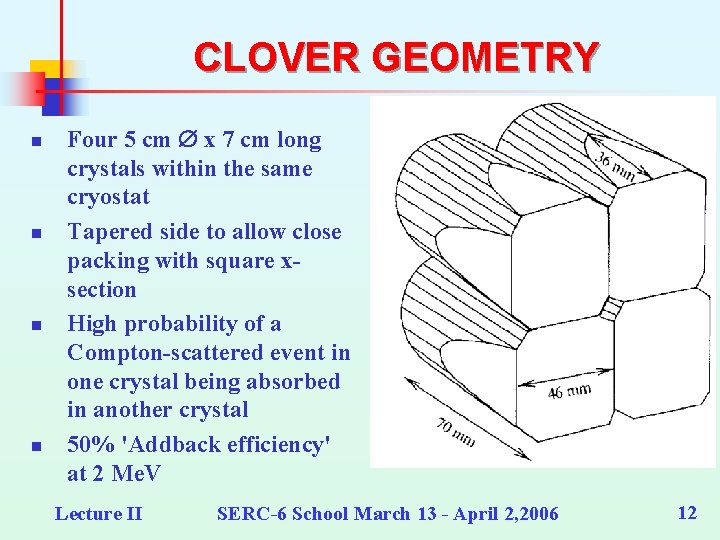
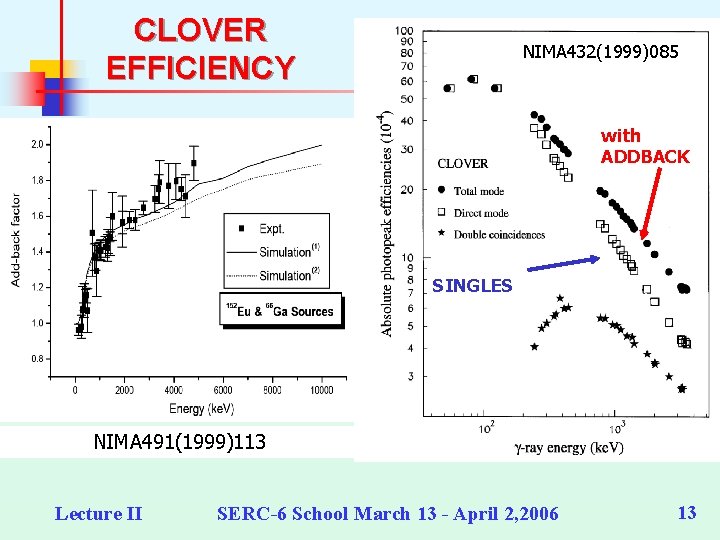
CLOVER GEOMETRY n n Four 5 cm x 7 cm long crystals within the same cryostat Tapered side to allow close packing with square xsection High probability of a Compton-scattered event in one crystal being absorbed in another crystal 50% 'Addback efficiency' at 2 Me. V Lecture II SERC-6 School March 13 - April 2, 2006 12
CLOVER EFFICIENCY NIMA 432(1999)085 with ADDBACK SINGLES NIMA 491(1999)113 Lecture II SERC-6 School March 13 - April 2, 2006 13
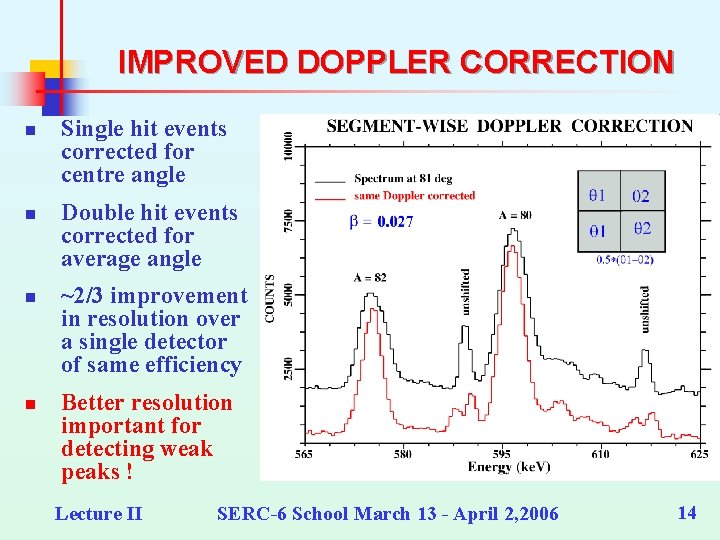
IMPROVED DOPPLER CORRECTION n n Single hit events corrected for centre angle Double hit events corrected for average angle ~2/3 improvement in resolution over a single detector of same efficiency Better resolution important for detecting weak peaks ! Lecture II SERC-6 School March 13 - April 2, 2006 14
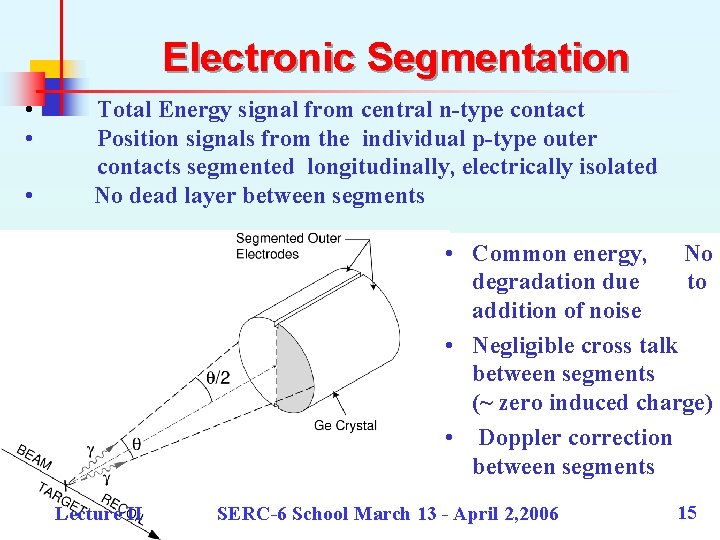
Electronic Segmentation • • • Total Energy signal from central n-type contact Position signals from the individual p-type outer contacts segmented longitudinally, electrically isolated No dead layer between segments • Common energy, No degradation due to addition of noise • Negligible cross talk between segments (~ zero induced charge) • Doppler correction between segments Lecture II SERC-6 School March 13 - April 2, 2006 15
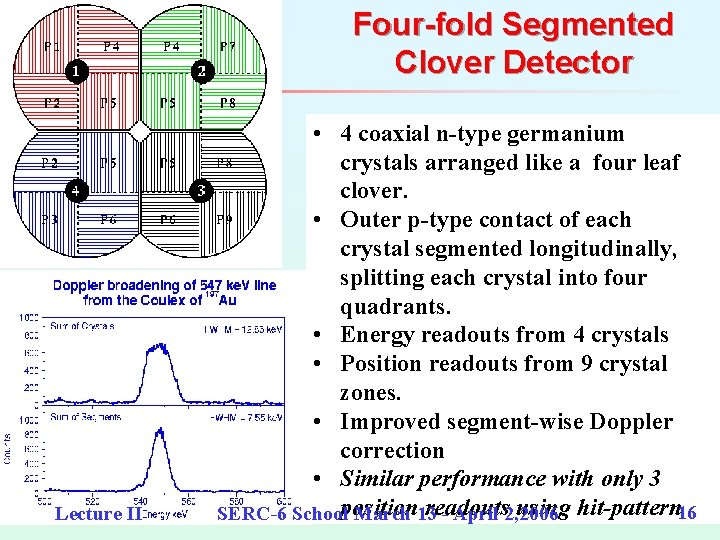
Four-fold Segmented Clover Detector Lecture II • 4 coaxial n-type germanium crystals arranged like a four leaf clover. • Outer p-type contact of each crystal segmented longitudinally, splitting each crystal into four quadrants. • Energy readouts from 4 crystals • Position readouts from 9 crystal zones. • Improved segment-wise Doppler correction • Similar performance with only 3 readouts using hit-pattern 16 SERC-6 Schoolposition March 13 - April 2, 2006
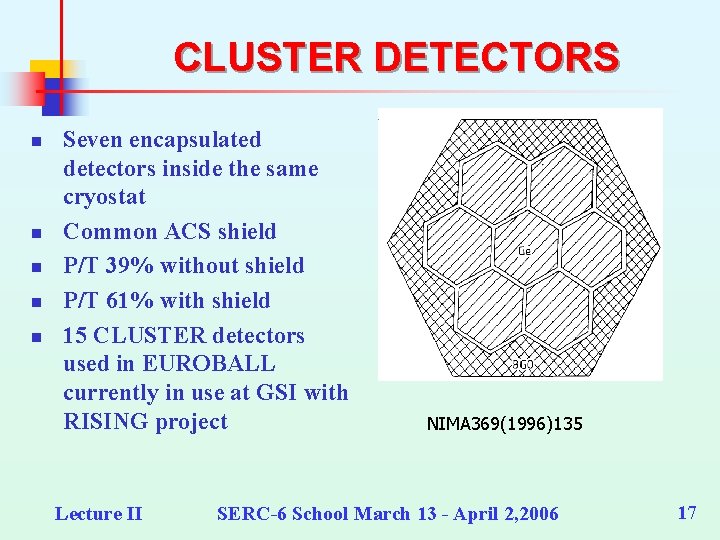
CLUSTER DETECTORS n n n Seven encapsulated detectors inside the same cryostat Common ACS shield P/T 39% without shield P/T 61% with shield 15 CLUSTER detectors used in EUROBALL currently in use at GSI with RISING project Lecture II NIMA 369(1996)135 SERC-6 School March 13 - April 2, 2006 17
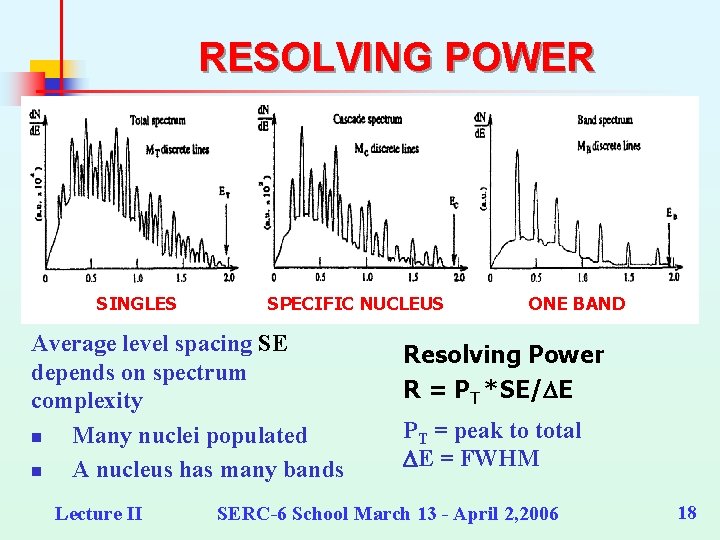
RESOLVING POWER SINGLES SPECIFIC NUCLEUS Average level spacing SE depends on spectrum complexity n Many nuclei populated n A nucleus has many bands Lecture II ONE BAND Resolving Power R = PT *SE/ E PT = peak to total E = FWHM SERC-6 School March 13 - April 2, 2006 18
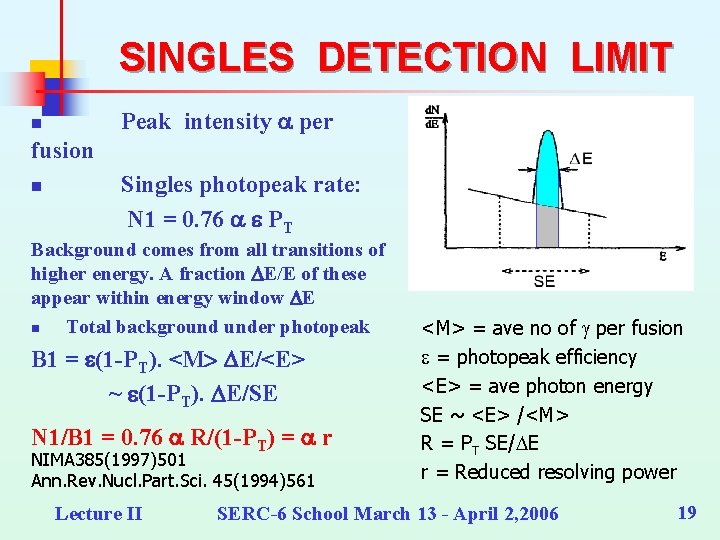
SINGLES DETECTION LIMIT Peak intensity a per n fusion n Singles photopeak rate: N 1 = 0. 76 a e PT Background comes from all transitions of higher energy. A fraction E/E of these appear within energy window E n Total background under photopeak B 1 = e(1 -PT). <M> E/<E> ~ e(1 -PT). E/SE N 1/B 1 = 0. 76 a R/(1 -PT) = a r NIMA 385(1997)501 Ann. Rev. Nucl. Part. Sci. 45(1994)561 Lecture II <M> = ave no of g per fusion e = photopeak efficiency <E> = ave photon energy SE ~ <E> /<M> R = PT SE/DE r = Reduced resolving power SERC-6 School March 13 - April 2, 2006 19
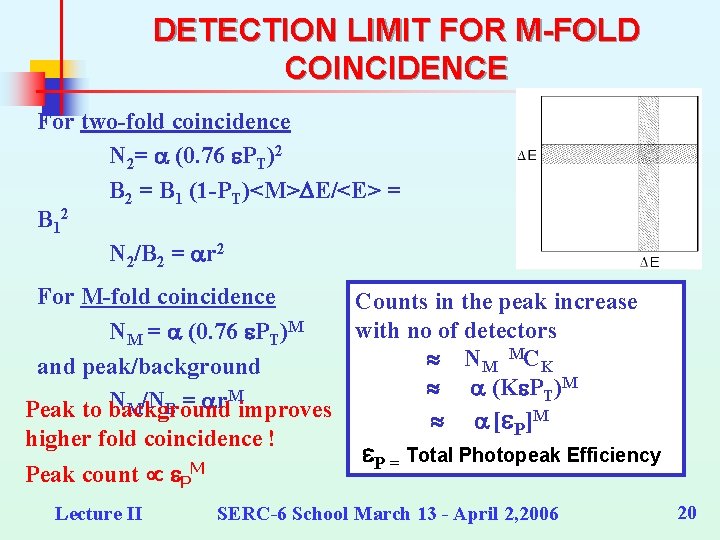
DETECTION LIMIT FOR M-FOLD COINCIDENCE For two-fold coincidence N 2= a (0. 76 e. PT)2 B 2 = B 1 (1 -PT)<M> E/<E> = B 12 N 2/B 2 = ar 2 For M-fold coincidence Counts in the peak increase with no of detectors NM = a (0. 76 e. PT)M MC N M K and peak/background M a (Ke. P ) M T N /N = ar M B Peak to background improves with a [e ]M P higher fold coincidence ! e. P = Total Photopeak Efficiency M Peak count e. P Lecture II SERC-6 School March 13 - April 2, 2006 20
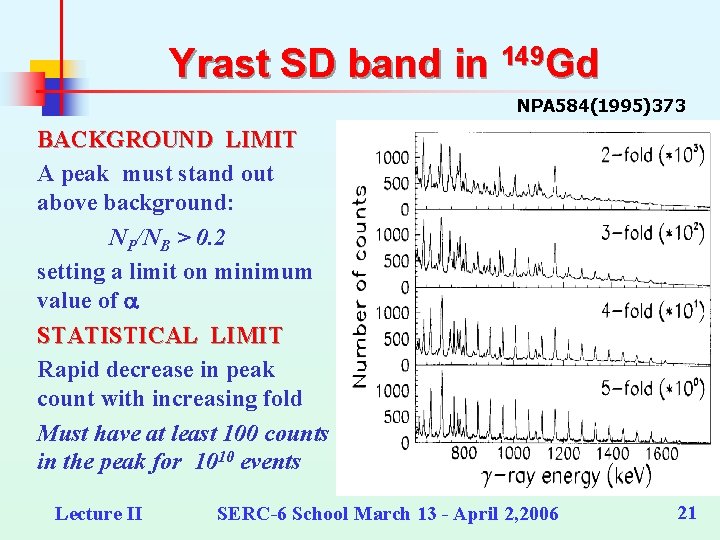
Yrast SD band in 149 Gd NPA 584(1995)373 BACKGROUND LIMIT A peak must stand out above background: NP/NB > 0. 2 setting a limit on minimum value of a STATISTICAL LIMIT Rapid decrease in peak count with increasing fold Must have at least 100 counts in the peak for 1010 events Lecture II SERC-6 School March 13 - April 2, 2006 21
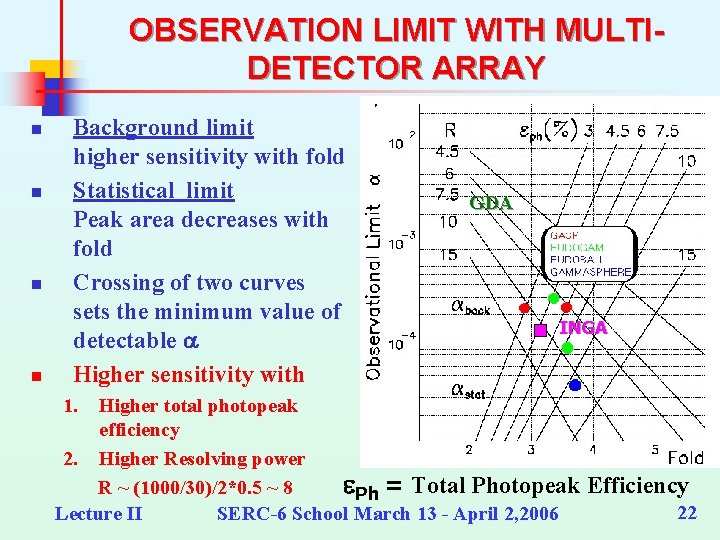
OBSERVATION LIMIT WITH MULTIDETECTOR ARRAY n n Background limit higher sensitivity with fold Statistical limit Peak area decreases with fold Crossing of two curves sets the minimum value of detectable a Higher sensitivity with 1. GDA INGA Higher total photopeak efficiency 2. Higher Resolving power e. Ph = Total Photopeak Efficiency R ~ (1000/30)/2*0. 5 ~ 8 22 Lecture II SERC-6 School March 13 - April 2, 2006
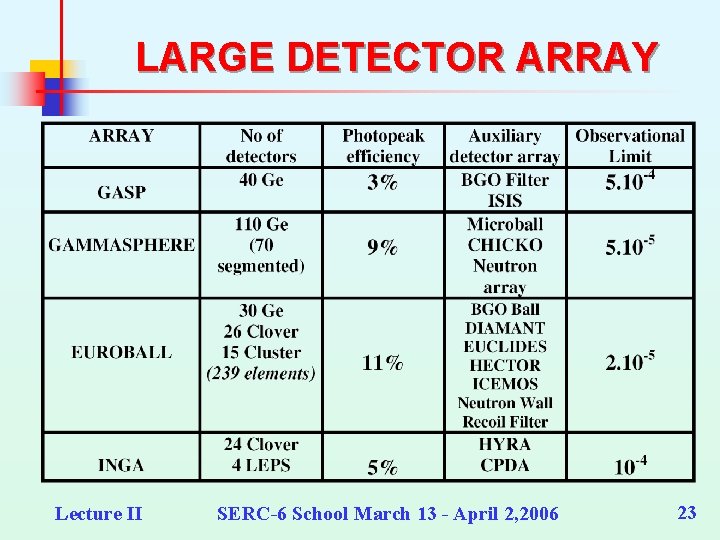
LARGE DETECTOR ARRAY Lecture II SERC-6 School March 13 - April 2, 2006 23
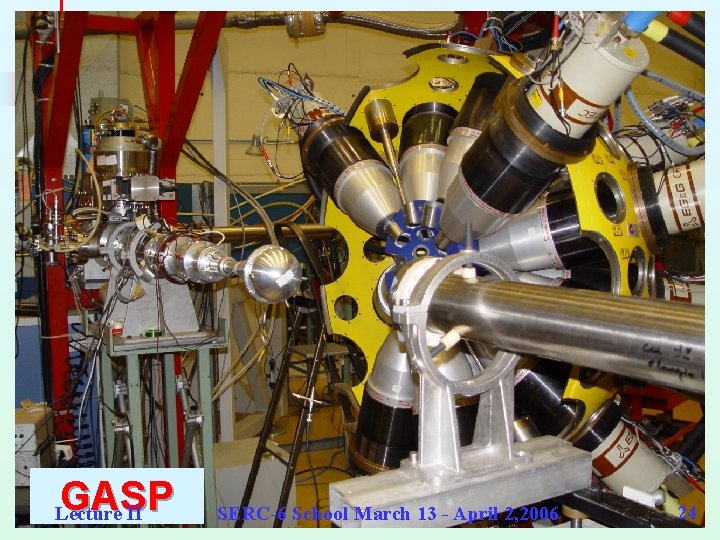
GASP Lecture II SERC-6 School March 13 - April 2, 2006 24
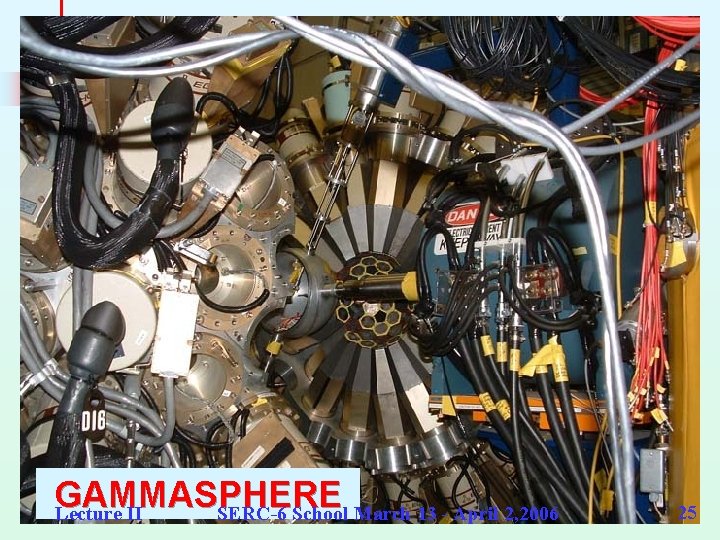
GAMMASPHERE Lecture II SERC-6 School March 13 - April 2, 2006 25
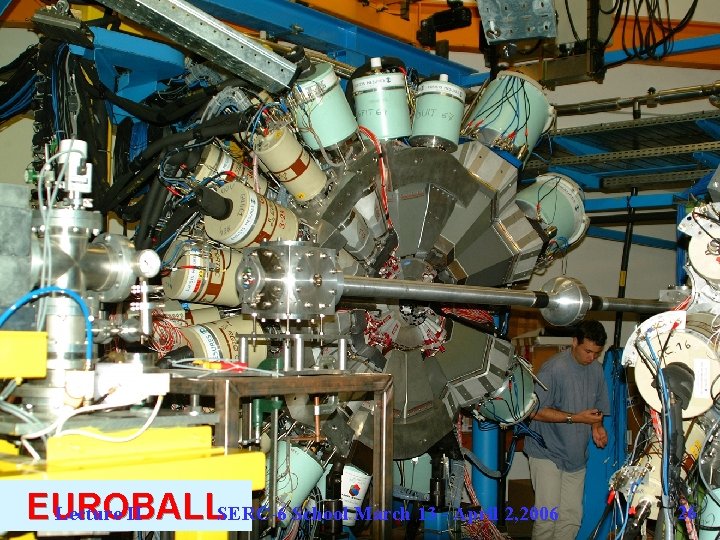
EUROBALL Lecture II SERC-6 School March 13 - April 2, 2006 26
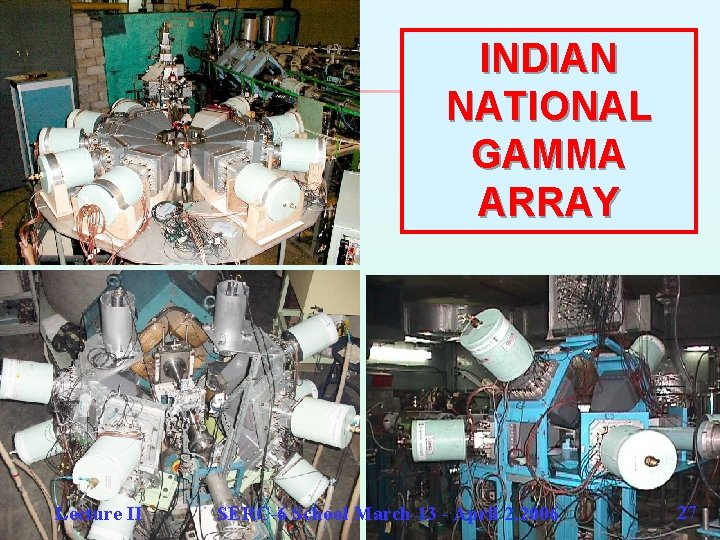
INDIAN NATIONAL GAMMA ARRAY Lecture II SERC-6 School March 13 - April 2, 2006 27
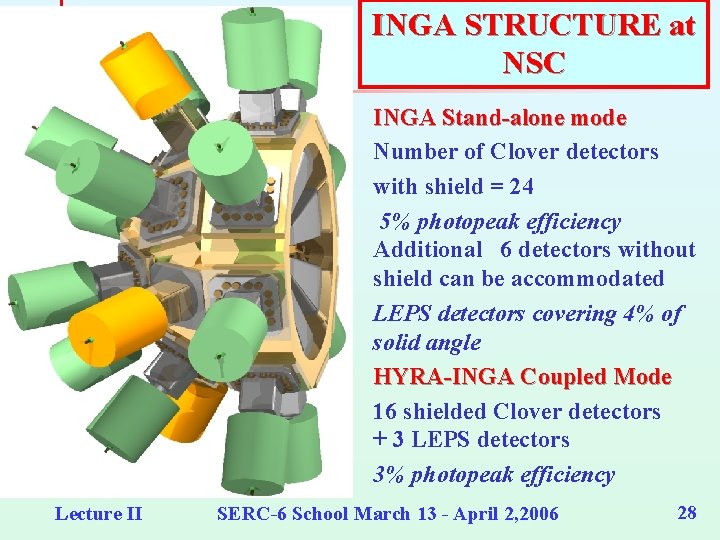
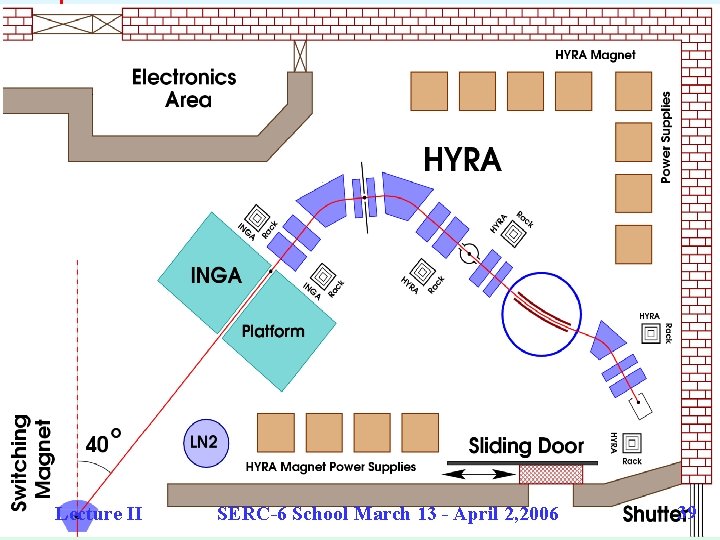
INGA STRUCTURE at NSC INGA Stand-alone mode Number of Clover detectors with shield = 24 5% photopeak efficiency Additional 6 detectors without shield can be accommodated LEPS detectors covering 4% of solid angle HYRA-INGA Coupled Mode 16 shielded Clover detectors + 3 LEPS detectors 3% photopeak efficiency Lecture II SERC-6 School March 13 - April 2, 2006 28
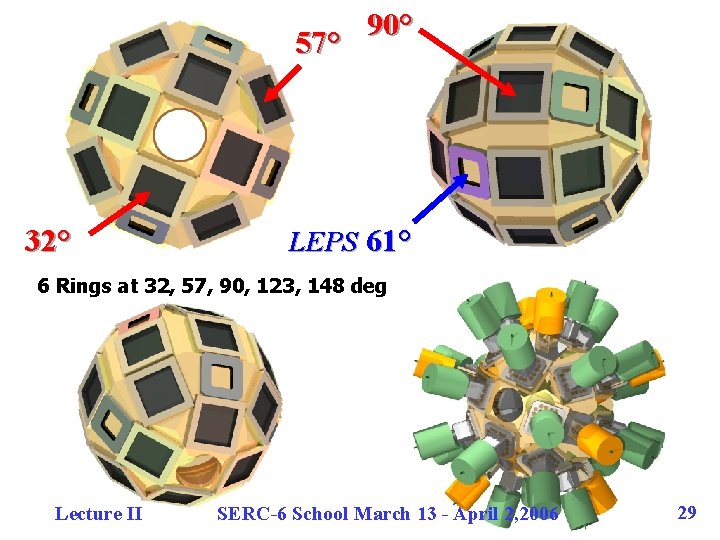
57° 32° 90° LEPS 61° 6 Rings at 32, 57, 90, 123, 148 deg Lecture II SERC-6 School March 13 - April 2, 2006 29
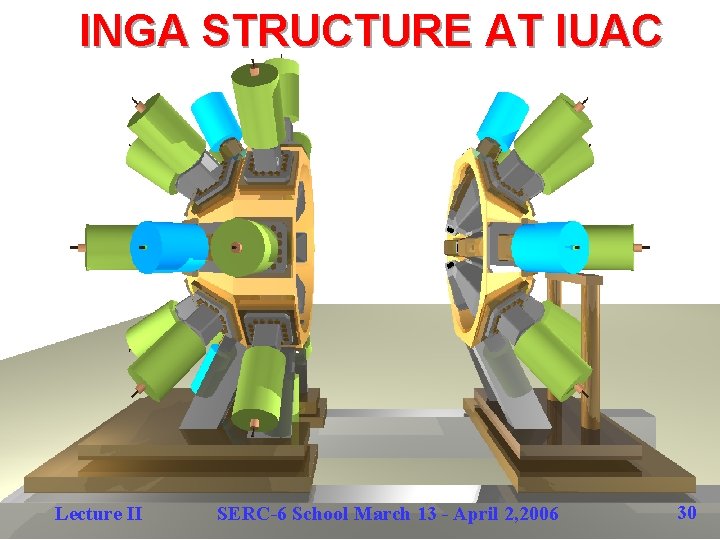
INGA STRUCTURE AT IUAC Lecture II SERC-6 School March 13 - April 2, 2006 30
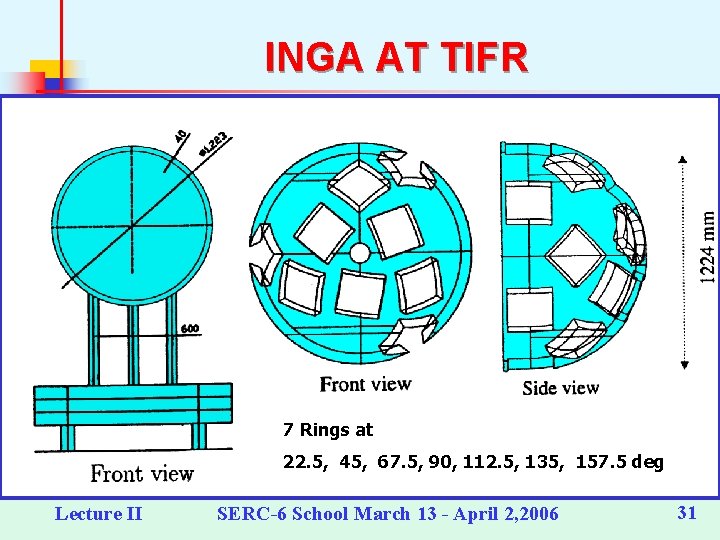
INGA AT TIFR 7 Rings at 22. 5, 45, 67. 5, 90, 112. 5, 135, 157. 5 deg Lecture II SERC-6 School March 13 - April 2, 2006 31
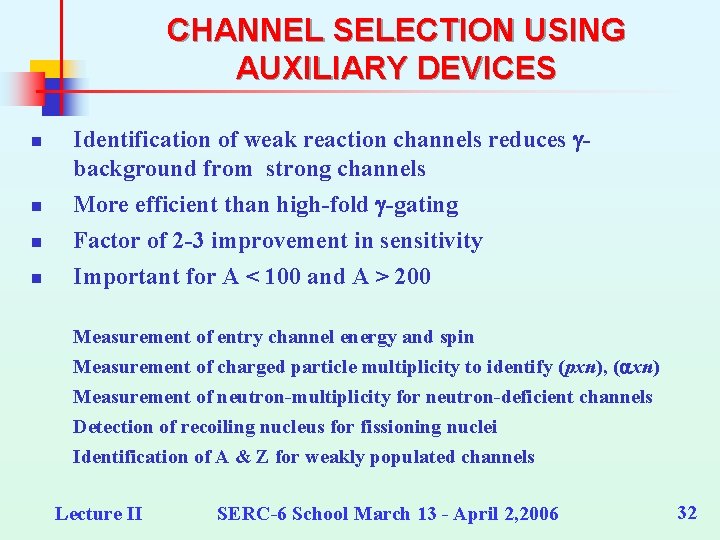
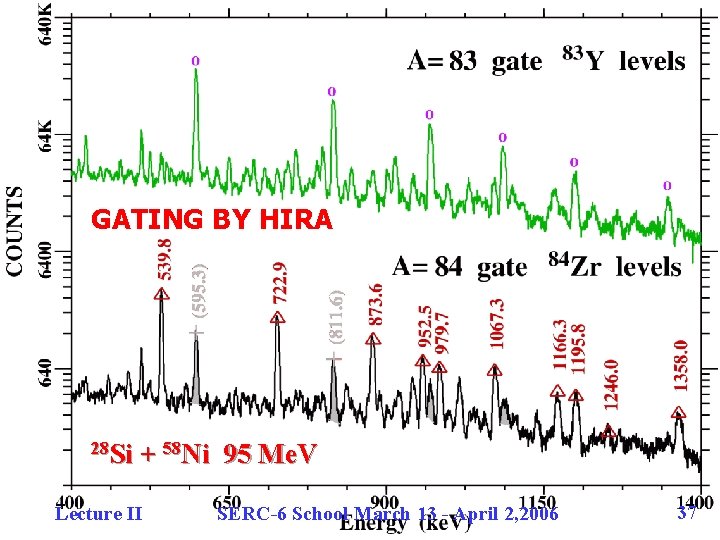
CHANNEL SELECTION USING AUXILIARY DEVICES n Identification of weak reaction channels reduces gbackground from strong channels More efficient than high-fold g-gating Factor of 2 -3 improvement in sensitivity n Important for A < 100 and A > 200 n n Measurement of entry channel energy and spin Measurement of charged particle multiplicity to identify (pxn), (axn) Measurement of neutron-multiplicity for neutron-deficient channels Detection of recoiling nucleus for fissioning nuclei Identification of A & Z for weakly populated channels Lecture II SERC-6 School March 13 - April 2, 2006 32
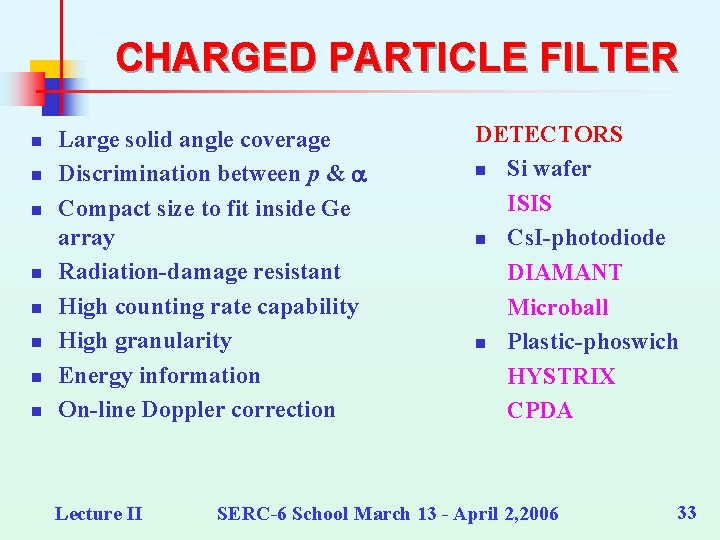
CHARGED PARTICLE FILTER n n n n Large solid angle coverage Discrimination between p & a Compact size to fit inside Ge array Radiation-damage resistant High counting rate capability High granularity Energy information On-line Doppler correction Lecture II DETECTORS n Si wafer ISIS n Cs. I-photodiode DIAMANT Microball n Plastic-phoswich HYSTRIX CPDA SERC-6 School March 13 - April 2, 2006 33
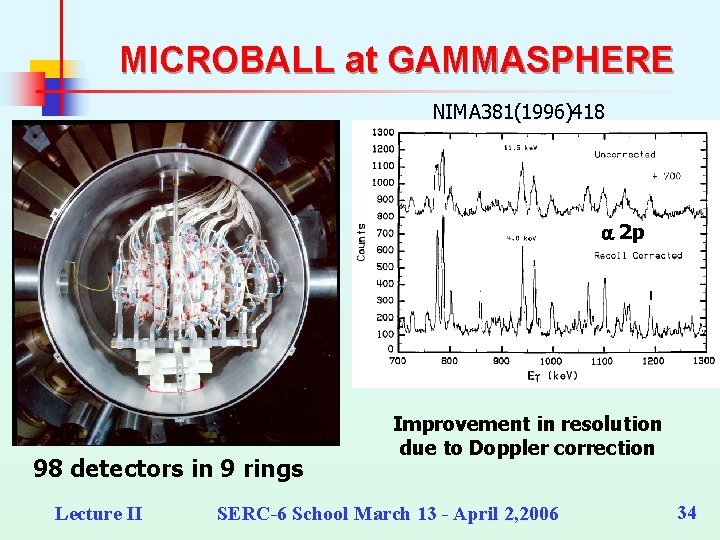
MICROBALL at GAMMASPHERE NIMA 381(1996)418 a 2 p 98 detectors in 9 rings Lecture II Improvement in resolution due to Doppler correction SERC-6 School March 13 - April 2, 2006 34
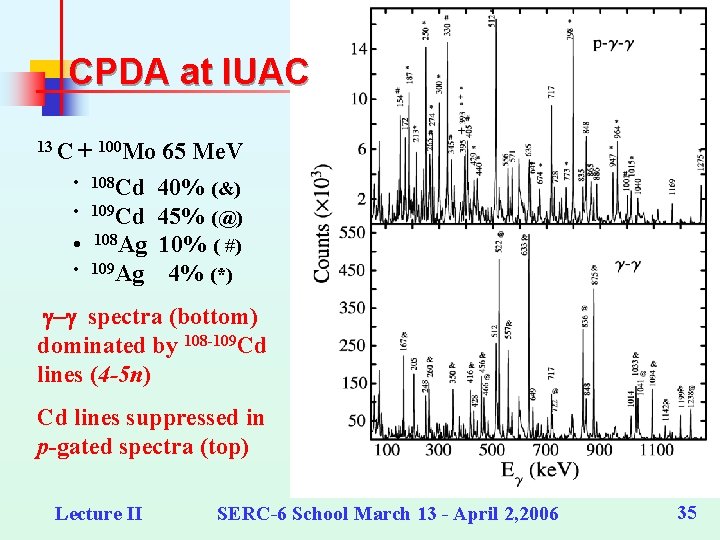
CPDA at IUAC 13 C + 100 Mo 65 Me. V • 108 Cd 40% (&) • 109 Cd 45% (@) • 108 Ag 10% ( #) • 109 Ag 4% (*) g-g spectra (bottom) dominated by 108 -109 Cd lines (4 -5 n) Cd lines suppressed in p-gated spectra (top) Lecture II SERC-6 School March 13 - April 2, 2006 35
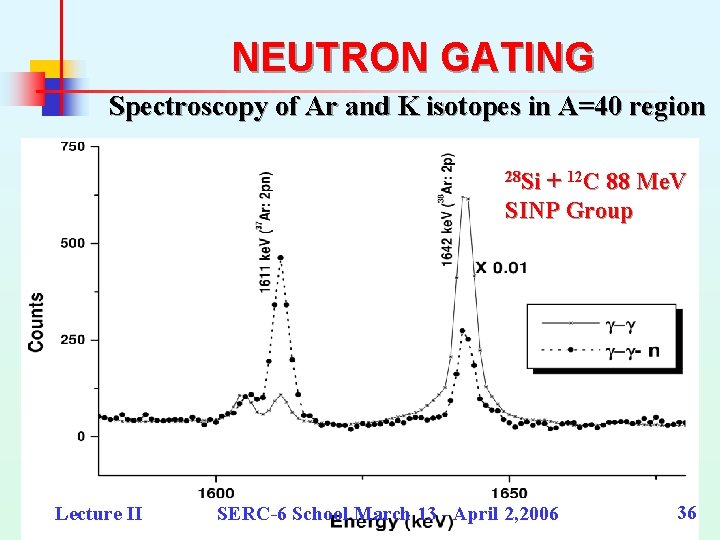
NEUTRON GATING Spectroscopy of Ar and K isotopes in A=40 region 28 Si + 12 C 88 Me. V SINP Group Lecture II SERC-6 School March 13 - April 2, 2006 36
GATING BY HIRA 28 Si + 58 Ni 95 Me. V Lecture II SERC-6 School March 13 - April 2, 2006 37
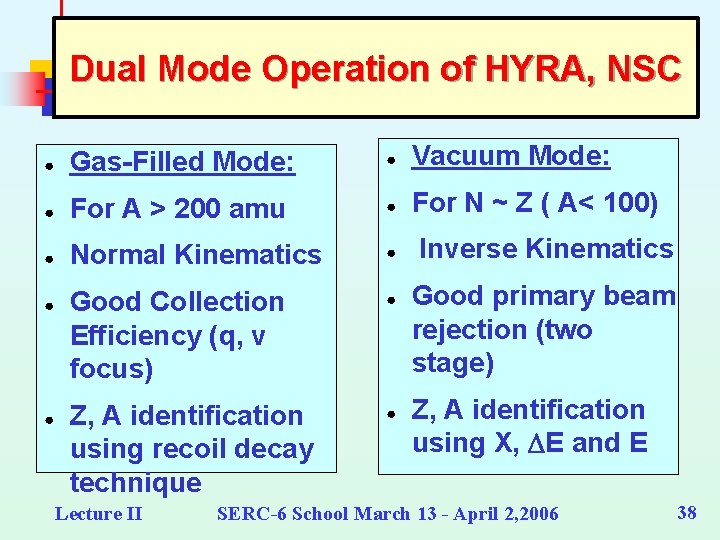
Dual Mode Operation of HYRA, NSC ● Gas-Filled Mode: ● Vacuum Mode: ● For A > 200 amu ● For N ~ Z ( A< 100) ● Normal Kinematics ● Good Collection Efficiency (q, v focus) ● Z, A identification using recoil decay technique ● ● ● Lecture II Inverse Kinematics Good primary beam rejection (two stage) Z, A identification using X, E and E SERC-6 School March 13 - April 2, 2006 38
Lecture II SERC-6 School March 13 - April 2, 2006 39
Lecture II SERC-6 School March 13 - April 2, 2006 40