
Experiments Outcomes Events and Random Variables A Revisit
Experiments, Outcomes, Events and Random Variables: A Revisit Berlin Chen Department of Computer Science & Information Engineering National Taiwan Normal University Reference: - D. P. Bertsekas, J. N. Tsitsiklis, Introduction to Probability
Experiments, Outcomes and Event • An experiment – Produces exactly one out of several possible outcomes – The set of all possible outcomes is called the sample space of the experiment, denoted by – A subset of the sample space (a collection of possible outcomes) is called an event • Examples of the experiment – – A single toss of a coin (finite outcomes) Three tosses of two dice (finite outcomes) An infinite sequences of tosses of a coin (infinite outcomes) Throwing a dart on a square (infinite outcomes), etc. 2
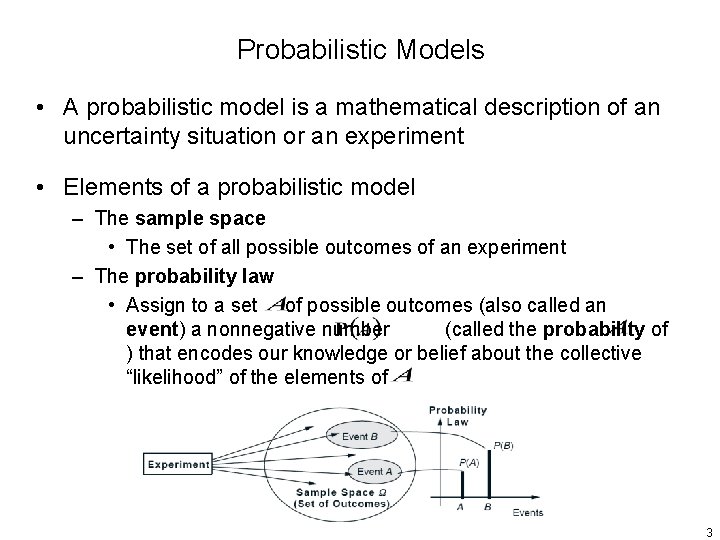
Probabilistic Models • A probabilistic model is a mathematical description of an uncertainty situation or an experiment • Elements of a probabilistic model – The sample space • The set of all possible outcomes of an experiment – The probability law • Assign to a set of possible outcomes (also called an event) a nonnegative number (called the probability of ) that encodes our knowledge or belief about the collective “likelihood” of the elements of 3
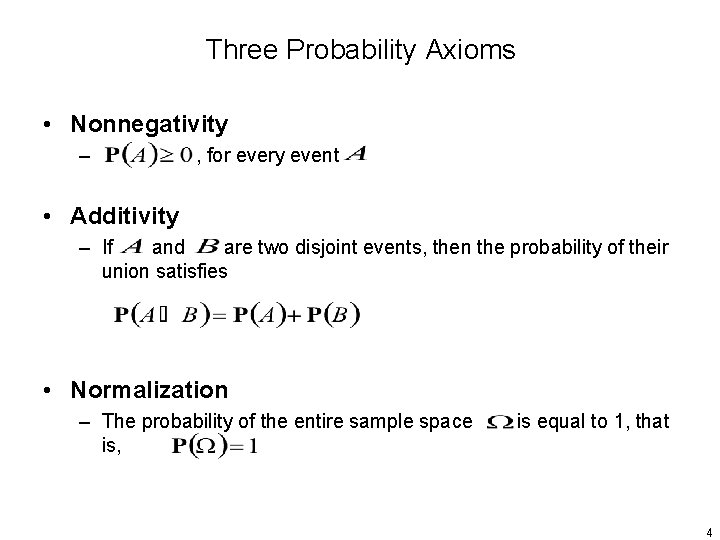
Three Probability Axioms • Nonnegativity – , for every event • Additivity – If and are two disjoint events, then the probability of their union satisfies • Normalization – The probability of the entire sample space is, is equal to 1, that 4
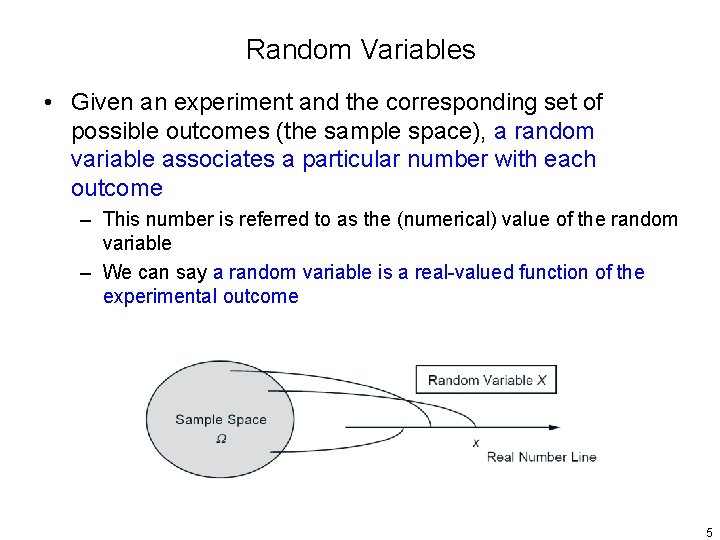
Random Variables • Given an experiment and the corresponding set of possible outcomes (the sample space), a random variable associates a particular number with each outcome – This number is referred to as the (numerical) value of the random variable – We can say a random variable is a real-valued function of the experimental outcome 5
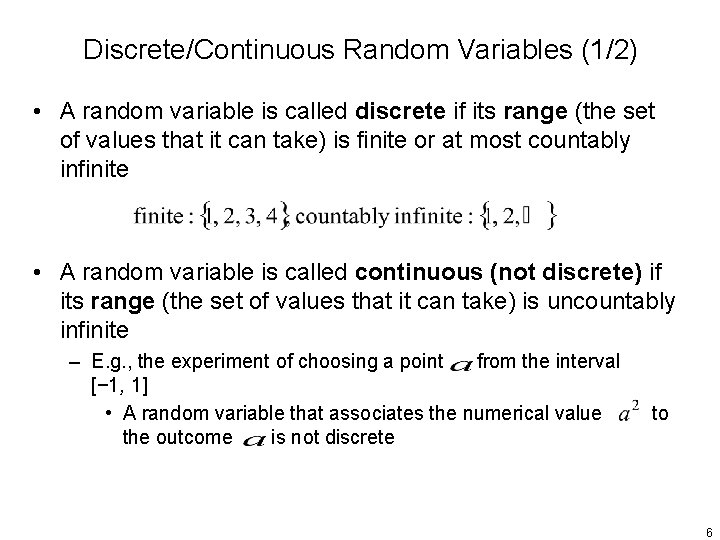
Discrete/Continuous Random Variables (1/2) • A random variable is called discrete if its range (the set of values that it can take) is finite or at most countably infinite • A random variable is called continuous (not discrete) if its range (the set of values that it can take) is uncountably infinite – E. g. , the experiment of choosing a point from the interval [− 1, 1] • A random variable that associates the numerical value the outcome is not discrete to 6
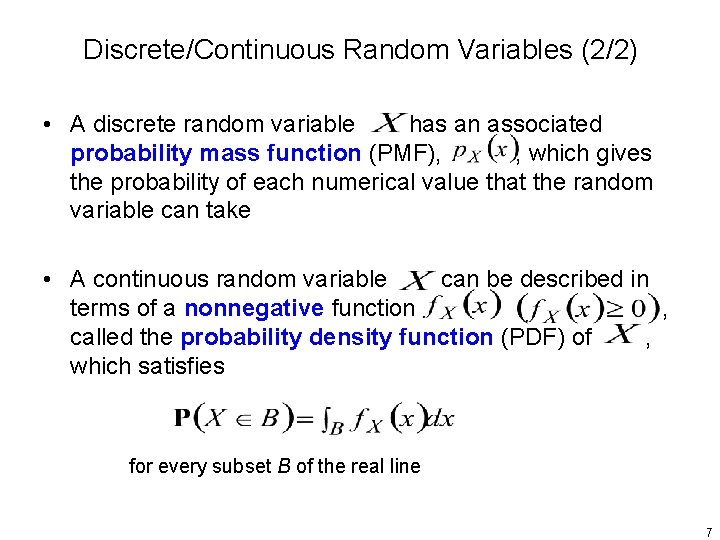
Discrete/Continuous Random Variables (2/2) • A discrete random variable has an associated probability mass function (PMF), , which gives the probability of each numerical value that the random variable can take • A continuous random variable can be described in terms of a nonnegative function , called the probability density function (PDF) of , which satisfies for every subset B of the real line 7
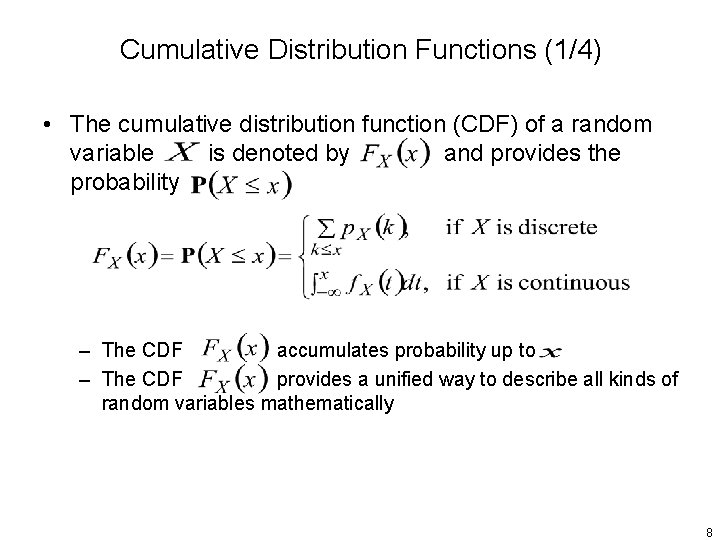
Cumulative Distribution Functions (1/4) • The cumulative distribution function (CDF) of a random variable is denoted by and provides the probability – The CDF accumulates probability up to – The CDF provides a unified way to describe all kinds of random variables mathematically 8
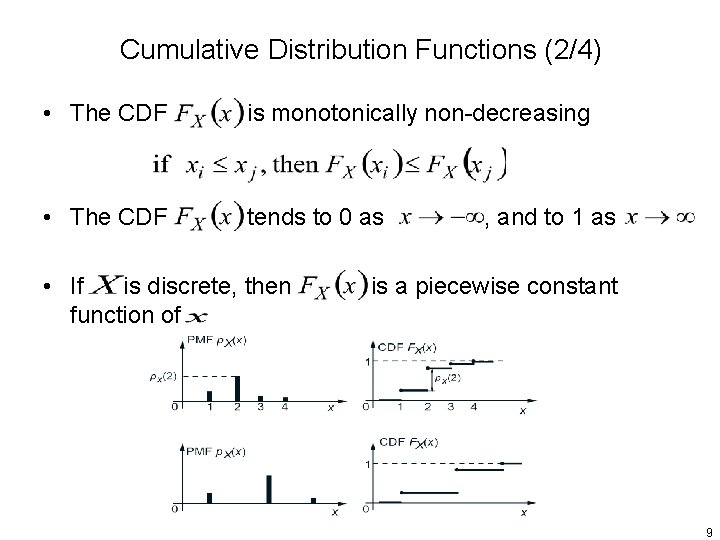
Cumulative Distribution Functions (2/4) • The CDF is monotonically non-decreasing • The CDF tends to 0 as • If is discrete, then function of , and to 1 as is a piecewise constant 9
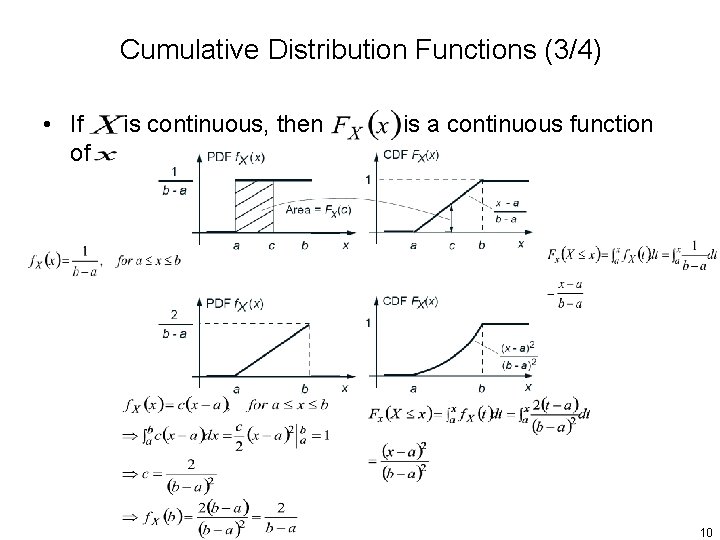
Cumulative Distribution Functions (3/4) • If of is continuous, then is a continuous function 10
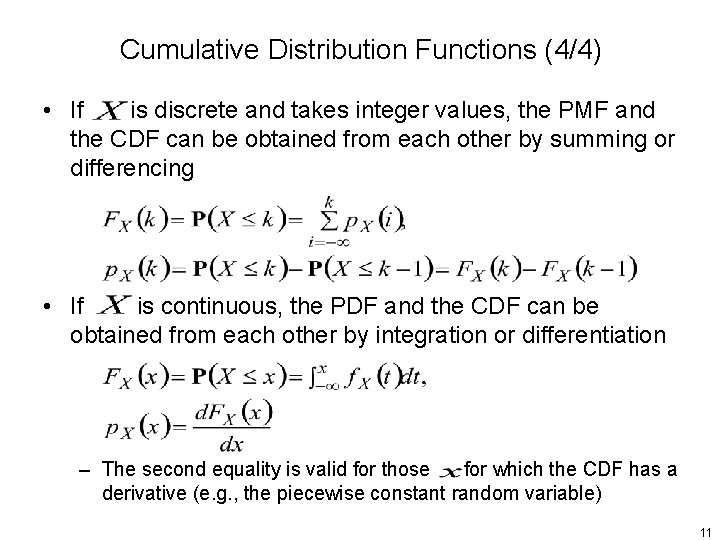
Cumulative Distribution Functions (4/4) • If is discrete and takes integer values, the PMF and the CDF can be obtained from each other by summing or differencing • If is continuous, the PDF and the CDF can be obtained from each other by integration or differentiation – The second equality is valid for those for which the CDF has a derivative (e. g. , the piecewise constant random variable) 11
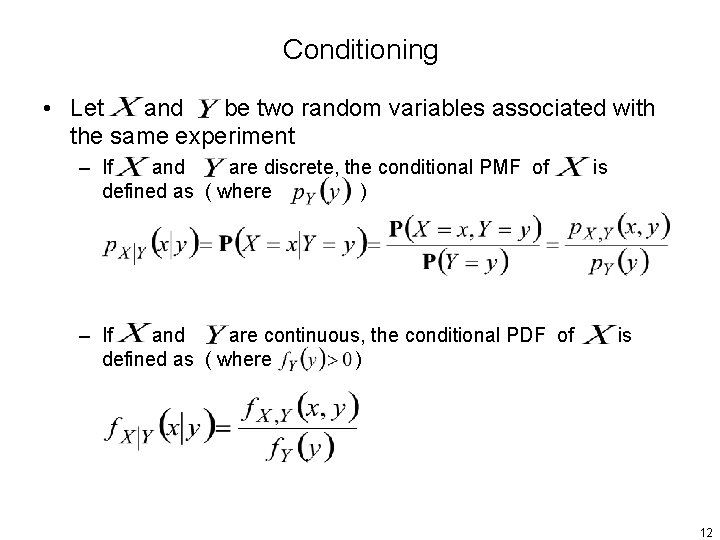
Conditioning • Let and be two random variables associated with the same experiment – If and are discrete, the conditional PMF of defined as ( where ) – If and are continuous, the conditional PDF of defined as ( where ) is is 12
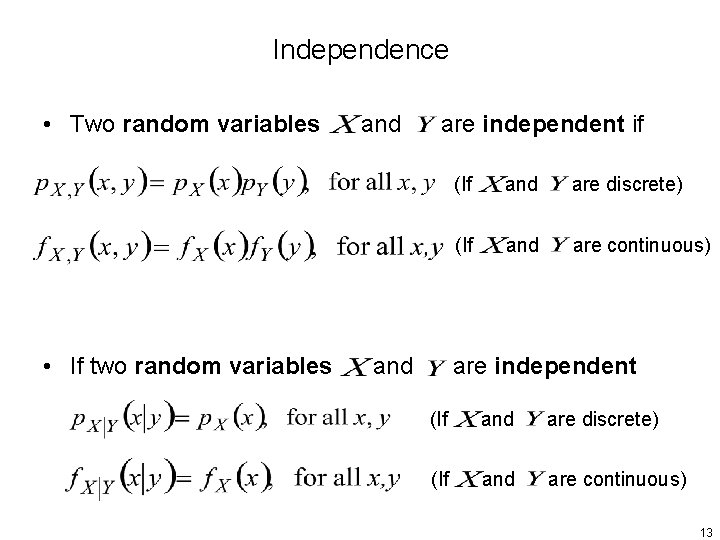
Independence • Two random variables • If two random variables and are independent if and (If and are discrete) (If and are continuous) are independent (If and are discrete) (If and are continuous) 13
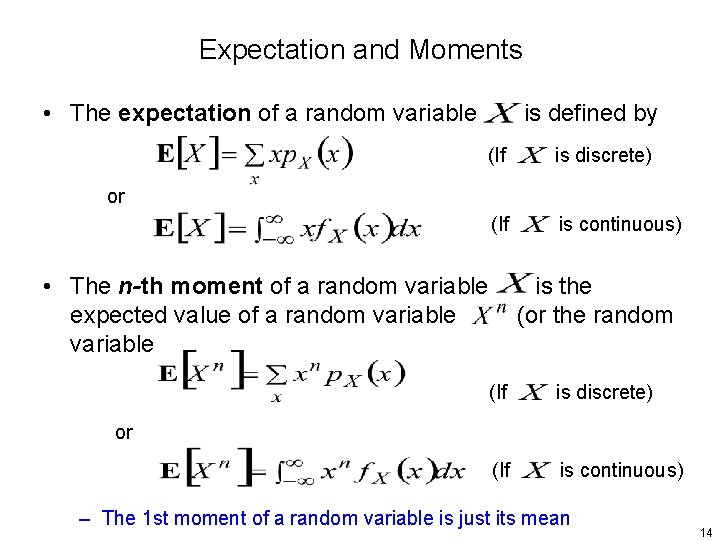
Expectation and Moments • The expectation of a random variable is defined by (If is discrete) (If is continuous) or • The n-th moment of a random variable expected value of a random variable is the (or the random (If is discrete) (If is continuous) or – The 1 st moment of a random variable is just its mean 14
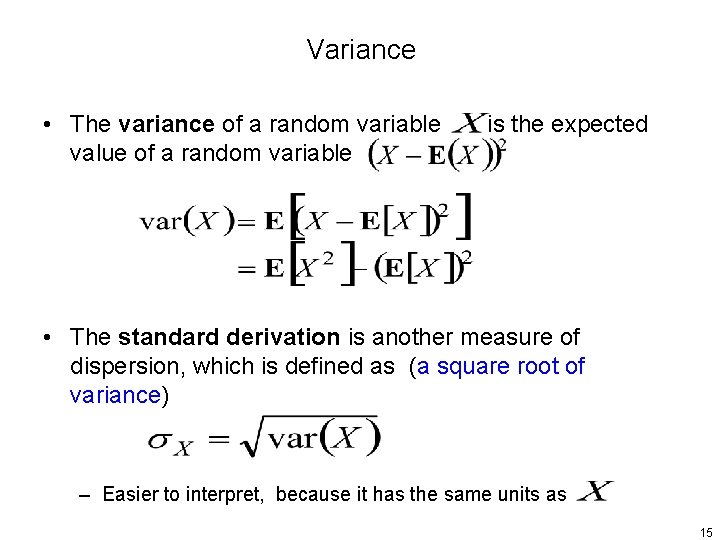
Variance • The variance of a random variable value of a random variable is the expected • The standard derivation is another measure of dispersion, which is defined as (a square root of variance) – Easier to interpret, because it has the same units as 15
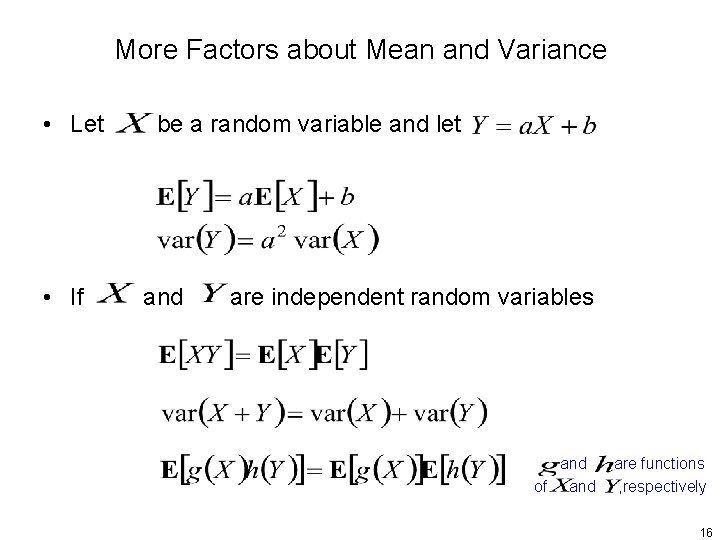
More Factors about Mean and Variance • Let • If be a random variable and let and are independent random variables and of and are functions , respectively 16
- Slides: 16