
Experiments in Software Verification using SMT Solvers VS
![EPR: efficient implementation DPLL(SX) calculus: DPLL + substitution sets (BDDs) [IJCAR’ 08] x: p(x,](https://slidetodoc.com/presentation_image_h/765b4d86202f58808ef17745c67b5bc1/image-32.jpg "EPR: efficient implementation DPLL(SX) calculus: DPLL + substitution sets (BDDs) [IJCAR’ 08] x: p(x,")
![Array Property Fragment (APF) i 1, …, in: F[i 1, …, in], F is](https://slidetodoc.com/presentation_image_h/765b4d86202f58808ef17745c67b5bc1/image-36.jpg "Array Property Fragment (APF) i 1, …, in: F[i 1, …, in], F is")
![Examples Array is sorted: i, j: i <= j implies a[i] <= a[j], or](https://slidetodoc.com/presentation_image_h/765b4d86202f58808ef17745c67b5bc1/image-37.jpg "Examples Array is sorted: i, j: i <= j implies a[i] <= a[j], or")
- Slides: 40
Experiments in Software Verification using SMT Solvers VS Experiments 2008 – Toronto, Canada Leonardo de Moura Microsoft Research
Agenda What is SMT? Experiments: Windows kernel verification. Extending SMT solvers. Garbage collector (Singularity) verification Supporting decidable fragments. Experiments in Software Verification using SMT Solvers
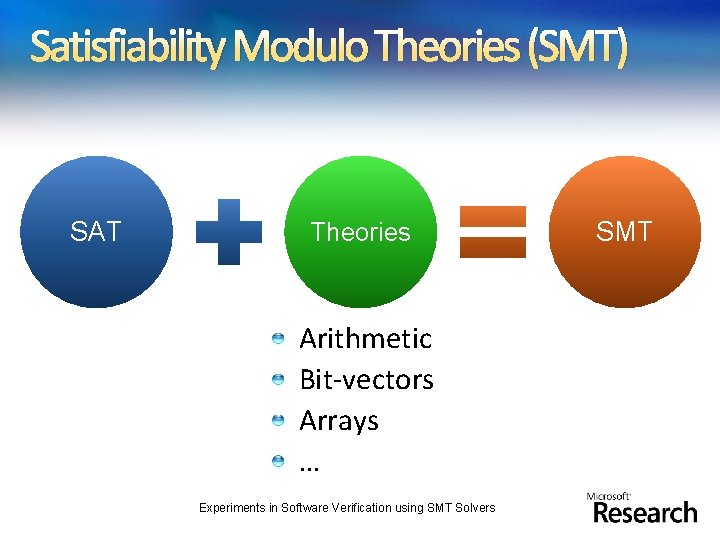
Satisfiability Modulo Theories (SMT) SAT Theories Arithmetic Bit-vectors Arrays … Experiments in Software Verification using SMT Solvers SMT
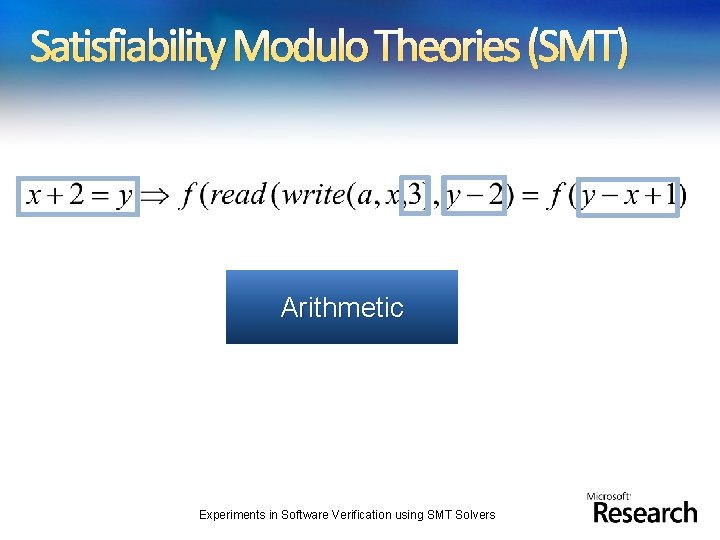
Satisfiability Modulo Theories (SMT) Arithmetic Experiments in Software Verification using SMT Solvers
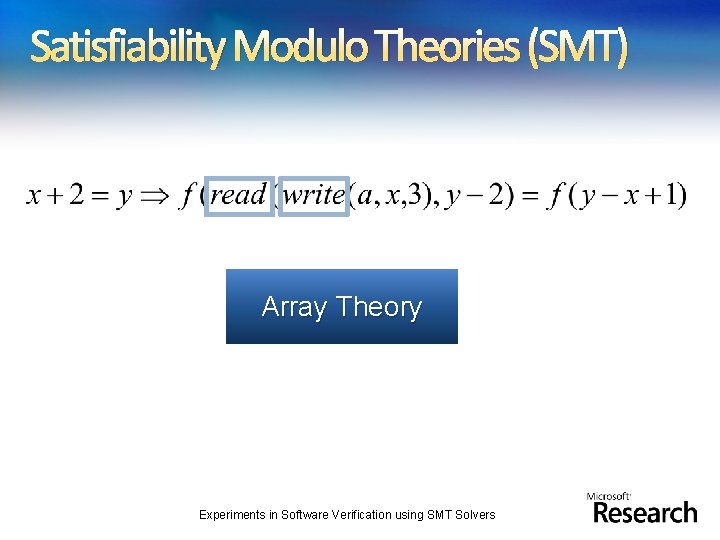
Satisfiability Modulo Theories (SMT) Array Theory Arithmetic Experiments in Software Verification using SMT Solvers
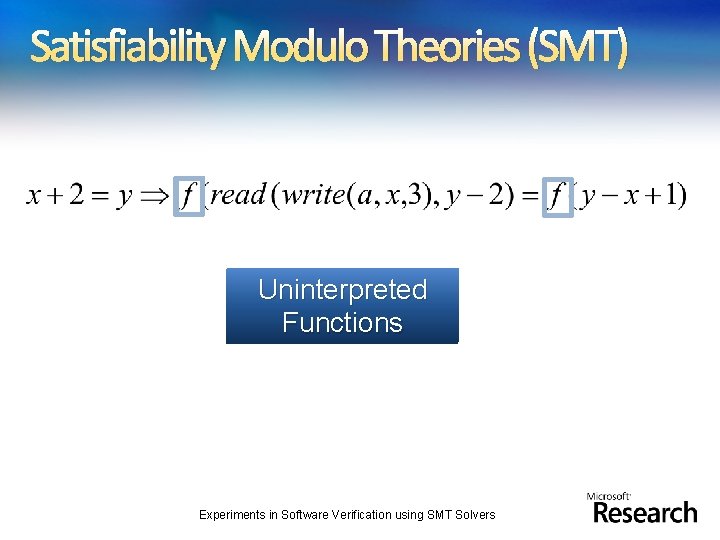
Satisfiability Modulo Theories (SMT) Uninterpreted Array Theory Arithmetic Functions Experiments in Software Verification using SMT Solvers
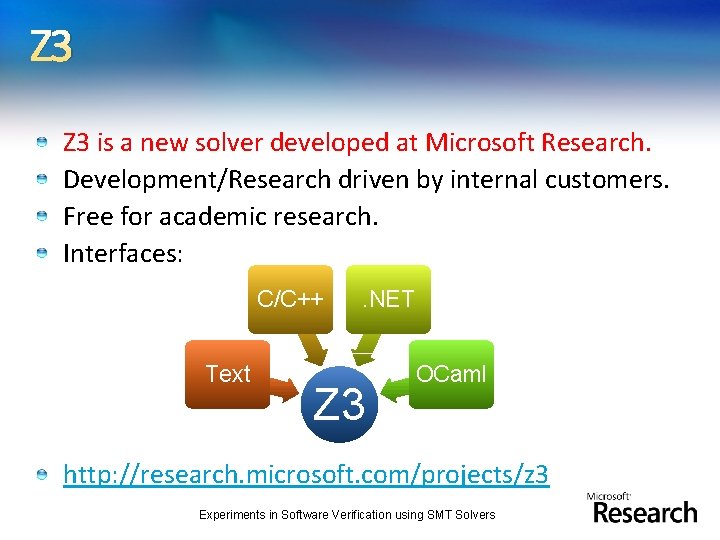
Z 3 is a new solver developed at Microsoft Research. Development/Research driven by internal customers. Free for academic research. Interfaces: C/C++ Text . NET Z 3 OCaml http: //research. microsoft. com/projects/z 3 Experiments in Software Verification using SMT Solvers
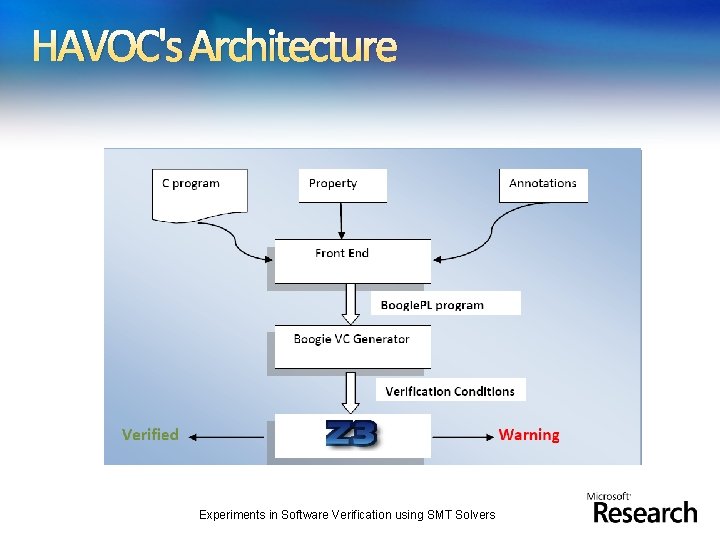
HAVOC Verifying Windows Components Lahiri & Qadeer, POPL’ 08, Also: Ball, Hackett, Lahiri, Qadeer, MSR-TR-08 -82.
HAVOC's Architecture Experiments in Software Verification using SMT Solvers
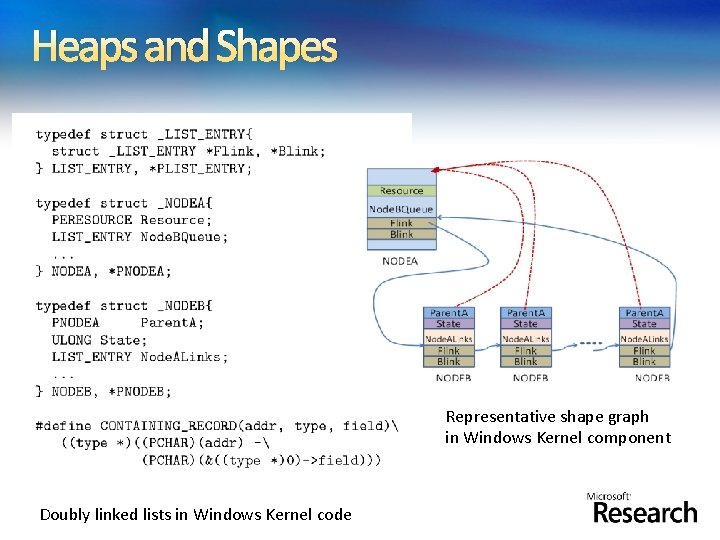
Heaps and Shapes Representative shape graph in Windows Kernel component Doubly linked lists in Windows Kernel code
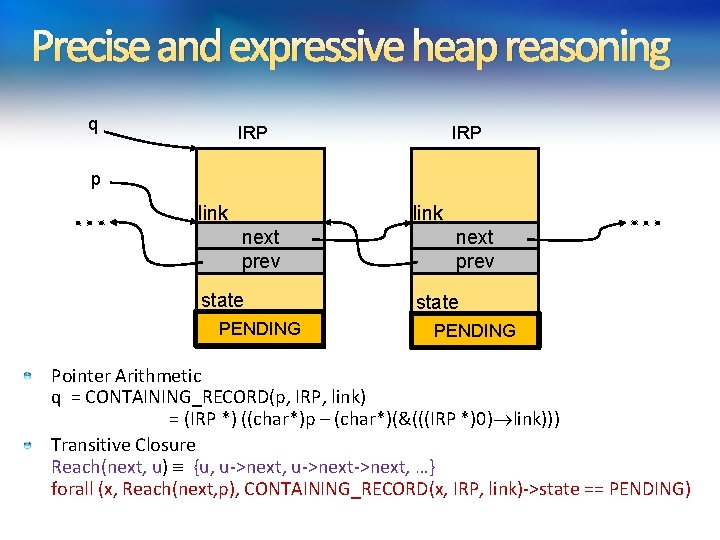
Precise and expressive heap reasoning q IRP p link next prev state PENDING Pointer Arithmetic q = CONTAINING_RECORD(p, IRP, link) = (IRP *) ((char*)p – (char*)(&(((IRP *)0) link))) Transitive Closure Reach(next, u) {u, u->next->next, …} forall (x, Reach(next, p), CONTAINING_RECORD(x, IRP, link)->state == PENDING)
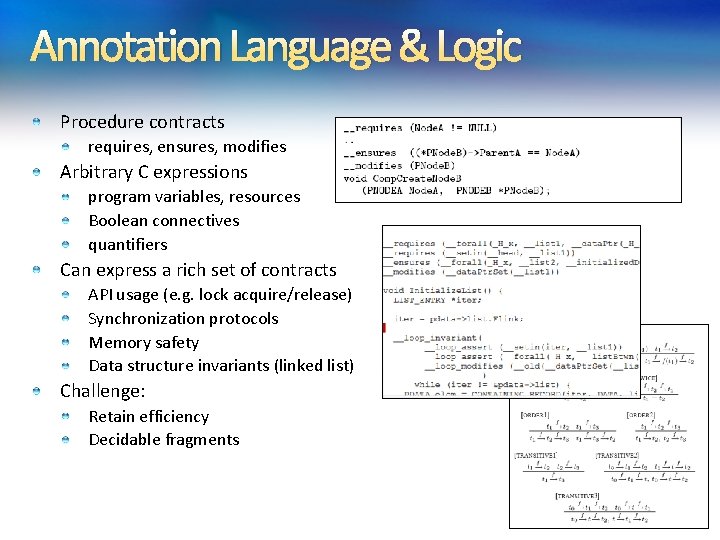
Annotation Language & Logic Procedure contracts requires, ensures, modifies Arbitrary C expressions program variables, resources Boolean connectives quantifiers Can express a rich set of contracts API usage (e. g. lock acquire/release) Synchronization protocols Memory safety Data structure invariants (linked list) Challenge: Retain efficiency Decidable fragments
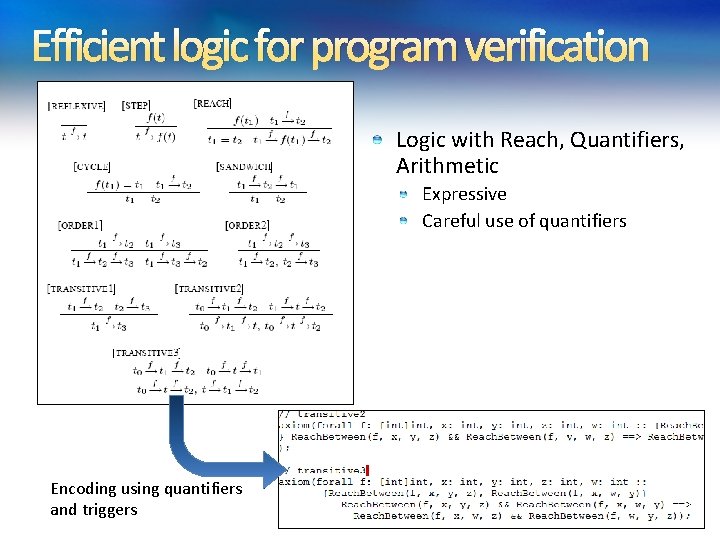
Efficient logic for program verification Logic with Reach, Quantifiers, Arithmetic Expressive Careful use of quantifiers Encoding using quantifiers and triggers
Success Story Used to check Windows Kernel code. Found 50 bugs, most confirmed. 250 lines required to specify properties. 600 lines of manual annotations. 3000 lines of inferred annotations. Houdini-like algorithm (Flanagan, Leino) Experiments in Software Verification using SMT Solvers
Extending Z 3 Axioms Inference rules (not supported yet) Very lazy loop New Z 3 theory (too complicated for users) Experiments in Software Verification using SMT Solvers
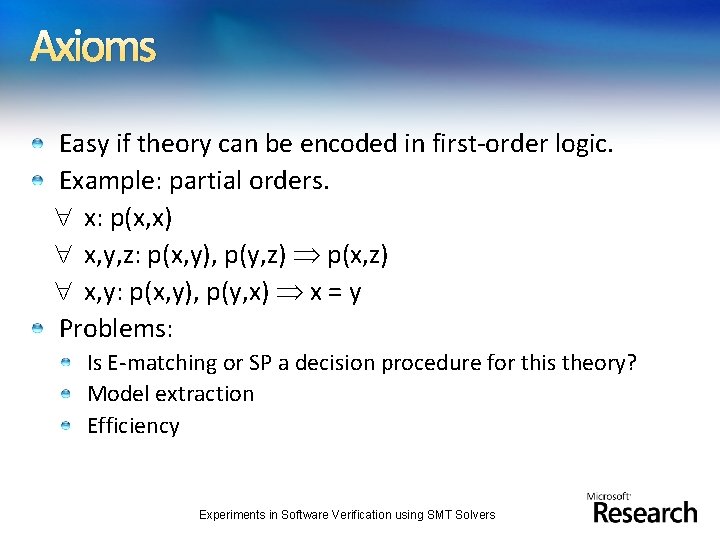
Axioms Easy if theory can be encoded in first-order logic. Example: partial orders. x: p(x, x) x, y, z: p(x, y), p(y, z) p(x, z) x, y: p(x, y), p(y, x) x = y Problems: Is E-matching or SP a decision procedure for this theory? Model extraction Efficiency Experiments in Software Verification using SMT Solvers
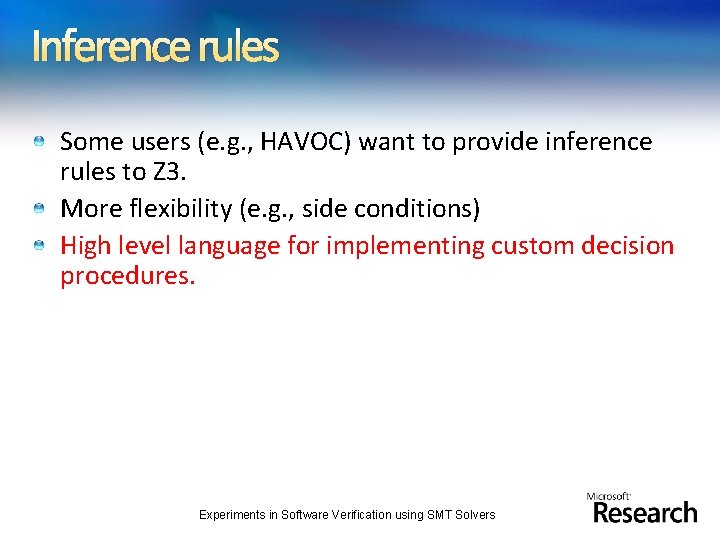
Inference rules Some users (e. g. , HAVOC) want to provide inference rules to Z 3. More flexibility (e. g. , side conditions) High level language for implementing custom decision procedures. Experiments in Software Verification using SMT Solvers
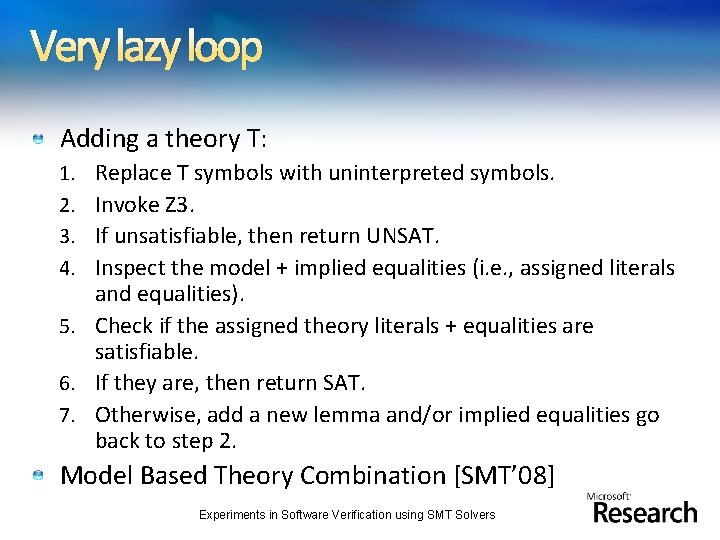
Very lazy loop Adding a theory T: Replace T symbols with uninterpreted symbols. Invoke Z 3. If unsatisfiable, then return UNSAT. Inspect the model + implied equalities (i. e. , assigned literals and equalities). 5. Check if the assigned theory literals + equalities are satisfiable. 6. If they are, then return SAT. 7. Otherwise, add a new lemma and/or implied equalities go back to step 2. 1. 2. 3. 4. Model Based Theory Combination [SMT’ 08] Experiments in Software Verification using SMT Solvers
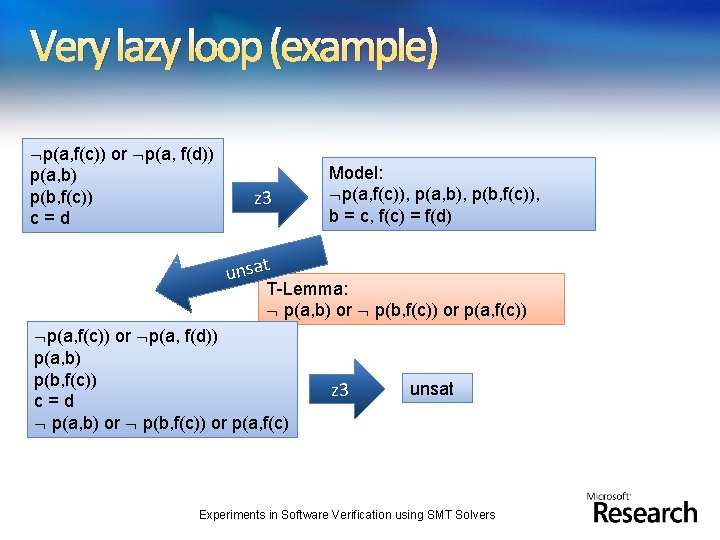
Very lazy loop (example) p(a, f(c)) or p(a, f(d)) p(a, b) p(b, f(c)) c=d z 3 Model: p(a, f(c)), p(a, b), p(b, f(c)), b = c, f(c) = f(d) unsat T-Lemma: p(a, b) or p(b, f(c)) or p(a, f(d)) p(a, b) p(b, f(c)) c=d p(a, b) or p(b, f(c)) or p(a, f(c) z 3 unsat Experiments in Software Verification using SMT Solvers
Verifying Garbage Chris Hawblitzel Collectors - Automatically and fast http: //www. codeplex. com/singularity/Source. Control/Directory. View. aspx? Source Path=%24%2 fsingularity%2 fbase%2 f. Kernel%2 f. Bartok%2 f. Verified. GCs&change Set. Id=14518
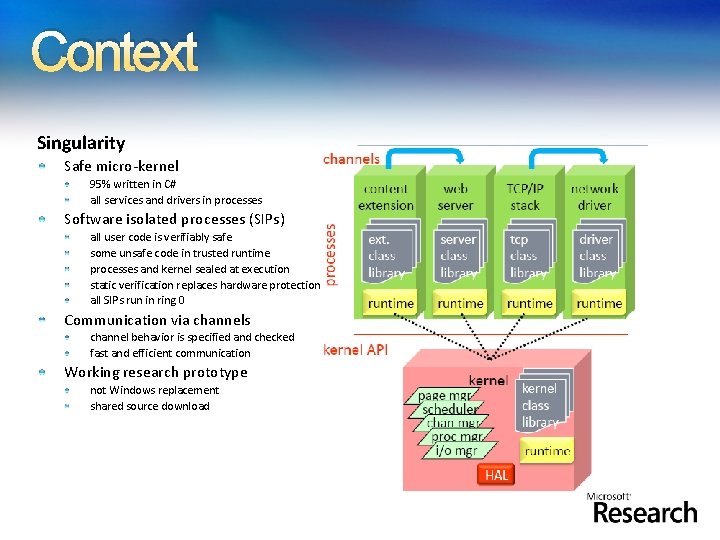
Context Singularity Safe micro-kernel 95% written in C# all services and drivers in processes Software isolated processes (SIPs) all user code is verifiably safe some unsafe code in trusted runtime processes and kernel sealed at execution static verification replaces hardware protection all SIPs run in ring 0 Communication via channels channel behavior is specified and checked fast and efficient communication Working research prototype not Windows replacement shared source download
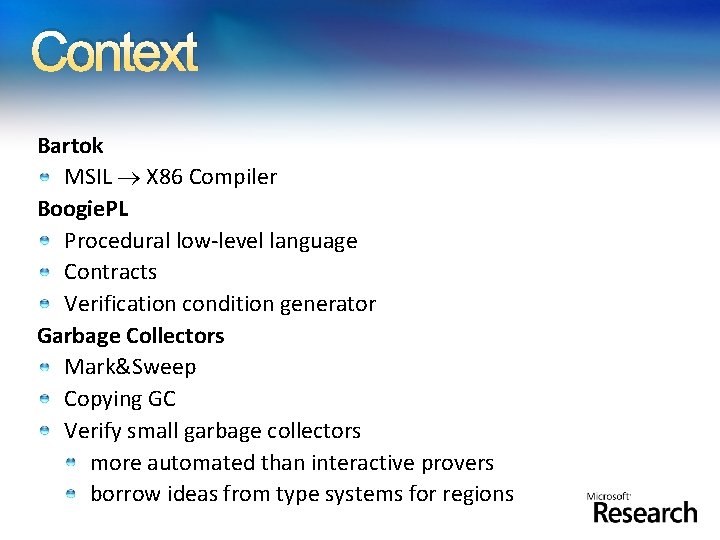
Context Bartok MSIL X 86 Compiler Boogie. PL Procedural low-level language Contracts Verification condition generator Garbage Collectors Mark&Sweep Copying GC Verify small garbage collectors more automated than interactive provers borrow ideas from type systems for regions
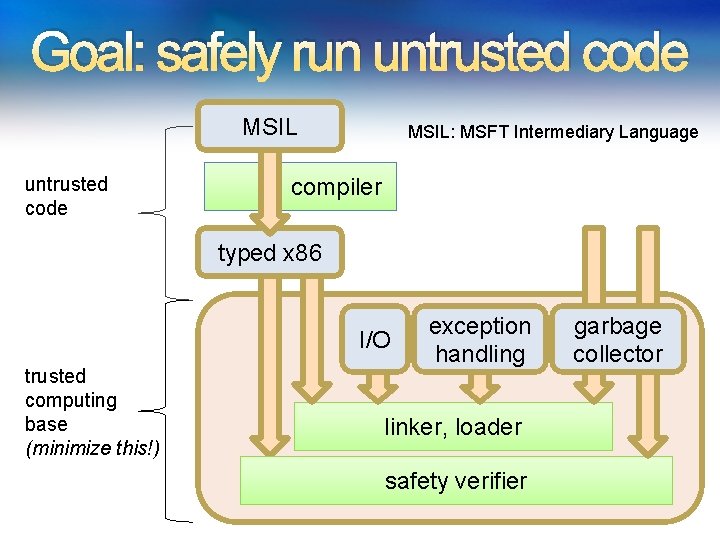
Goal: safely run untrusted code MSIL: MSFT Intermediary Language compiler typed x 86 I/O trusted computing base (minimize this!) exception handling linker, loader safety verifier garbage collector
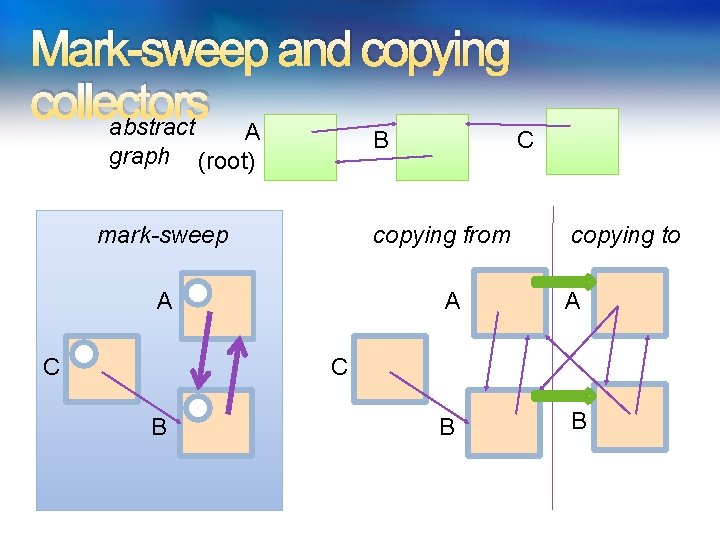
Mark-sweep and copying collectors abstract A graph B (root) mark-sweep copying from A C C copying to A A B B C B
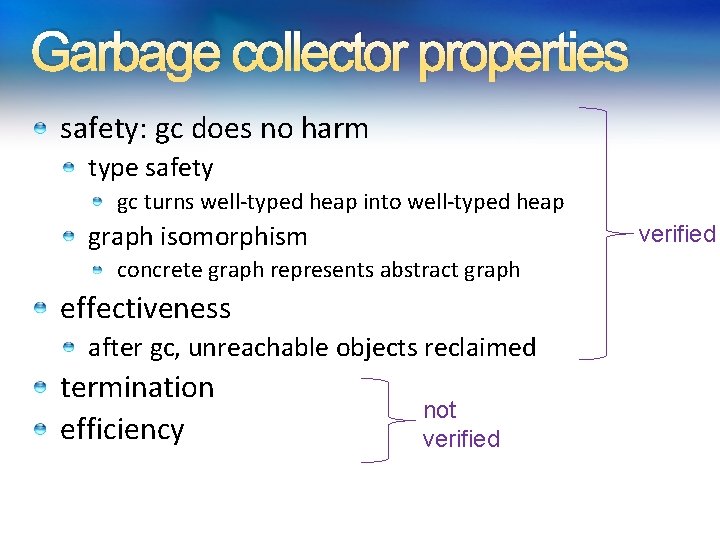
Garbage collector properties safety: gc does no harm type safety gc turns well-typed heap into well-typed heap graph isomorphism verified concrete graph represents abstract graph effectiveness after gc, unreachable objects reclaimed termination efficiency not verified
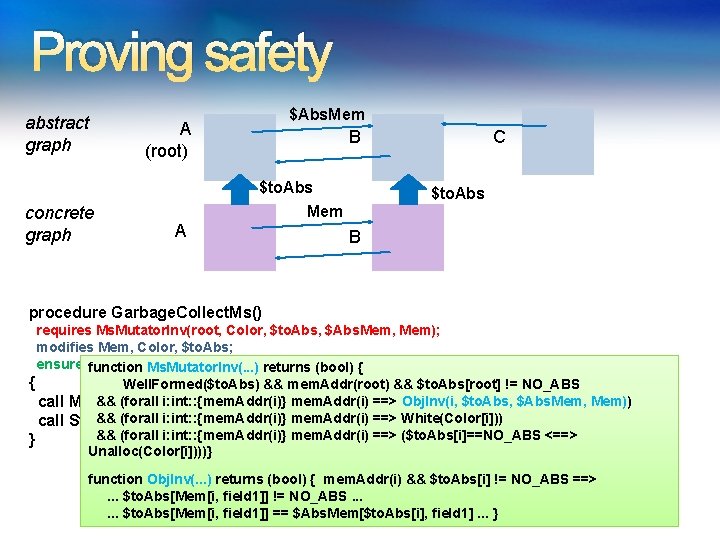
Proving safety abstract graph concrete graph $Abs. Mem A (root) B $to. Abs Mem A C $to. Abs B procedure Garbage. Collect. Ms() requires Ms. Mutator. Inv(root, Color, $to. Abs, $Abs. Mem, Mem); modifies Mem, Color, $to. Abs; ensuresfunction Ms. Mutator. Inv(root, Color, returns $to. Abs, $Abs. Mem, Mem); Ms. Mutator. Inv(. . . ) (bool) { { Well. Formed($to. Abs) && mem. Addr(root) && $to. Abs[root] != NO_ABS && (forall i: int: : {mem. Addr(i)} mem. Addr(i) ==> Obj. Inv(i, $to. Abs, $Abs. Mem, Mem)) call Mark(root); && (forall i: int: : {mem. Addr(i)} mem. Addr(i) ==> White(Color[i])) call Sweep(); && (forall i: int: : {mem. Addr(i)} mem. Addr(i) ==> ($to. Abs[i]==NO_ABS <==> } Unalloc(Color[i])))} function Obj. Inv(. . . ) returns (bool) { mem. Addr(i) && $to. Abs[i] != NO_ABS ==>. . . $to. Abs[Mem[i, field 1]] != NO_ABS. . . $to. Abs[Mem[i, field 1]] == $Abs. Mem[$to. Abs[i], field 1]. . . }
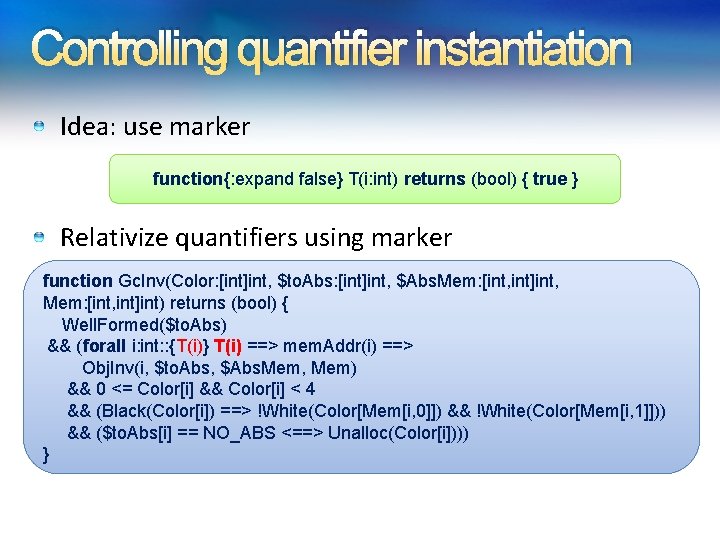
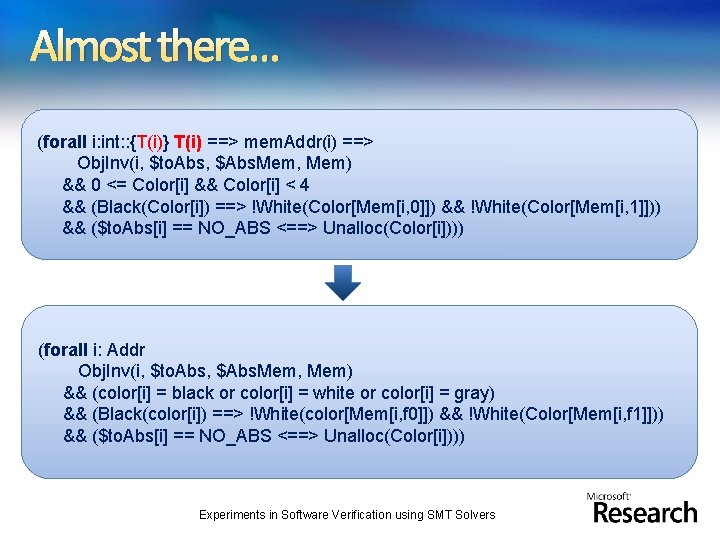
Controlling quantifier instantiation Idea: use marker function{: expand false} T(i: int) returns (bool) { true } Relativize quantifiers using marker function Gc. Inv(Color: [int]int, $to. Abs: [int]int, $Abs. Mem: [int, int]int, Mem: [int, int]int) returns (bool) { Well. Formed($to. Abs) && (forall i: int: : {T(i)} T(i) ==> mem. Addr(i) ==> Obj. Inv(i, $to. Abs, $Abs. Mem, Mem) && 0 <= Color[i] && Color[i] < 4 && (Black(Color[i]) ==> !White(Color[Mem[i, 0]]) && !White(Color[Mem[i, 1]])) && ($to. Abs[i] == NO_ABS <==> Unalloc(Color[i]))) }
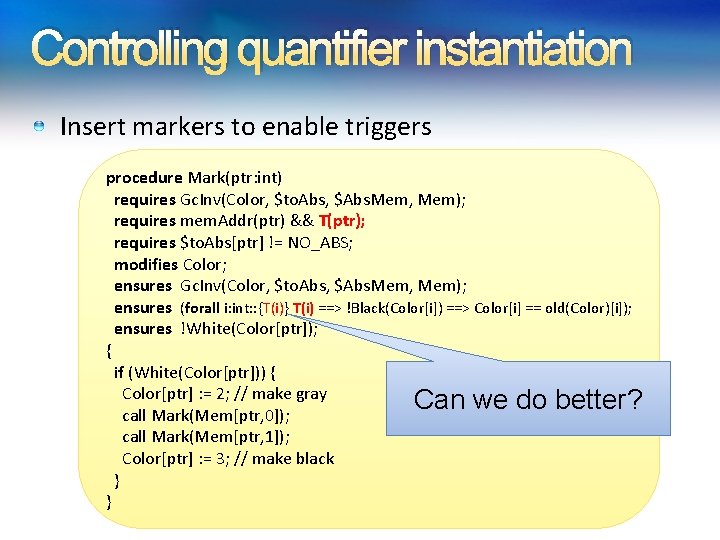
Controlling quantifier instantiation Insert markers to enable triggers procedure Mark(ptr: int) requires Gc. Inv(Color, $to. Abs, $Abs. Mem, Mem); requires mem. Addr(ptr) && T(ptr); requires $to. Abs[ptr] != NO_ABS; modifies Color; ensures Gc. Inv(Color, $to. Abs, $Abs. Mem, Mem); ensures (forall i: int: : {T(i)} T(i) ==> !Black(Color[i]) ==> Color[i] == old(Color)[i]); ensures !White(Color[ptr]); { if (White(Color[ptr])) { Color[ptr] : = 2; // make gray Can we do better? call Mark(Mem[ptr, 0]); call Mark(Mem[ptr, 1]); Color[ptr] : = 3; // make black } }
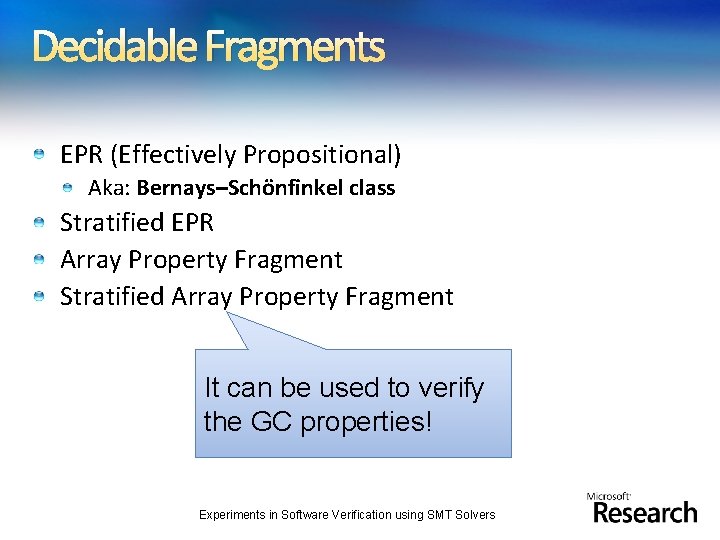
Decidable Fragments EPR (Effectively Propositional) Aka: Bernays–Schönfinkel class Stratified EPR Array Property Fragment Stratified Array Property Fragment It can be used to verify the GC properties! Experiments in Software Verification using SMT Solvers
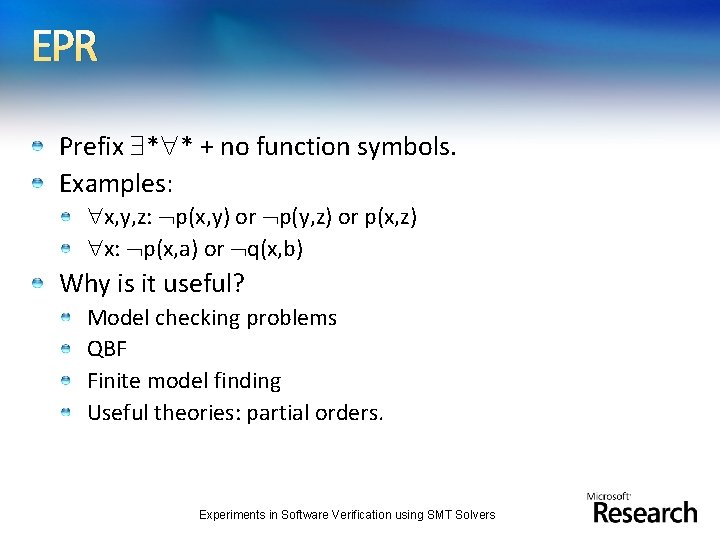
EPR Prefix * * + no function symbols. Examples: x, y, z: p(x, y) or p(y, z) or p(x, z) x: p(x, a) or q(x, b) Why is it useful? Model checking problems QBF Finite model finding Useful theories: partial orders. Experiments in Software Verification using SMT Solvers
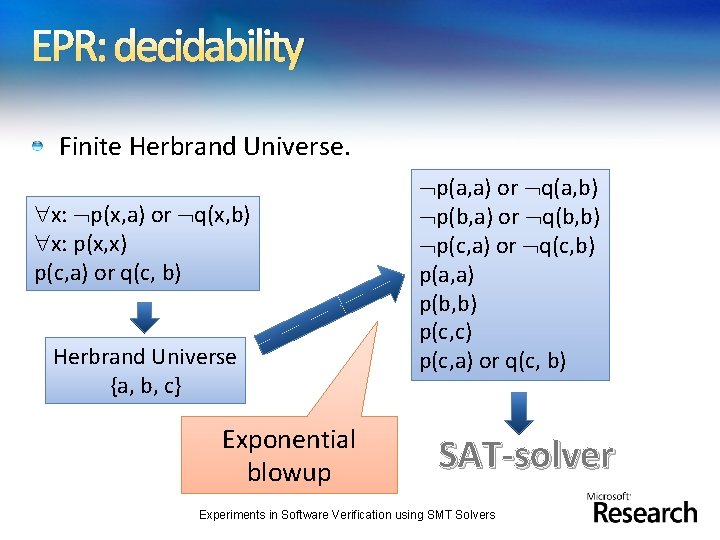
EPR: decidability Finite Herbrand Universe. x: p(x, a) or q(x, b) x: p(x, x) p(c, a) or q(c, b) Herbrand Universe {a, b, c} Exponential blowup p(a, a) or q(a, b) p(b, a) or q(b, b) p(c, a) or q(c, b) p(a, a) p(b, b) p(c, c) p(c, a) or q(c, b) SAT-solver Experiments in Software Verification using SMT Solvers
EPR: efficient implementation DPLL(SX) calculus: DPLL + substitution sets (BDDs) [IJCAR’ 08] x: p(x, a) or q(x, b) p(a, a) or q(a, b) p(b, a) or q(b, b) p(c, a) or q(c, b) x: p(x 1, x 2) or q(x 3, x 4) + {(a, a, a, b), (b, a, b, b), (c, a, c, b)} Substitution set (BDD) Experiments in Software Verification using SMT Solvers
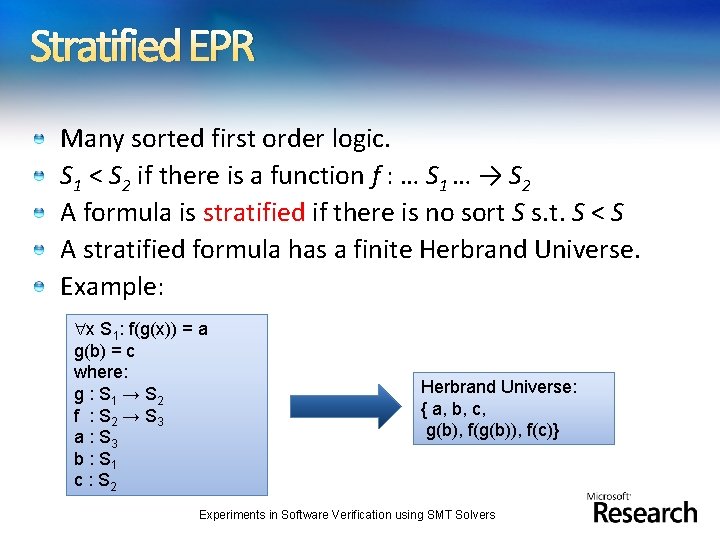
Stratified EPR Many sorted first order logic. S 1 < S 2 if there is a function f : … S 1 … → S 2 A formula is stratified if there is no sort S s. t. S < S A stratified formula has a finite Herbrand Universe. Example: x S 1: f(g(x)) = a g(b) = c where: g : S 1 → S 2 f : S 2 → S 3 a : S 3 b : S 1 c : S 2 Herbrand Universe: { a, b, c, g(b), f(g(b)), f(c)} Experiments in Software Verification using SMT Solvers
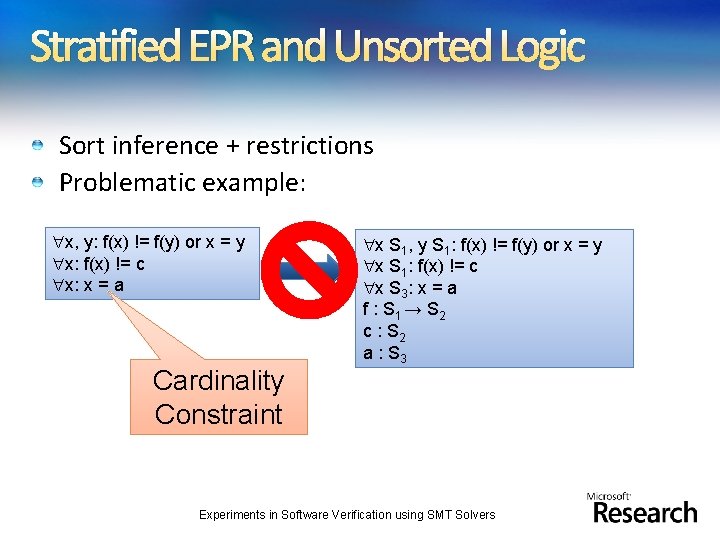
Stratified EPR and Unsorted Logic Sort inference + restrictions Problematic example: x, y: f(x) != f(y) or x = y x: f(x) != c x: x = a Cardinality Constraint x S 1, y S 1: f(x) != f(y) or x = y x S 1: f(x) != c x S 3: x = a f : S 1 → S 2 c : S 2 a : S 3 Experiments in Software Verification using SMT Solvers
Almost there… (forall i: int: : {T(i)} T(i) ==> mem. Addr(i) ==> Obj. Inv(i, $to. Abs, $Abs. Mem, Mem) && 0 <= Color[i] && Color[i] < 4 && (Black(Color[i]) ==> !White(Color[Mem[i, 0]]) && !White(Color[Mem[i, 1]])) && ($to. Abs[i] == NO_ABS <==> Unalloc(Color[i]))) (forall i: Addr Obj. Inv(i, $to. Abs, $Abs. Mem, Mem) && (color[i] = black or color[i] = white or color[i] = gray) && (Black(color[i]) ==> !White(color[Mem[i, f 0]]) && !White(Color[Mem[i, f 1]])) && ($to. Abs[i] == NO_ABS <==> Unalloc(Color[i]))) Experiments in Software Verification using SMT Solvers
Array Property Fragment (APF) i 1, …, in: F[i 1, …, in], F is in NNF, then the following atoms can contain universal variables: ik > t (t is ground) ik > ik’ ik != t (t is ground) ik != ik’ L[a[ik]] (ik only appears in a[ik]) Experiments in Software Verification using SMT Solvers
Examples Array is sorted: i, j: i <= j implies a[i] <= a[j], or equivalently: i, j: i > j or a[i] <= a[j] Array update b = write(a, j, v) b[j] = v x: x > j-1 or b[x] = a[x] x: x < j+1 or b[x] = a[x] Equivalent to: x: x = j or b[x] = a[x] Experiments in Software Verification using SMT Solvers
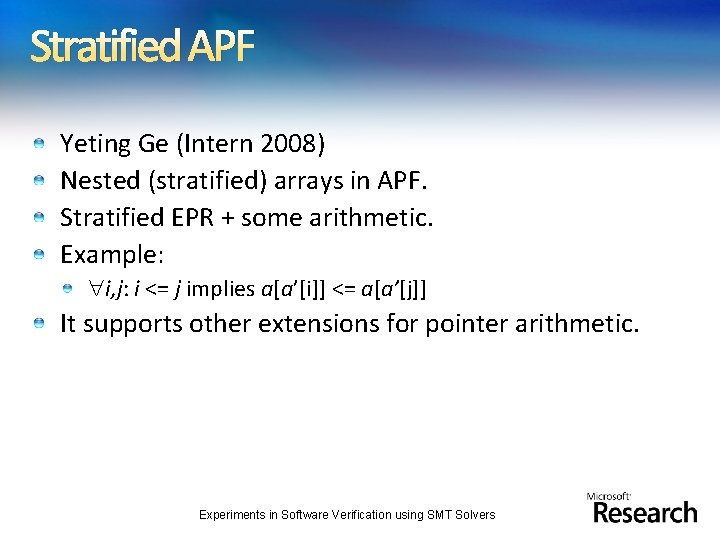
Stratified APF Yeting Ge (Intern 2008) Nested (stratified) arrays in APF. Stratified EPR + some arithmetic. Example: i, j: i <= j implies a[a’[i]] <= a[a’[j]] It supports other extensions for pointer arithmetic. Experiments in Software Verification using SMT Solvers
Conclusion Users frequently need new theories. Quantifiers. Inference rules. Very lazy loop. Decidable fragments are useful in practice. http: //research. microsoft. com/projects/z 3 Thank You! Experiments in Software Verification using SMT Solvers
Is Z 3 available for commercial use? Not yet… However, PEX (comes with Z 3) and Chess will be available for commercial use for VS users. http: //research. microsoft. com/Pex/ http: //research. microsoft. com/projects/chess/ SLAM/SDV 2. 0 (comes with Z 3) is part of DDK and will ship with the next version of Windows. http: //research. microsoft. com/slam/ Experiments in Software Verification using SMT Solvers