
Experiments demonstrated that DNA was the hereditary material
- Slides: 25
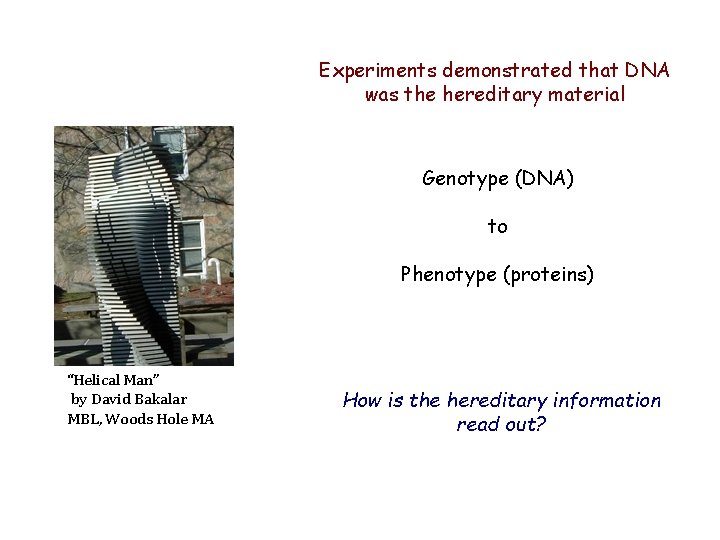
Experiments demonstrated that DNA was the hereditary material Genotype (DNA) to Phenotype (proteins) “Helical Man” by David Bakalar MBL, Woods Hole MA How is the hereditary information read out?
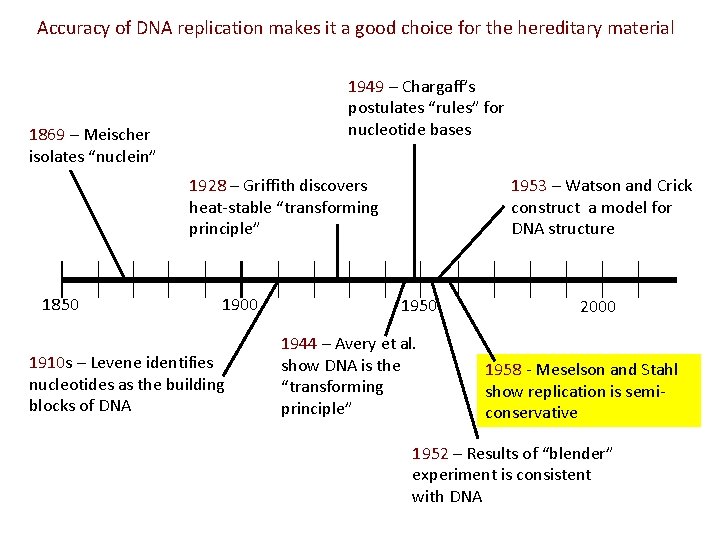
Accuracy of DNA replication makes it a good choice for the hereditary material 1949 – Chargaff’s postulates “rules” for nucleotide bases 1869 – Meischer isolates “nuclein” 1953 – Watson and Crick construct a model for DNA structure 1928 – Griffith discovers heat-stable “transforming principle” 1850 1900 1910 s – Levene identifies nucleotides as the building blocks of DNA 1950 1944 – Avery et al. show DNA is the “transforming principle” 2000 1958 - Meselson and Stahl show replication is semiconservative 1952 – Results of “blender” experiment is consistent with DNA
DNA replication is FAST and PRECISE Fast – can incorporate hundreds of nucleotides/second DNA polymerase has some proofreading ability Cells also have DNA repair activities Error rate estimates range from 1/10 -6 to 1/10 -9 Precision of DNA replication makes it a good hereditary material
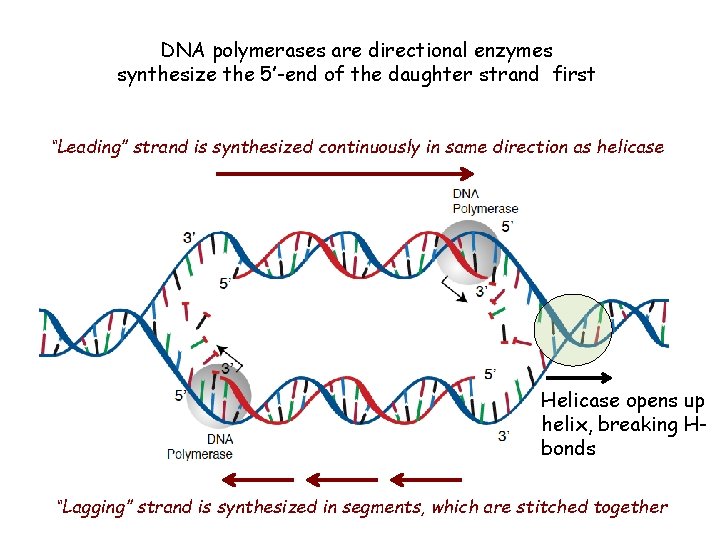
DNA polymerases are directional enzymes synthesize the 5’-end of the daughter strand first “Leading” strand is synthesized continuously in same direction as helicase Helicase opens up helix, breaking Hbonds “Lagging” strand is synthesized in segments, which are stitched together
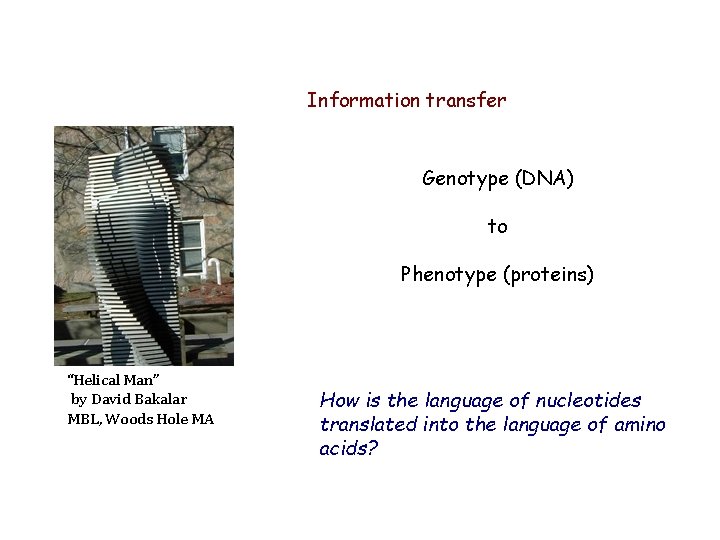
Information transfer Genotype (DNA) to Phenotype (proteins) “Helical Man” by David Bakalar MBL, Woods Hole MA How is the language of nucleotides translated into the language of amino acids?
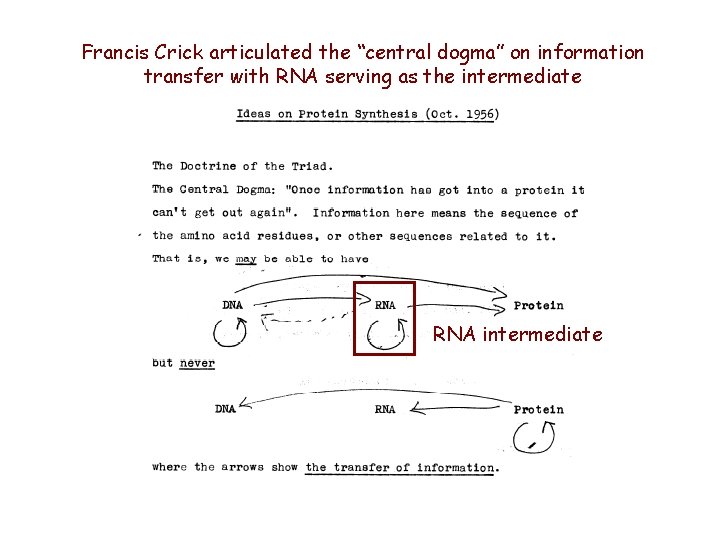
Francis Crick articulated the “central dogma” on information transfer with RNA serving as the intermediate RNA intermediate
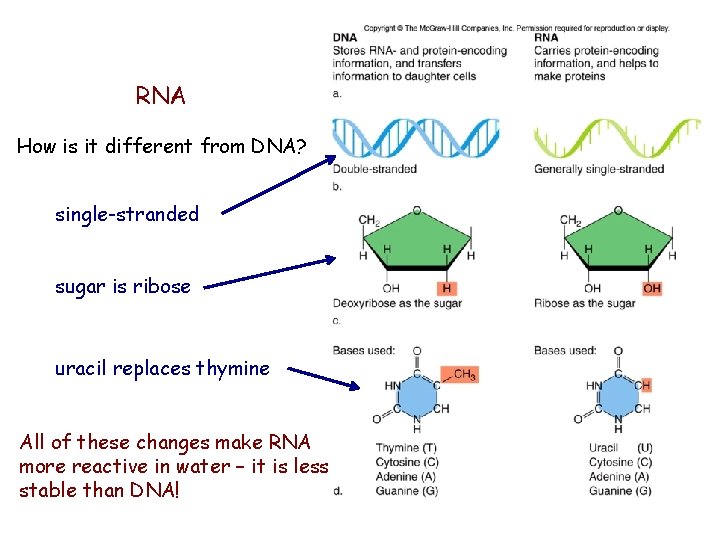
RNA How is it different from DNA? single-stranded sugar is ribose uracil replaces thymine All of these changes make RNA more reactive in water – it is less stable than DNA!
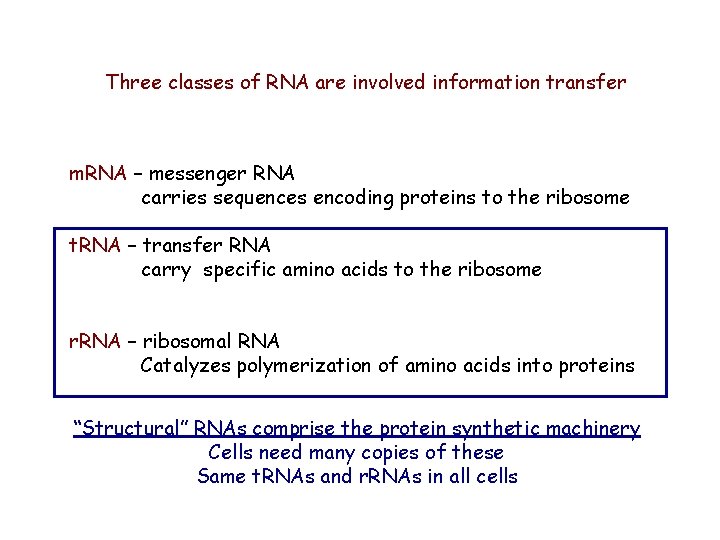
Three classes of RNA are involved information transfer m. RNA – messenger RNA carries sequences encoding proteins to the ribosome t. RNA – transfer RNA carry specific amino acids to the ribosome r. RNA – ribosomal RNA Catalyzes polymerization of amino acids into proteins “Structural” RNAs comprise the protein synthetic machinery Cells need many copies of these Same t. RNAs and r. RNAs in all cells
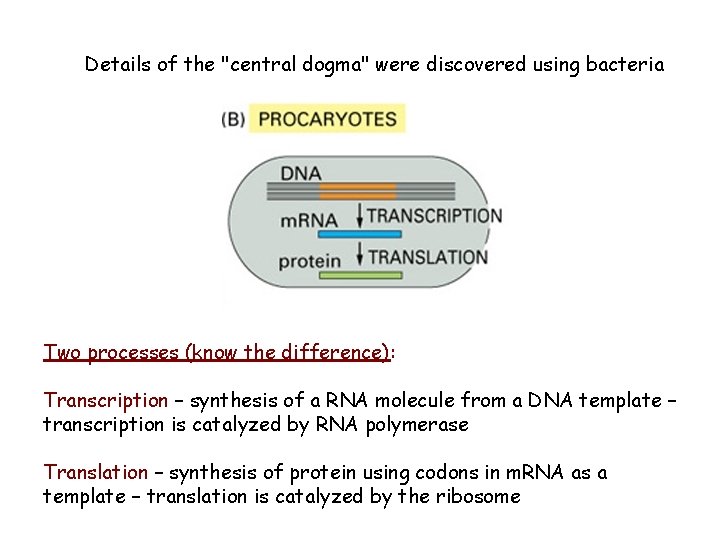
Details of the "central dogma" were discovered using bacteria Two processes (know the difference): Transcription – synthesis of a RNA molecule from a DNA template – transcription is catalyzed by RNA polymerase Translation – synthesis of protein using codons in m. RNA as a template – translation is catalyzed by the ribosome
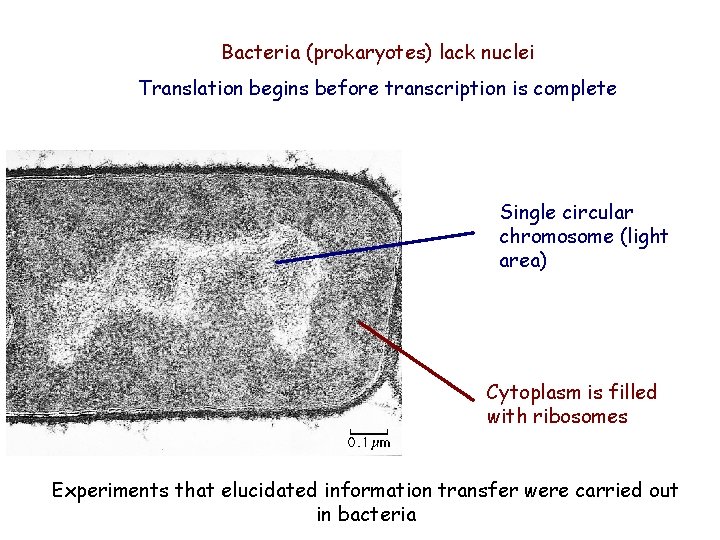
Bacteria (prokaryotes) lack nuclei Translation begins before transcription is complete Single circular chromosome (light area) Cytoplasm is filled with ribosomes Experiments that elucidated information transfer were carried out in bacteria
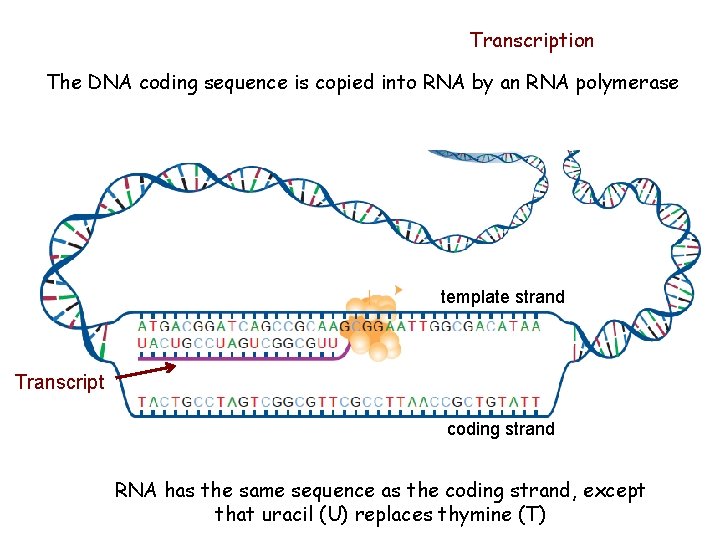
Transcription The DNA coding sequence is copied into RNA by an RNA polymerase template strand Transcript coding strand RNA has the same sequence as the coding strand, except that uracil (U) replaces thymine (T)
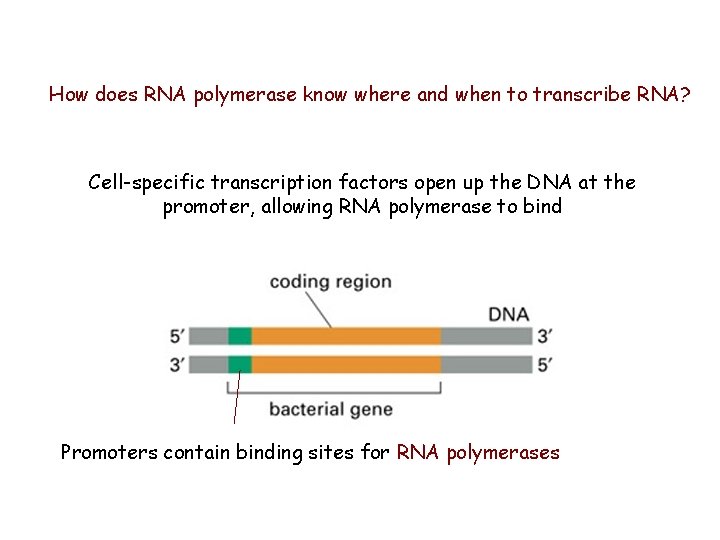
How does RNA polymerase know where and when to transcribe RNA? Cell-specific transcription factors open up the DNA at the promoter, allowing RNA polymerase to bind Promoters contain binding sites for RNA polymerases
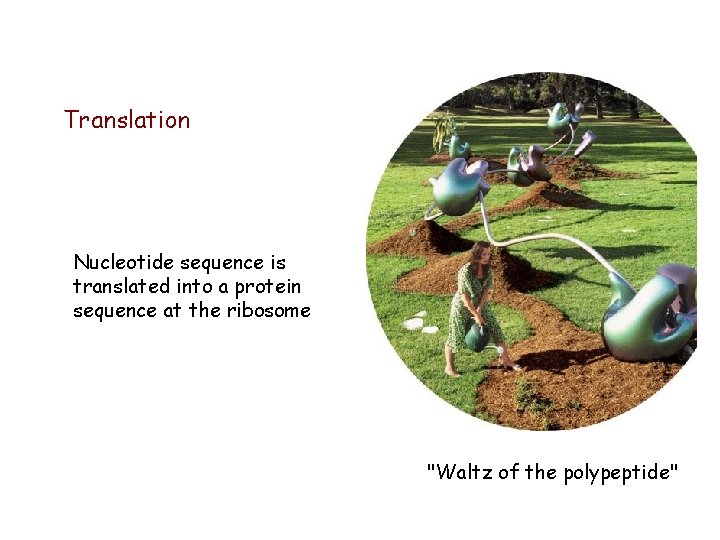
Translation Nucleotide sequence is translated into a protein sequence at the ribosome "Waltz of the polypeptide"
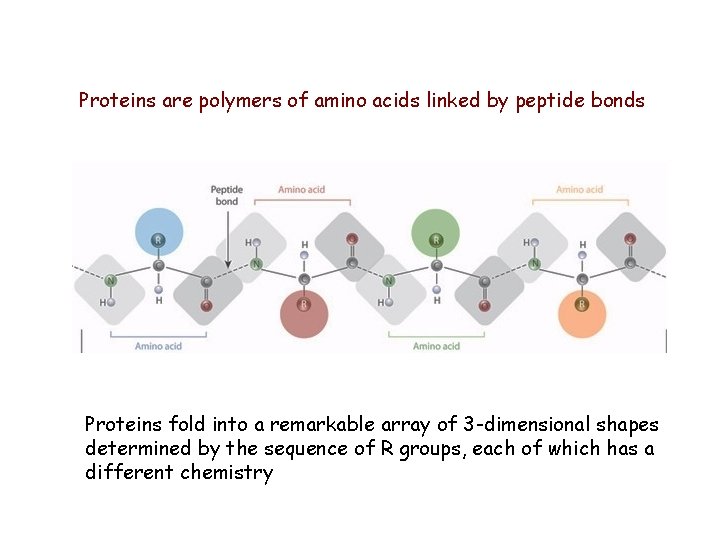
Proteins are polymers of amino acids linked by peptide bonds Proteins fold into a remarkable array of 3 -dimensional shapes determined by the sequence of R groups, each of which has a different chemistry
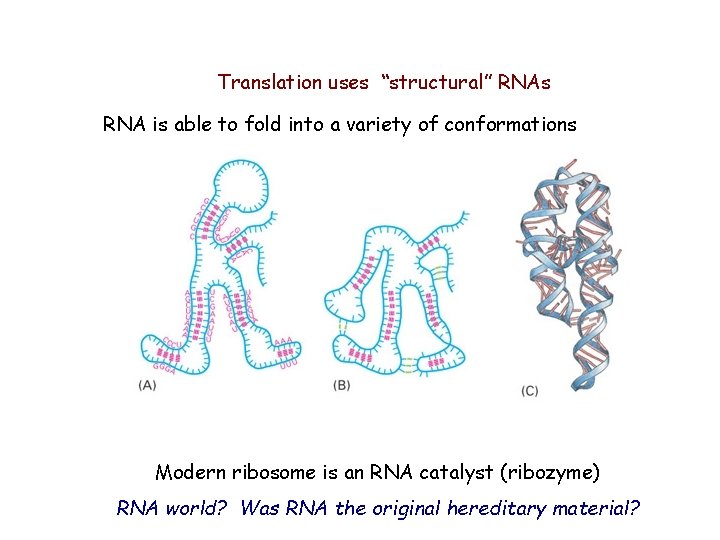
Translation uses “structural” RNAs RNA is able to fold into a variety of conformations Modern ribosome is an RNA catalyst (ribozyme) RNA world? Was RNA the original hereditary material?
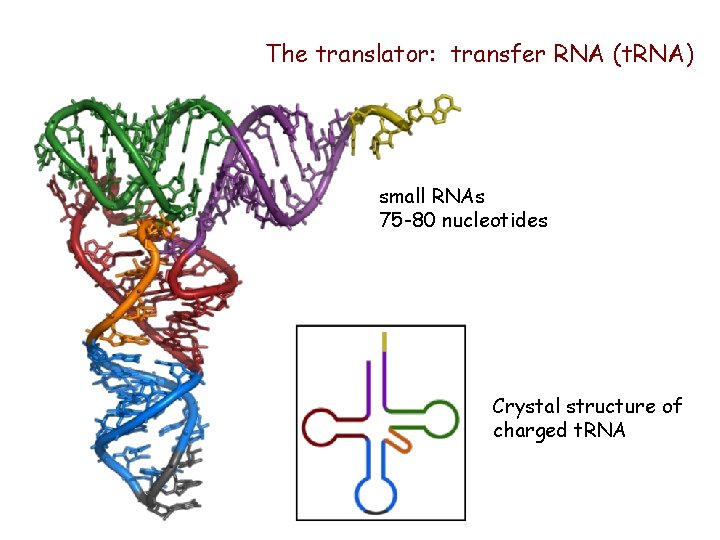
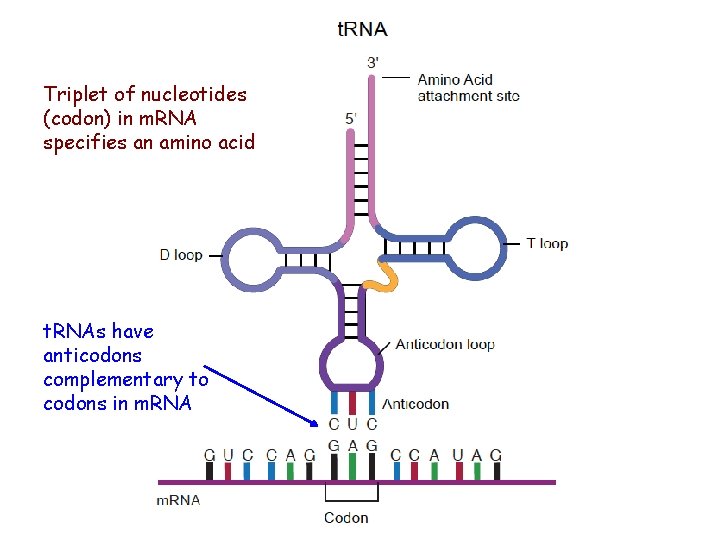
The translator: transfer RNA (t. RNA) small RNAs 75 -80 nucleotides Crystal structure of charged t. RNA
How does the code work? 4 different nucleotides are found in RNAs 20 different amino acids are found in proteins
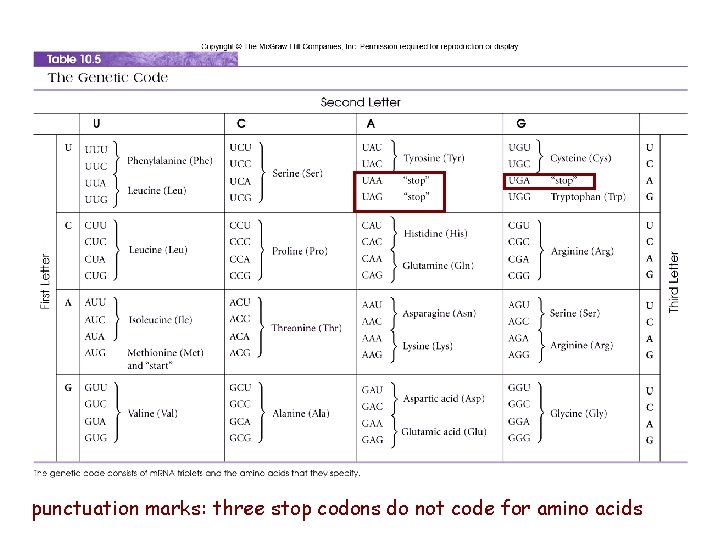
Triplet of nucleotides (codon) in m. RNA specifies an amino acid t. RNAs have anticodons complementary to codons in m. RNA
punctuation marks: three stop codons do not code for amino acids
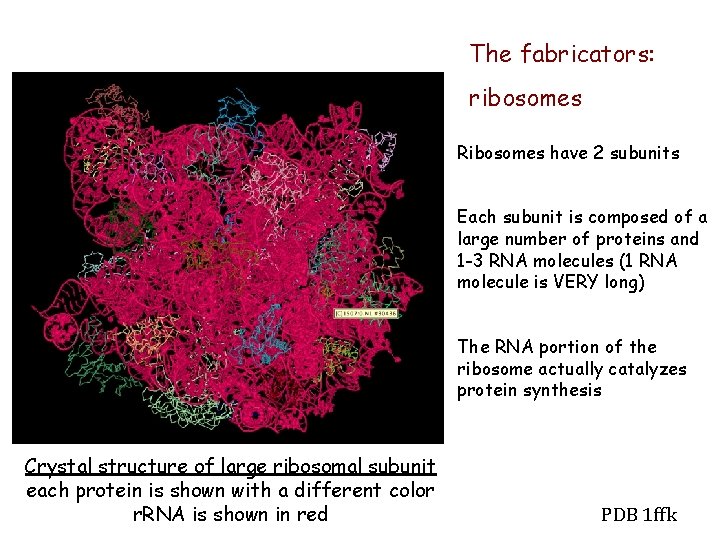
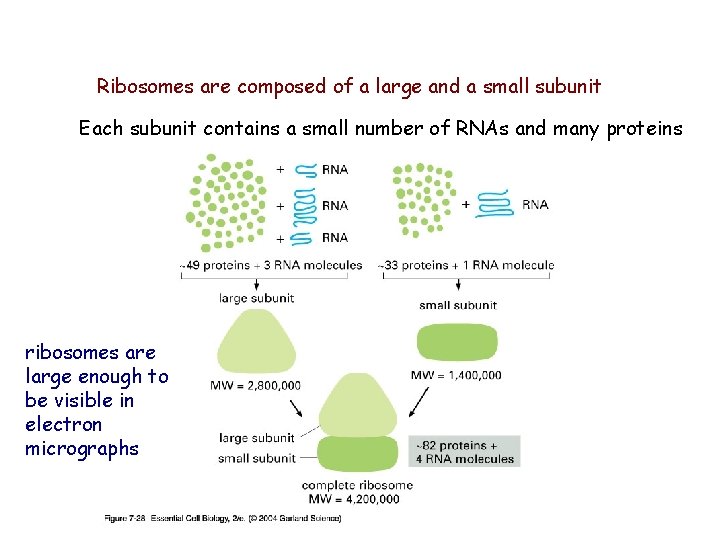
The fabricators: ribosomes Ribosomes have 2 subunits Each subunit is composed of a large number of proteins and 1 -3 RNA molecules (1 RNA molecule is VERY long) The RNA portion of the ribosome actually catalyzes protein synthesis Crystal structure of large ribosomal subunit each protein is shown with a different color r. RNA is shown in red PDB 1 ffk
Ribosomes are composed of a large and a small subunit Each subunit contains a small number of RNAs and many proteins ribosomes are large enough to be visible in electron micrographs
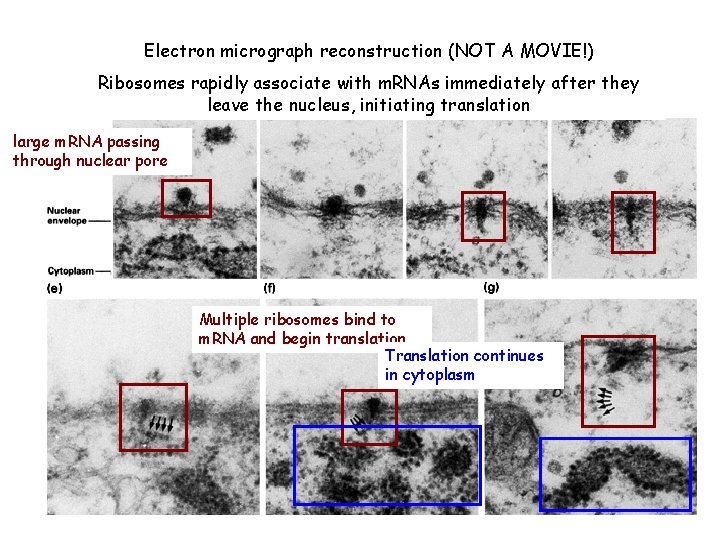
Electron micrograph reconstruction (NOT A MOVIE!) Ribosomes rapidly associate with m. RNAs immediately after they leave the nucleus, initiating translation large m. RNA passing through nuclear pore Multiple ribosomes bind to m. RNA and begin translation Translation continues in cytoplasm
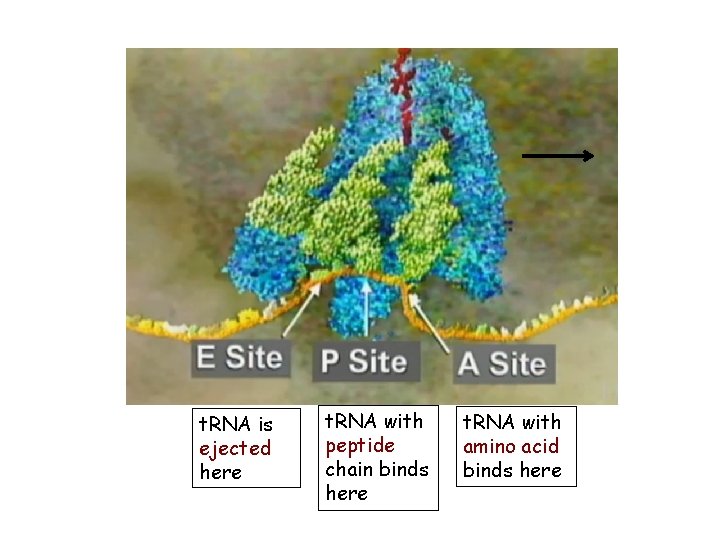
t. RNA is ejected here t. RNA with peptide chain binds here t. RNA with amino acid binds here
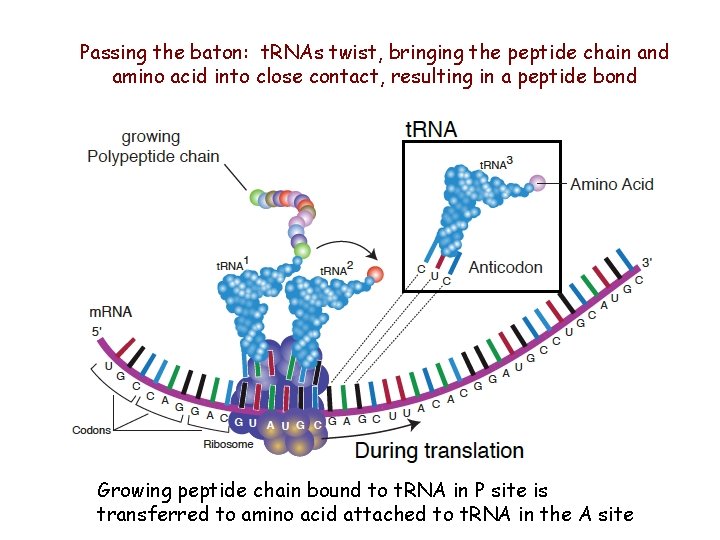
Passing the baton: t. RNAs twist, bringing the peptide chain and amino acid into close contact, resulting in a peptide bond Growing peptide chain bound to t. RNA in P site is transferred to amino acid attached to t. RNA in the A site
RNA acts as the intermediary between DNA (the information) and protein (catalysts and structural units in cells) RNA differs from DNA in that it is single-stranded, contains uracil in the place of thymine and ribose sugar in the place of deoxyribose. Three kinds of RNA are found in cells: messenger RNA (m. RNA), ribosomal RNA (r. RNA) and transfer RNA (t. RNA) Transcription refers to the synthesis of RNA from a DNA template Genes contain regulatory sequences in addition to the coding sequences for proteins – transcription factors bind to regulatory sequences RNA polymerases catalyze the synthesis of RNA molecules RNA polymerases bind to promoter sequences and move processively along the DNA templates as they synthesize RNA molecules Translation refers to the synthesis of protein Ribosomal RNA forms the scaffold for ribosomes and is responsible for catalyzing protein synthesis Transfer RNAs carry activated amino acids to the ribosomes. Anticodon sequences on t. RNAs bind codons in m. RNAs.