
Experiments and Observational Studies chapter 13 OBSERVATIONAL VS
Experiments and Observational Studies chapter 13
OBSERVATIONAL VS. EXPERIMENTAL observational study no treatment is assigned – SELF SELECTION merely observe a characteristic Prospective vs. Retrospective ▪ Prospective: Pick subjects, then follow them for some time ▪ Retrospective: Pick subjects, then look up their past records experimental study a treatment is assigned (hopefully RANDOMLY) observe the response and measure its effect
The ONLY way to show CAUSE & EFFECT is with a randomized experiment!!! (RANDOM ASSIGNMENT OF SUBJECTS TO TREATMENTS!!!)
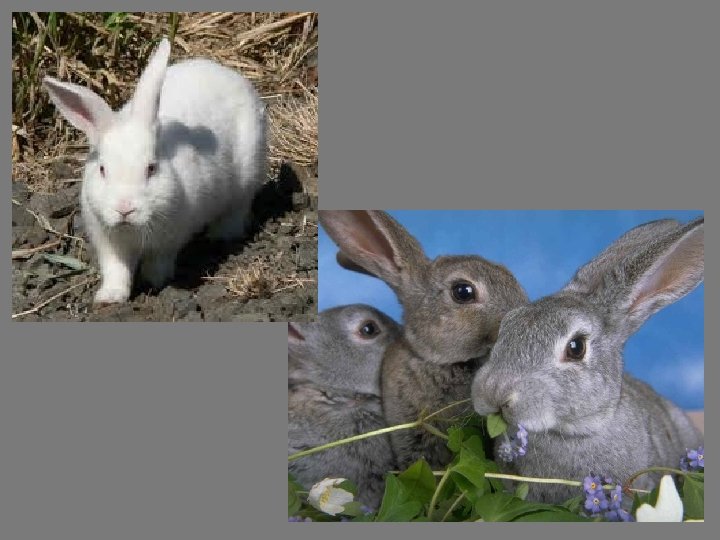
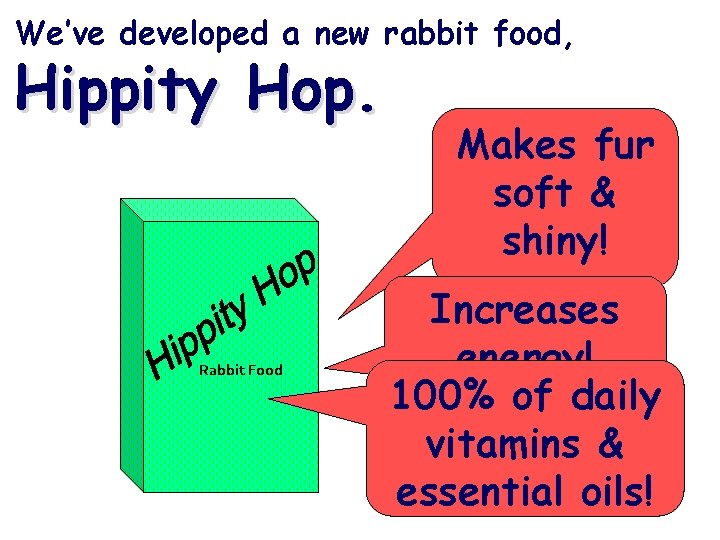
We’ve developed a new rabbit food, Hippity Hop. Rabbit Food Makes fur soft & shiny! Increases energy! 100% of daily vitamins & essential oils!
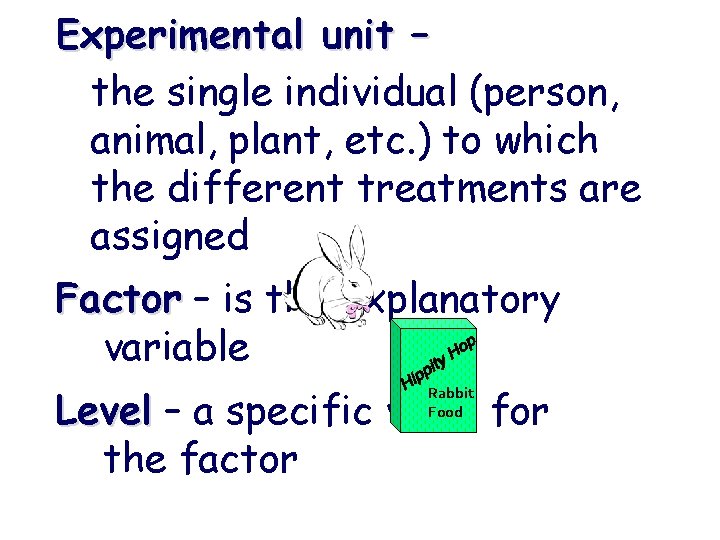
Experimental unit – the single individual (person, animal, plant, etc. ) to which the different treatments are assigned Factor – is the explanatory variable Level – a specific value for the factor Rabbit Food
Treatment – a specific experimental condition applied to the units made up of factors at different levels Response variable – what you measure You must be specific!
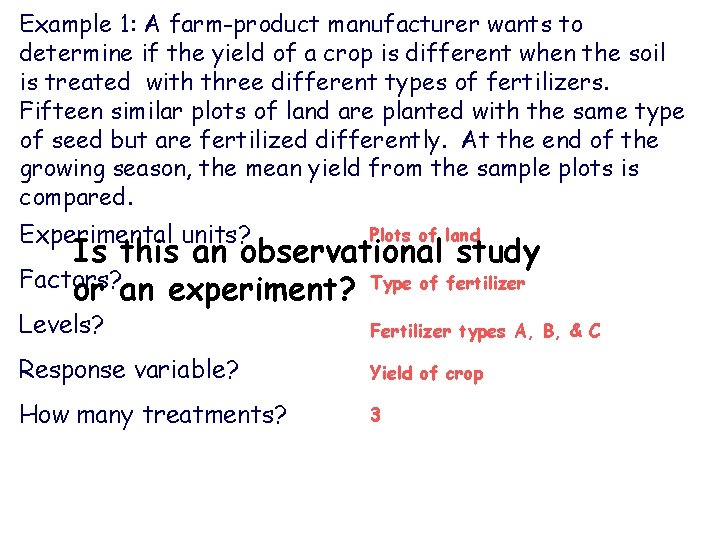
Example 1: A farm-product manufacturer wants to determine if the yield of a crop is different when the soil is treated with three different types of fertilizers. Fifteen similar plots of land are planted with the same type of seed but are fertilized differently. At the end of the growing season, the mean yield from the sample plots is compared. Experimental units? Plots of land Levels? Fertilizer types A, B, & C Response variable? Yield of crop How many treatments? 3 Is this an observational study Factors? or an experiment? Type of fertilizer
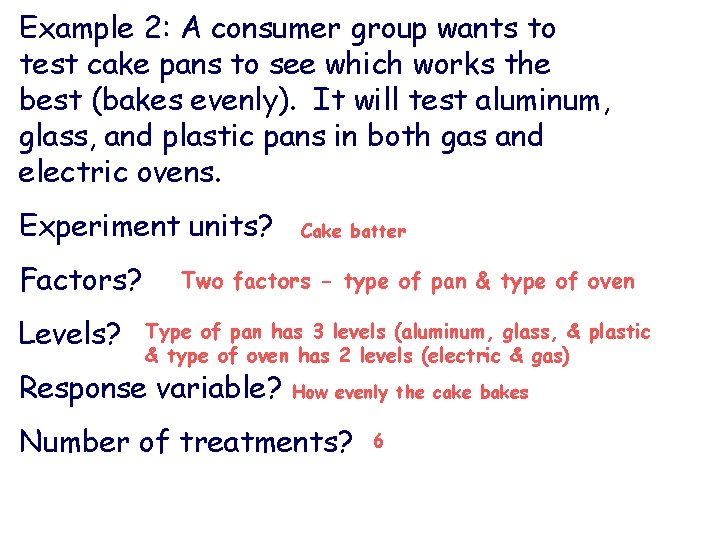
Example 2: A consumer group wants to test cake pans to see which works the best (bakes evenly). It will test aluminum, glass, and plastic pans in both gas and electric ovens. Experiment units? Factors? Levels? Cake batter Two factors - type of pan & type of oven Type of pan has 3 levels (aluminum, glass, & plastic & type of oven has 2 levels (electric & gas) Response variable? How evenly the cake bakes Number of treatments? 6
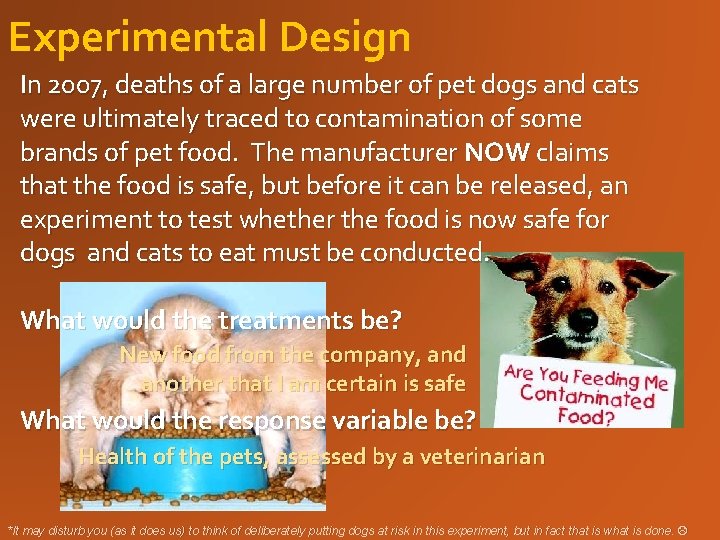
Experimental Design In 2007, deaths of a large number of pet dogs and cats were ultimately traced to contamination of some brands of pet food. The manufacturer NOW claims that the food is safe, but before it can be released, an experiment to test whether the food is now safe for dogs and cats to eat must be conducted. What would the treatments be? New food from the company, and another that I am certain is safe What would the response variable be? Health of the pets, assessed by a veterinarian *It may disturb you (as it does us) to think of deliberately putting dogs at risk in this experiment, but in fact that is what is done.
Experimental Design A group of 32 dog owners have volunteered their pets for this experimental study. Explain how you would carry out a completely* randomized experiment to see if the new food is safe for dogs to eat. The dogs will eat the assigned food for a period of 6 weeks. *completely randomized experiment means NO BLOCKING ALLOWED!!!
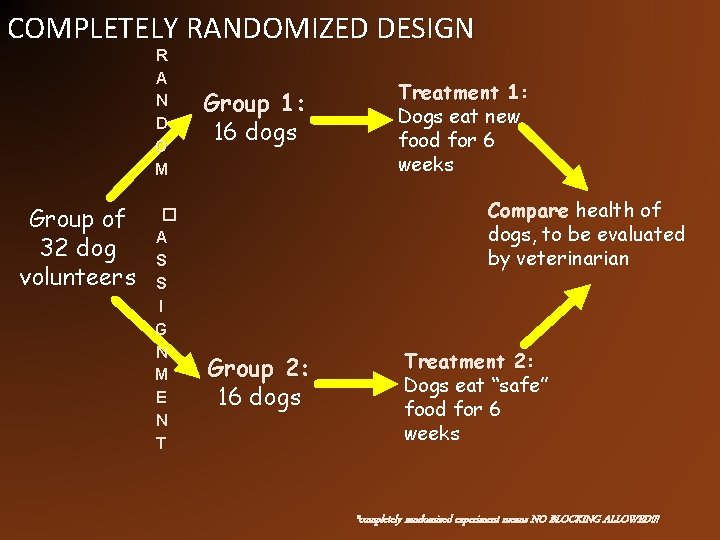
COMPLETELY RANDOMIZED DESIGN R A N D O M Group of 32 dog volunteers � A S S I G N M E N T Group 1: 16 dogs Treatment 1: Dogs eat new food for 6 weeks Compare health of dogs, to be evaluated by veterinarian Group 2: 16 dogs Treatment 2: Dogs eat “safe” food for 6 weeks *completely randomized experiment means NO BLOCKING ALLOWED!!!
(explaining the randomization procedure…) Using a RNG on a calculator/computer, RANDOMLY assign each dog a unique number from 1 to 32. The dogs with numbers 1 – 16 are placed in treatment group 1. The rest of the dogs will be placed in treatment group 2 (or the control group). OR We will number the dogs from 1 to 32. Take 32 slips of paper, number them from 1 to 32, and put them in a hat. Stir the slips in the hat, then draw 16 of the slips without looking. The dogs with those numbers are placed in treatment group 1…
why is random assignment important? In theory, randomization EQUALIZES all other variables (including the things we can’t predict). BUT… …VARIATION WILL OCCUR. Sometimes we end up with “unfair” groups… That is why we replicate the experiment (perform the experiment a number of times, with different groups of subjects, in different locations, etc)
Principles of Experimental Design Control – make conditions as similar as possible for all treatment groups (aside from the actual treatments). If we observe a difference between groups, we want to know that it is a result of the treatment(s)! Randomization – the use of chance to assign subjects/units to treatments Replication of the experiment on many subjects/in different locations/etc.
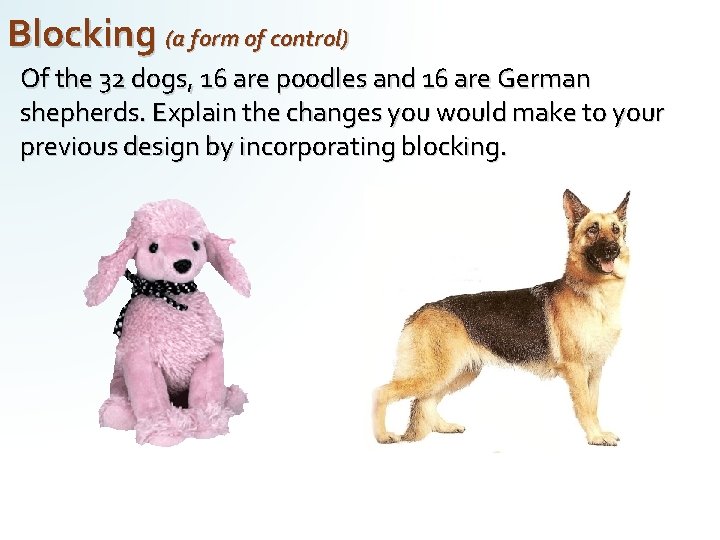
Blocking (a form of control) Of the 32 dogs, 16 are poodles and 16 are German shepherds. Explain the changes you would make to your previous design by incorporating blocking. It may disturb you (as it does us) to think of deliberately putting dogs at risk in this experiment… but in fact that is what is done.
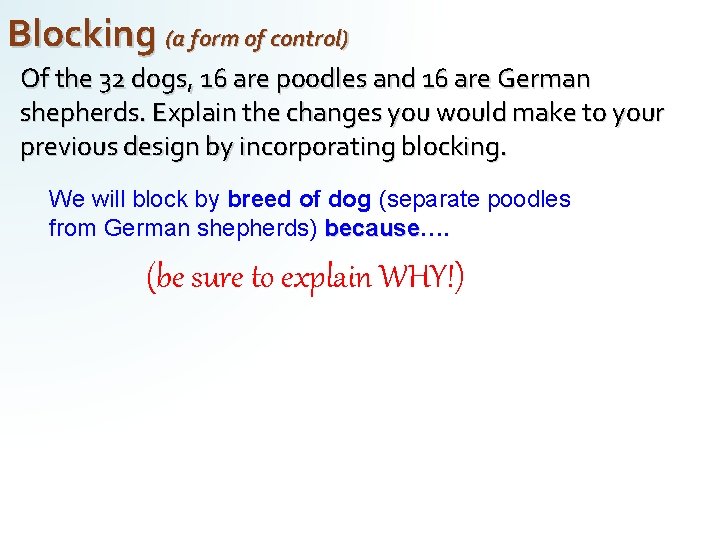
Blocking (a form of control) Of the 32 dogs, 16 are poodles and 16 are German shepherds. Explain the changes you would make to your previous design by incorporating blocking. We will block by breed of dog (separate poodles from German shepherds) because…. because (be sure to explain WHY!)
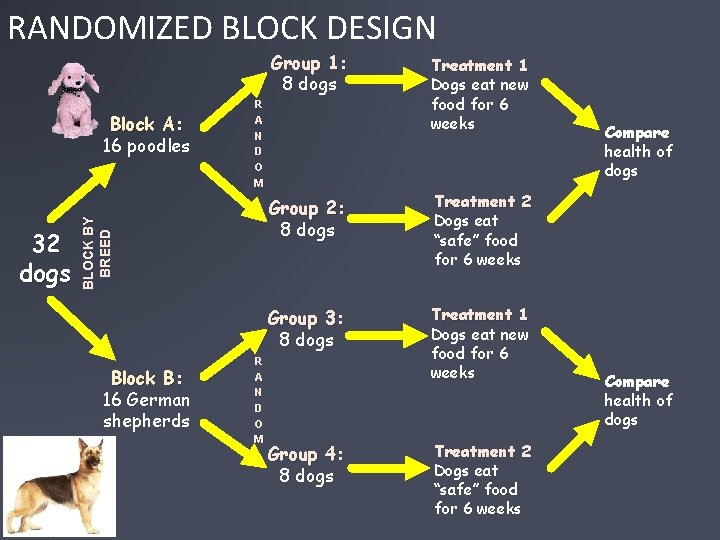
RANDOMIZED BLOCK DESIGN Group 1: 8 dogs 32 dogs BLOCK BY BREED Block A: 16 poodles R A N D O M Block B: 16 German shepherds R A N D O M Treatment 1 Dogs eat new food for 6 weeks Group 2: 8 dogs Treatment 2 Dogs eat “safe” food for 6 weeks Group 3: 8 dogs Treatment 1 Dogs eat new food for 6 weeks Group 4: 8 dogs Treatment 2 Dogs eat “safe” food for 6 weeks Compare health of dogs
Blocking is to experiments stratifying as ____ is to sampling.
Is the difference in our results statistically significant? (what does that even mean? ? ? )
“statistically significant” An observed effect so large that it would rarely occur by chance is called statistically significant.
SAT PREP CLASSES! (blegh!) Higher SAT scores in only 6 weeks! top-secret far-eastern study strategies! 3 sessions a week, only 5 hours per session! all the other kids are being forced into it by their parents, so why not!? ! • Cost: only $30, 000!!! What a bargain! • • • Scores will improve (guaranteed!) or your money back!!!
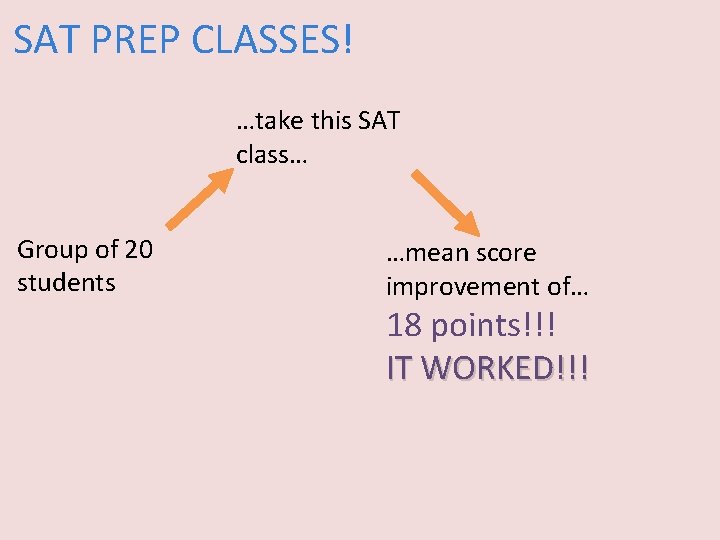
SAT PREP CLASSES! …take this SAT class… Group of 20 students …mean score improvement of… 18 points!!! IT WORKED!!!
CONTROL GROUP a group that is used to compare the factor against; can be a placebo or the “old” or current item
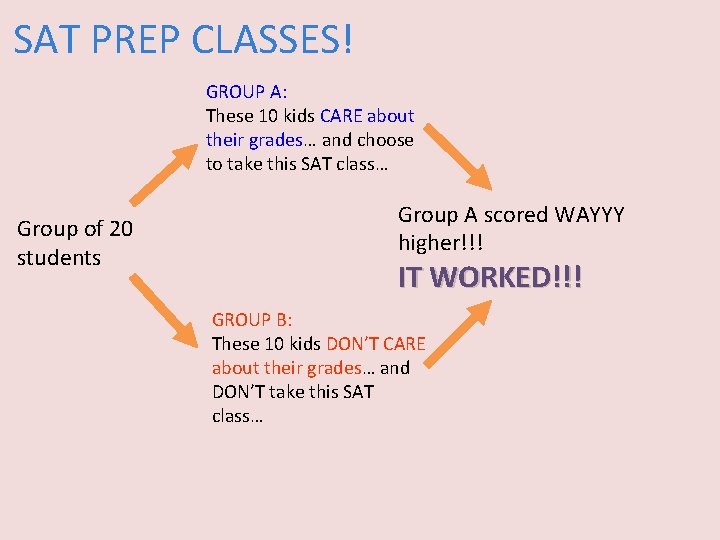
SAT PREP CLASSES! GROUP A: These 10 kids CARE about their grades… and choose to take this SAT class… Group of 20 students Group A scored WAYYY higher!!! IT WORKED!!! GROUP B: These 10 kids DON’T CARE about their grades… and DON’T take this SAT class…
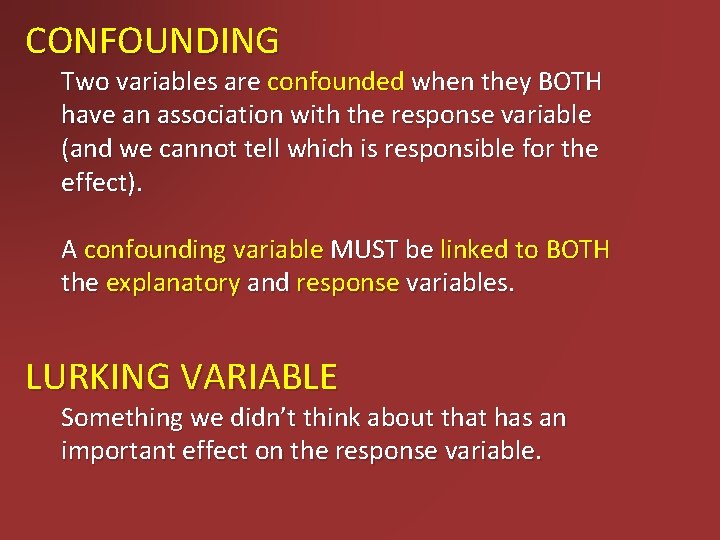
CONFOUNDING Two variables are confounded when they BOTH have an association with the response variable (and we cannot tell which is responsible for the effect). A confounding variable MUST be linked to BOTH the explanatory and response variables. LURKING VARIABLE Something we didn’t think about that has an important effect on the response variable.
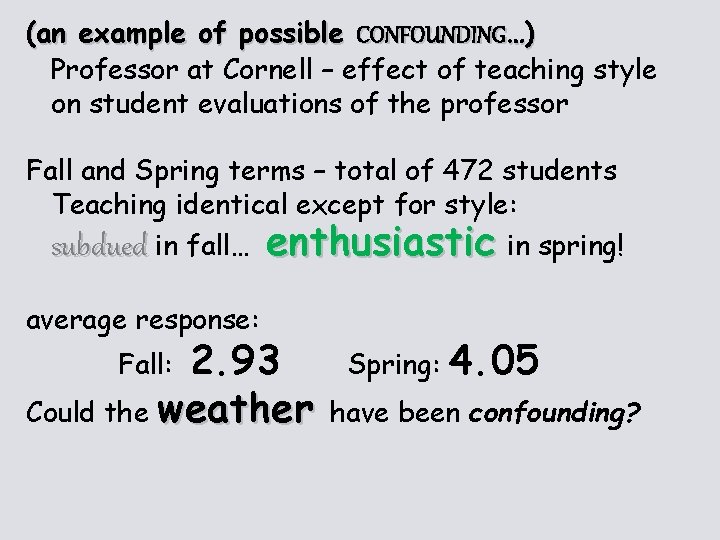
(an example of possible CONFOUNDING…) Professor at Cornell – effect of teaching style on student evaluations of the professor Fall and Spring terms – total of 472 students Teaching identical except for style: subdued in fall… enthusiastic in spring! average response: 2. 93 Could the weather Fall: Spring: 4. 05 have been confounding?
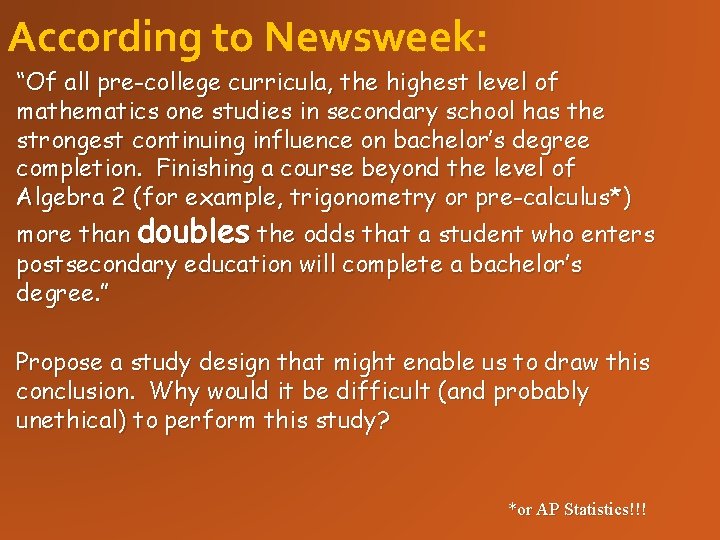
According to Newsweek: “Of all pre-college curricula, the highest level of mathematics one studies in secondary school has the strongest continuing influence on bachelor’s degree completion. Finishing a course beyond the level of Algebra 2 (for example, trigonometry or pre-calculus*) more than doubles the odds that a student who enters postsecondary education will complete a bachelor’s degree. ” Propose a study design that might enable us to draw this conclusion. Why would it be difficult (and probably unethical) to perform this study? *or AP Statistics!!!
about “control”…
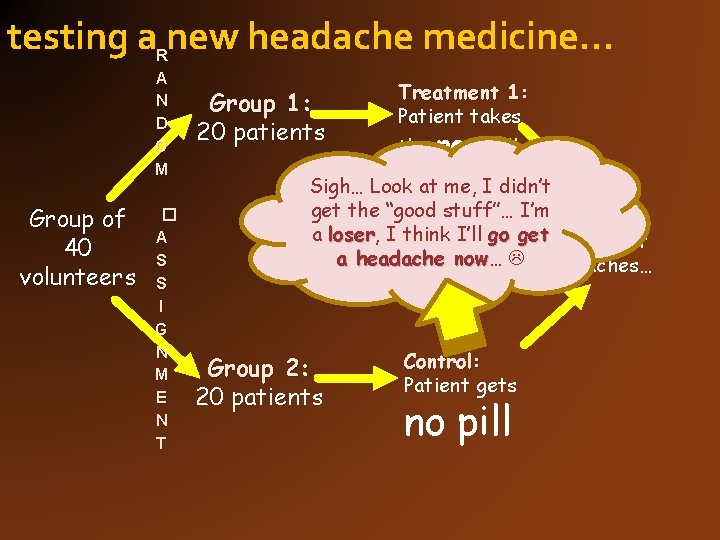
testing a new headache medicine… R A N D O M Group of 40 volunteers � A S S I G N M E N T Group 1: 20 patients Treatment 1: Patient takes the new pill Sigh… Look at me, I didn’t get the “good stuff”… I’m. Compare a loser, loser I think I’ll go getnumbers of a headache now… now headaches… Group 2: 20 patients Control: Patient gets no pill
PLACEBO a “dummy” treatment that has no effect on the response variable. (sometimes we say “no physical effect” but…)
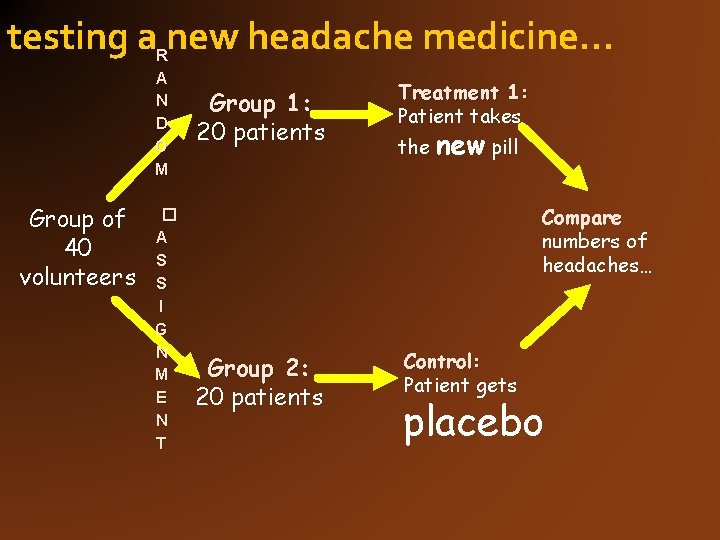
testing a new headache medicine… R A N D O M Group of 40 volunteers � A S S I G N M E N T Group 1: 20 patients Treatment 1: Patient takes the new pill Compare numbers of headaches… Group 2: 20 patients Control: Patient gets placebo
BLINDING units do not know which treatment they are getting DOUBLE BLIND neither the subjects nor the evaluator* know which treatment a subject received *(nor anybody who administers the treatments and/or cares for the subjects… basically ANYBODY who interacts directly with the experimental units)
placebos? A pharmaceutical company is testing a new headache medicine pill, and wishes to test it in an experimental study against a control group. Is it possible for the experiment to be blinded? double blinded? The subjects can be blinded by being given a placebo – a dummy pill which looks and feels the same as the “real” drug, but contains no active ingredient. The evaluators* should also be blinded by not knowing which group received the real drug vs. the placebo (assignment of treatments should be administered by a 3 rd party). *or anyone that deals directly with the patients
more placebos…? ! A cutting-edge treatment for combatting brain tumors involves drilling tiny holes in the patient’s skull and injecting a drug cocktail into the brain. Is it possible to carry out a double-blind experiment in this scenario? Explain… Sure… just drill holes in the skulls of the control group patients and inject a non-active “dummy” cocktail into their brains… (is it ethical? ? )
ex: ulcers in upper intestine Treatment for stomach ulcers Anesthetize patient Put balloon in stomach Fill with freezing coolant Initial Experiment, 1958 24 patients, all cured Became popular, and better than surgery But there were some skeptics….
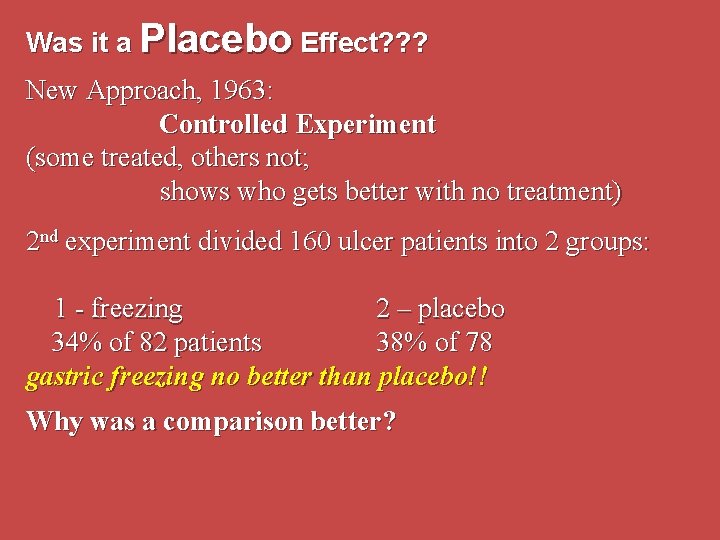
Was it a Placebo Effect? ? ? New Approach, 1963: Controlled Experiment (some treated, others not; shows who gets better with no treatment) 2 nd experiment divided 160 ulcer patients into 2 groups: 1 - freezing 2 – placebo 34% of 82 patients 38% of 78 gastric freezing no better than placebo!! Why was a comparison better?
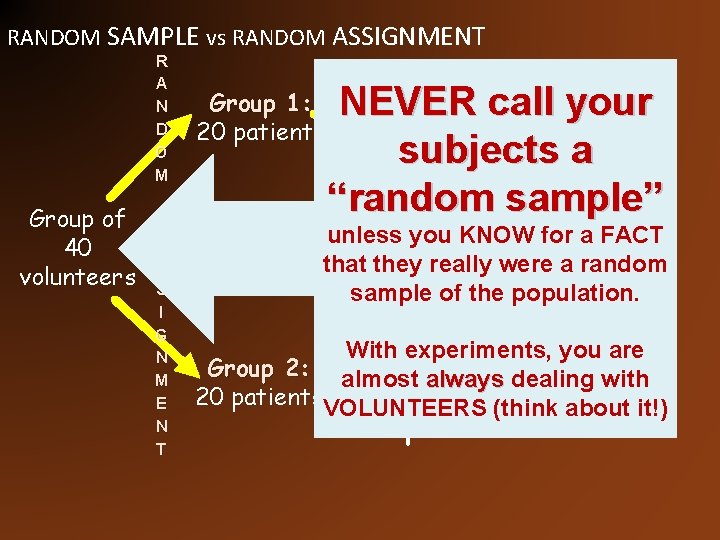
RANDOM SAMPLE vs RANDOM ASSIGNMENT R A N D O M Group of 40 volunteers � A S S I G N M E N T Group 1: 20 patients Treatment 1: Patient takes NEVER call your the new pill subjects a “random sample” Compare unless you KNOW for a FACT numbers of that they really wereheadaches… a random sample of the population. With Control: experiments, you are Group 2: almost always dealing with Patient gets 20 patients. VOLUNTEERS (think about it!) placebo
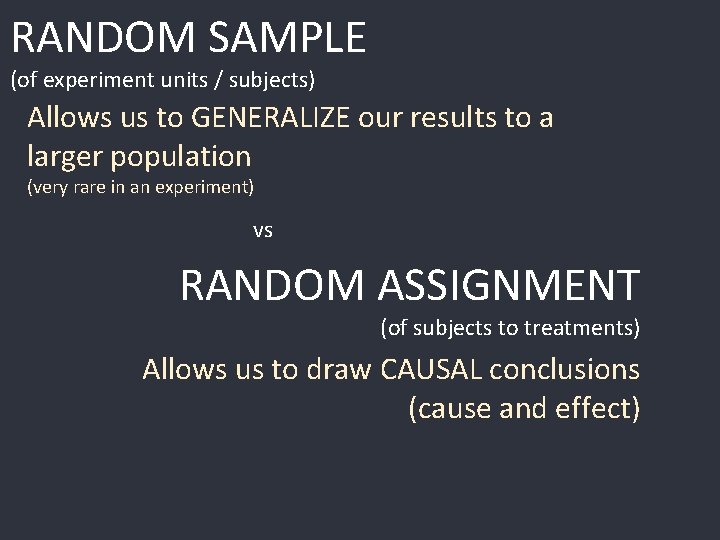
RANDOM SAMPLE (of experiment units / subjects) Allows us to GENERALIZE our results to a larger population (very rare in an experiment) vs RANDOM ASSIGNMENT (of subjects to treatments) Allows us to draw CAUSAL conclusions (cause and effect)
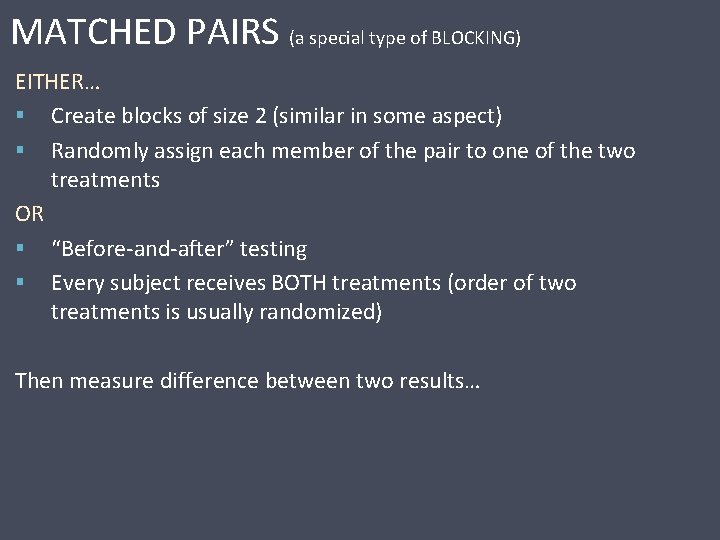
MATCHED PAIRS (a special type of BLOCKING) EITHER… Create blocks of size 2 (similar in some aspect) Randomly assign each member of the pair to one of the two treatments OR “Before-and-after” testing Every subject receives BOTH treatments (order of two treatments is usually randomized) Then measure difference between two results…
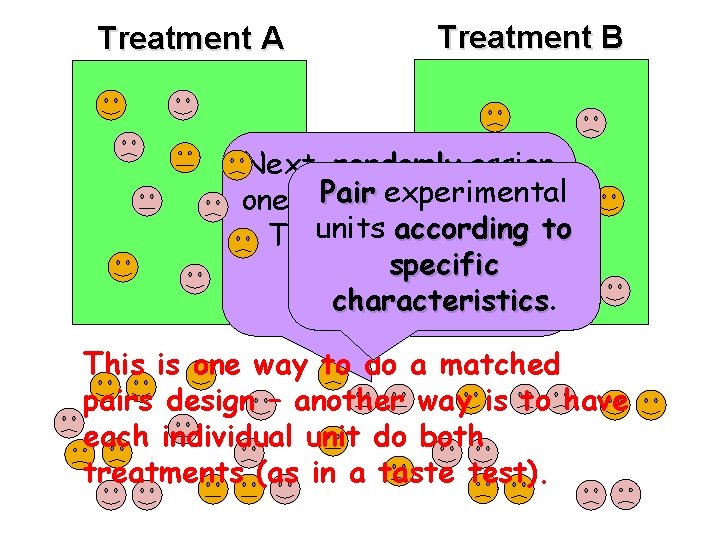
Treatment A Treatment B Next, randomly assign Pairfrom experimental one unit a pair to units according Treatment A. The to specific other unit gets characteristics Treatment B. This is one way to do a matched pairs design – another way is to have each individual unit do both treatments (as in a taste test).
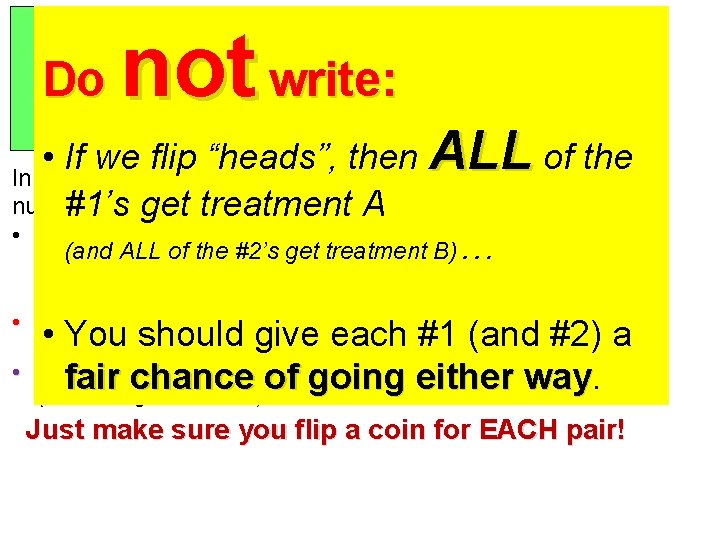
Treatment A Do Treatment B not write: • If we flip “heads”, then ALL of the In each pair, assign one unit the 1 2 number “ 1” and other the # “ 2”. #1’s getthetreatment A • In each block (pair), we will flip a (and ALL of the #2’s get treatment B)… fair coin such that if the side of the coin facing up is… • “heads”, “heads” #1 will get treatment A 1 2 • You should give each #1 (and #2) a “tails”, #2 will get treatment A “tails” fair chance of going either way (and #1 will get treatment B) (and #2 will get treatment B) • Just make sure you flip a coin for EACH pair!
- Slides: 42