
Experimentation as a research methodology to achieve concrete
- Slides: 18
Experimentation as a research methodology to achieve concrete results: where, how, when Dimitri Papadimitriou (ALB) ECODE (FIRE) Project FIA Stockholm November 23 -24, 2009 ECODE FP 7 Project
ECODE Project Outline Context: fundamental challenges of the Internet and its evolution < 11/25/2020 Operational challenges o Manageability/diagnosability • Case: Network performance monitoring by combining adaptive passive and active measurements o Availability • Case: Informed path ranking based on (bandwidth x delay) predictive metrics • Case: Traffic (rate) informed path rerouting in case of topological failures ECODE FP 7 Project 2
ECODE Project Outline Context: fundamental challenges of the Internet and its evolution < New challenges Security Case: cooperative/distributed detection of traffic anomalies to identify intrusions and attacks o Accountability Case: detection of created congestion volume wrt to congestion profiles and their adaptation to maintain fair resource usage o Scalability and quality of routing system Case: (pro-active) detection of path exploration events impacting routing system dynamics and decision on mitigation (proactions) reactions o 11/25/2020 ECODE FP 7 Project 3
ECODE Project Outline q Context: fundamental challenges of the Internet and its evolution < < Operational challenges: manageability/ diagnosability, and availability New challenges: security, accountability, and scalability & quality (routing system) Derive machine learning algorithms, building blocks (architecture) and functional & system-level components q Objective: cognitive routing system combining networking x machine learning technique < 11/25/2020 Main concept: extend IP networking equipment with a distributed machine learning engine ECODE FP 7 Project 4
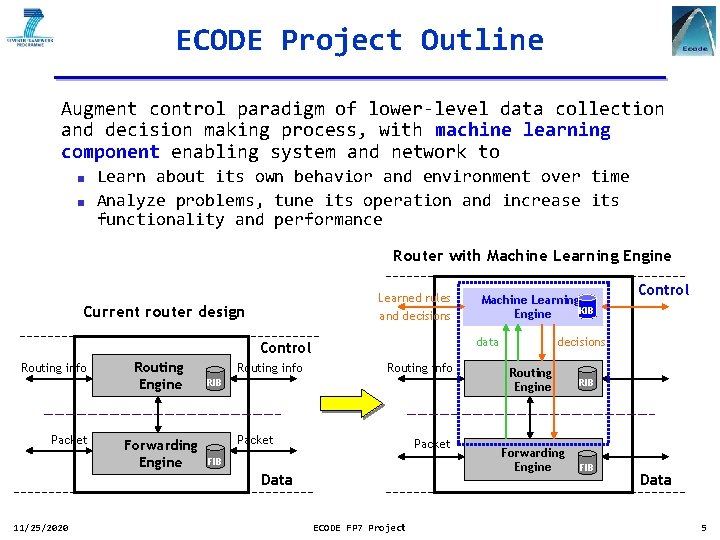
ECODE Project Outline Augment control paradigm of lower-level data collection and decision making process, with machine learning component enabling system and network to < < Learn about its own behavior and environment over time Analyze problems, tune its operation and increase its functionality and performance Router with Machine Learning Engine Learned rules Current router design and decisions Packet Routing Engine Forwarding Engine Routing info RIB Packet FIB Data 11/25/2020 ECODE FP 7 Project Control decisions data Control Routing info Machine Learning KIB Engine Routing Engine Forwarding Engine RIB FIB Data 5
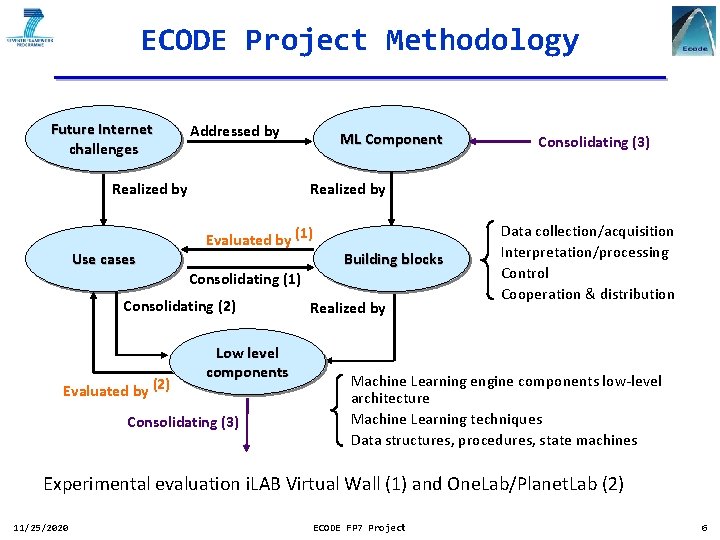
ECODE Project Methodology Future Internet challenges Addressed by Realized by Use cases Consolidating (3) Realized by Evaluated by (1) Consolidating (2) Evaluated by (2) ML Component Low level components Consolidating (3) Building blocks Realized by Data collection/acquisition Interpretation/processing Control Cooperation & distribution Machine Learning engine components low-level architecture Machine Learning techniques Data structures, procedures, state machines Experimental evaluation i. LAB Virtual Wall (1) and One. Lab/Planet. Lab (2) 11/25/2020 ECODE FP 7 Project 6
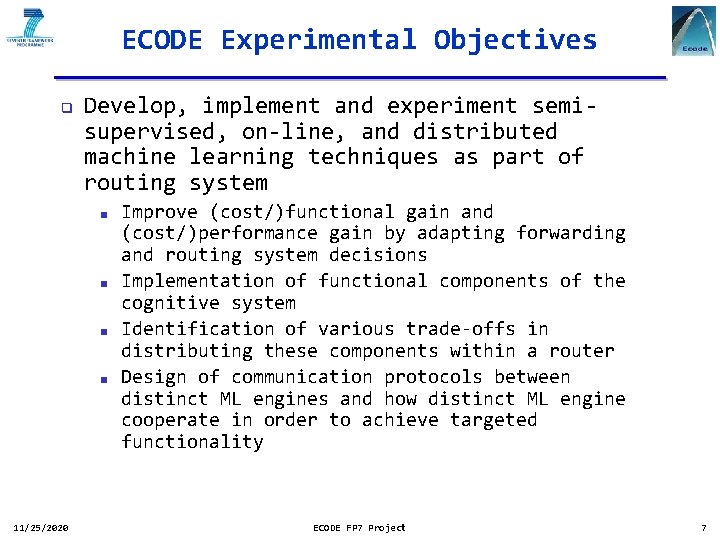
ECODE Experimental Objectives q Develop, implement and experiment semisupervised, on-line, and distributed machine learning techniques as part of routing system < < 11/25/2020 Improve (cost/)functional gain and (cost/)performance gain by adapting forwarding and routing system decisions Implementation of functional components of the cognitive system Identification of various trade-offs in distributing these components within a router Design of communication protocols between distinct ML engines and how distinct ML engine cooperate in order to achieve targeted functionality ECODE FP 7 Project 7
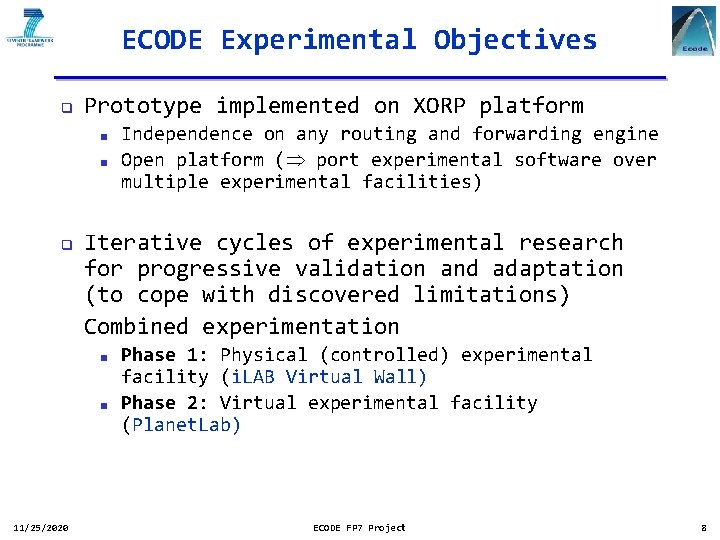
ECODE Experimental Objectives q Prototype implemented on XORP platform < < q Iterative cycles of experimental research for progressive validation and adaptation (to cope with discovered limitations) Combined experimentation < < 11/25/2020 Independence on any routing and forwarding engine Open platform ( port experimental software over multiple experimental facilities) Phase 1: Physical (controlled) experimental facility (i. LAB Virtual Wall) Phase 2: Virtual experimental facility (Planet. Lab) ECODE FP 7 Project 8
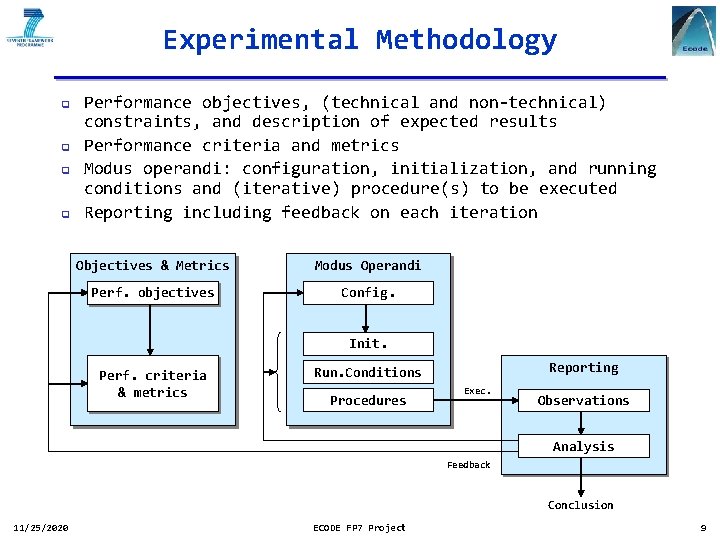
Experimental Methodology q q Performance objectives, (technical and non-technical) constraints, and description of expected results Performance criteria and metrics Modus operandi: configuration, initialization, and running conditions and (iterative) procedure(s) to be executed Reporting including feedback on each iteration Objectives & Metrics Modus Operandi Perf. objectives Config. Init. Perf. criteria & metrics Reporting Run. Conditions Procedures Exec. Observations Analysis Feedback Conclusion 11/25/2020 ECODE FP 7 Project 9
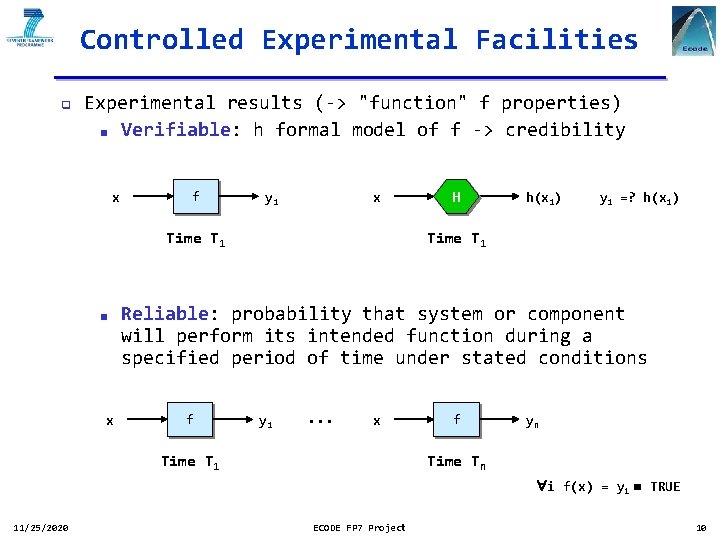
Controlled Experimental Facilities q Experimental results (-> "function" f properties) < Verifiable: h formal model of f -> credibility x f y 1 x Time T 1 < x H h(x 1) y 1 =? h(x 1) Time T 1 Reliable: probability that system or component will perform its intended function during a specified period of time under stated conditions f y 1 . . . x Time T 1 f yn Time Tn i f(x) = yi TRUE 11/25/2020 ECODE FP 7 Project 10
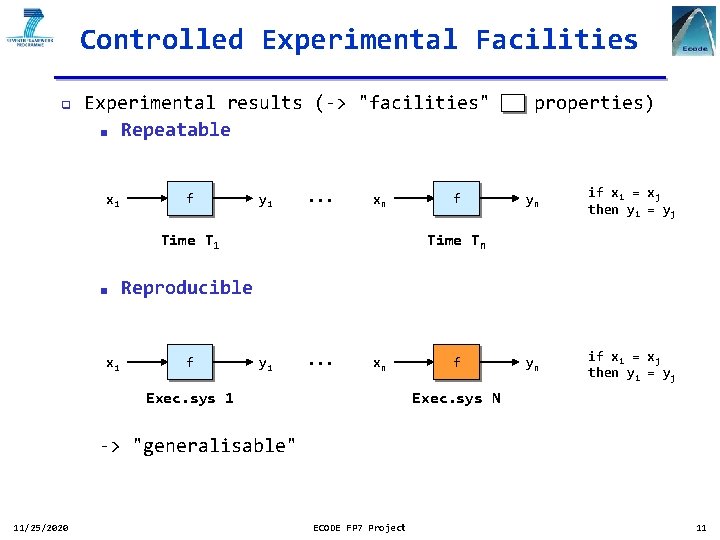
Controlled Experimental Facilities q Experimental results (-> "facilities" < Repeatable x 1 f y 1 . . . xn Time T 1 < x 1 f properties) yn if xi = xj then yi = yj Time Tn Reproducible f y 1 . . . xn Exec. sys 1 f Exec. sys N -> "generalisable" 11/25/2020 ECODE FP 7 Project 11
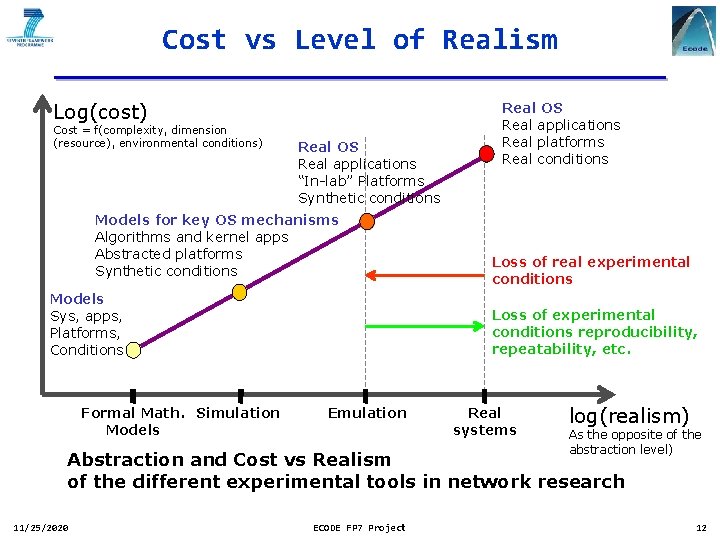
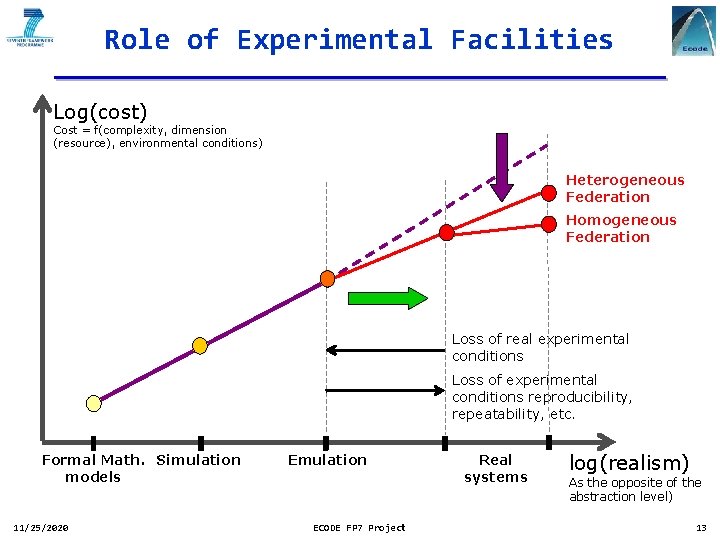
Cost vs Level of Realism Log(cost) Cost = f(complexity, dimension (resource), environmental conditions) Real OS Real applications “In-lab” Platforms Synthetic conditions Models for key OS mechanisms Algorithms and kernel apps Abstracted platforms Synthetic conditions Models Sys, apps, Platforms, Conditions Formal Math. Simulation Models Real OS Real applications Real platforms Real conditions Loss of real experimental conditions Loss of experimental conditions reproducibility, repeatability, etc. Emulation Real systems log(realism) As the opposite of the abstraction level) Abstraction and Cost vs Realism of the different experimental tools in network research 11/25/2020 ECODE FP 7 Project 12
Role of Experimental Facilities Log(cost) Cost = f(complexity, dimension (resource), environmental conditions) Heterogeneous Federation Homogeneous Federation Loss of real experimental conditions Loss of experimental conditions reproducibility, repeatability, etc. Formal Math. Simulation models 11/25/2020 Emulation ECODE FP 7 Project Real systems log(realism) As the opposite of the abstraction level) 13
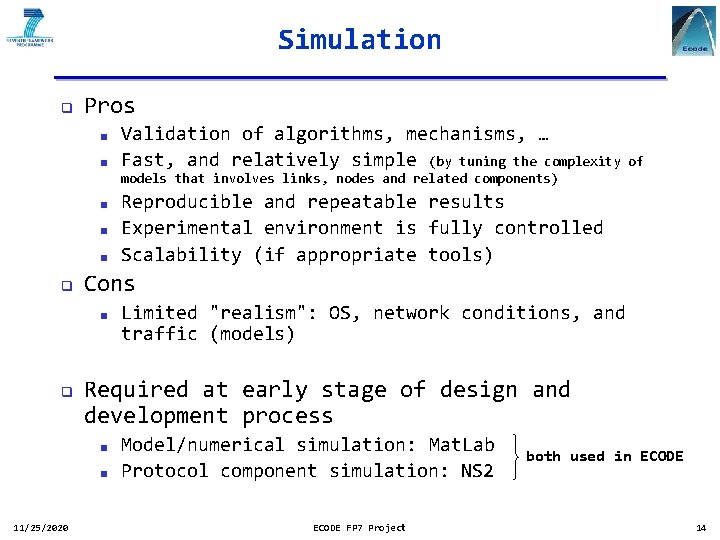
Simulation q Pros < < Validation of algorithms, mechanisms, … Fast, and relatively simple (by tuning the complexity of models that involves links, nodes and related components) < < < q Cons < q Limited "realism": OS, network conditions, and traffic (models) Required at early stage of design and development process < < 11/25/2020 Reproducible and repeatable results Experimental environment is fully controlled Scalability (if appropriate tools) Model/numerical simulation: Mat. Lab Protocol component simulation: NS 2 ECODE FP 7 Project both used in ECODE 14
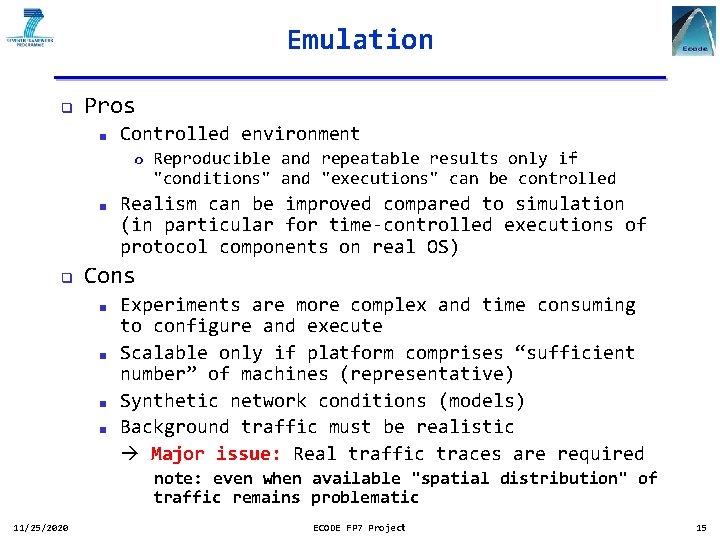
Emulation q Pros < Controlled environment o < q Reproducible and repeatable results only if "conditions" and "executions" can be controlled Realism can be improved compared to simulation (in particular for time-controlled executions of protocol components on real OS) Cons < < Experiments are more complex and time consuming to configure and execute Scalable only if platform comprises “sufficient number” of machines (representative) Synthetic network conditions (models) Background traffic must be realistic Major issue: Real traffic traces are required note: even when available "spatial distribution" of traffic remains problematic 11/25/2020 ECODE FP 7 Project 15
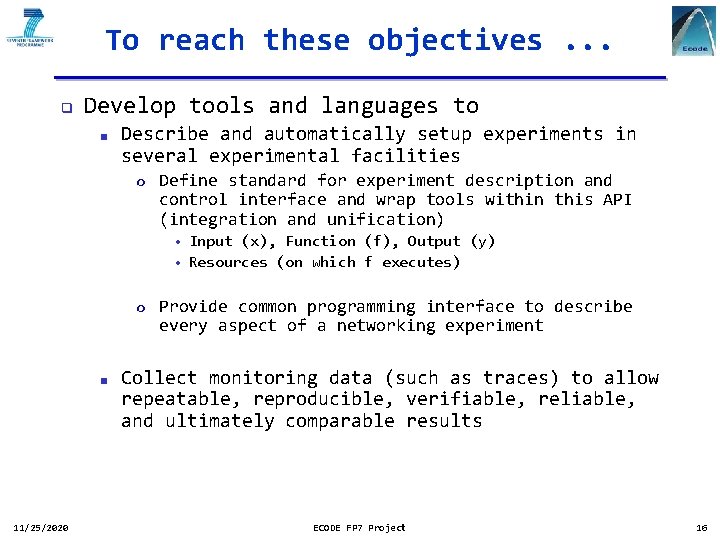
To reach these objectives. . . q Develop tools and languages to < Describe and automatically setup experiments in several experimental facilities o Define standard for experiment description and control interface and wrap tools within this API (integration and unification) • Input (x), Function (f), Output (y) • Resources (on which f executes) o < 11/25/2020 Provide common programming interface to describe every aspect of a networking experiment Collect monitoring data (such as traces) to allow repeatable, reproducible, verifiable, reliable, and ultimately comparable results ECODE FP 7 Project 16
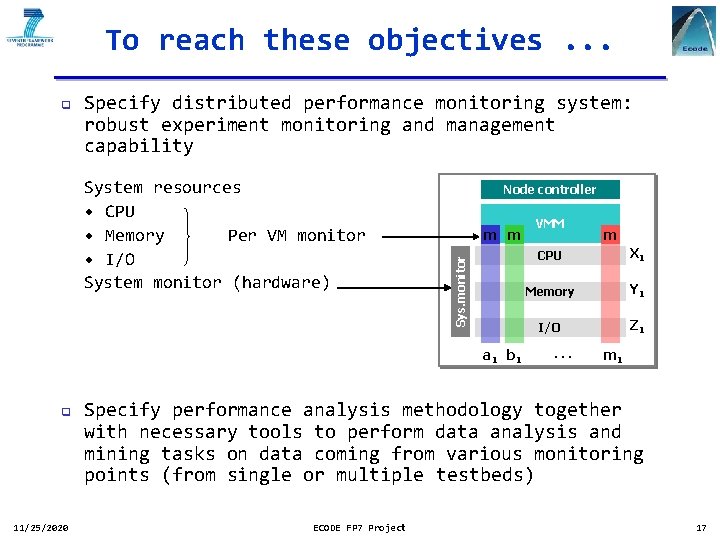
To reach these objectives. . . Specify distributed performance monitoring system: robust experiment monitoring and management capability System resources • CPU • Memory Per VM monitor • I/O System monitor (hardware) Node controller m m Sys. monitor q a 1 b 1 q 11/25/2020 VMM m CPU X 1 Memory Y 1 I/O Z 1 … m 1 Specify performance analysis methodology together with necessary tools to perform data analysis and mining tasks on data coming from various monitoring points (from single or multiple testbeds) ECODE FP 7 Project 17
To reach these objectives. . . q Develop tools to analyze sensitivity of performance measures to changes in "experimental model" parameters -> Sensitivity analysis: identify how results of an experimental model are responsive to changes in its (input or structural) parameters < < 11/25/2020 Fundamental tool for achieving confidence in experimentation and making its results credible Sensitivity analysis o Quantifies dependence of system behavior on parameters that affect modeled process and in particular its dynamics o Determine how sensitive a model is to changes in the numerical value of the model input parameters and changes in the model structural parameters ECODE FP 7 Project 18