
Experimental Track Research and Development Outline A Brief

Experimental Track – Research and Development
Outline • A Brief Overview of the Experimental Track • Phase I – The Imitation Game • Phase II – Can we make the world better?
Outline • A Brief Overview of the Experimental Track • Phase I – The Imitation Game • Phase II – Can we make the world better?
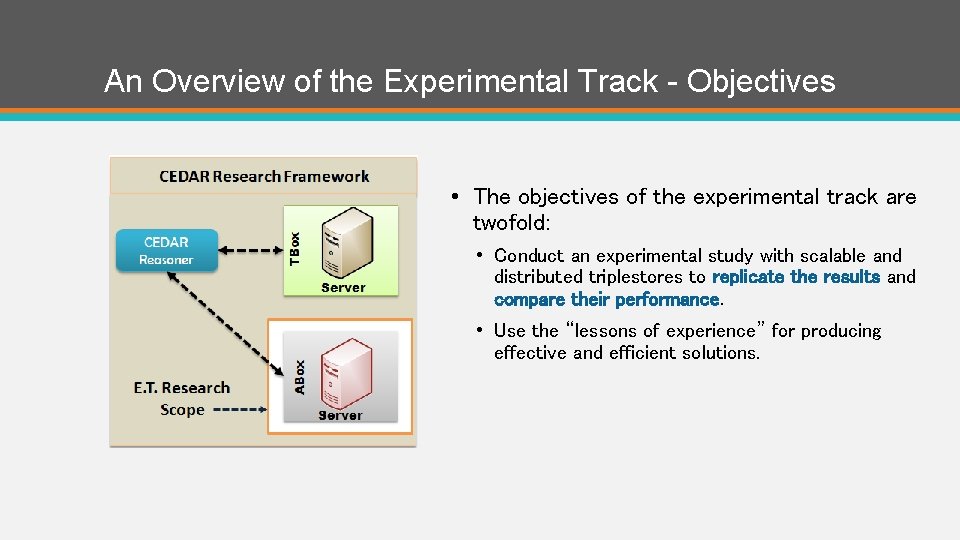
An Overview of the Experimental Track - Objectives • The objectives of the experimental track are twofold: • Conduct an experimental study with scalable and distributed triplestores to replicate the results and compare their performance. • Use the “lessons of experience” for producing effective and efficient solutions.
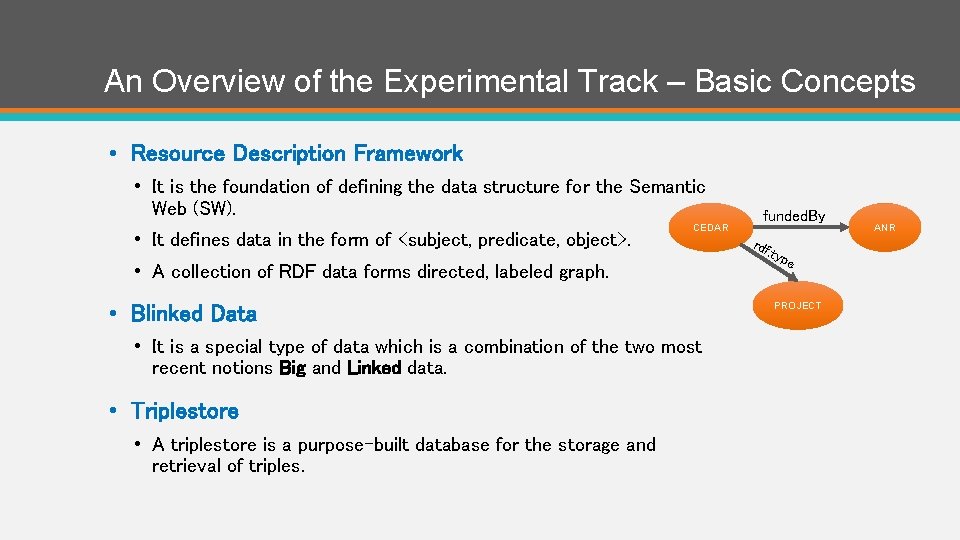
An Overview of the Experimental Track – Basic Concepts • Resource Description Framework • It is the foundation of defining the data structure for the Semantic Web (SW). • It defines data in the form of <subject, predicate, object>. CEDAR • A collection of RDF data forms directed, labeled graph. • Blinked Data • It is a special type of data which is a combination of the two most recent notions Big and Linked data. • Triplestore • A triplestore is a purpose-built database for the storage and retrieval of triples. funded. By rdf : typ e PROJECT ANR
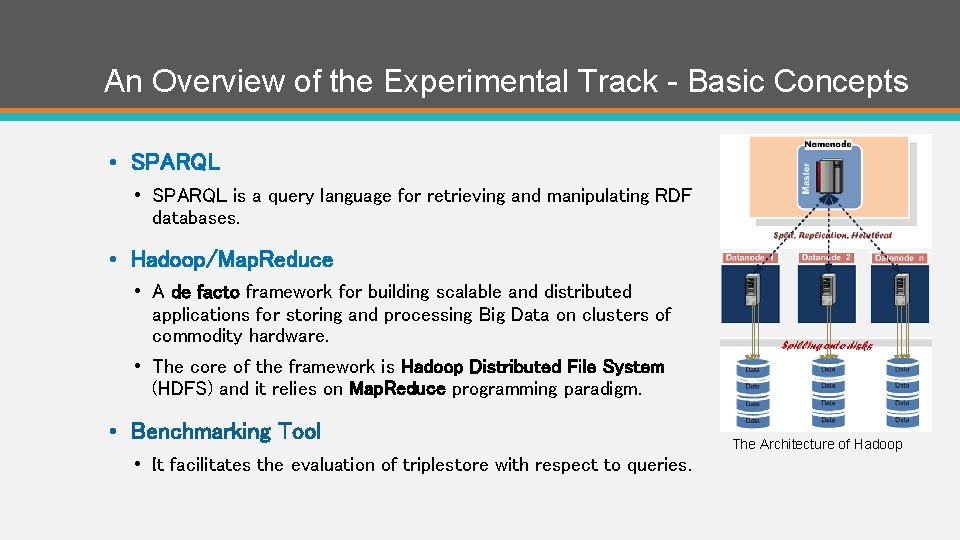
An Overview of the Experimental Track - Basic Concepts • SPARQL is a query language for retrieving and manipulating RDF databases. • Hadoop/Map. Reduce • A de facto framework for building scalable and distributed applications for storing and processing Big Data on clusters of commodity hardware. • The core of the framework is Hadoop Distributed File System (HDFS) and it relies on Map. Reduce programming paradigm. • Benchmarking Tool • It facilitates the evaluation of triplestore with respect to queries. The Architecture of Hadoop
An Overview of the Experimental Track – Key People • Lead Researcher • Prof. Mohand-Saïd Hacid • Manager/Researcher/Developer • Rafiqul Haque • Lead Developers • Minwei CHEN (Ced. TMart) • Tanguy Raynaud (Ced. Com) • Mohammed Ali Hammal (Xadoop) • Third Party Service Provider • Laurent Pouilloux (Grid 5000, École Normale Supérieure, Lyon) • Vincent Hurtevent (LIRIS Cloud, Université Claude Bernard Lyon 1, Lyon) Research Chair • Prof. Hassan Aït-kaci
Outline • A Brief Overview of the Experimental Track • Phase I – The Imitation Game • Experiments with Triplestores • • Large-scale Triplestores Experiment Platform Experiment Setting Results • Lessons Learnt
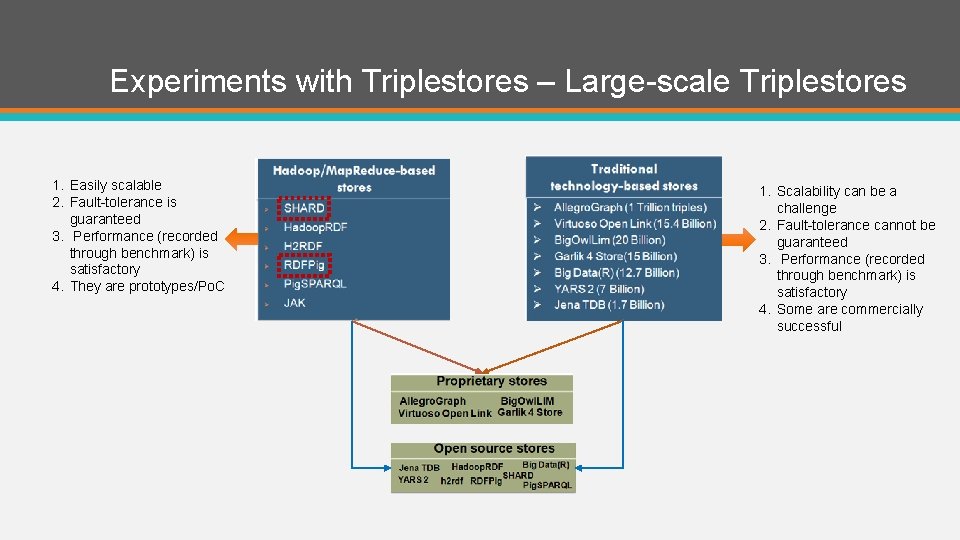
Experiments with Triplestores – Large-scale Triplestores 1. Easily scalable 2. Fault-tolerance is guaranteed 3. Performance (recorded through benchmark) is satisfactory 4. They are prototypes/Po. C 1. Scalability can be a challenge 2. Fault-tolerance cannot be guaranteed 3. Performance (recorded through benchmark) is satisfactory 4. Some are commercially successful
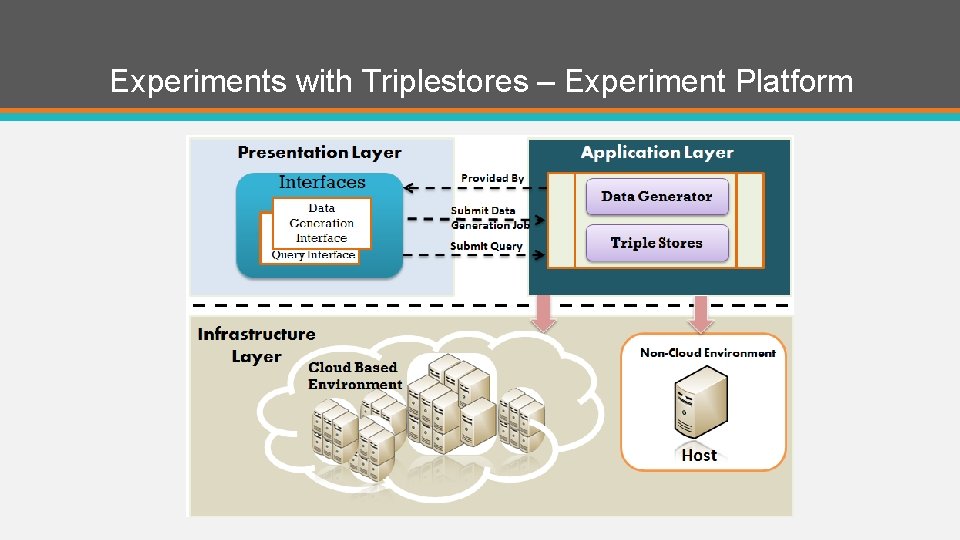
Experiments with Triplestores – Experiment Platform

Experiments with Triplestores – Experiment Setting • Triplestores • SHARD (Scalable, High-Performance, Robust and Distributed) • Developed by the BBN technologies • SHARD saves intermediate results of the query processing to speed up the processing of similar later queries • RDFPig • Developed jointly by VUA and Yahoo • It relies on “Skew-resistant” optimization technique • LUBM • A benchmarking tool to facilitate the evaluation of triplestore with respect to extensional queries. • Queries • 14 SPARQL queries suggested by LUBM • Dataset • 20 Gigabytes
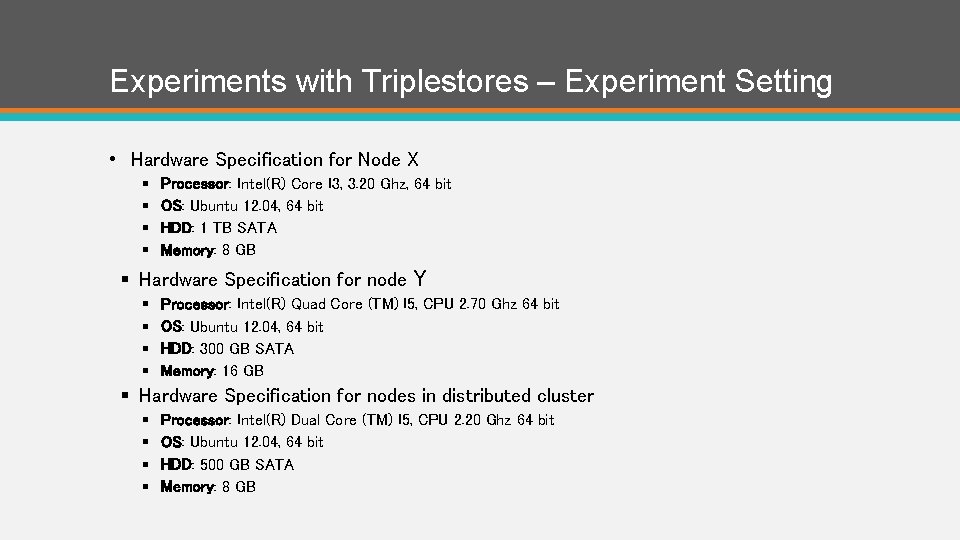
Experiments with Triplestores – Experiment Setting • Hardware Specification for Node X § § Processor: Intel(R) Core I 3, 3. 20 Ghz, 64 bit OS: Ubuntu 12. 04, 64 bit HDD: 1 TB SATA Memory: 8 GB § Hardware Specification for node Y § § Processor: Intel(R) Quad Core (TM) I 5, CPU 2. 70 Ghz 64 bit OS: Ubuntu 12. 04, 64 bit HDD: 300 GB SATA Memory: 16 GB § Hardware Specification for nodes in distributed cluster § § Processor: Intel(R) Dual Core (TM) I 5, CPU 2. 20 Ghz 64 bit OS: Ubuntu 12. 04, 64 bit HDD: 500 GB SATA Memory: 8 GB
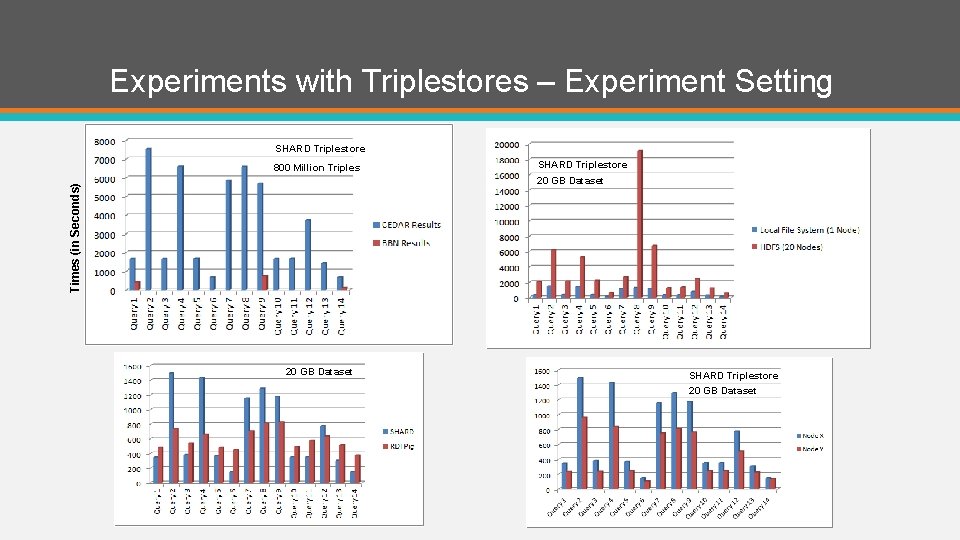
Experiments with Triplestores – Experiment Setting SHARD Triplestore 800 Million Triples SHARD Triplestore Times (in Seconds) 20 GB Dataset SHARD Triplestore 20 GB Dataset
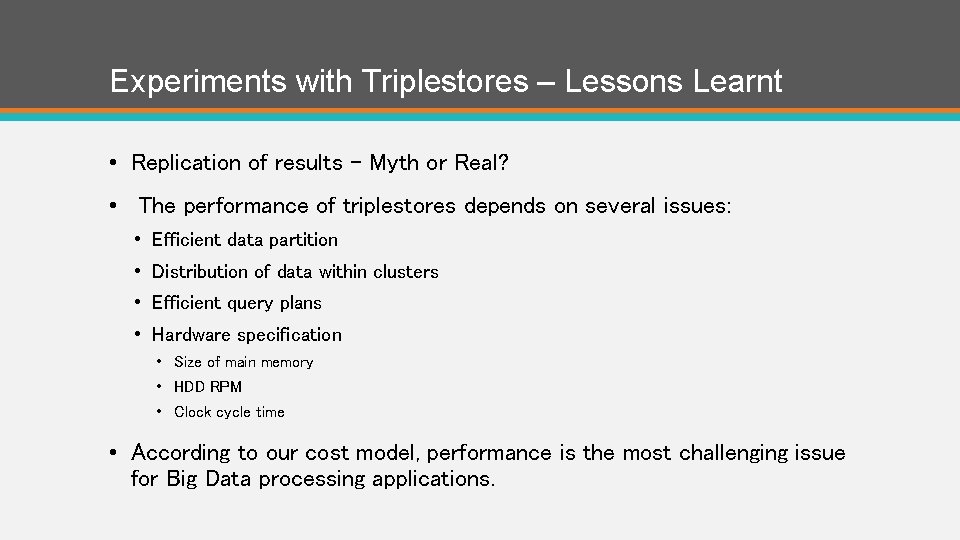
Experiments with Triplestores – Lessons Learnt • Replication of results – Myth or Real? • The performance of triplestores depends on several issues: • Efficient data partition • Distribution of data within clusters • Efficient query plans • Hardware specification • Size of main memory • HDD RPM • Clock cycle time • According to our cost model, performance is the most challenging issue for Big Data processing applications.
Experiments with Triplestores – Lessons Learnt (cont. ) • The insight of Hadoop/Map. Reduce • It guarantees scalability for Big Linked Data applications • It has almost 150 configuration parameters. Therefore, configuring a highperformance Hadoop cluster is highly challenging • The performance tuning parameters are heavily dependent on each other • At runtime, failure of slave nodes affects application performance • The overhead cost affect performance • The delay time between map sort reduce can affect the performance severely • The creators were friendly but not always responsive. Hadoop/Map. Reduce can be an ideal framework for building analytics with batch processing style. However, it is not ideal technology for a real-time analytic.
Outline • Phase II – Can we make the world better? • An Overview of Ced. TMart Triplestore • The Architecture • Ced. TMart Components • Query Optimization • Conclusion and Future Work • Demonstration Implementation Credit: The main implementer of Ced. TMart is Minwei Chen, M. Sc.
An Overview of Ced. TMart • Ced. TMart is a framework for processing Big Linked Data and queries in both centralized and distributed environment. • The main goal of this framework is to guarantee the scalability and high-performance in processing queries on large-scale datasets. • The key functions of this framework are: data cleaning, conversion, compression, comparison, distribution, and query processing.
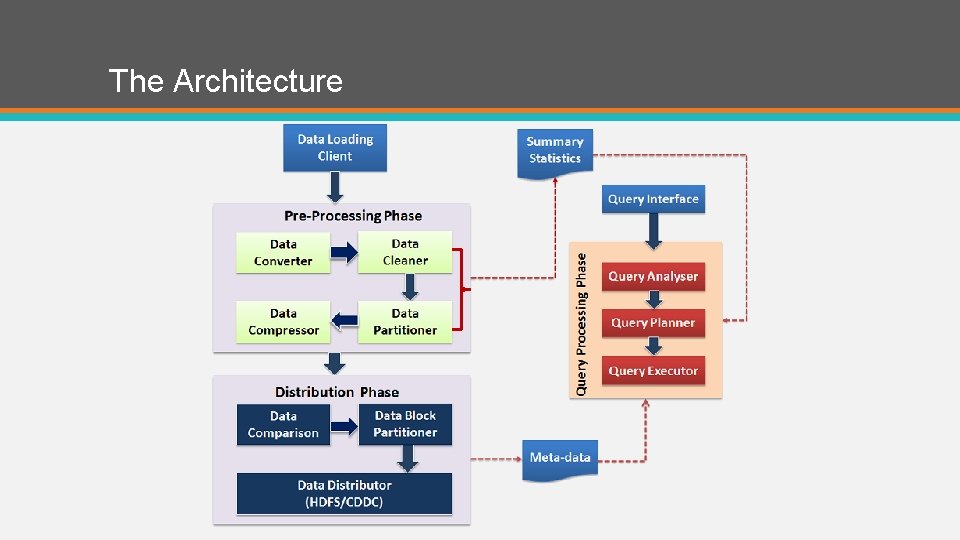
The Architecture
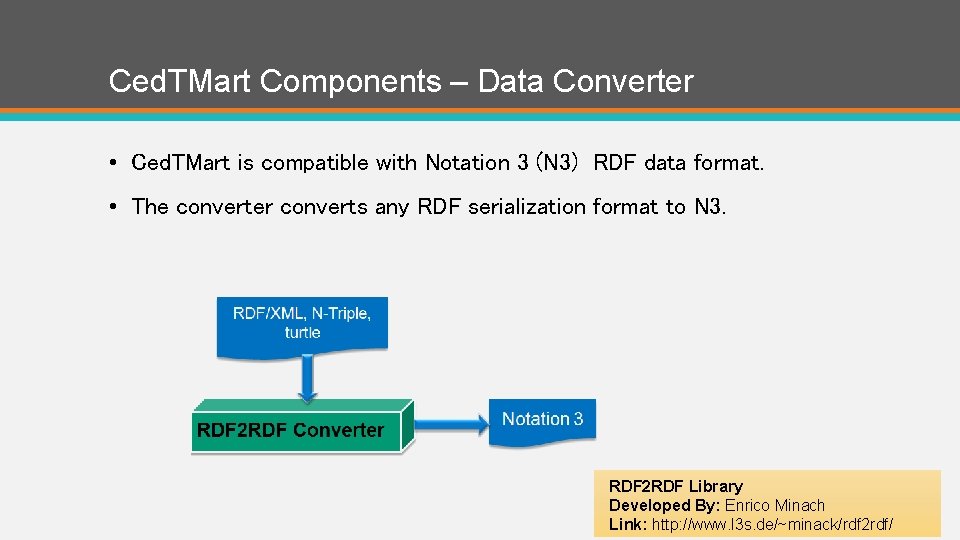
Ced. TMart Components – Data Converter • Ced. TMart is compatible with Notation 3 (N 3) RDF data format. • The converter converts any RDF serialization format to N 3. RDF 2 RDF Library Developed By: Enrico Minach Link: http: //www. l 3 s. de/~minack/rdf 2 rdf/
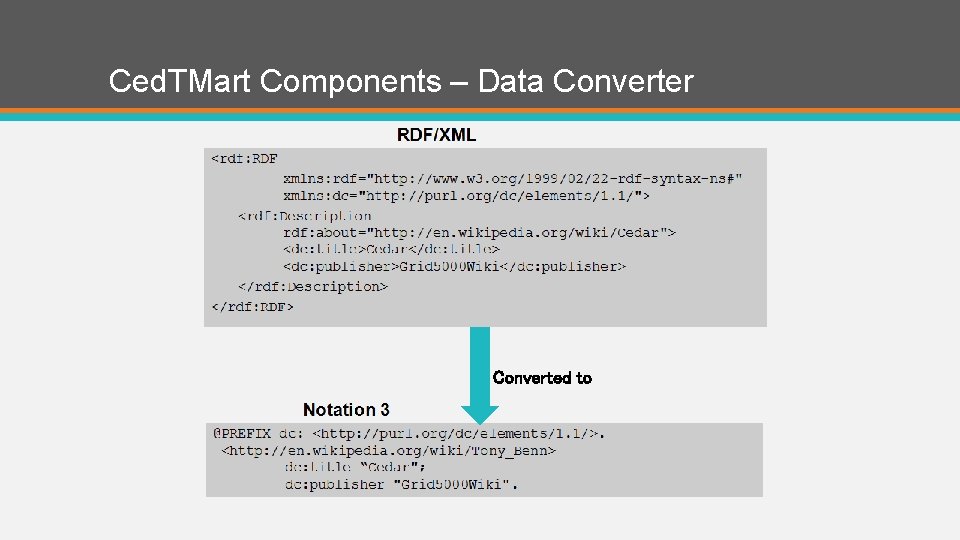
Ced. TMart Components – Data Converter Converted to
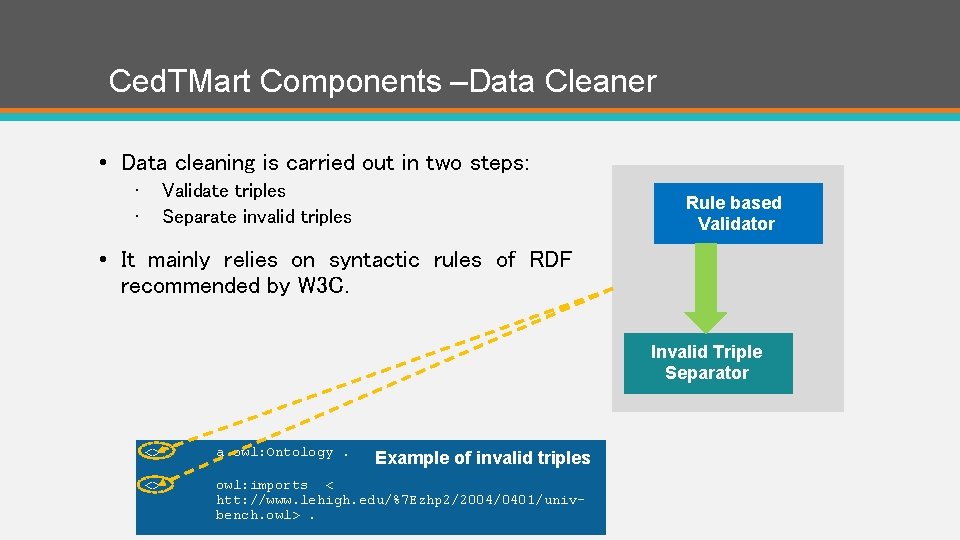
Ced. TMart Components –Data Cleaner • Data cleaning is carried out in two steps: • • Validate triples Separate invalid triples Rule based Validator • It mainly relies on syntactic rules of RDF recommended by W 3 C. Invalid Triple Separator <> a owl: Ontology. Example of invalid triples <> owl: imports < htt: //www. lehigh. edu/%7 Ezhp 2/2004/0401/univbench. owl>.
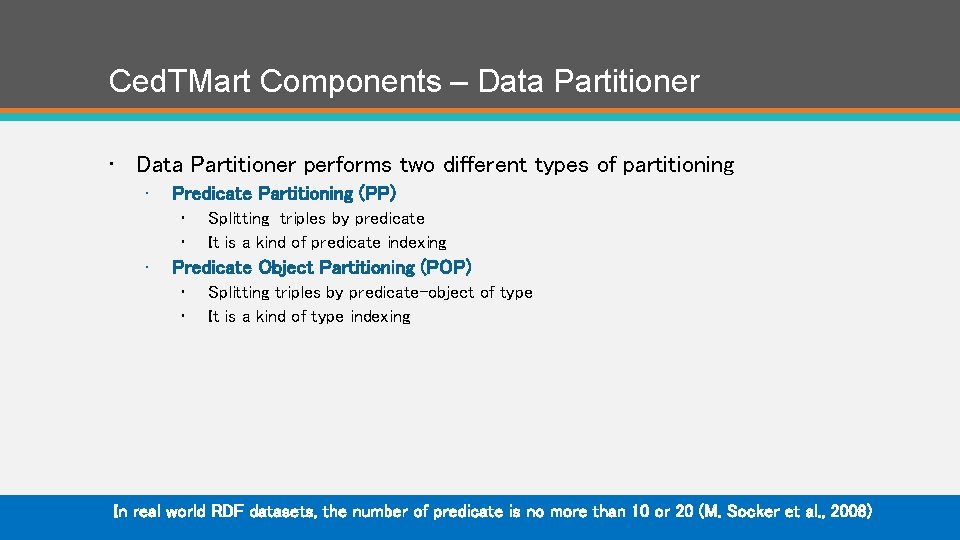
Ced. TMart Components – Data Partitioner • Data Partitioner performs two different types of partitioning • Predicate Partitioning (PP) • • • Splitting triples by predicate It is a kind of predicate indexing Predicate Object Partitioning (POP) • • Splitting triples by predicate-object of type It is a kind of type indexing In real world RDF datasets, the number of predicate is no more than 10 or 20 (M. Socker et al. , 2008)
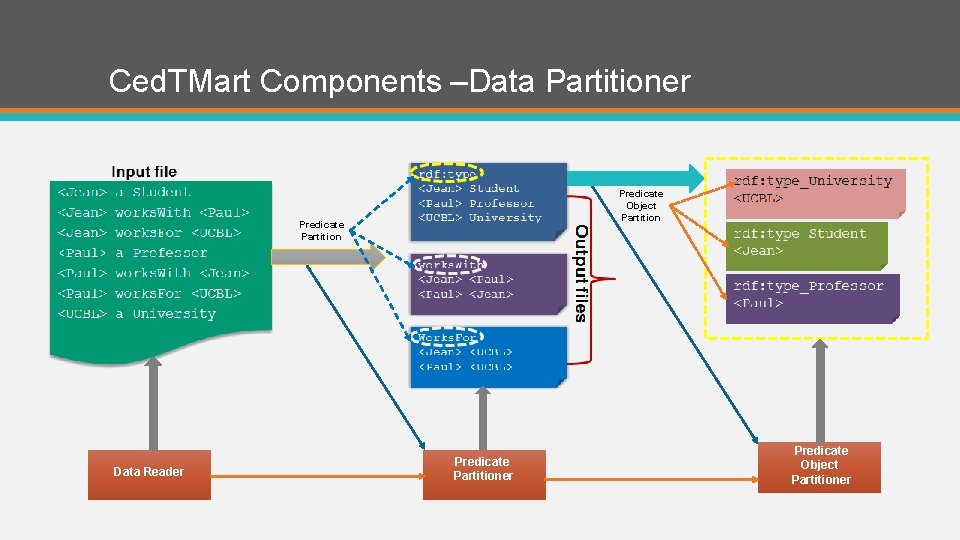
Ced. TMart Components –Data Partitioner Predicate Object Partition Predicate Partition Data Reader Predicate Partitioner Predicate Object Partitioner
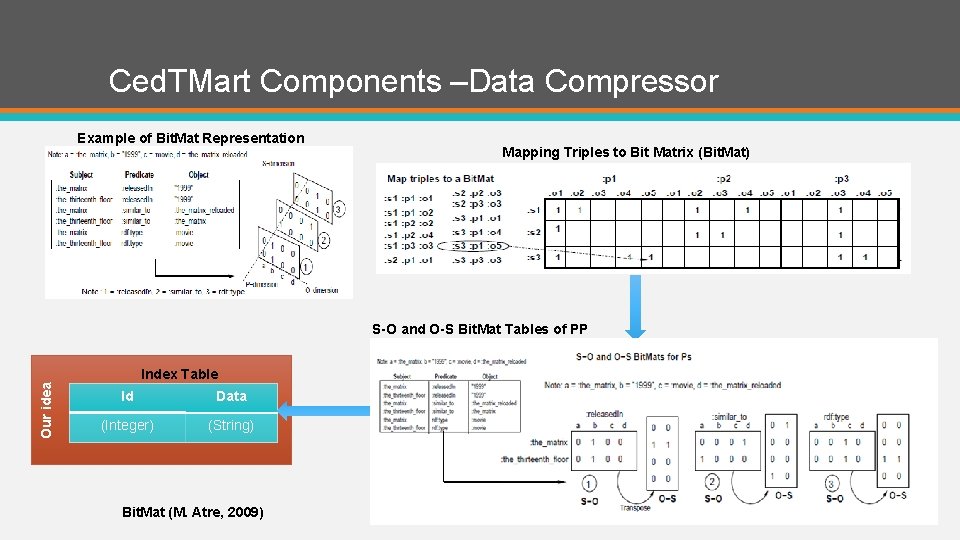
Ced. TMart Components –Data Compressor Example of Bit. Mat Representation Mapping Triples to Bit Matrix (Bit. Mat) S-O and O-S Bit. Mat Tables of PP Our idea Index Table Id Data (Integer) (String) Bit. Mat (M. Atre, 2009)
Ced. TMart Components –Data Compressor • D-Gap Compression • It is a process to translating a bit array into a structure using integer. • It is a special type of Run Length Encoding (RLE) method. • The key purpose is to compress the sparse Bit. Mat matrices and enable the system to load the S-O (Subject-Object) and O-S (Object-Subject) matrices onto the main memory which helps processing queries faster. • It enables performing logical operations such as processing queries directly on the compressed files.
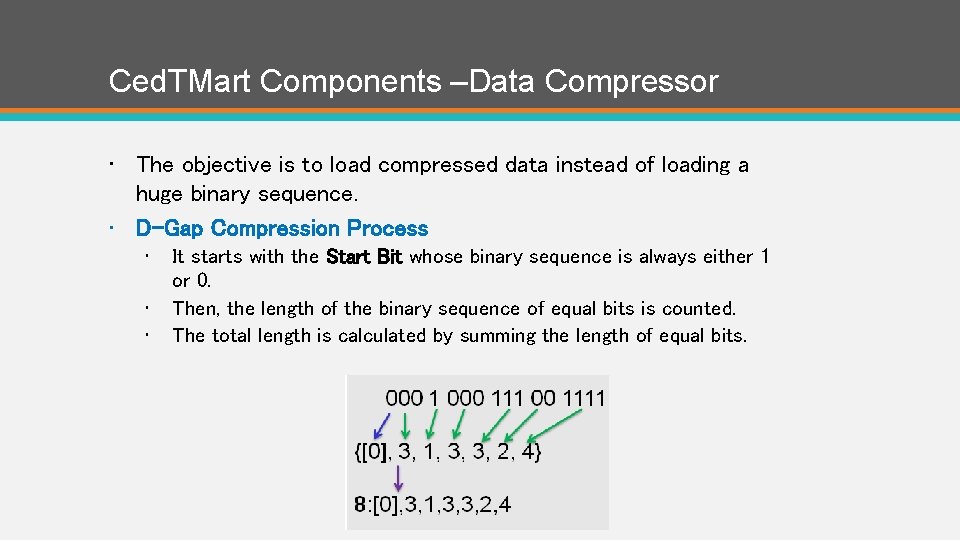
Ced. TMart Components –Data Compressor • The objective is to load compressed data instead of loading a huge binary sequence. • D-Gap Compression Process • • • It starts with the Start Bit whose binary sequence is always either 1 or 0. Then, the length of the binary sequence of equal bits is counted. The total length is calculated by summing the length of equal bits.
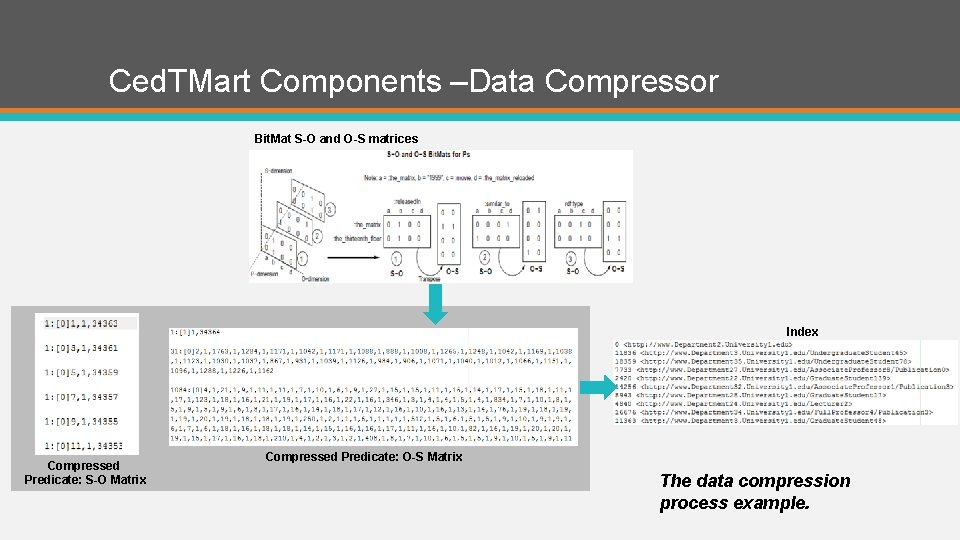
Ced. TMart Components –Data Compressor Bit. Mat S-O and O-S matrices Index Compressed Predicate: S-O Matrix Compressed Predicate: O-S Matrix The data compression process example.
Ced. TMart Components – Data Distributor • Data distributor performs two functions: • Data Comparison • The key purpose is to partition dataset intelligently to reduce communication between data nodes. • It is a process of comparing subject-object pairs between the predicates. • It calculates similarity between predicates by summing the common distinct subjects and objects between two predicates. • Data Distribution • It distributes data within a cluster of nodes.
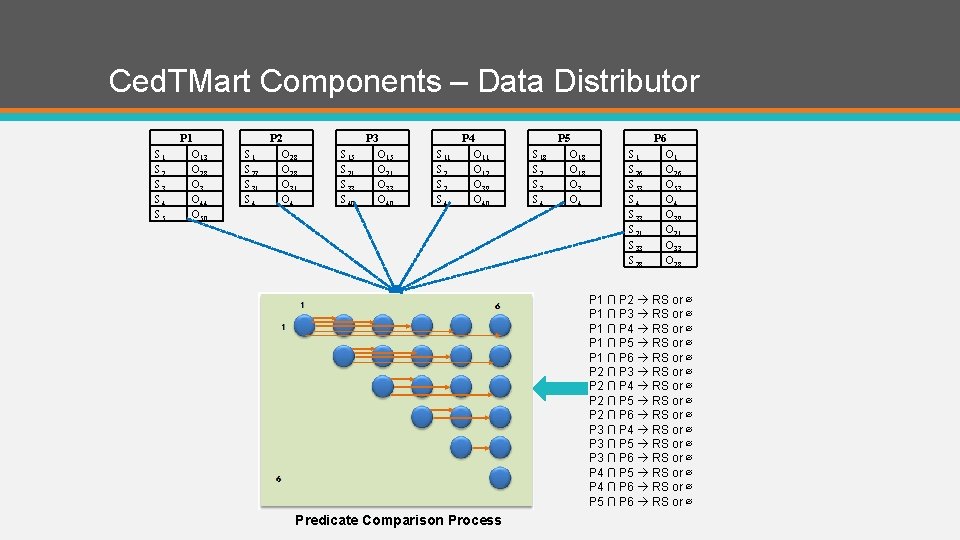
Ced. TMart Components – Data Distributor S 1 S 2 S 3 S 4 S 5 P 1 O 13 O 28 O 3 O 44 O 50 S 1 S 27 S 31 S 4 P 2 O 28 O 31 O 4 S 15 S 21 S 33 S 40 P 3 O 15 O 21 O 33 O 40 S 11 S 2 S 4 P 4 O 11 O 12 O 39 O 40 S 18 S 2 S 3 S 4 P 5 O 18 O 3 O 4 S 1 S 26 S 53 S 4 S 33 S 21 S 33 S 28 P 6 O 1 O 26 O 53 O 4 O 39 O 21 O 33 O 28 P 1 ∩ P 2 RS or ∅ P 1 ∩ P 3 RS or ∅ P 1 ∩ P 4 RS or ∅ P 1 ∩ P 5 RS or ∅ P 1 ∩ P 6 RS or ∅ P 2 ∩ P 3 RS or ∅ P 2 ∩ P 4 RS or ∅ P 2 ∩ P 5 RS or ∅ P 2 ∩ P 6 RS or ∅ P 3 ∩ P 4 RS or ∅ P 3 ∩ P 5 RS or ∅ P 3 ∩ P 6 RS or ∅ P 4 ∩ P 5 RS or ∅ P 4 ∩ P 6 RS or ∅ P 5 ∩ P 6 RS or ∅ Predicate Comparison Process
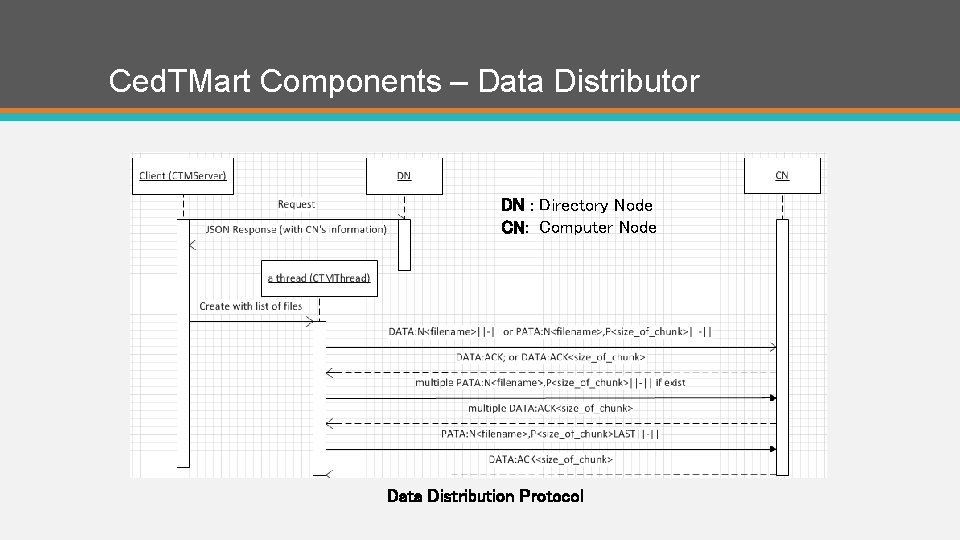
Ced. TMart Components – Data Distributor DN : Directory Node CN: Computer Node Data Distribution Protocol
Ced. TMart Components – Query Processor • The query processor is composed of three components: • Query analyser • Performs analysis • Measure the complexity of queries • Query Planner • • Partitions SPARQL graphs Ranks subgraphs Calculate costs Generates an efficient plan based on the cost of executing subgraphs (parts of a query) • Query executor • Executes subgraphs
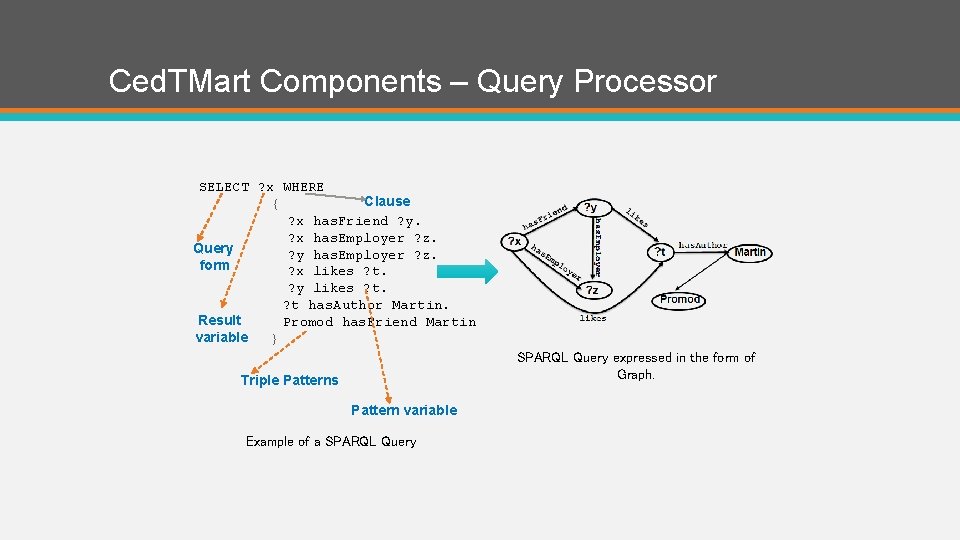
Ced. TMart Components – Query Processor SELECT ? x WHERE Clause { ? x has. Friend ? y. ? x has. Employer ? z. Query ? y has. Employer ? z. form ? x likes ? t. ? y likes ? t has. Author Martin. Result Promod has. Friend Martin variable } SPARQL Query expressed in the form of Graph. Triple Patterns Pattern variable Example of a SPARQL Query
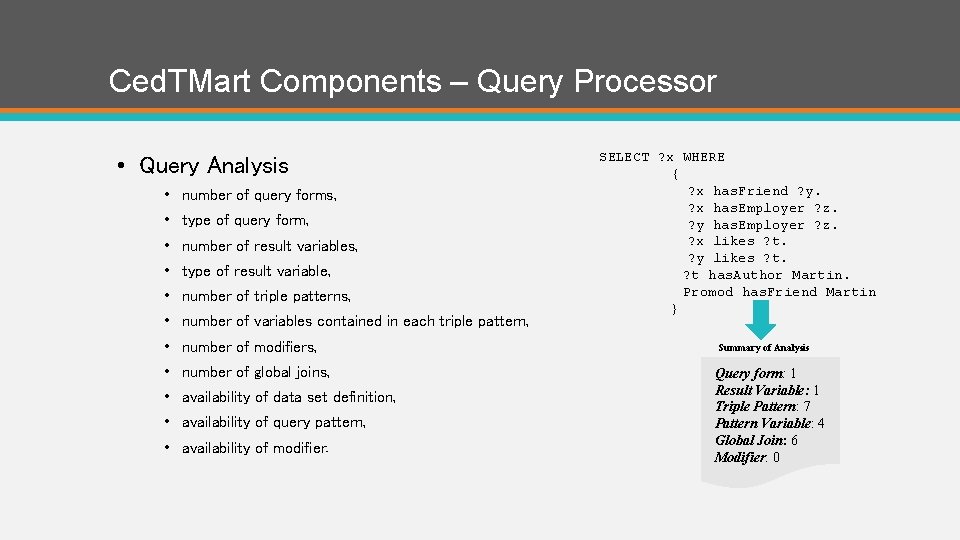
Ced. TMart Components – Query Processor • Query Analysis • number of query forms, • type of query form, • number of result variables, • type of result variable, • number of triple patterns, • number of variables contained in each triple pattern, • number of modifiers, • number of global joins, • availability of data set definition, • availability of query pattern, • availability of modifier. SELECT ? x WHERE { ? x has. Friend ? y. ? x has. Employer ? z. ? y has. Employer ? z. ? x likes ? t. ? y likes ? t has. Author Martin. Promod has. Friend Martin } Summary of Analysis Query form: 1 Result Variable: 1 Triple Pattern: 7 Pattern Variable: 4 Global Join: 6 Modifier: 0
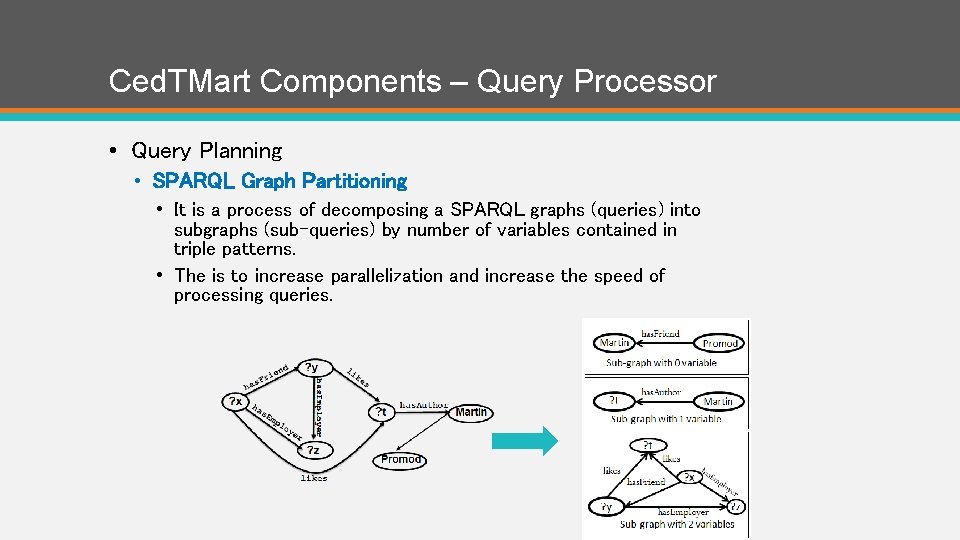
Ced. TMart Components – Query Processor • Query Planning • SPARQL Graph Partitioning • It is a process of decomposing a SPARQL graphs (queries) into subgraphs (sub-queries) by number of variables contained in triple patterns. • The is to increase parallelization and increase the speed of processing queries.
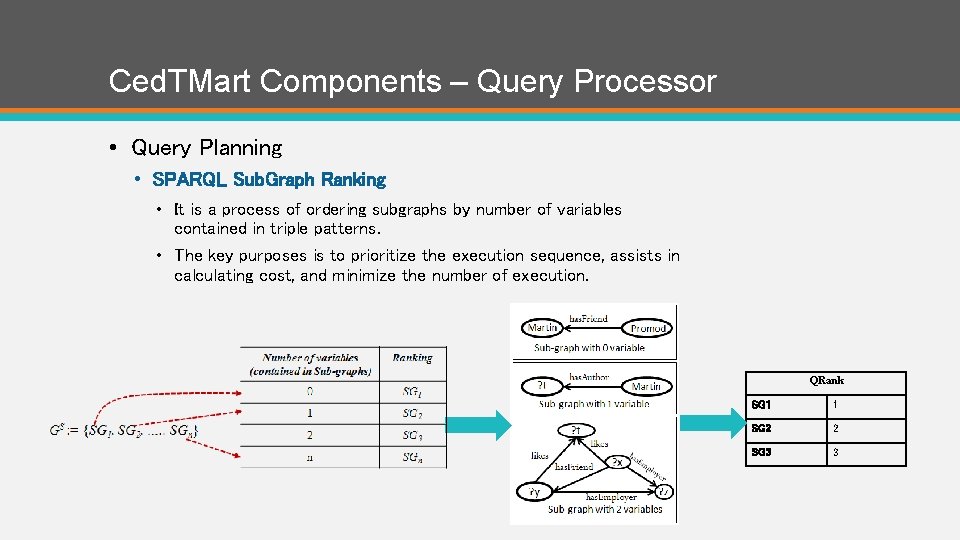
Ced. TMart Components – Query Processor • Query Planning • SPARQL Sub. Graph Ranking • It is a process of ordering subgraphs by number of variables contained in triple patterns. • The key purposes is to prioritize the execution sequence, assists in calculating cost, and minimize the number of execution. QRank SG 1 1 SG 2 2 SG 3 3
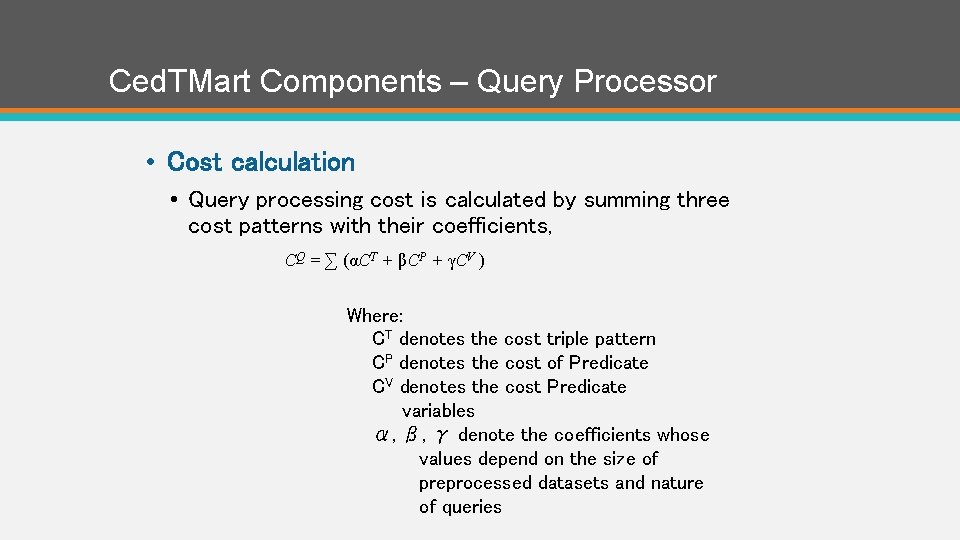
Ced. TMart Components – Query Processor • Cost calculation • Query processing cost is calculated by summing three cost patterns with their coefficients, CQ = ∑ (αCT + βCP + γCV ) Where: CT denotes the cost triple pattern CP denotes the cost of Predicate CV denotes the cost Predicate variables α, β, γ denote the coefficients whose values depend on the size of preprocessed datasets and nature of queries
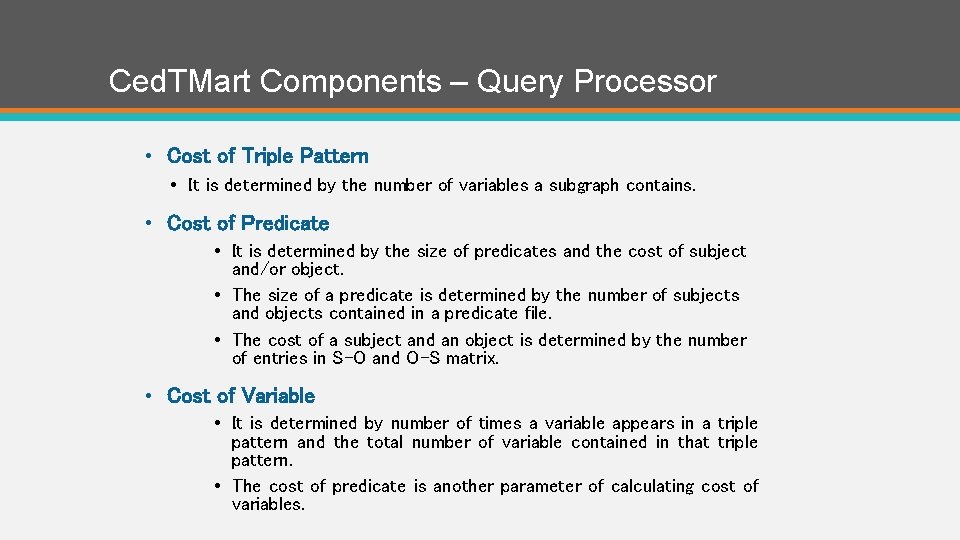
Ced. TMart Components – Query Processor • Cost of Triple Pattern • It is determined by the number of variables a subgraph contains. • Cost of Predicate • It is determined by the size of predicates and the cost of subject and/or object. • The size of a predicate is determined by the number of subjects and objects contained in a predicate file. • The cost of a subject and an object is determined by the number of entries in S-O and O-S matrix. • Cost of Variable • It is determined by number of times a variable appears in a triple pattern and the total number of variable contained in that triple pattern. • The cost of predicate is another parameter of calculating cost of variables.
Ced. TMart Components – Query Processor • Generating Execution Plan • The planner generates an efficient execution plan based on the estimated cost. • Query Execution • The executor executes queries according to the generated plan.
Query Optimization • Predicate partitioning helps in planning global and local joins efficiently. • Predicate object partition is a type of index which enables generating a highly-efficient plan for a special type of queries. • Intelligent partitioning of data blocks within a cluster can optimize the performance. • Multilevel indexing enables faster information retrieval. • We developed a binary tree structure of block location which enables identify data location faster. • The cost patterns assist in generating efficient query execution plan. • D-Gap compression enables loading a huge index table on memory.
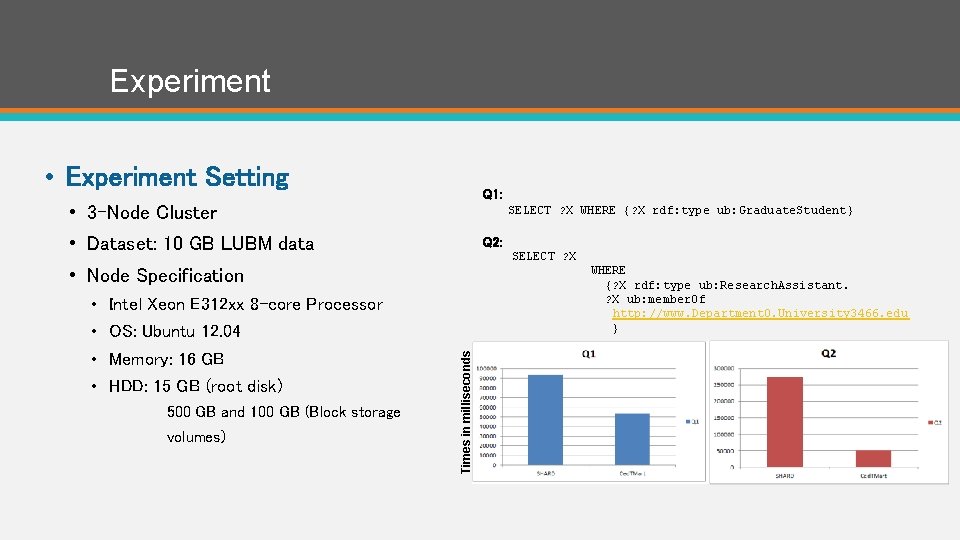
Experiment • Experiment Setting Q 1: • 3–Node Cluster SELECT ? X WHERE {? X rdf: type ub: Graduate. Student} • Dataset: 10 GB LUBM data Q 2: SELECT ? X WHERE {? X rdf: type ub: Research. Assistant. ? X ub: member. Of http: //www. Department 0. University 3466. edu } • Node Specification Intel Xeon E 312 xx 8 -core Processor OS: Ubuntu 12. 04 Memory: 16 GB HDD: 15 GB (root disk) 500 GB and 100 GB (Block storage volumes) Times in milliseconds • •
Conclusion & Future Work • Conclusion • The Ced. TMart framework provides a complete set of functionalities for processing multi-join queries on Big Linked dataset. • It has been built on various methods and techniques to guarantee high-performance in processing queries. • The cost patterns along with binary tree representation data block locations are efficient techniques for processing queries faster. • The framework is scalable but it needs further investigation.
Conclusion & Future Work • Conclusion • Contribution: experimenting with our own ideas for a distributed triplestore. • The query processor has a few limitations: • • It cannot handle all SPARQL query forms. The compressor is memory bound. It cannot process modifiers, and optional pattern queries. The performance of Ced. Tmart in Big Linked Data is not yet guaranteed. • It does not have some important functional features such as Update.
Conclusion & Future Work • Potential Improvements • The data cleaner should be improved by adding more rules. • Ced. TMart should be experimented in a massive-scale cluster to validate scalability. • The algorithms and optimization techniques should be refined by conducting more experiments with respect to different use cases. • Further research is required to optimize the global join of complex queries. • The source code of triplestore needs debugging.
Demonstration
- Slides: 44