
Experimental Simulations of Intense Beam Propagation Over Large
Experimental Simulations of Intense Beam Propagation Over Large Distances in a Compact Linear Paul Trap* Erik P. Gilson Princeton Plasma Physics Laboratory 2005 APS-DPP Denver, CO October 26 th, 2005 In collaboration with: Andy Carpe, Moses Chung, Ron Davidson, Mikhail Dorf, Phil Efthimion, Ed Startsev, Dick Majeski, and Hong Qin *This work is supported by the U. S. Department of Energy.
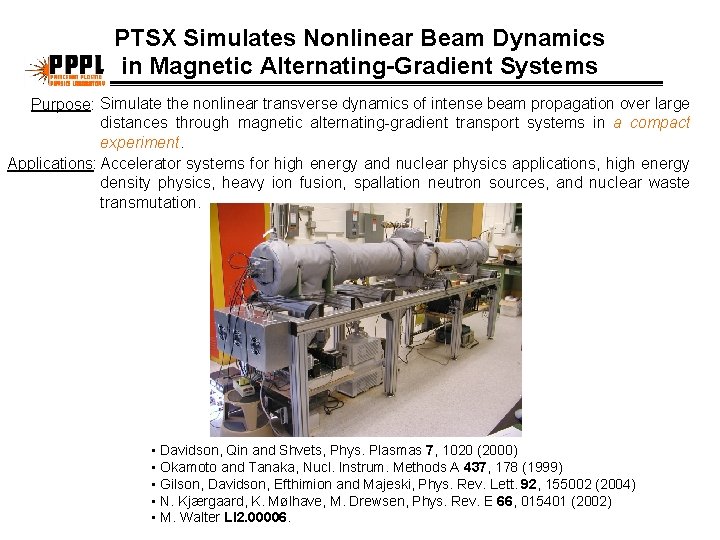
PTSX Simulates Nonlinear Beam Dynamics in Magnetic Alternating-Gradient Systems Purpose: Simulate the nonlinear transverse dynamics of intense beam propagation over large distances through magnetic alternating-gradient transport systems in a compact experiment. Applications: Accelerator systems for high energy and nuclear physics applications, high energy density physics, heavy ion fusion, spallation neutron sources, and nuclear waste transmutation. • Davidson, Qin and Shvets, Phys. Plasmas 7, 1020 (2000) • Okamoto and Tanaka, Nucl. Instrum. Methods A 437, 178 (1999) • Gilson, Davidson, Efthimion and Majeski, Phys. Rev. Lett. 92, 155002 (2004) • N. Kjærgaard, K. Mølhave, M. Drewsen, Phys. Rev. E 66, 015401 (2002) • M. Walter LI 2. 00006.
Scientific Motivation • Beam mismatch and envelope instabilities • Collective wave excitations • Chaotic particle dynamics and production of halo particles • Mechanisms for emittance growth • Effects of distribution function on stability properties • Compression techniques
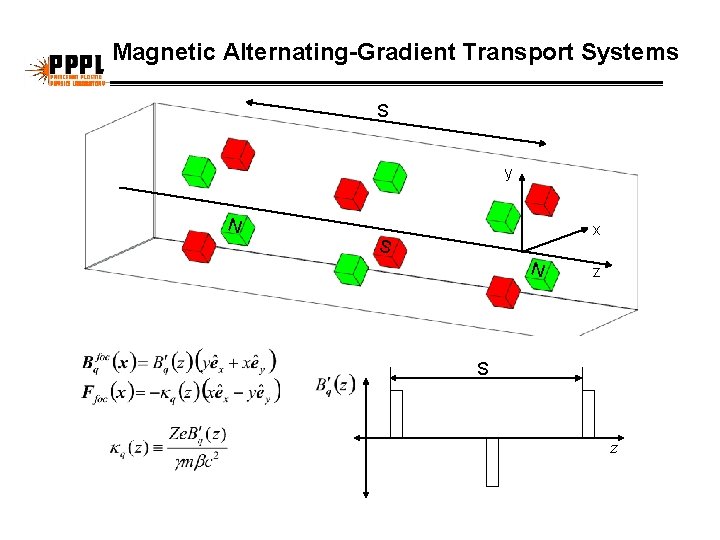
Magnetic Alternating-Gradient Transport Systems S y N x S N z S z

Transverse Focusing Frequency, Vacuum Phase Advance, and Normalized Intensity Parameter Characterize the System Transverse focusing period, 2 p/wq 5/f 10/f 15/f 20/f The smooth trajectory’s vacuum phase advance, sv, is 35 degrees in this example. To avoid instabilities, Normalized intensity parameter s ~ 0. 2 for Spallation Neutron Source. to confine the space-charge.
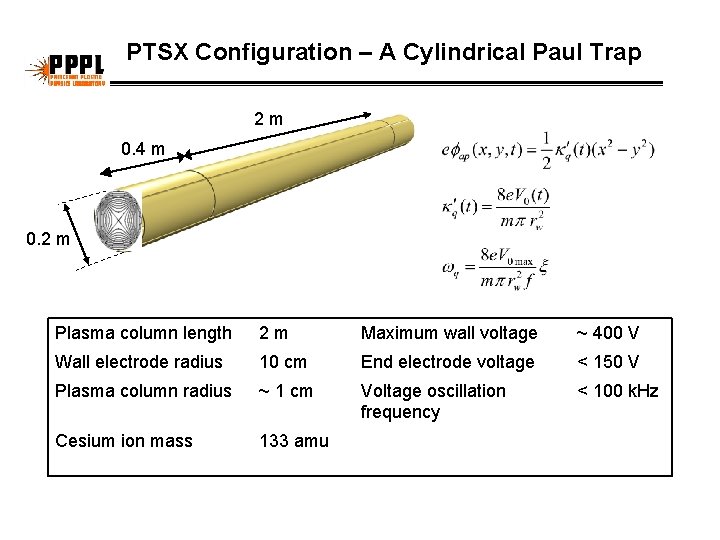
PTSX Configuration – A Cylindrical Paul Trap 2 m 0. 4 m 0. 2 m Plasma column length 2 m Maximum wall voltage ~ 400 V Wall electrode radius 10 cm End electrode voltage < 150 V Plasma column radius ~ 1 cm Voltage oscillation frequency < 100 k. Hz Cesium ion mass 133 amu
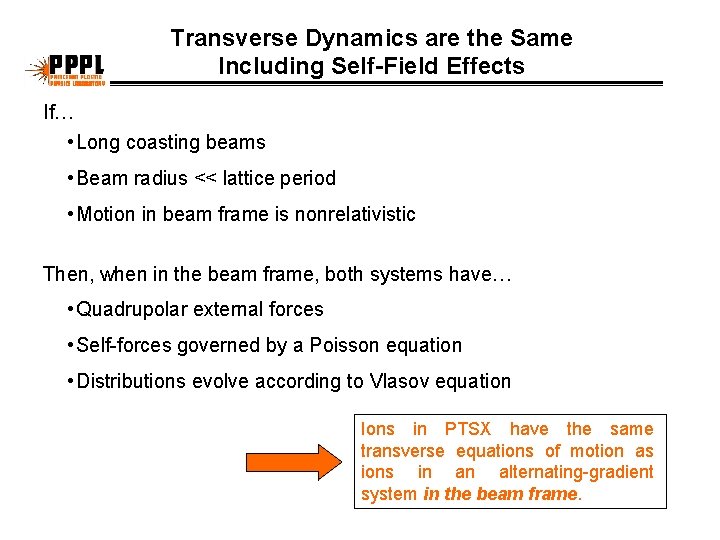
Transverse Dynamics are the Same Including Self-Field Effects If… • Long coasting beams • Beam radius << lattice period • Motion in beam frame is nonrelativistic Then, when in the beam frame, both systems have… • Quadrupolar external forces • Self-forces governed by a Poisson equation • Distributions evolve according to Vlasov equation Ions in PTSX have the same transverse equations of motion as ions in an alternating-gradient system in the beam frame.
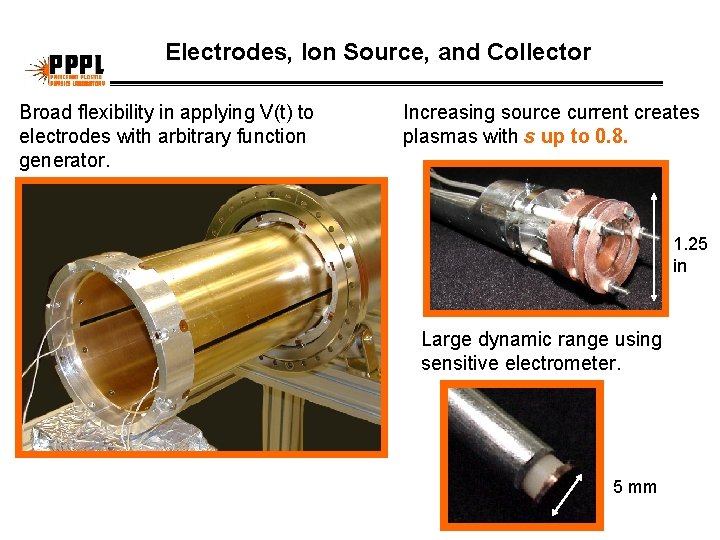
Electrodes, Ion Source, and Collector Broad flexibility in applying V(t) to electrodes with arbitrary function generator. Increasing source current creates plasmas with s up to 0. 8. 1 cm 1. 25 in Large dynamic range using sensitive electrometer. 5 mm
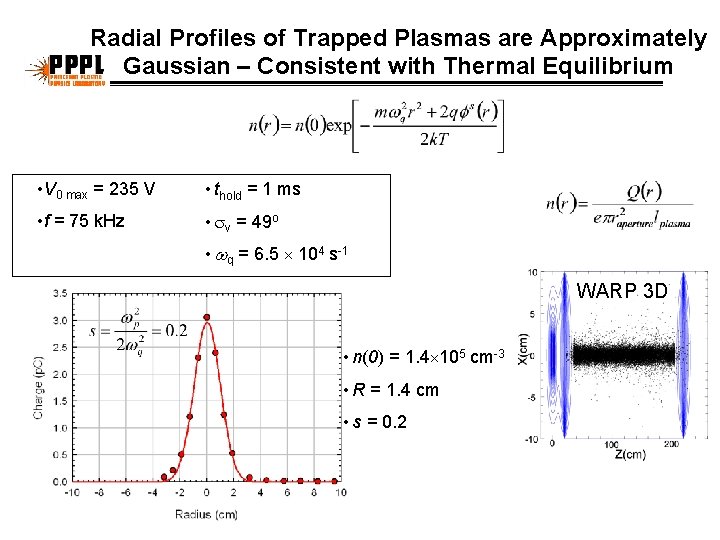
Radial Profiles of Trapped Plasmas are Approximately Gaussian – Consistent with Thermal Equilibrium • V 0 max = 235 V • thold = 1 ms • f = 75 k. Hz • sv = 49 o • wq = 6. 5 104 s-1 WARP 3 D • n(0) = 1. 4 105 cm-3 • R = 1. 4 cm • s = 0. 2
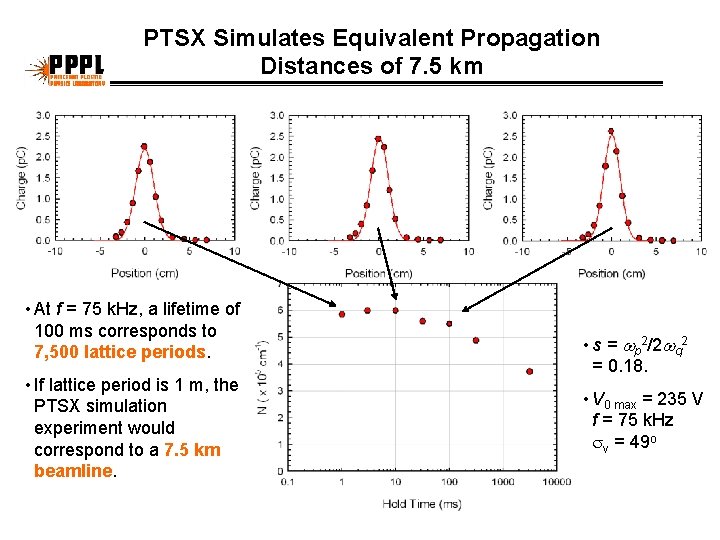
PTSX Simulates Equivalent Propagation Distances of 7. 5 km • At f = 75 k. Hz, a lifetime of 100 ms corresponds to 7, 500 lattice periods. • If lattice period is 1 m, the PTSX simulation experiment would correspond to a 7. 5 km beamline. • s = wp 2/2 wq 2 = 0. 18. • V 0 max = 235 V f = 75 k. Hz sv = 49 o
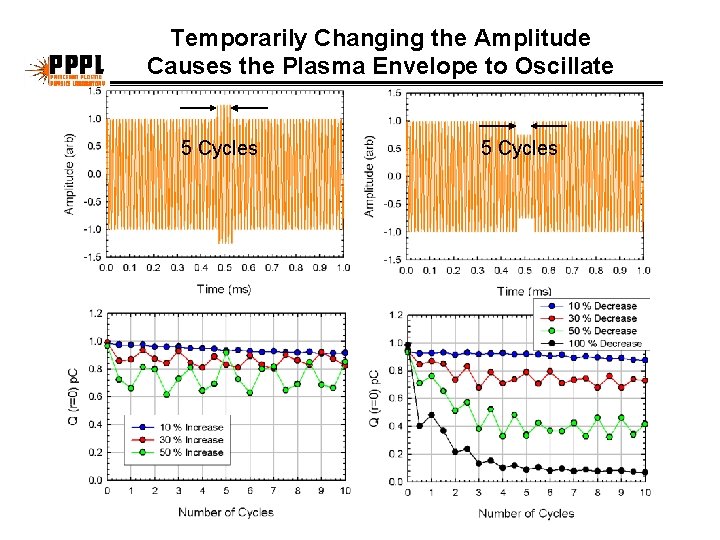
Temporarily Changing the Amplitude Causes the Plasma Envelope to Oscillate 5 Cycles
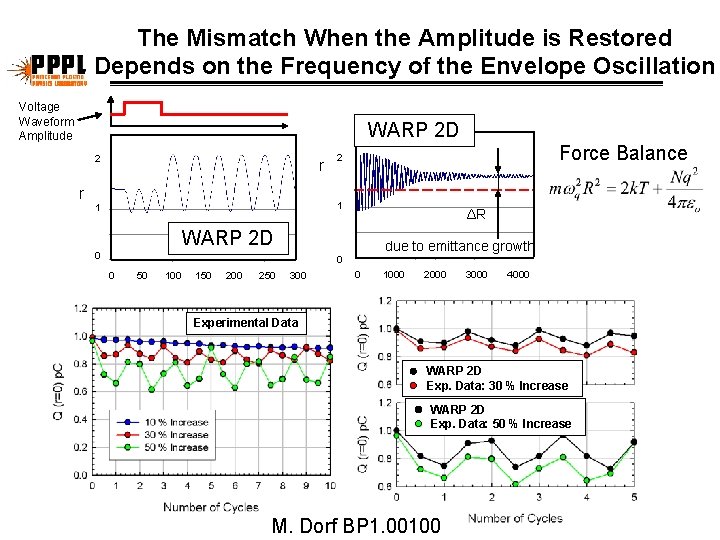
The Mismatch When the Amplitude is Restored Depends on the Frequency of the Envelope Oscillation Voltage Waveform Amplitude WARP 2 D 2 r r Force Balance 2 1 1 ΔR WARP 2 D due to emittance growth 0 0 0 50 100 150 200 250 300 0 1000 2000 3000 4000 Experimental Data WARP 2 D Exp. Data: 30 % Increase WARP 2 D Exp. Data: 50 % Increase M. Dorf BP 1. 00100
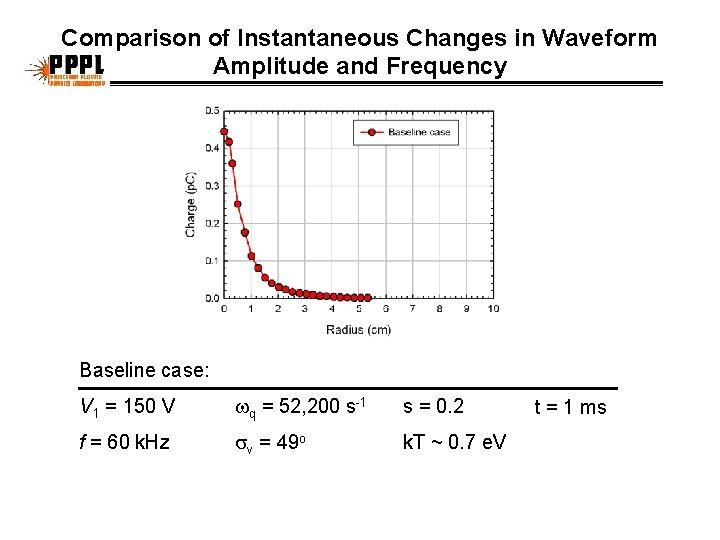
Comparison of Instantaneous Changes in Waveform Amplitude and Frequency Baseline case: V 1 = 150 V wq = 52, 200 s-1 s = 0. 2 f = 60 k. Hz sv = 49 o k. T ~ 0. 7 e. V t = 1 ms
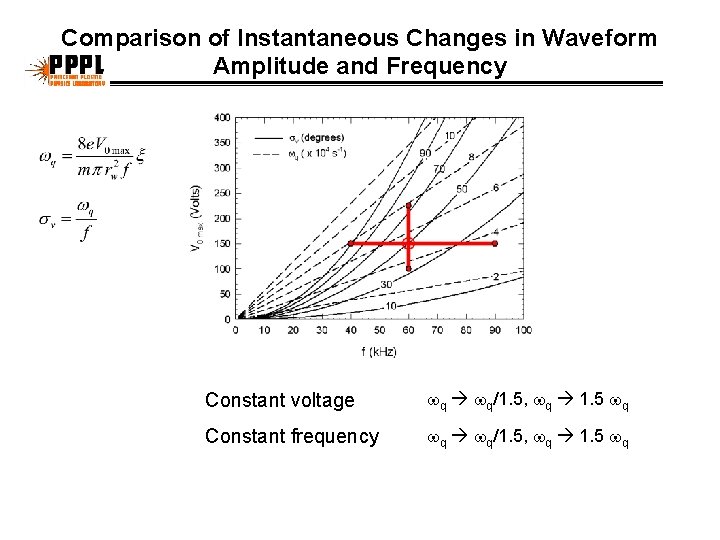
Comparison of Instantaneous Changes in Waveform Amplitude and Frequency Constant voltage wq wq/1. 5, wq 1. 5 wq Constant frequency wq wq/1. 5, wq 1. 5 wq
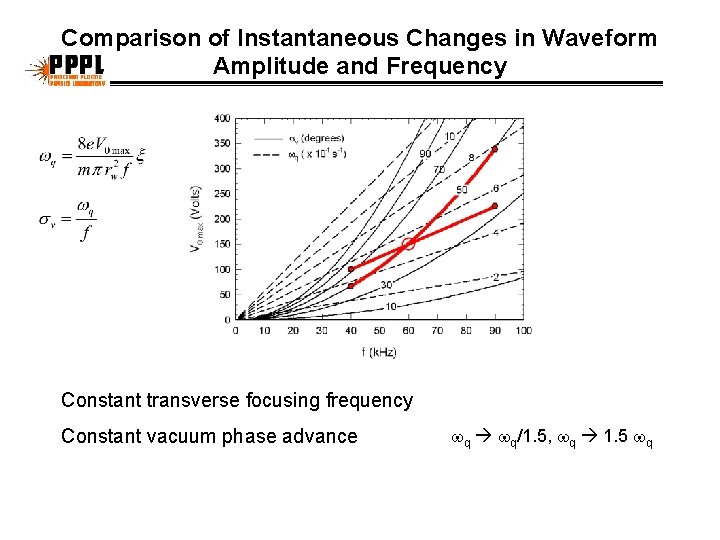
Comparison of Instantaneous Changes in Waveform Amplitude and Frequency Constant transverse focusing frequency Constant vacuum phase advance wq wq/1. 5, wq 1. 5 wq
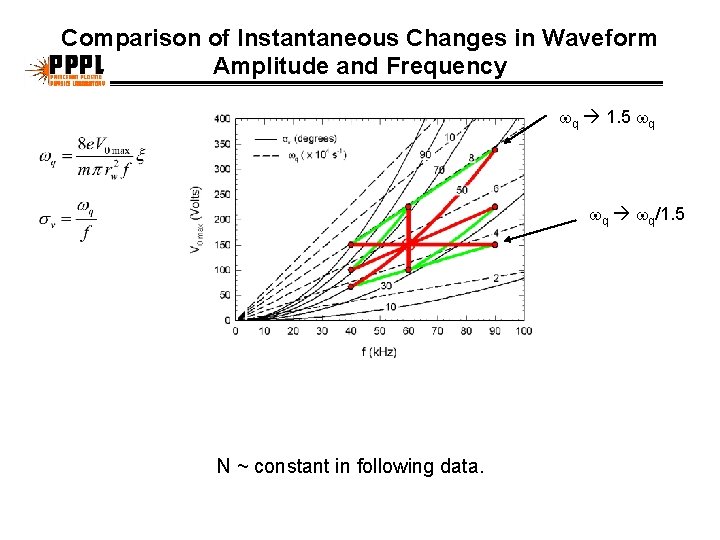
Comparison of Instantaneous Changes in Waveform Amplitude and Frequency wq 1. 5 wq wq wq/1. 5 N ~ constant in following data.
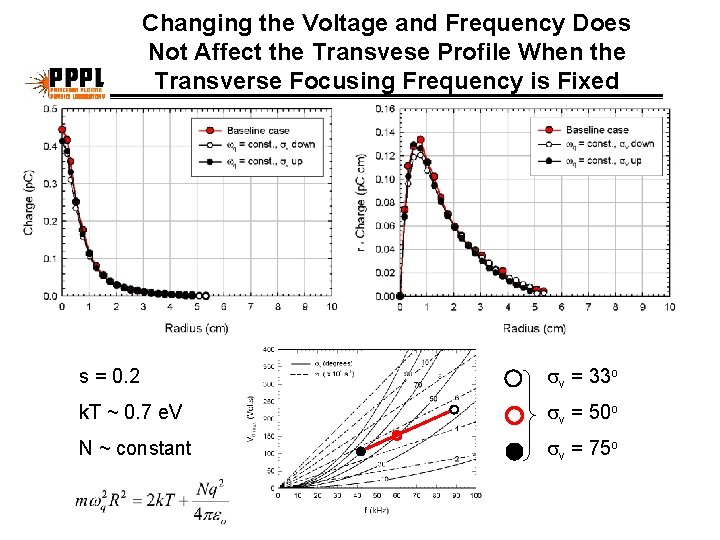
Changing the Voltage and Frequency Does Not Affect the Transvese Profile When the Transverse Focusing Frequency is Fixed s = 0. 2 sv = 33 o k. T ~ 0. 7 e. V sv = 50 o N ~ constant sv = 75 o
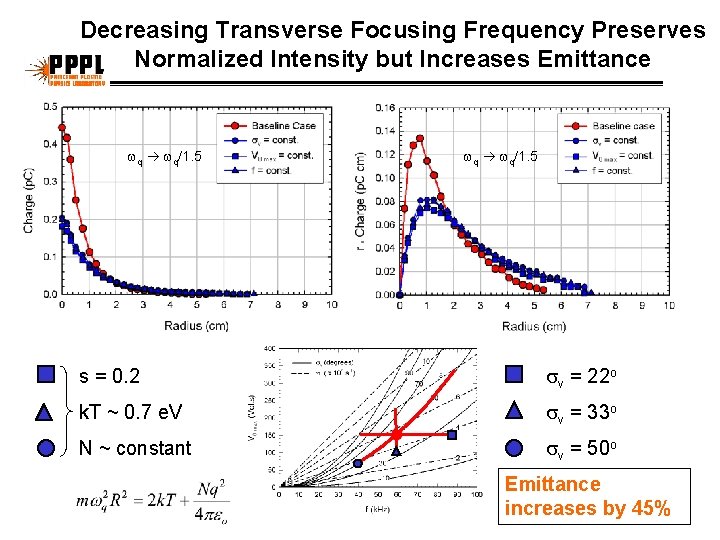
Decreasing Transverse Focusing Frequency Preserves Normalized Intensity but Increases Emittance wq wq/1. 5 s = 0. 2 sv = 22 o k. T ~ 0. 7 e. V sv = 33 o N ~ constant sv = 50 o Emittance increases by 45%
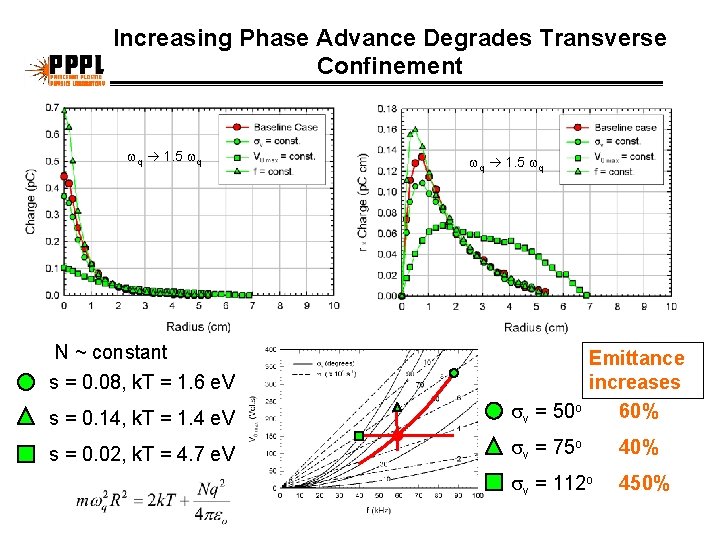
Increasing Phase Advance Degrades Transverse Confinement wq 1. 5 wq N ~ constant s = 0. 08, k. T = 1. 6 e. V wq 1. 5 wq s = 0. 14, k. T = 1. 4 e. V Emittance increases sv = 50 o 60% s = 0. 02, k. T = 4. 7 e. V sv = 75 o 40% sv = 112 o 450%
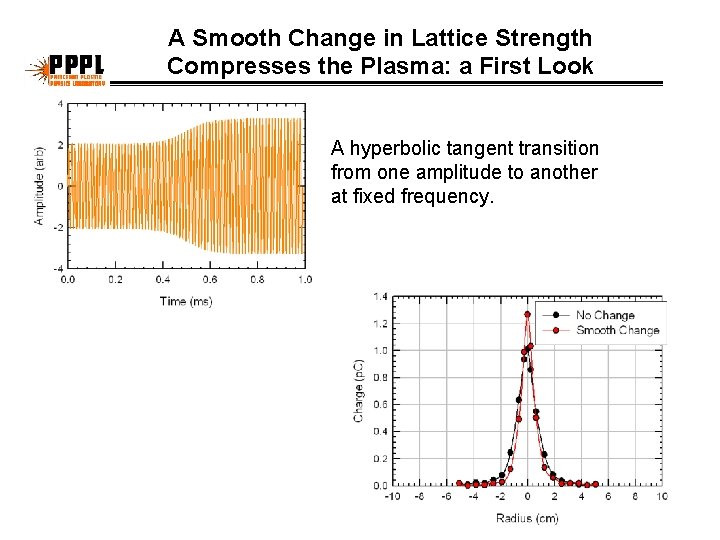
A Smooth Change in Lattice Strength Compresses the Plasma: a First Look A hyperbolic tangent transition from one amplitude to another at fixed frequency.
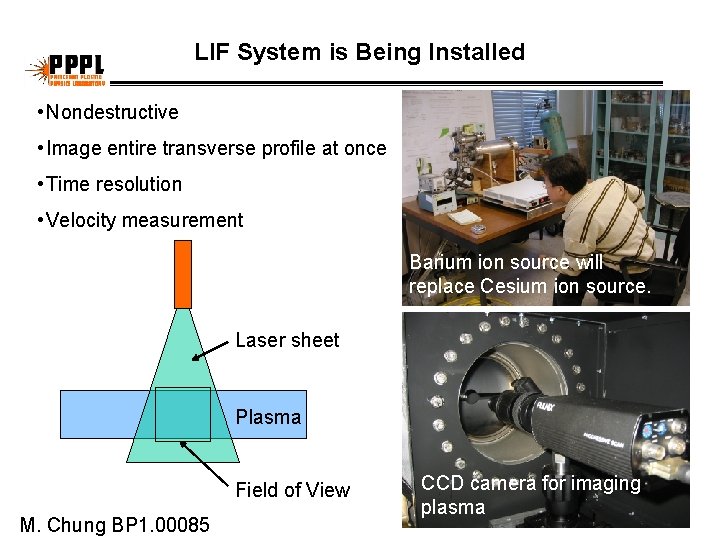
LIF System is Being Installed • Nondestructive • Image entire transverse profile at once • Time resolution • Velocity measurement Barium ion source will replace Cesium ion source. Laser sheet Plasma Field of View M. Chung BP 1. 00085 CCD camera for imaging plasma
PTSX Simulates the Transverse Dynamics of Intense Beam Propagation Over Large Distances Through Magnetic Alternating-Gradient Transport Systems • PTSX is a compact and flexible laboratory experiment. • PTSX can trap plasmas with normalized intensity s up to 0. 8. • Confinement times can correspond to up to 7, 500 lattice periods. • Instantaneous lattice changes are detrimental to transverse confinement, leading to mismatch, envelope oscillations, and subsequent emittance growth (unless transverse focusing frequency is fixed. ) Large vacuum phase advance sv degrades transverse confinement. • Study of smooth lattice changes is planned.
- Slides: 22