
Experimental Research Methods YEAR 12 STAGE 34 PSYCHOLOGY

- Slides: 10
Experimental Research Methods. YEAR 12 STAGE 3&4 PSYCHOLOGY
SCASA SYLLABUS features of experimental research methods independent and dependent variables operational hypotheses controlled and uncontrolled variables experimental and control groups placebo and experimenter effects
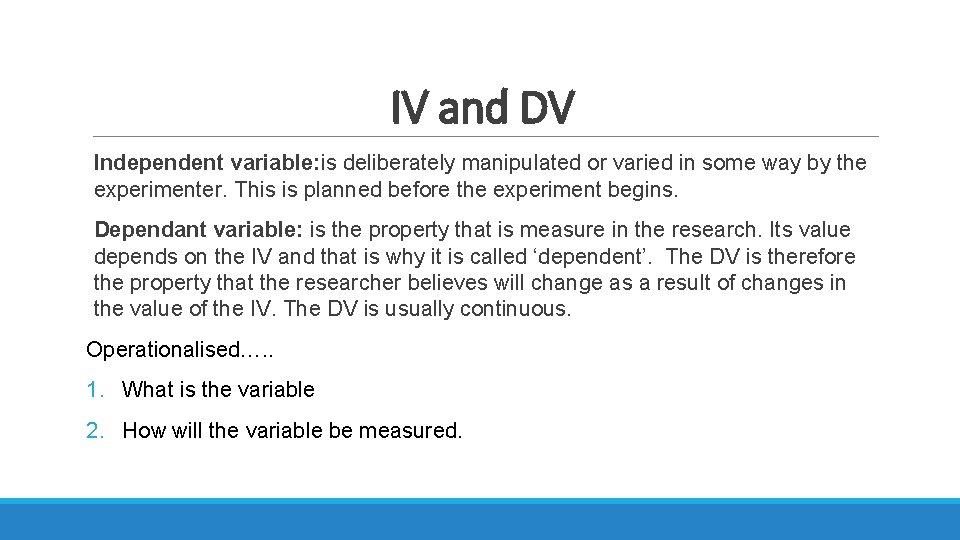
IV and DV Independent variable: is deliberately manipulated or varied in some way by the experimenter. This is planned before the experiment begins. Dependant variable: is the property that is measure in the research. Its value depends on the IV and that is why it is called ‘dependent’. The DV is therefore the property that the researcher believes will change as a result of changes in the value of the IV. The DV is usually continuous. Operationalised…. . 1. What is the variable 2. How will the variable be measured.
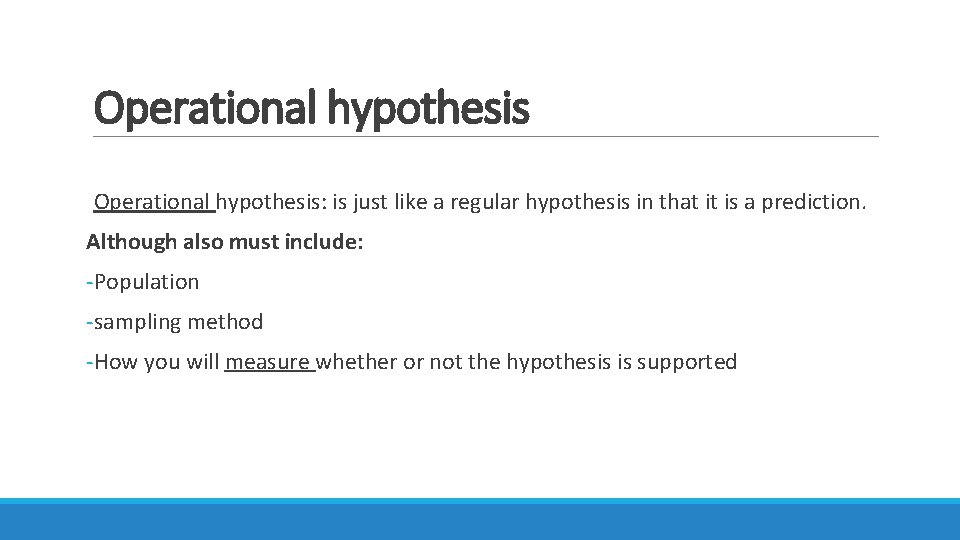
Operational hypothesis: is just like a regular hypothesis in that it is a prediction. Although also must include: -Population -sampling method -How you will measure whether or not the hypothesis is supported
Controlled and uncontrolled variables Controlled variable: is one that is not changed throughout the experiment to ensure that the changes observed are the results of the IV. Uncontrolled variable: is one that is allowed to stay random as it would have no predicted effects on the outcome. I. e. the color of someone's eyes.
EV and CV Extraneous Variable: any variable (other than the IV) that may cause a change in the results of, and therefore may have an unwanted effect on the experiment When the potential effects of an extraneous variable have been removed from the experiment, the variable then becomes called a controlled variable. Confounding variable: Any variable known to cause a change in the dependent variable, so its effects may be confused with those of the IV. (an EV that can not be controlled).
Minimising Extraneous Variables See sheet…. .
Experimental and control groups the group exposed to the experimental conditions/where the independent variable is present is the experimental group the group that is exposed where the condition where the variable under investigation is absent. This provides a basis of comparison. i. e. drug trial. Experimental group receives the drug and records effects, control group receives no drug and records effects.
placebo and methods of counteracting its effects. Placebo - Both the control and experimental groups receive some sort of treatment, however the experimental group receives the actual treatment, and the control group will receive a “placebo” a fake treatment. Single-blind procedure. This is when the participants do not know if they are in the control group receiving a placebo or in the experimental group receiving a treatment. This eliminates the placebo effect. Double-blind procedure. This is when both the participants AND the experimenter don't know which group is the control group and which group is the experimental group.
Experimenter effect The experimenters’ behaviour towards a group can (i. e. body language, verbal cues, preferential treatment) could influence the results of a study. Experimenter effect when there is an unintentional change in participants behaviour and hence results, due to the experimenters influence. Reduced by double blind procedure.