
Experimental Psychology PSY 433 Chapter 4 Ethics Parts
- Slides: 12
Experimental Psychology PSY 433 Chapter 4 Ethics
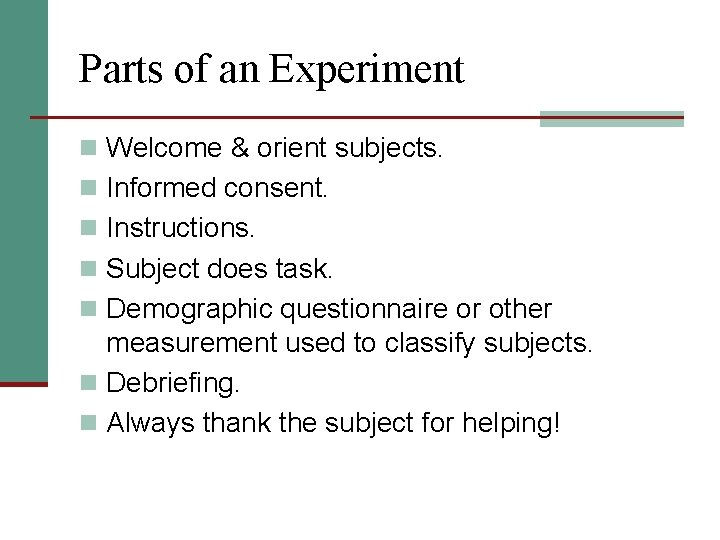
Parts of an Experiment n Welcome & orient subjects. n Informed consent. n Instructions. n Subject does task. n Demographic questionnaire or other measurement used to classify subjects. n Debriefing. n Always thank the subject for helping!
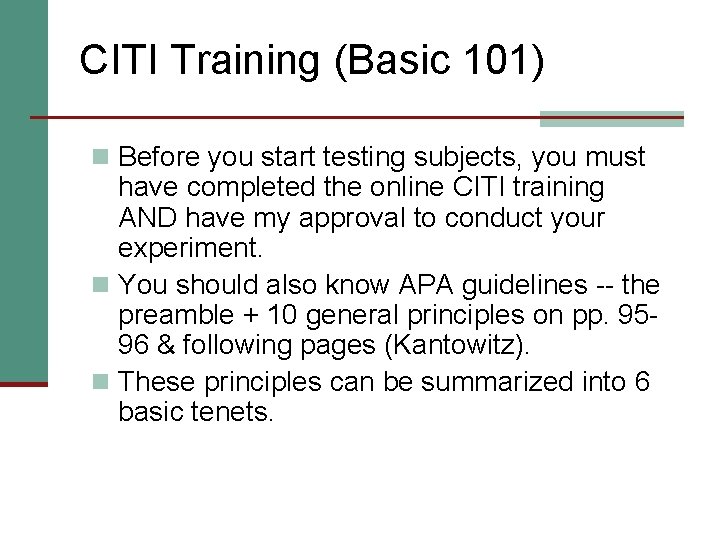
CITI Training (Basic 101) n Before you start testing subjects, you must have completed the online CITI training AND have my approval to conduct your experiment. n You should also know APA guidelines -- the preamble + 10 general principles on pp. 9596 & following pages (Kantowitz). n These principles can be summarized into 6 basic tenets.
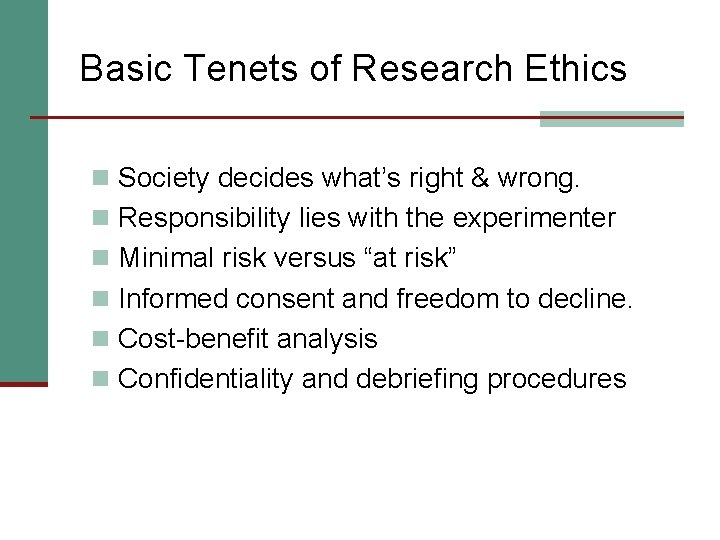
Basic Tenets of Research Ethics n Society decides what’s right & wrong. n Responsibility lies with the experimenter n Minimal risk versus “at risk” n Informed consent and freedom to decline. n Cost-benefit analysis n Confidentiality and debriefing procedures
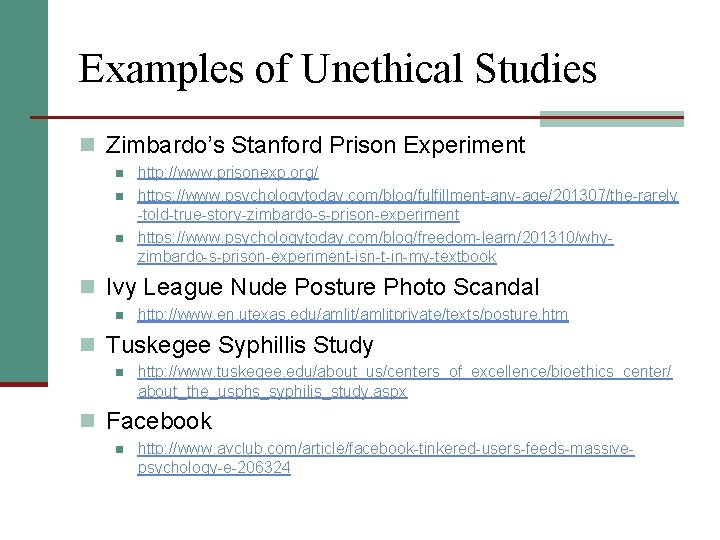
Examples of Unethical Studies n Zimbardo’s Stanford Prison Experiment n n n http: //www. prisonexp. org/ https: //www. psychologytoday. com/blog/fulfillment-any-age/201307/the-rarely -told-true-story-zimbardo-s-prison-experiment https: //www. psychologytoday. com/blog/freedom-learn/201310/whyzimbardo-s-prison-experiment-isn-t-in-my-textbook n Ivy League Nude Posture Photo Scandal n http: //www. en. utexas. edu/amlitprivate/texts/posture. htm n Tuskegee Syphillis Study n http: //www. tuskegee. edu/about_us/centers_of_excellence/bioethics_center/ about_the_usphs_syphilis_study. aspx n Facebook n http: //www. avclub. com/article/facebook-tinkered-users-feeds-massivepsychology-e-206324
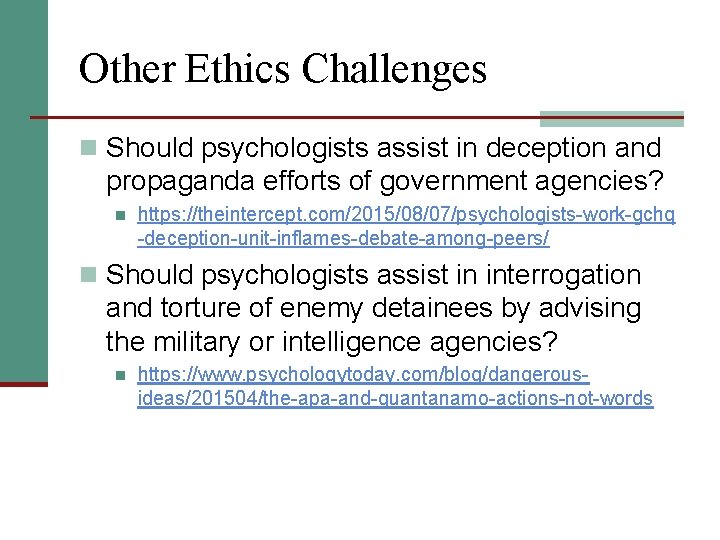
Other Ethics Challenges n Should psychologists assist in deception and propaganda efforts of government agencies? n https: //theintercept. com/2015/08/07/psychologists-work-gchq -deception-unit-inflames-debate-among-peers/ n Should psychologists assist in interrogation and torture of enemy detainees by advising the military or intelligence agencies? n https: //www. psychologytoday. com/blog/dangerousideas/201504/the-apa-and-guantanamo-actions-not-words
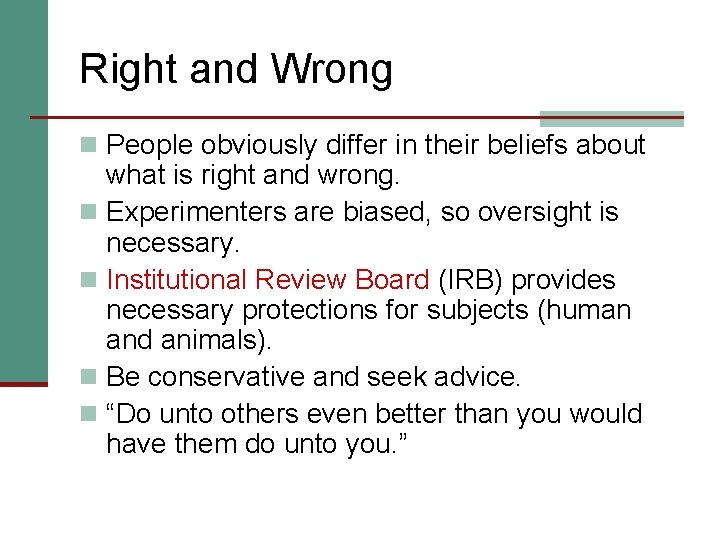
Right and Wrong n People obviously differ in their beliefs about what is right and wrong. n Experimenters are biased, so oversight is necessary. n Institutional Review Board (IRB) provides necessary protections for subjects (human and animals). n Be conservative and seek advice. n “Do unto others even better than you would have them do unto you. ”
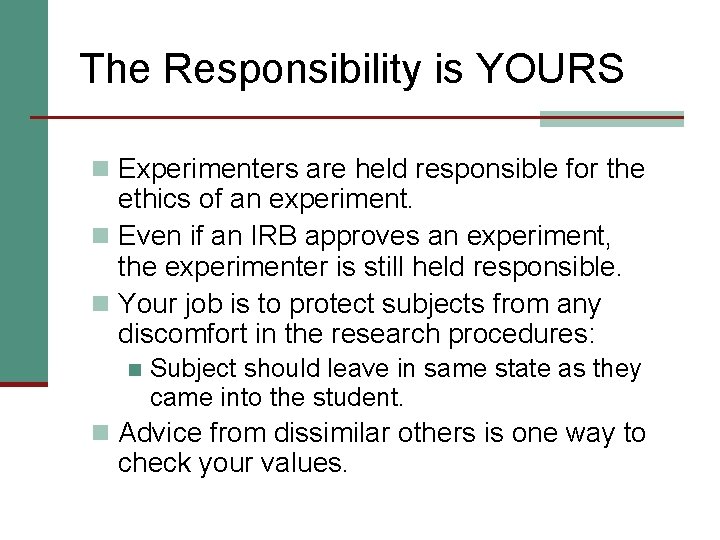
The Responsibility is YOURS n Experimenters are held responsible for the ethics of an experiment. n Even if an IRB approves an experiment, the experimenter is still held responsible. n Your job is to protect subjects from any discomfort in the research procedures: n Subject should leave in same state as they came into the student. n Advice from dissimilar others is one way to check your values.
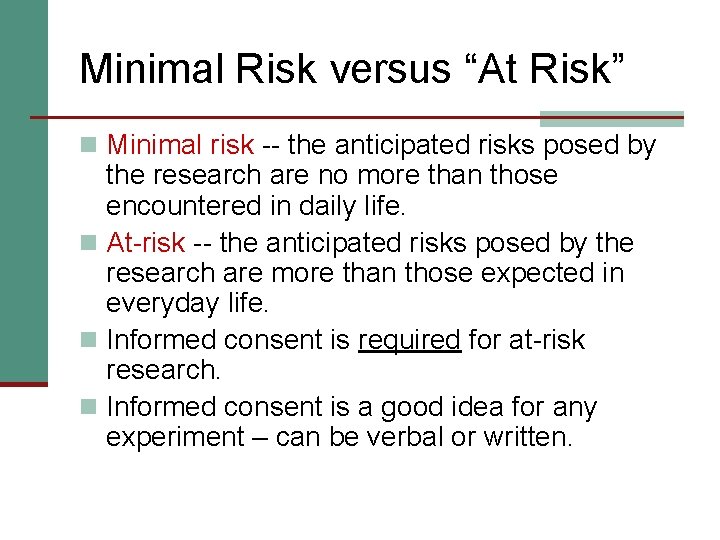
Minimal Risk versus “At Risk” n Minimal risk -- the anticipated risks posed by the research are no more than those encountered in daily life. n At-risk -- the anticipated risks posed by the research are more than those expected in everyday life. n Informed consent is required for at-risk research. n Informed consent is a good idea for any experiment – can be verbal or written.
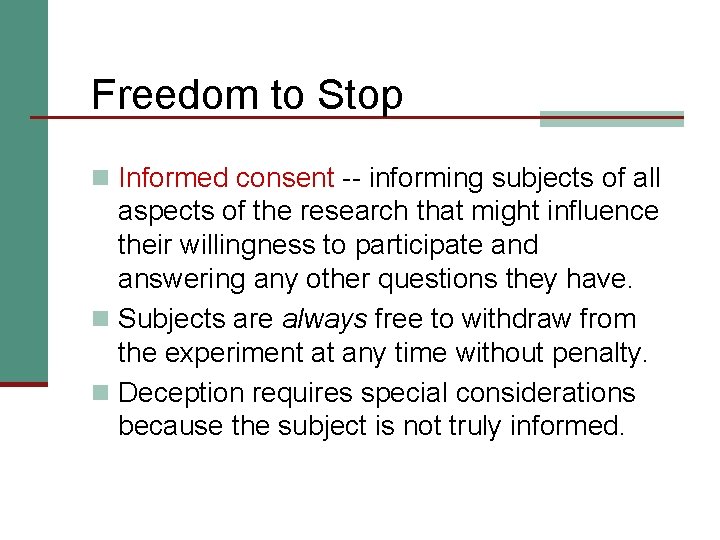
Freedom to Stop n Informed consent -- informing subjects of all aspects of the research that might influence their willingness to participate and answering any other questions they have. n Subjects are always free to withdraw from the experiment at any time without penalty. n Deception requires special considerations because the subject is not truly informed.
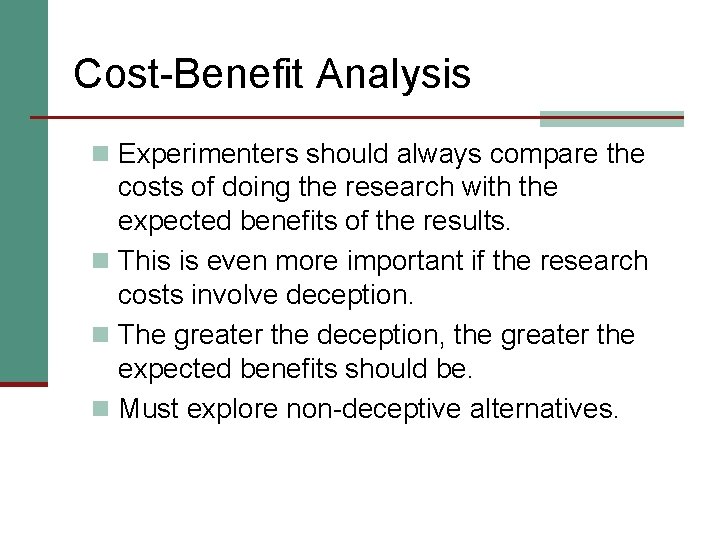
Cost-Benefit Analysis n Experimenters should always compare the costs of doing the research with the expected benefits of the results. n This is even more important if the research costs involve deception. n The greater the deception, the greater the expected benefits should be. n Must explore non-deceptive alternatives.
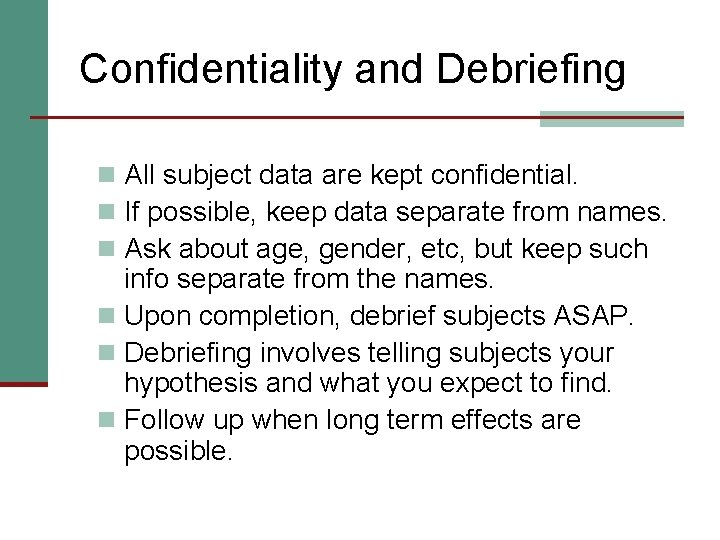
Confidentiality and Debriefing n All subject data are kept confidential. n If possible, keep data separate from names. n Ask about age, gender, etc, but keep such info separate from the names. n Upon completion, debrief subjects ASAP. n Debriefing involves telling subjects your hypothesis and what you expect to find. n Follow up when long term effects are possible.