
Experimental Mathematics for Secondary Schools Connecting Curriculum Strands
- Slides: 30
Experimental Mathematics for Secondary Schools: Connecting Curriculum Strands Through Technology Integration Matemáticas experimentales para escuelas secundarias: Conectando hebras curriculares por medio de integración tecnológica Sergei Abramovich State University of New York at Potsdam
National Council of Teachers of Mathematics Position Statement (2011) “Effective teachers optimize the potential of technology to develop students’ understanding, stimulate their interest, and increase their proficiency in mathematics”. HOW TO STIMULATE INTERST?
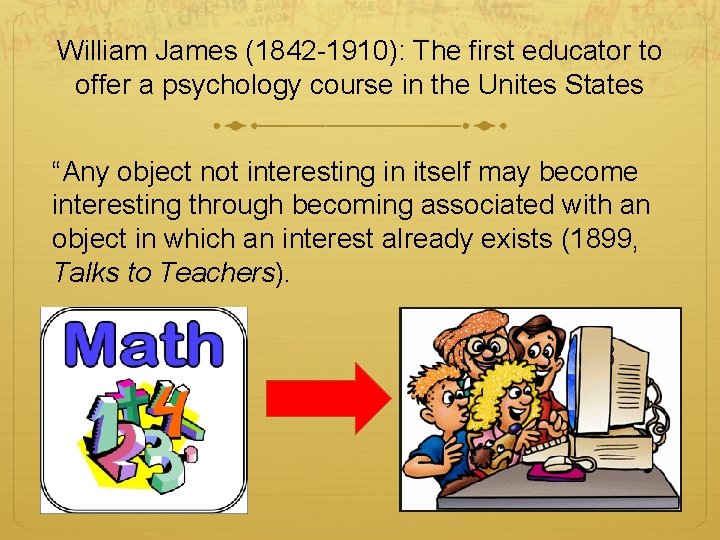
William James (1842 -1910): The first educator to offer a psychology course in the Unites States “Any object not interesting in itself may become interesting through becoming associated with an object in which an interest already exists (1899, Talks to Teachers).
Conference Board of the Mathematical Sciences: The mathematical education of teachers (2001) “Activities in the capstone sequence for high school teachers should explore the variety of possible uses of calculators and computers in analysis—from numerical and graphic exploration and problem solving to formal symbolic operations. . . —and consider carefully the interplay of technology and formal reasoning methods”. Experimental mathematics approach can provide such an interplay.
Theoretical background of mathematical experiment Mc. Call (1923): Experiment is a milieu where “teachers join their pupils in becoming question askers”. Heibert et al. (2003): Treating lessons as experiments by “making some aspects of teachers’ routine, natural activity more systematic and intensive. . . focusing attention on. . . the process of forming and testing hypotheses”.
Experimental Mathematics Research Borwein & Bayley (2004): The use of advanced computing technology in mathematics research Epstein et al. (1992): “many mathematical experiments these days are carried out on computers, but others are still the result of paper-and-pencil work”
Experimental Secondary Mathematics An approach to mathematics teaching and learning made possible by the use of various commonly available and user friendly computational tools. It draws on the power of computers to perform numeric computations and geometric/graphic constructions when mathematics under study is too complex to be approached in the traditional way.
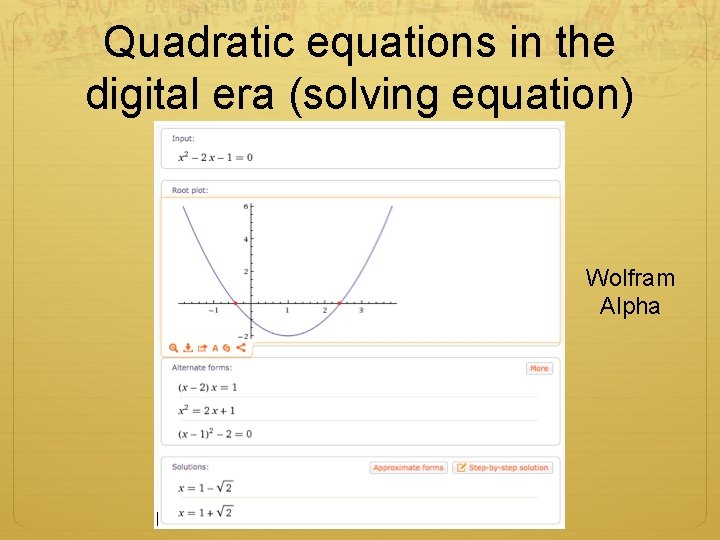
Quadratic equations in the digital era (solving equation) Wolfram Alpha
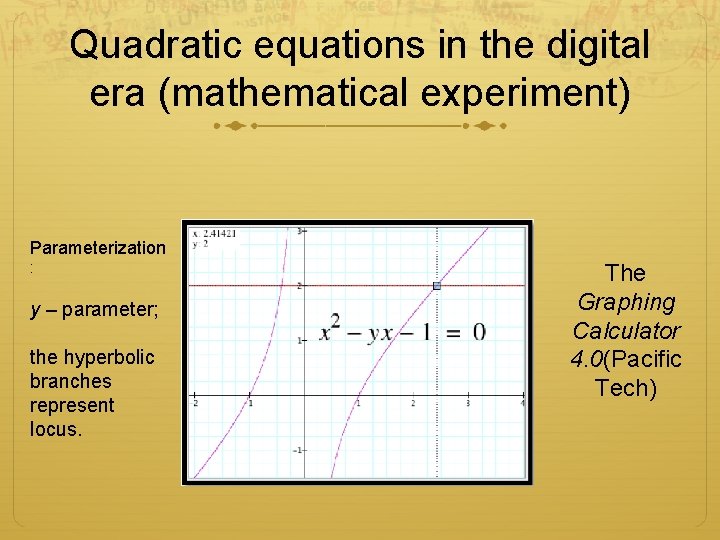
Quadratic equations in the digital era (mathematical experiment) Parameterization : y – parameter; the hyperbolic branches represent locus. The Graphing Calculator 4. 0(Pacific Tech)
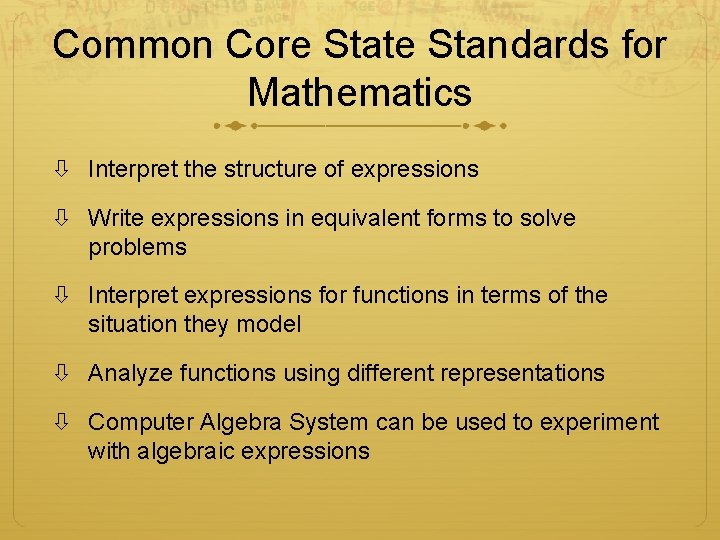
Common Core State Standards for Mathematics Interpret the structure of expressions Write expressions in equivalent forms to solve problems Interpret expressions for functions in terms of the situation they model Analyze functions using different representations Computer Algebra System can be used to experiment with algebraic expressions
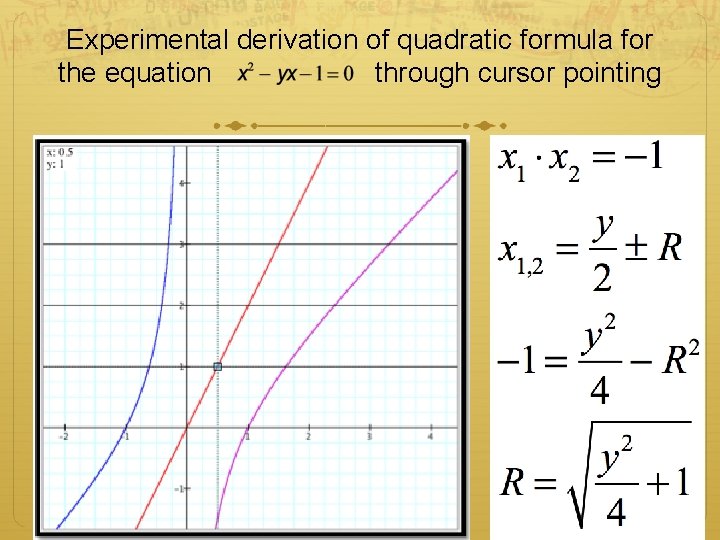
Experimental derivation of quadratic formula for the equation through cursor pointing
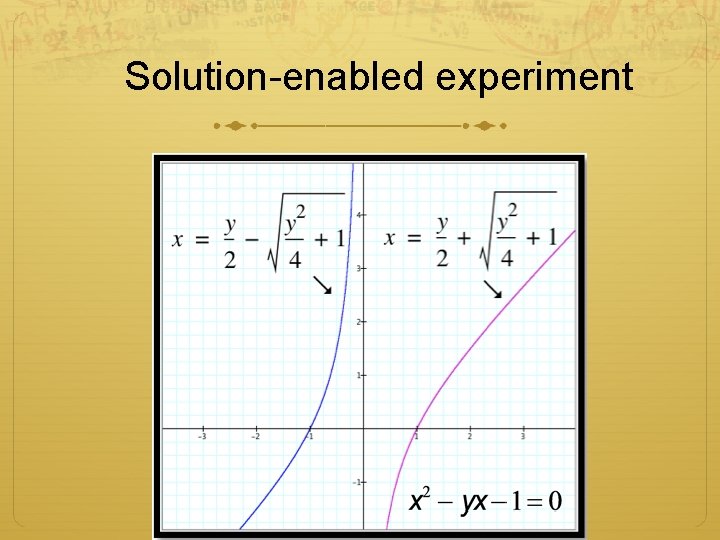
Solution-enabled experiment
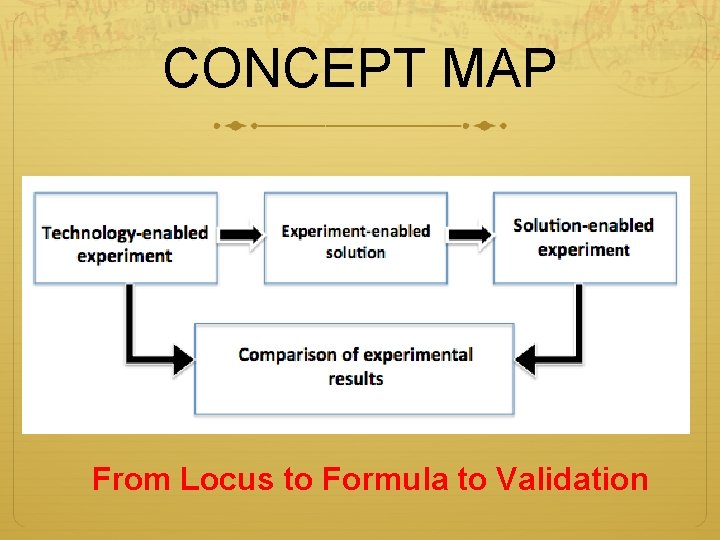
CONCEPT MAP From Locus to Formula to Validation
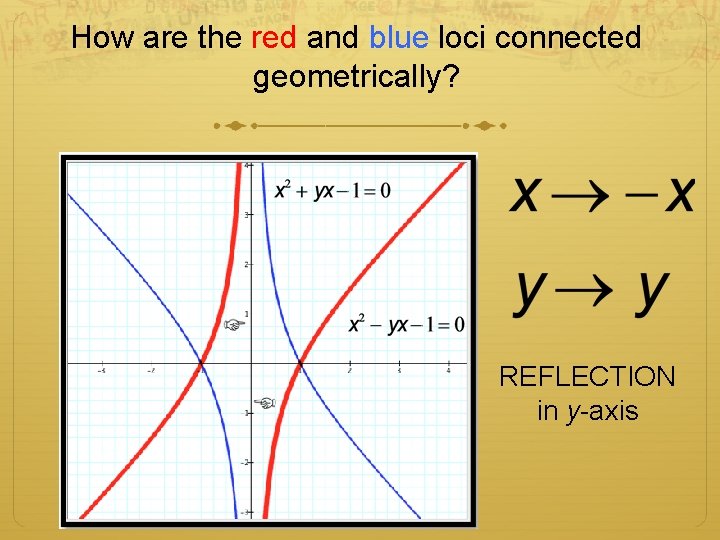
How are the red and blue loci connected geometrically? REFLECTION in y-axis
COMMON CORE STATE STANDARDS FOR MATHEMATICS HIGH SCHOOL: Describe transformations as functions that take points in the plane as inputs and give other points as outputs
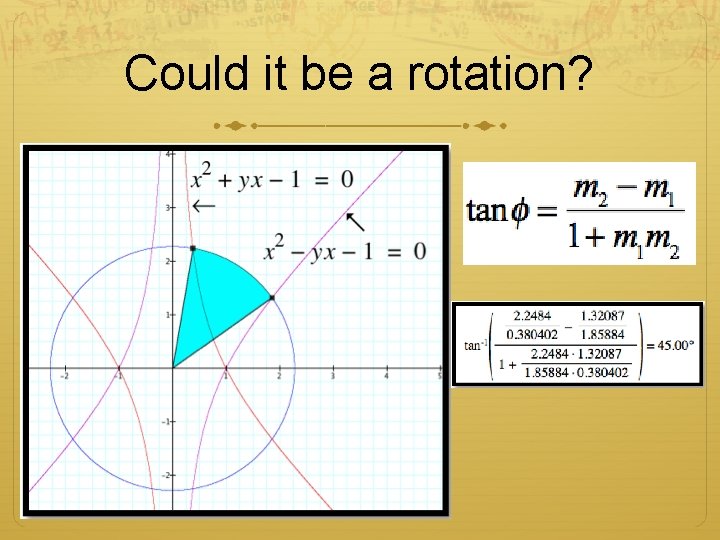
Could it be a rotation?
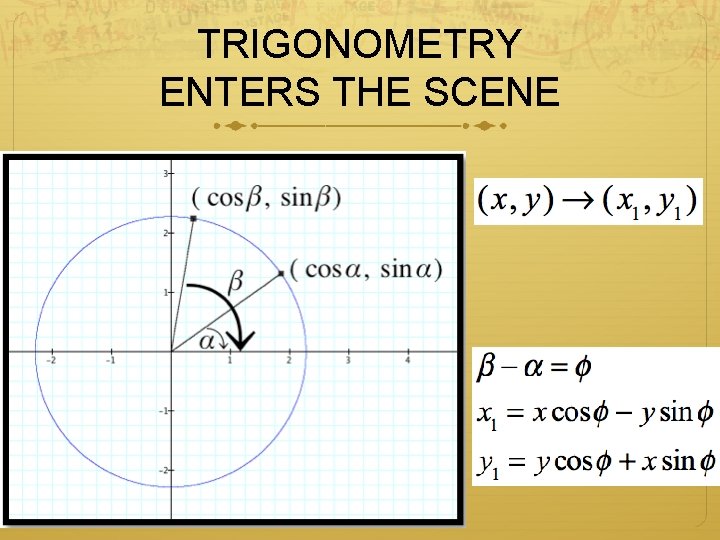
TRIGONOMETRY ENTERS THE SCENE
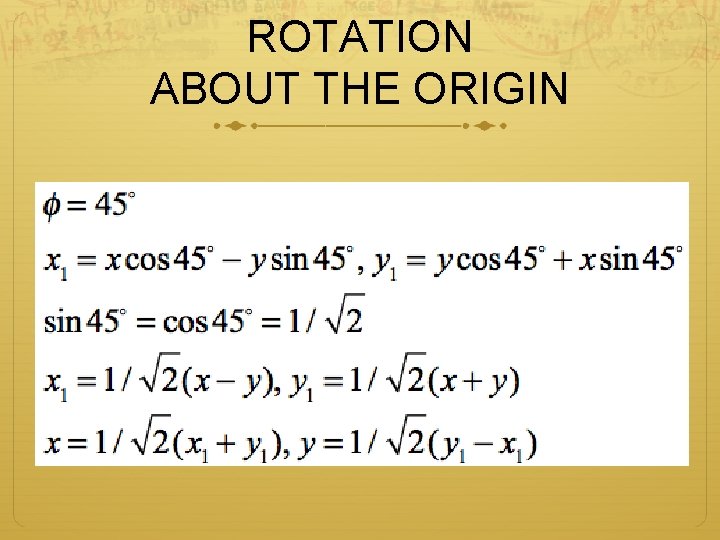
ROTATION ABOUT THE ORIGIN
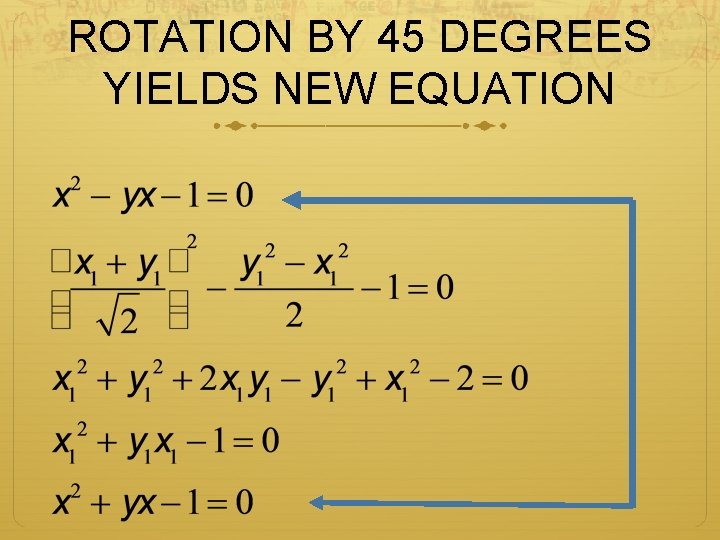
ROTATION BY 45 DEGREES YIELDS NEW EQUATION
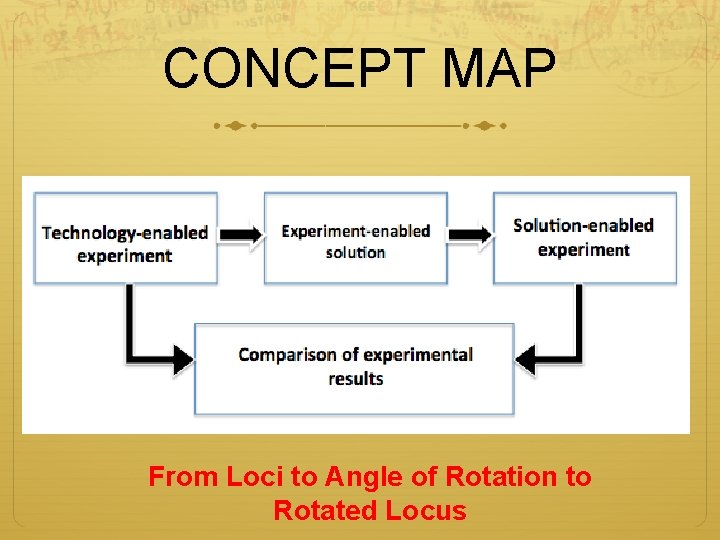
CONCEPT MAP From Loci to Angle of Rotation to Rotated Locus
Collateral Learning “Perhaps the greatest of all pedagogical fallacies is the notion that a person learns only the particular thing he is studying at the time” (Dewey, 1938) Encouraging reflection creates conditions for what Dewey called collateral learning Through integrating mathematics with technology, hidden opportunities for collateral learning unfold
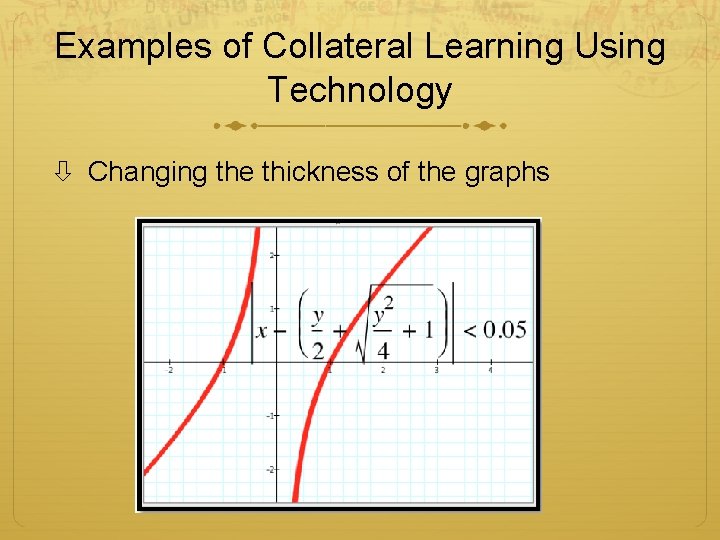
Examples of Collateral Learning Using Technology Changing the thickness of the graphs
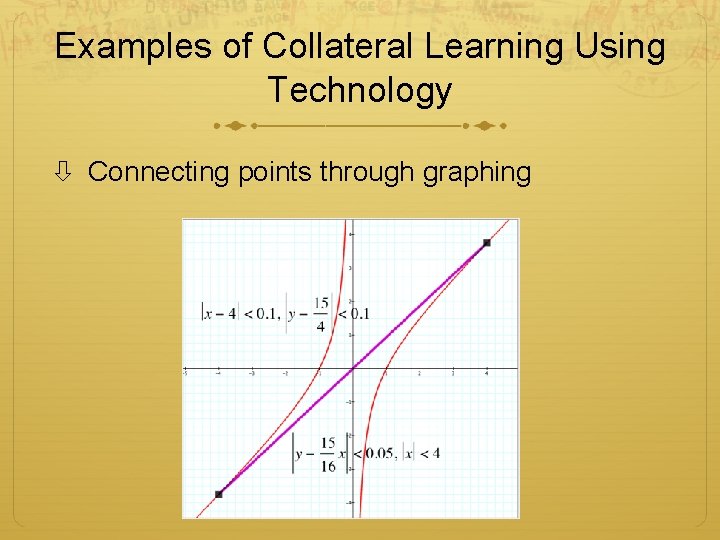
Examples of Collateral Learning Using Technology Connecting points through graphing
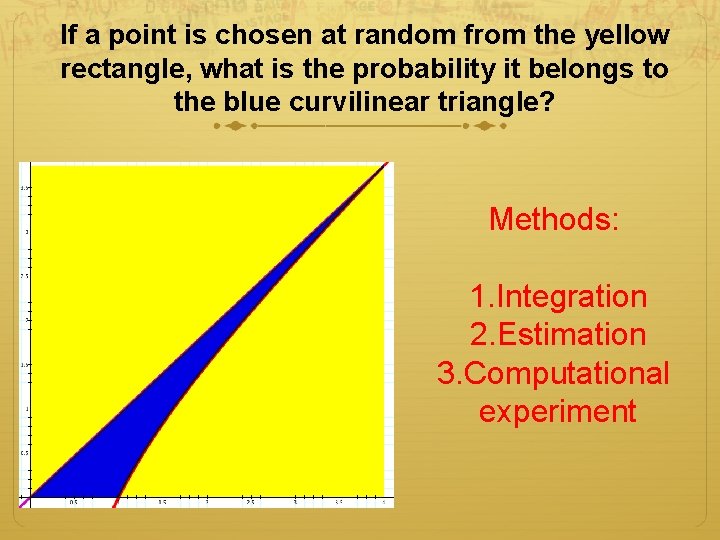
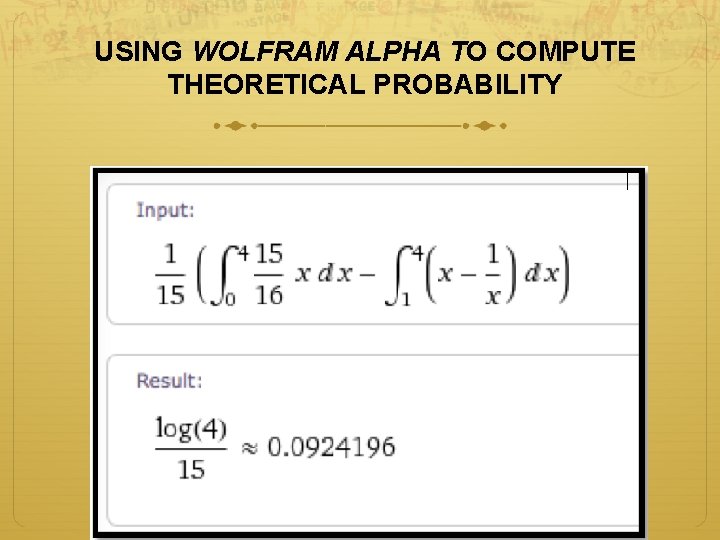
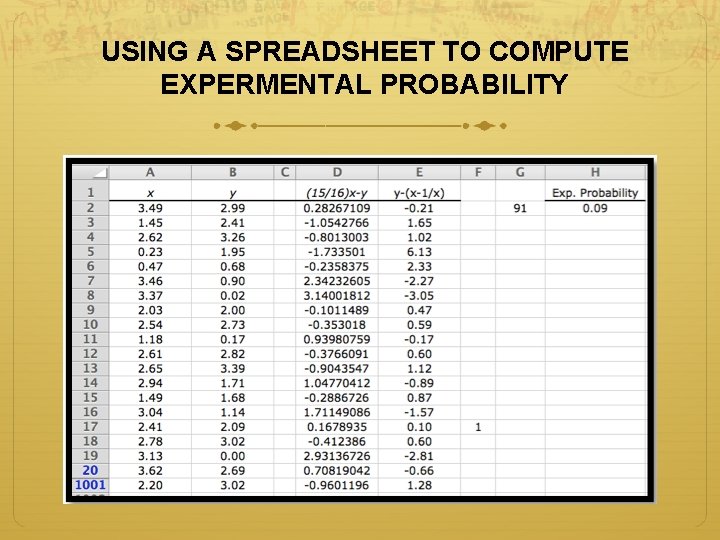
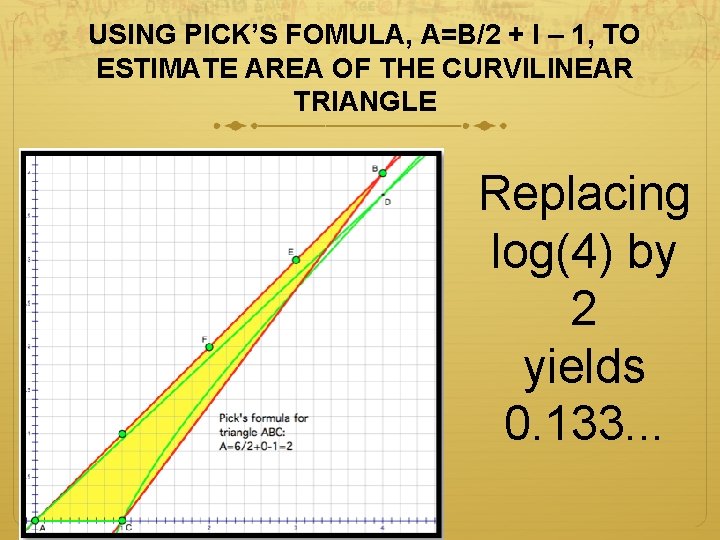
If a point is chosen at random from the yellow rectangle, what is the probability it belongs to the blue curvilinear triangle? Methods: 1. Integration 2. Estimation 3. Computational experiment
USING WOLFRAM ALPHA TO COMPUTE THEORETICAL PROBABILITY
USING A SPREADSHEET TO COMPUTE EXPERMENTAL PROBABILITY
USING PICK’S FOMULA, A=B/2 + I – 1, TO ESTIMATE AREA OF THE CURVILINEAR TRIANGLE Replacing log(4) by 2 yields 0. 133. . .
Conclusion: Experimental mathematics approach Makes subject matter interesting (James) Creates conditions for collateral learning (Dewey) Enables students and teachers become ‘partners in advancement’ (Bruner) Provides experience with uncertainty, formation, and engagement as the major descriptors of signature pedagogy (Shulman)
References Borwein, J. , & Bailey, D. (2004). Mathematics by Experiment: Plausible Reasoning in the 21 st Century. Natick, MA: A K Peters. Bruner, J. (1985). Vygotsky: A historical and conceptual perspective. In J. V. Wertsch (Ed. ), Culture, Communication, and Cognition: Vygotskian Perspectives (pp. 21 -34). Cambridge University Press. Common Core State Standards Initiative. (2010). Common Core Standards Initiative: Preparing America’s Students for College and Career. [Online materials]. Available at http: //www. corestandards. org Conference Board of the Mathematical Sciences. (2001). The Mathematical Education of Teachers. Washington, DC: The Mathematical Association of America. Dewey, J. (1938). Experience and Education. New York: Mac. Millan. Epstein, D. , Levy, S. , & de la Llave, R. , (1992). About this journal. Experimental Mathematics, 1(1), 1 -3. Hiebert, J. , Morris, A. K. , & Glass, B. (2003). Learning to learn to teach: An experiment model for teaching and teacher preparation in mathematics. Journal of Mathematics Teacher Education, 6(3), 201 -222. James, W. (1983). Talks to Teachers on Psychology. Cambridge, MA: Harvard University Press. Mc. Call, W. A. (1923). How to Experiment in Education. New York: Macmillan. National Council of Teachers of Mathematics. (2011). Technology in Teaching and Learning of Mathematics: A Position of the National Council of Teachers of Mathematics. Reston, VA: Author. Shulman L. S. (2005). Signature pedagogies in the professions. Daedalus, 134(3), 52 -59.
THANK YOU! ¡GRACIAS!