
EXPERIMENTAL DESIGN WHY EXPERIMENT IN SPACE Unique conditions
- Slides: 16
EXPERIMENTAL DESIGN
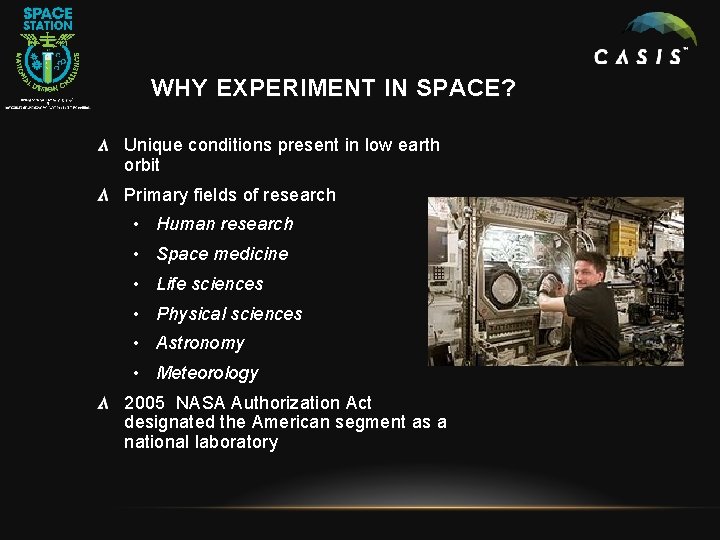
WHY EXPERIMENT IN SPACE? Unique conditions present in low earth orbit Primary fields of research • Human research • Space medicine • Life sciences • Physical sciences • Astronomy • Meteorology 2005 NASA Authorization Act designated the American segment as a national laboratory
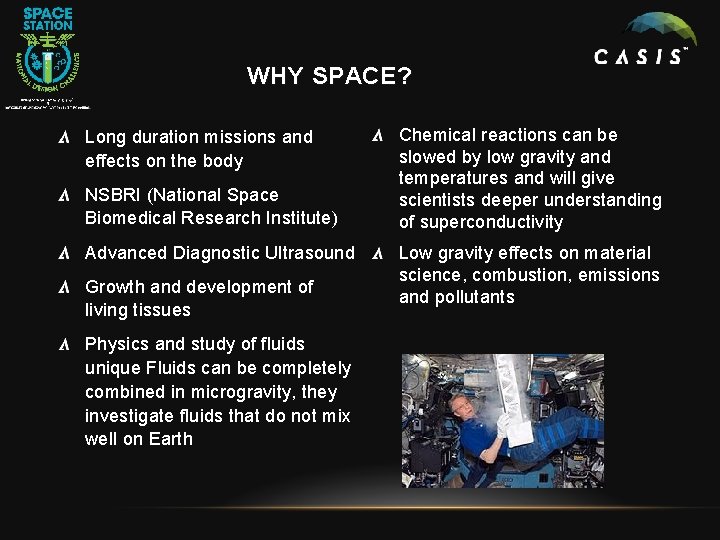
WHY SPACE? Long duration missions and effects on the body NSBRI (National Space Biomedical Research Institute) Advanced Diagnostic Ultrasound Growth and development of living tissues Physics and study of fluids unique Fluids can be completely combined in microgravity, they investigate fluids that do not mix well on Earth Chemical reactions can be slowed by low gravity and temperatures and will give scientists deeper understanding of superconductivity Low gravity effects on material science, combustion, emissions and pollutants
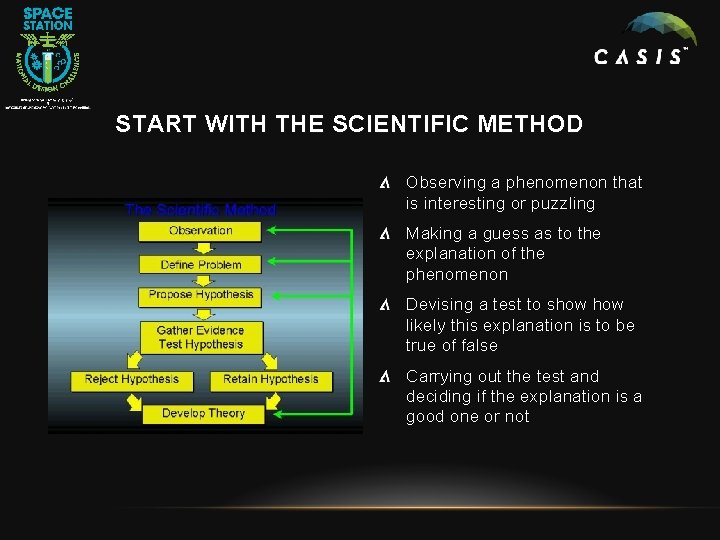
START WITH THE SCIENTIFIC METHOD Observing a phenomenon that is interesting or puzzling Making a guess as to the explanation of the phenomenon Devising a test to show likely this explanation is to be true of false Carrying out the test and deciding if the explanation is a good one or not
CHARACTERISTICS OF EXPERIMENTAL DESIGN Discrimination • Experiments should be able to differentiate between different hypothesis. Too many hypothesis for same experiment will result in indistinguishable results when tested by poorly designed experiments. Replication and generality • Experiments must be able to be repeated enough times for the results to be analyzed statistically. Don’t generalize results that may apply to many spectra, especially in biological nature due to natural variability.
CHARACTERISTICS OF EXPERIMENTAL DESIGN Controls • Experiments must be well controlled. Eliminate all variable factors to induce good results. Measurements • Measurements are critical and must stay consistent • Important to have accuracy and precision • Keep measurements in Engineering Journal
EXAMPLE Bean Plant Experiment Forty bean plants, growing in pots Covered one afternoon by individual glass containers Left in lab over night Next morning inside of lid of each container were covered in water droplets Conclusion Plants generally give off water vapor IS THIS A GOOD CONCLUSION? ?
WHAT IS WRONG WITH CONCLUSION? Critique Lack of controls Explanation Water can come from plants, the soil, the pots, or the air in the jar. Controls should have been put in place. Conclusion contains some points Experiment done overnight, behavior of plants might be that are not Valid different at other times of day, generally should NEVER be used in a conclusion No evidence that water is given off as a vapor What about other plants? Don’t generalize!!
WHAT MAKES GOOD EXPERIMENTAL DESIGN? 3 Important steps Define the Objectives What is the relevance? Devise a strategy Record precisely how you can achieve the objective. Size, structure, subsystems, materials, parts and pieces Operational Details Procedures, Length of time to run experiment, specifics of experiment
REMEMBER Experiments that yield no useful results can be due to inadequate amounts of data collected Experiments that seem like they should give useful results but the Procedures were not robust enough
CONTROLS AND VARIABLES Independent Variable – What is manipulated or the treatment in an experiment Controls: factors that remain constant throughout an experiment Dependent Variable – is what is observed from the effects of the treatment in an experiment Extraneous Variables – influence the relationship between the independent and dependent variables of an experiment
EXAMPLE A student directly manipulated stress levels in human subjects and measures how those stress levels change heart rate
ANALYSIS OF EXPERIMENT EXAMPLE Independent variable: STRESS Dependent Variable: Heart Rate Controlled Variables: Time of day, temperature, location, males or females only, weight of subjects, type of stress tests, and no food intake for 2 hours. Extraneous variables - type of food eaten by subjects, how much sleep the subjects had the previous night, and resting heart rate of the subjects
HYPOTHESIS Are the independent and dependent variables testable? Usually an IF, THEN statement From Research conducted is this experiment a relevant objective? What would it answer? Does it answer the driving question or theory in question? Driving question is not a yes or no answer, but rather the cause and effect along with being openended
EXAMPLE HYPOTHESIS Raising the temperature of a cup of water (temp is the independent variable) will increase the amount of sugar that dissolves (amt of sugar is the dependent variable. ) If a plant receives fertilizer (fertilizer is independent variable) then it will grow to be bigger than a plant that does not receive fertilizer (plant size is the dependent variable)
FINAL STEPS IN EXPERIMENTAL DESIGN How is data going to be collected? Procedures for conducting the experiment Identifying factors that determine if the hypothesis was supported or not supported by experimental findings Key Point: If the student has developed a deeper understanding of the processes of science experimentation the student will be able to redesign the experiment for additional testing