
Experimental Design Using the scientific method The scientific
- Slides: 6
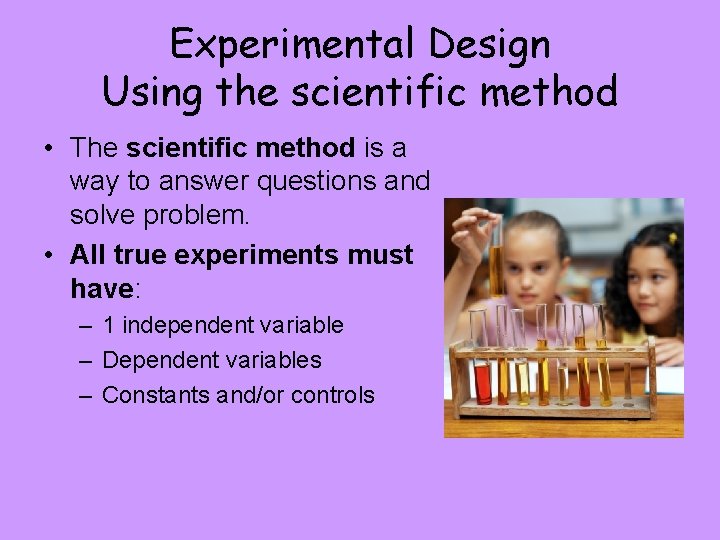
Experimental Design Using the scientific method • The scientific method is a way to answer questions and solve problem. • All true experiments must have: – 1 independent variable – Dependent variables – Constants and/or controls
Steps in the Scientific Method 1. Question or Problem- This is what you are trying to find out. The question must be specific and testable. 2. Collect background information- Find out as much as you can about your question or problem. Use books, periodicals, notes, and experts to help you. Teacher directed notes fit here.
3. State Hypothesis: This is an educated answer to the problem/question. The words “I think or I believe” should not be used in the hypothesis. The hypothesis should be in “if…then…” format. 4. Test your hypothesis: Develop a procedure to find out whether your hypothesis is correct. The procedure is a detailed, step-by-step set of directions for carrying out your experiment.
Your procedure is a true experiment if it has the following: • An Independent Variable: The only change between the experimental groups. It is the difference between the groups. It is what you are testing! • A dependent variable: The effect or result that can be observed and measured in your experiment. • Constants: All parts of the experiment that are kept the same. Only one difference should be tested at a time in an experiment. • Control Group- A group used to compare the test groups against. The control group does not have anything done to it.
5. Collect Data: Measure and record the information you get from your procedure. These are sometimes called observations or results. Record your information carefully in a Data table. Display your information in a graph. Quantitative-numerical Qualitative- descriptive
6. Conclusion- The conclusion is the result or outcome of your experiment. A conclusion is a paragraph that addresses all of the following: • Answers your problem question. • Discusses if your hypothesis was correct. • Use evidence to explain whether the hypothesis was correct. • Discuss hidden variables or limiting factors. • How could you improve the experiment? • How could you extend the experiment?