
Experimental Design How to conduct a valid experiment
- Slides: 11
Experimental Design How to conduct a valid experiment.
Variable l l A variable is anything in an experiment that can change or vary. It is any factor that can have an effect on the outcome of the experiment.
3 types of variables Independent variable (IV) l Something that is intentionally changed (on purpose by the scientist. l What is changed l What is the something special l AKA the manipulated variable l YOU can only changed ONE variable in an experiment.
3 types of variables l To determine the IV ask yourself: What is being changed? What was the something special?
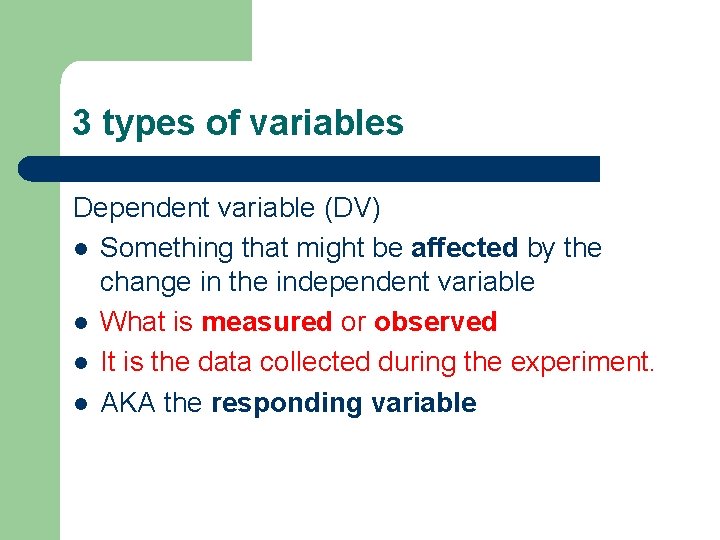
3 types of variables Dependent variable (DV) l Something that might be affected by the change in the independent variable l What is measured or observed l It is the data collected during the experiment. l AKA the responding variable
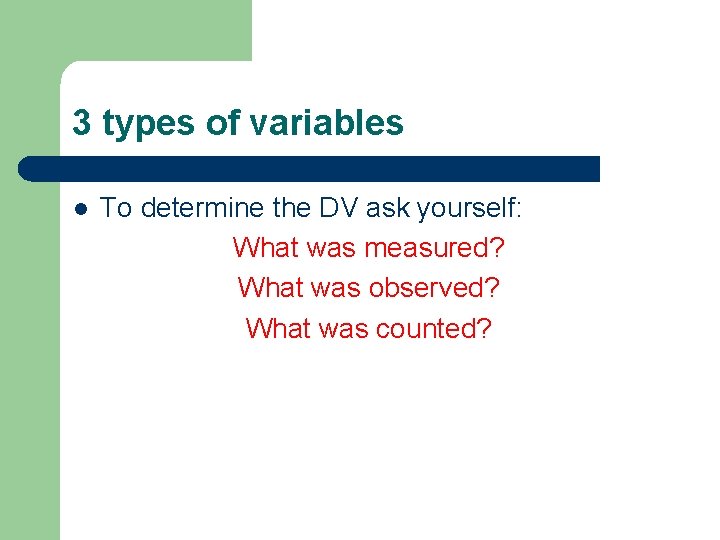
3 types of variables l To determine the DV ask yourself: What was measured? What was observed? What was counted?
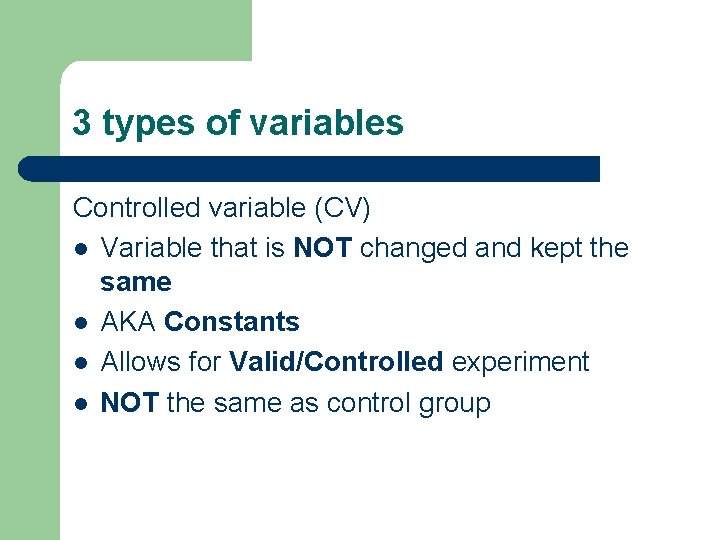
3 types of variables Controlled variable (CV) l Variable that is NOT changed and kept the same l AKA Constants l Allows for Valid/Controlled experiment l NOT the same as control group
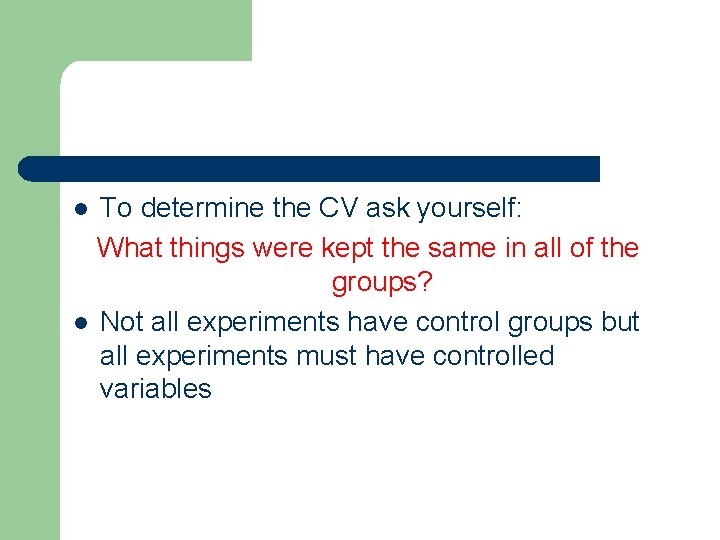
To determine the CV ask yourself: What things were kept the same in all of the groups? l Not all experiments have control groups but all experiments must have controlled variables l
Control Group (CG) l A group or individual that is not tested, but is used for comparison as a reference for what “normal” would be like. l Not all experiments have control groups but all experiments must have controlled variables.
A Good Experiment – 5 things 1. 2. 3. Tests one variable at a time. If more than one thing is tested at a time, it won’t be clear which variable caused the end result. Must be fair and unbiased. This means that the experimenter does not allow his or her opinion to influence the experiment. Does not allow any outside factors to affect the outcome of the experiment.
A Good Experiment 4. Is valid. The experimental procedure must test your hypothesis to see if its correct. If the procedure does not test your hypothesis, the experiment is NOT valid and the data will make no sense! 5. Has repeated trials. Repeating the trials in the experiment will reduce the effect of experimental errors and give a more accurate conclusion.