
Experimental Design and Living Organisms Characteristics of Organisms

- Slides: 15
Experimental Design and Living Organisms
Characteristics of Organisms
Organisms are organized They have a structure
Organisms reproduce They produce offspring that are similar to themselves. This is essential for the survival of the species
Organisms change over their life They grow and die.
Organisms respond to their environment. • A stimulus in the environment causes a response.
Organisms use energy to move, grow and reproduce.
Organisms adapt to their environment over generations. Mosquitoes and DDT
Experimentation with Organisms • Observations lead to questions • Questions can lead to a hypothesis
How do we test a hypothesis? • Control groups and experimental groups. – Control group provides a comparison – Experimental group is exactly the same as a control, except for the factor you want to test. Hypothesis
Test one factor at a time. • Independent variable – The factor that you change. • Dependent variable – The response of the organism.
Procedure One step at a time. • Enough information for replication • List your constants: temperature, amount of salt, time frame for experiment. • Replicate
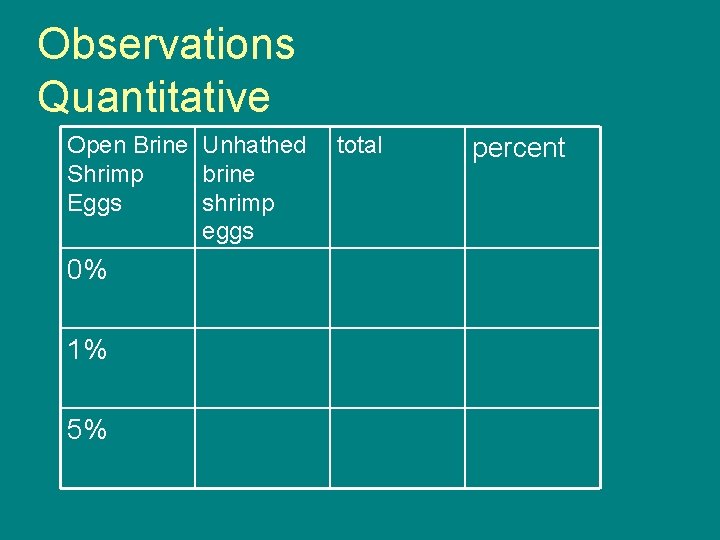
Observations Quantitative Open Brine Unhathed Shrimp brine Eggs shrimp eggs 0% 1% 5% total percent
Conclusions
Replication • Others need to be able to do your experiment and get the same result.