
Experimental dark matter searches Weakly Interacting Massive Particles
- Slides: 23
Experimental dark matter searches
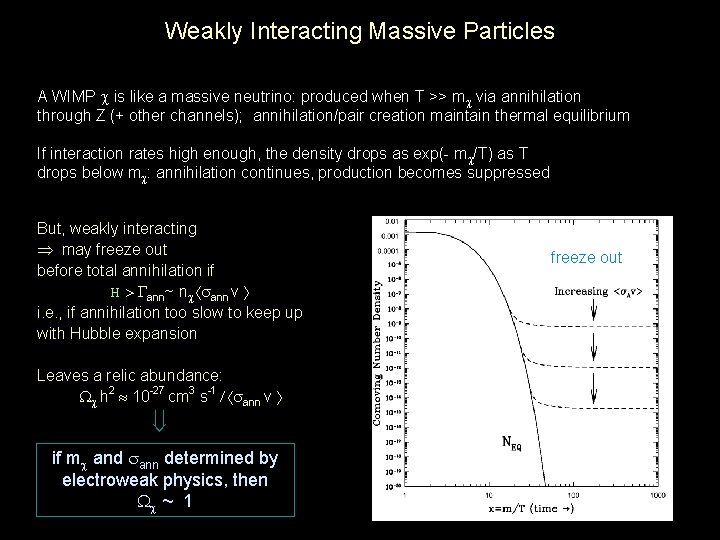
Weakly Interacting Massive Particles A WIMP is like a massive neutrino: produced when T >> m via annihilation through Z (+ other channels); annihilation/pair creation maintain thermal equilibrium If interaction rates high enough, the density drops as exp(- m /T) as T drops below m : annihilation continues, production becomes suppressed But, weakly interacting may freeze out before total annihilation if H > Gann~ n ann v i. e. , if annihilation too slow to keep up with Hubble expansion Leaves a relic abundance: h 2 10 -27 cm 3 s-1 ann v if m and ann determined by electroweak physics, then ~ 1 freeze out
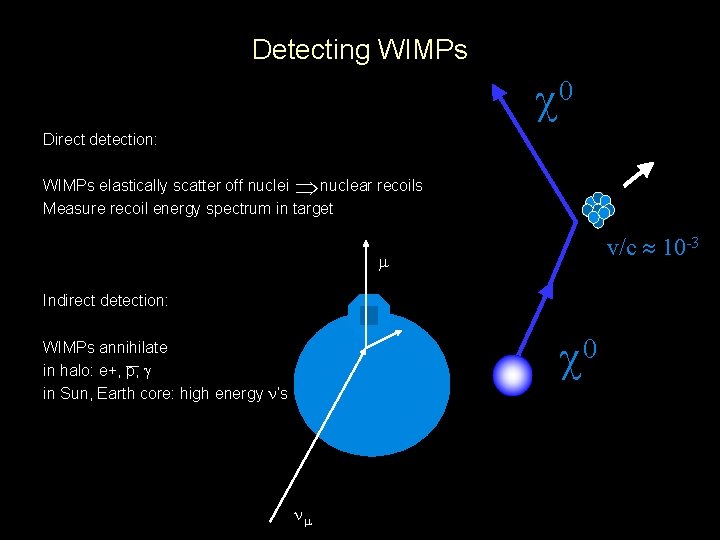
Detecting WIMPs 0 Direct detection: WIMPs elastically scatter off nuclei nuclear recoils Measure recoil energy spectrum in target v/c 10 -3 m Indirect detection: 0 WIMPs annihilate in halo: e+, p, g in Sun, Earth core: high energy n’s nm
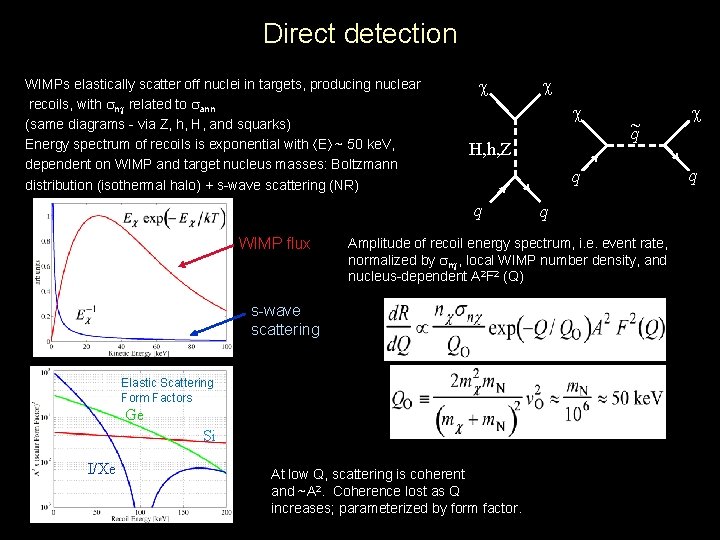
Direct detection WIMPs elastically scatter off nuclei in targets, producing nuclear recoils, with n related to ann (same diagrams - via Z, h, H, and squarks) Energy spectrum of recoils is exponential with E ~ 50 ke. V, dependent on WIMP and target nucleus masses: Boltzmann distribution (isothermal halo) + s-wave scattering (NR) H, h, Z q Amplitude of recoil energy spectrum, i. e. event rate, normalized by n , local WIMP number density, and nucleus-dependent A 2 F 2 (Q) s-wave scattering Elastic Scattering Form Factors Ge Si I/Xe ~ q q q WIMP flux At low Q, scattering is coherent and ~A 2. Coherence lost as Q increases; parameterized by form factor. q
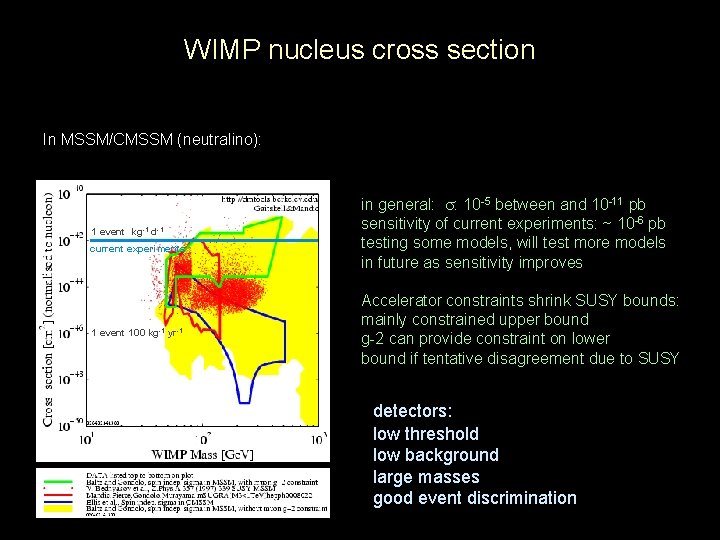
WIMP nucleus cross section In MSSM/CMSSM (neutralino): 1 event kg-1 d-1 current experiments 1 event 100 kg-1 yr-1 in general: : 10 -5 between and 10 -11 pb sensitivity of current experiments: ~ 10 -6 pb testing some models, will test more models in future as sensitivity improves Accelerator constraints shrink SUSY bounds: mainly constrained upper bound g-2 can provide constraint on lower bound if tentative disagreement due to SUSY detectors: low threshold low background large masses good event discrimination
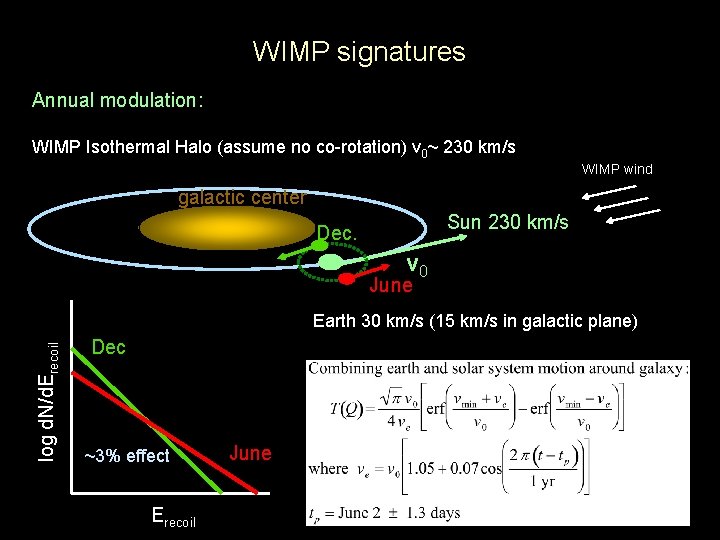
WIMP signatures Annual modulation: WIMP Isothermal Halo (assume no co-rotation) v 0~ 230 km/s WIMP wind galactic center Sun 230 km/s Dec. v 0 June log d. N/d. Erecoil Earth 30 km/s (15 km/s in galactic plane) Dec ~3% effect Erecoil June
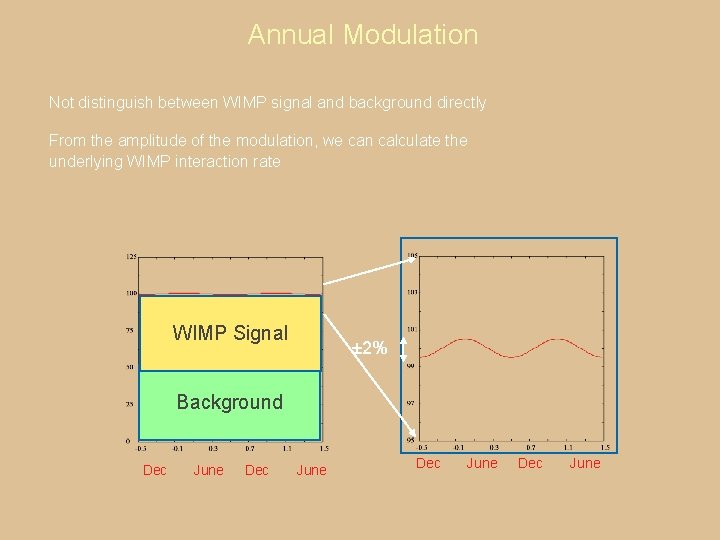
Annual Modulation Not distinguish between WIMP signal and background directly From the amplitude of the modulation, we can calculate the underlying WIMP interaction rate WIMP Signal ± 2% Background Dec June
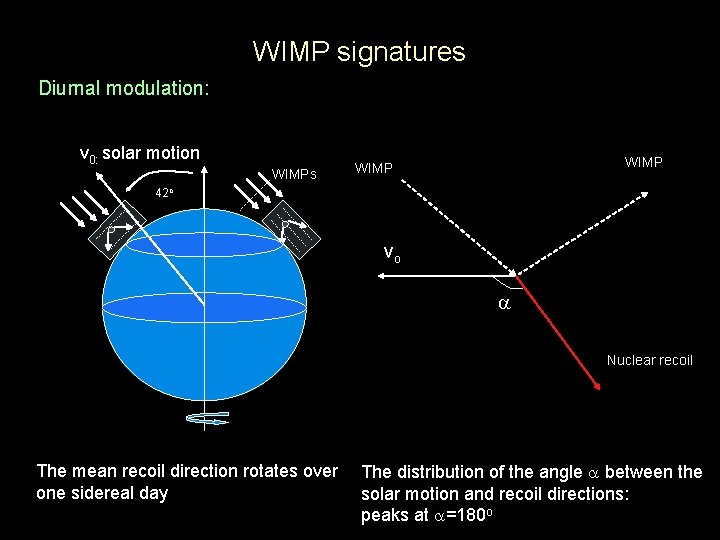
WIMP signatures Diurnal modulation: v 0: solar motion WIMPs WIMP 42 o vo a Nuclear recoil The mean recoil direction rotates over one sidereal day The distribution of the angle a between the solar motion and recoil directions: peaks at a=180 o
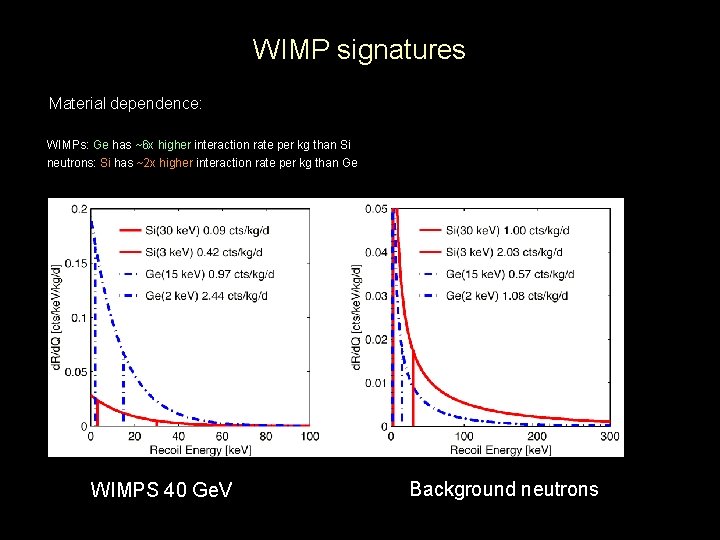
WIMP signatures Material dependence: WIMPs: Ge has ~6 x higher interaction rate per kg than Si neutrons: Si has ~2 x higher interaction rate per kg than Ge WIMPS 40 Ge. V Background neutrons
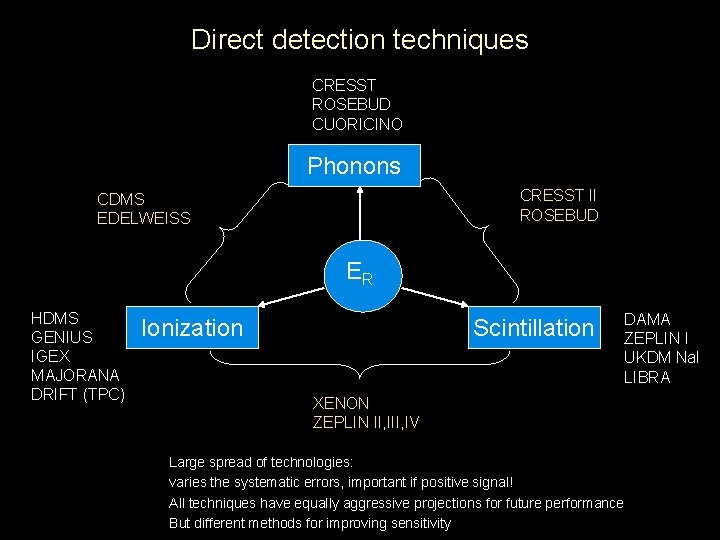
Direct detection techniques CRESST ROSEBUD CUORICINO Phonons CRESST II ROSEBUD CDMS EDELWEISS ER HDMS GENIUS IGEX MAJORANA DRIFT (TPC) Ionization Scintillation XENON ZEPLIN II, IV Large spread of technologies: varies the systematic errors, important if positive signal! All techniques have equally aggressive projections for future performance But different methods for improving sensitivity DAMA ZEPLIN I UKDM Na. I LIBRA
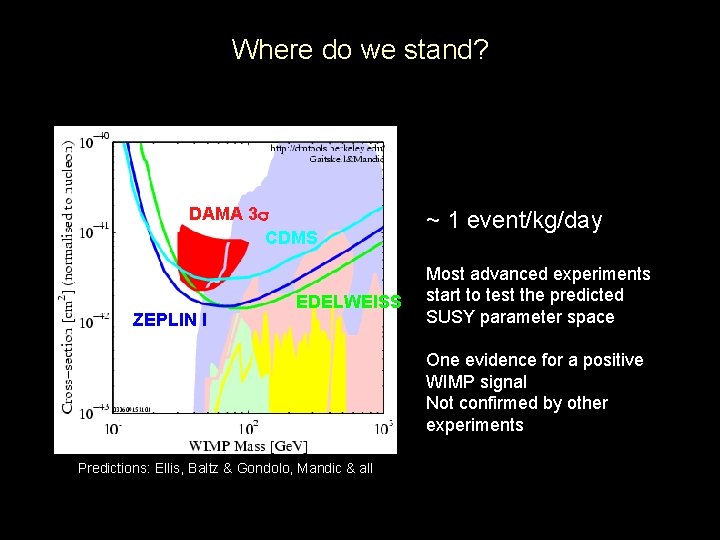
Where do we stand? DAMA 3 s CDMS ZEPLIN I EDELWEISS ~ 1 event/kg/day Most advanced experiments start to test the predicted SUSY parameter space One evidence for a positive WIMP signal Not confirmed by other experiments Predictions: Ellis, Baltz & Gondolo, Mandic & all
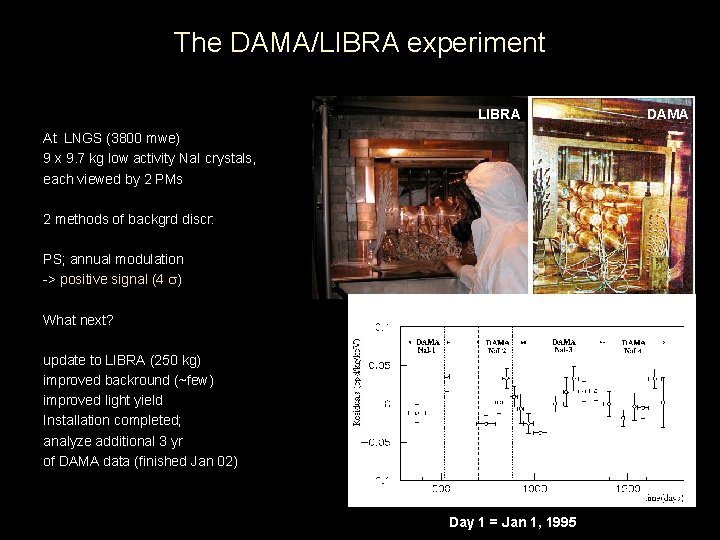
The DAMA/LIBRA experiment LIBRA At LNGS (3800 mwe) 9 x 9. 7 kg low activity Na. I crystals, each viewed by 2 PMs 2 methods of backgrd discr: PS; annual modulation -> positive signal (4 ) What next? update to LIBRA (250 kg) improved backround (~few) improved light yield Installation completed; analyze additional 3 yr of DAMA data (finished Jan 02) Day 1 = Jan 1, 1995 DAMA
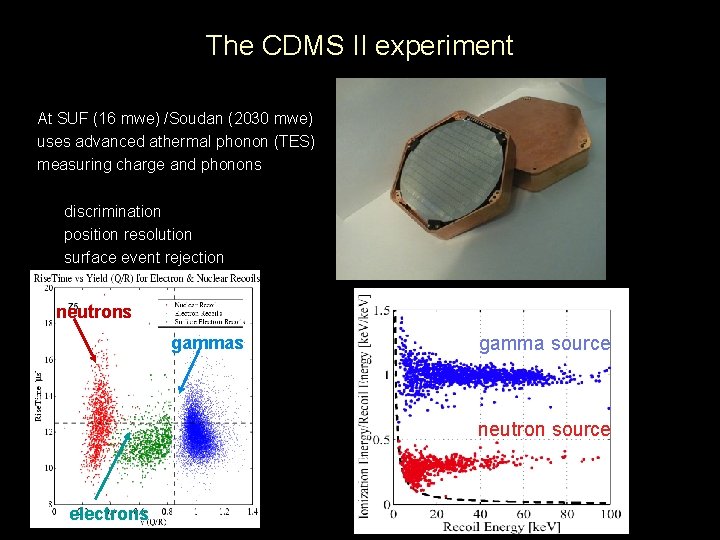
The CDMS II experiment At SUF (16 mwe) /Soudan (2030 mwe) uses advanced athermal phonon (TES) measuring charge and phonons discrimination position resolution surface event rejection neutrons gamma source neutron source electrons
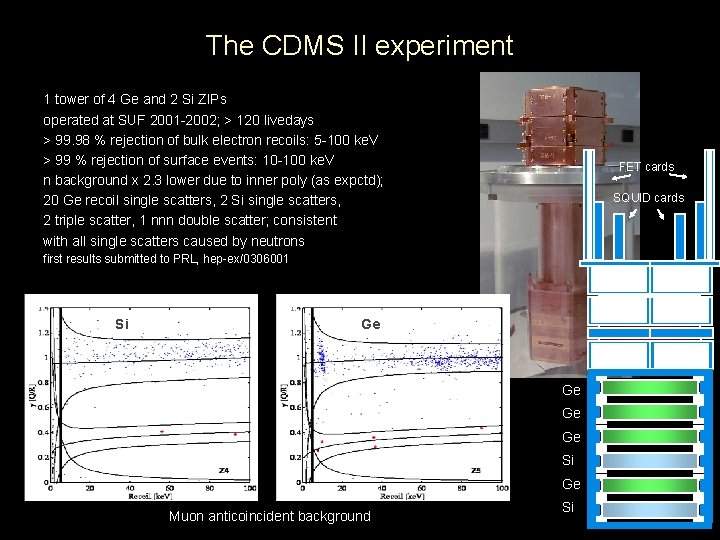
The CDMS II experiment 1 tower of 4 Ge and 2 Si ZIPs operated at SUF 2001 -2002; > 120 livedays > 99. 98 % rejection of bulk electron recoils: 5 -100 ke. V > 99 % rejection of surface events: 10 -100 ke. V n background x 2. 3 lower due to inner poly (as expctd); 20 Ge recoil single scatters, 2 Si single scatters, 2 triple scatter, 1 nnn double scatter; consistent with all single scatters caused by neutrons FET cards SQUID cards first results submitted to PRL, hep-ex/0306001 Si Ge Ge Si Ge Muon anticoincident background Si
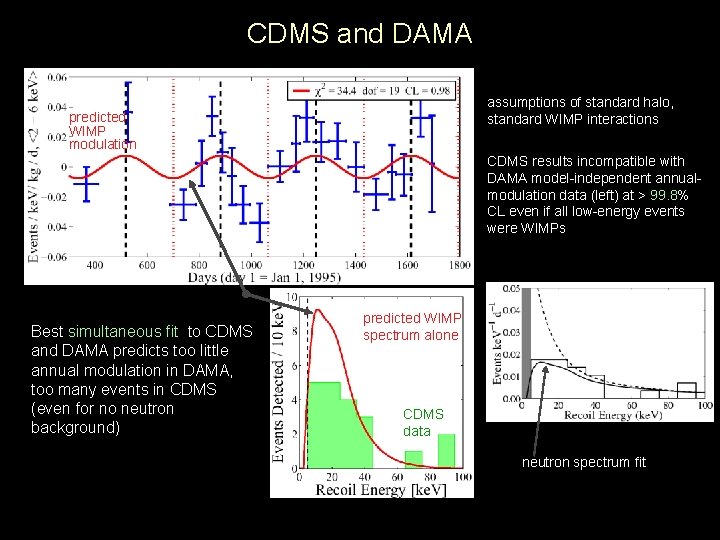
CDMS and DAMA assumptions of standard halo, standard WIMP interactions predicted WIMP modulation CDMS results incompatible with DAMA model-independent annualmodulation data (left) at > 99. 8% CL even if all low-energy events were WIMPs Best simultaneous fit to CDMS and DAMA predicts too little annual modulation in DAMA, too many events in CDMS (even for no neutron background) predicted WIMP spectrum alone CDMS data neutron spectrum fit
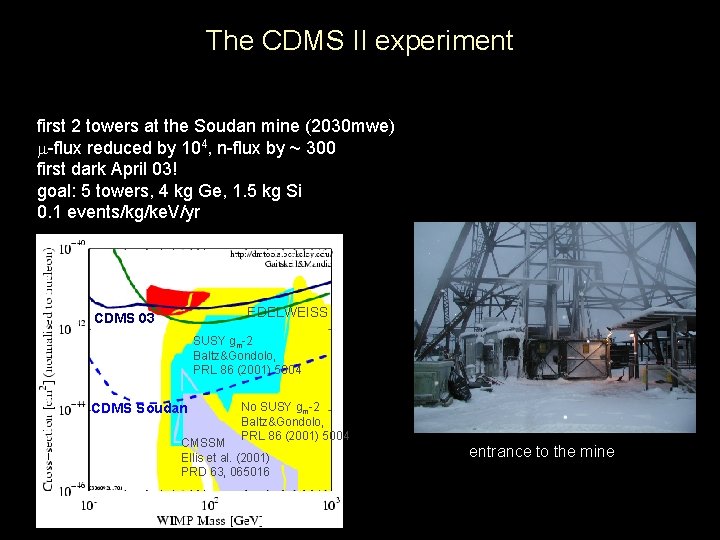
The CDMS II experiment first 2 towers at the Soudan mine (2030 mwe) m-flux reduced by 104, n-flux by ~ 300 first dark April 03! goal: 5 towers, 4 kg Ge, 1. 5 kg Si 0. 1 events/kg/ke. V/yr EDELWEISS CDMS 03 SUSY gm-2 Baltz&Gondolo, PRL 86 (2001) 5004 CDMS Soudan No SUSY gm-2 Baltz&Gondolo, PRL 86 (2001) 5004 CMSSM Ellis et al. (2001) PRD 63, 065016 entrance to the mine
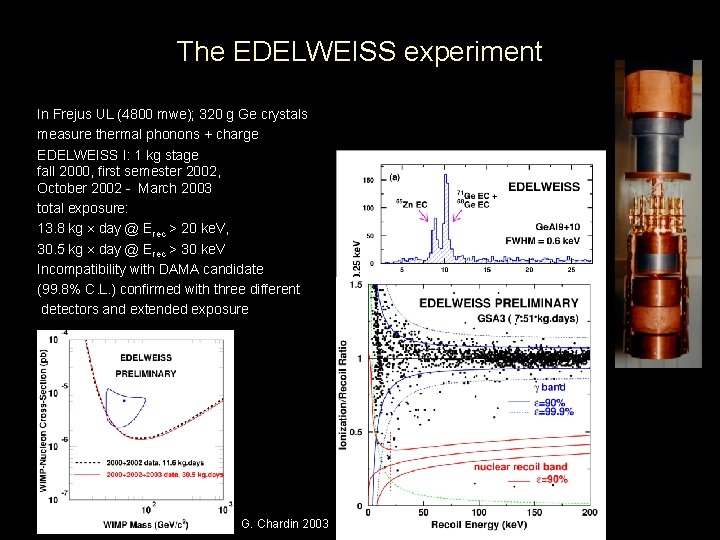
The EDELWEISS experiment In Frejus UL (4800 mwe); 320 g Ge crystals measure thermal phonons + charge EDELWEISS I: 1 kg stage fall 2000, first semester 2002, October 2002 - March 2003 total exposure: 13. 8 kg day @ Erec > 20 ke. V, 30. 5 kg day @ Erec > 30 ke. V Incompatibility with DAMA candidate (99. 8% C. L. ) confirmed with three different detectors and extended exposure G. Chardin 2003
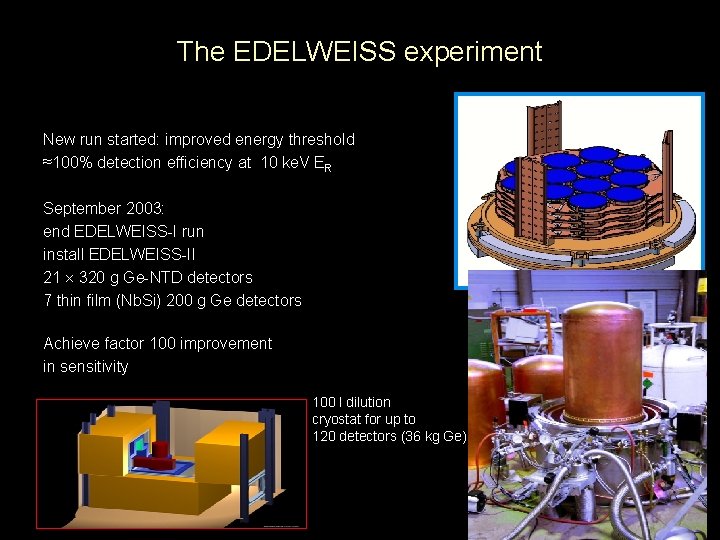
The EDELWEISS experiment New run started: improved energy threshold ≈100% detection efficiency at 10 ke. V ER September 2003: end EDELWEISS-I run install EDELWEISS-II 21 320 g Ge-NTD detectors 7 thin film (Nb. Si) 200 g Ge detectors Achieve factor 100 improvement in sensitivity 100 l dilution cryostat for up to 120 detectors (36 kg Ge)
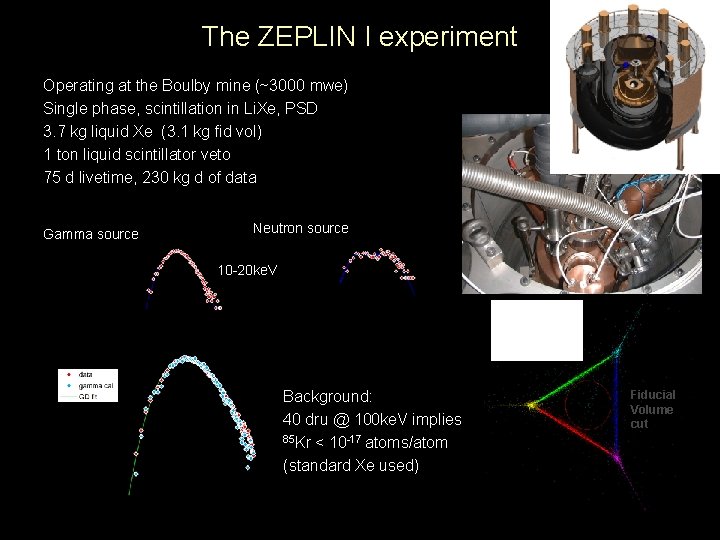
The ZEPLIN I experiment Operating at the Boulby mine (~3000 mwe) Single phase, scintillation in Li. Xe, PSD 3. 7 kg liquid Xe (3. 1 kg fid vol) 1 ton liquid scintillator veto 75 d livetime, 230 kg d of data Gamma source Neutron source 10 -20 ke. V Background: 40 dru @ 100 ke. V implies 85 Kr < 10 -17 atoms/atom (standard Xe used) Fiducial Volume cut
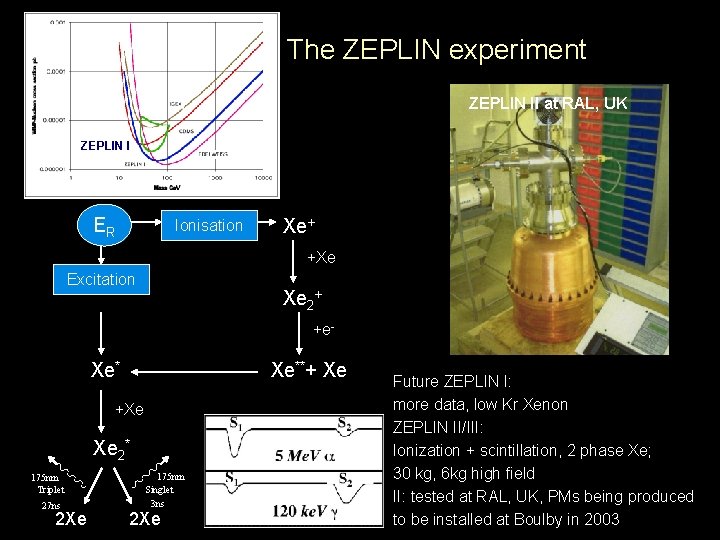
The ZEPLIN experiment ZEPLIN II at RAL, UK ZEPLIN I ER Ionisation Xe+ +Xe Excitation Xe 2+ +e- Xe**+ Xe +Xe Xe 2* 175 nm Triplet 27 ns 2 Xe 175 nm Singlet 3 ns 2 Xe Future ZEPLIN I: more data, low Kr Xenon ZEPLIN II/III: Ionization + scintillation, 2 phase Xe; 30 kg, 6 kg high field II: tested at RAL, UK, PMs being produced to be installed at Boulby in 2003
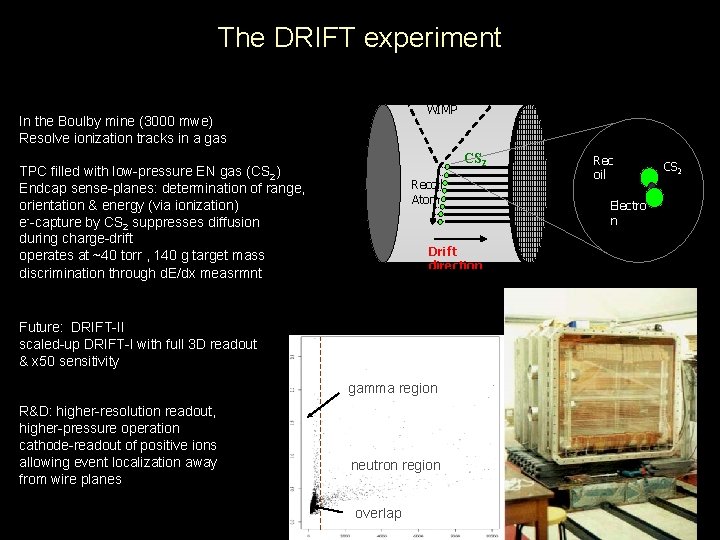
The DRIFT experiment Scattered WIMP In the Boulby mine (3000 mwe) Resolve ionization tracks in a gas TPC filled with low-pressure EN gas (CS 2) Endcap sense-planes: determination of range, orientation & energy (via ionization) e--capture by CS 2 suppresses diffusion during charge-drift operates at ~40 torr , 140 g target mass discrimination through d. E/dx measrmnt Future: DRIFT-II scaled-up DRIFT-I with full 3 D readout & x 50 sensitivity R&D: higher-resolution readout, higher-pressure operation cathode-readout of positive ions allowing event localization away from wire planes CS 2 Rec oil Recoil Atom Cathode Drift direction Electric Field gamma region Gamma Region Neutron Region neutron region overlap. Region Overlap Electro n MWPC Readout Plane CS 2
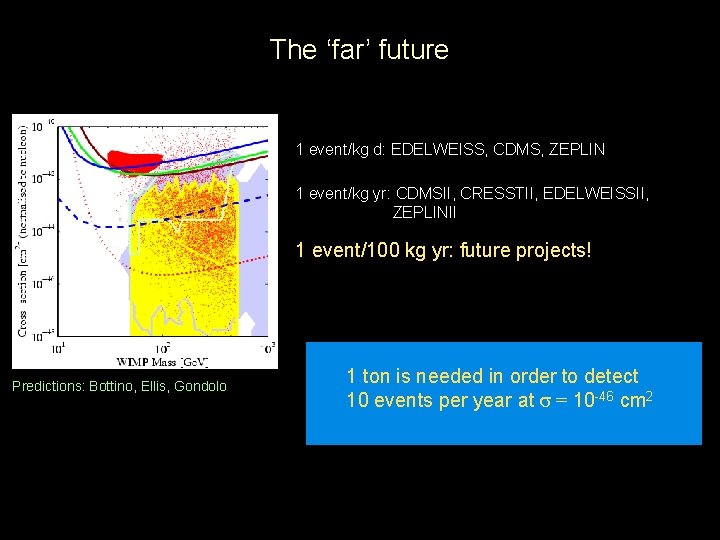
The ‘far’ future 1 event/kg d: EDELWEISS, CDMS, ZEPLIN 1 event/kg yr: CDMSII, CRESSTII, EDELWEISSII, ZEPLINII 1 event/100 kg yr: future projects! Predictions: Bottino, Ellis, Gondolo 1 ton is needed in order to detect 10 events per year at = 10 -46 cm 2
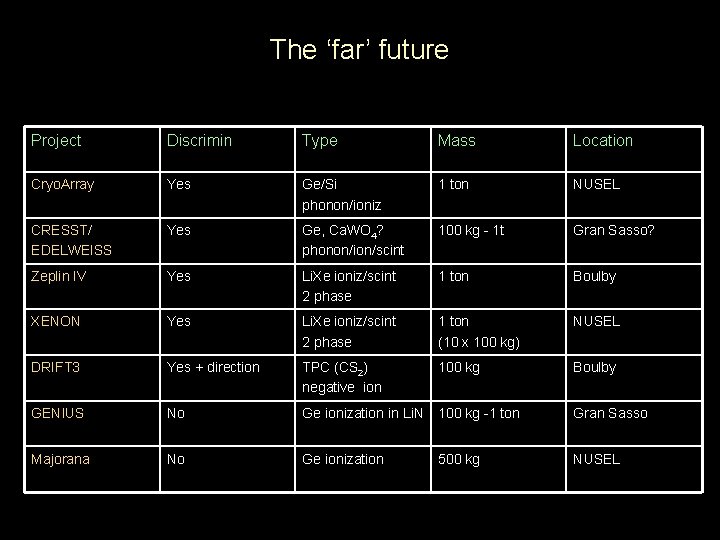
The ‘far’ future Project Discrimin Type Mass Location Cryo. Array Yes Ge/Si phonon/ioniz 1 ton NUSEL CRESST/ EDELWEISS Yes Ge, Ca. WO 4? phonon/ion/scint 100 kg - 1 t Gran Sasso? Zeplin IV Yes Li. Xe ioniz/scint 2 phase 1 ton Boulby XENON Yes Li. Xe ioniz/scint 2 phase 1 ton (10 x 100 kg) NUSEL DRIFT 3 Yes + direction TPC (CS 2) negative ion 100 kg Boulby GENIUS No Ge ionization in Li. N 100 kg -1 ton Gran Sasso Majorana No Ge ionization 500 kg NUSEL