
Experimental Comparison of Two Quantum Computing Architectures Norbert
Experimental Comparison of Two Quantum Computing Architectures Norbert M. Linke, Dmitri Maslov, Martin Roerreler, Shantanu Debnath, Caroline Figgatt, Kevein A. Landsman, Kenneth Wright and Christopher Monroe UMD, NSF, Microsoft Research and Ion. Q Inc.
Contents • • • Motivation The Two Quantum Computers Experimental Results Discussion

Motivation • Leap in performance with Quantum • Many candidate architectures • Need to determine which is better
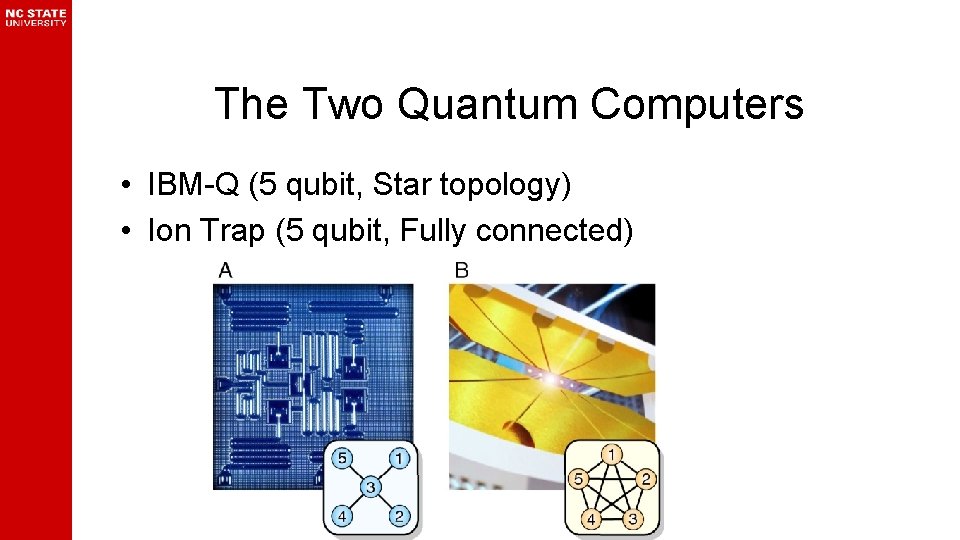
The Two Quantum Computers • IBM-Q (5 qubit, Star topology) • Ion Trap (5 qubit, Fully connected)

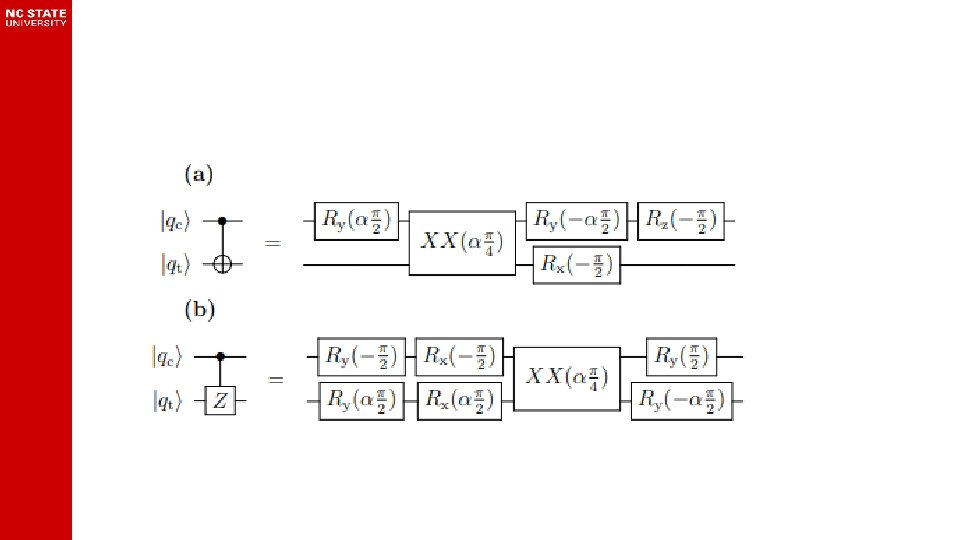
IBM-Q • Superconductor Islands with Josephson Junctions • 130 ns single qubit gates • 250 -450 ns 2 -qubit gates • Lower accuracy (80%) • More gates used for mapping algorithms • Uses the Clifford + T library (X, Y, Z, T, H, CNOT and S) Ion Trap • Ytterbium Ions • • • 20μs single qubit gates 250μs 2 -qubit gates Highly accurate (95. 7%) Requires fewer gates Uses R/XX Library
More on Accuracy IBM-Q Ion Trap • • • 1 qubit gate – 99. 1% • 2 qubit gate – 97% • Reading one qubit – 99. 7 for 0 and 99. 1 for 1 • Reading all five qubits – 95. 7% 1 qubit gate – 99. 7% 2 qubit gate – 96. 5% Reading one qubit – 96% Reading all five qubits – 80%
Experiments • • • Four algorithms (Gates) : Margolus Toffoli Bernstein-Vazirani Hidden Shift
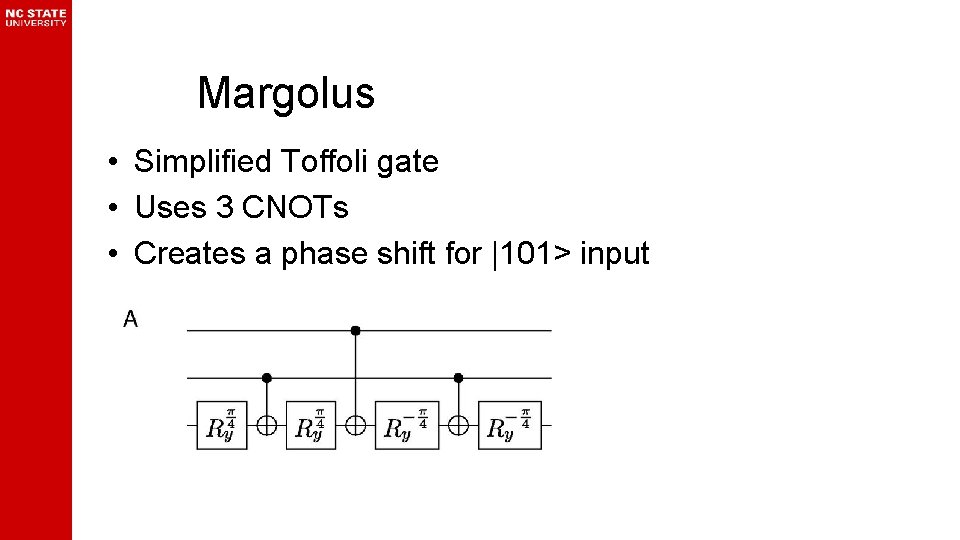
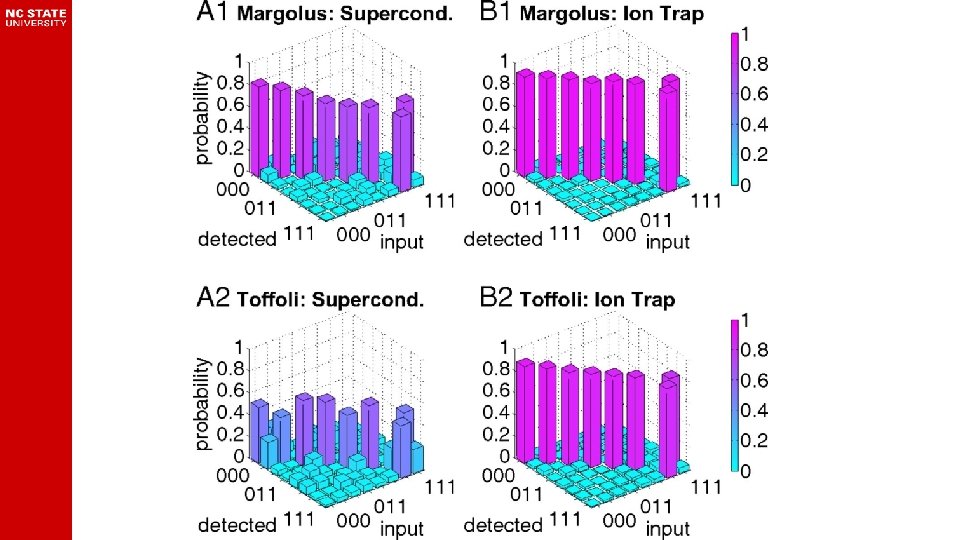
Margolus • Simplified Toffoli gate • Uses 3 CNOTs • Creates a phase shift for |101> input
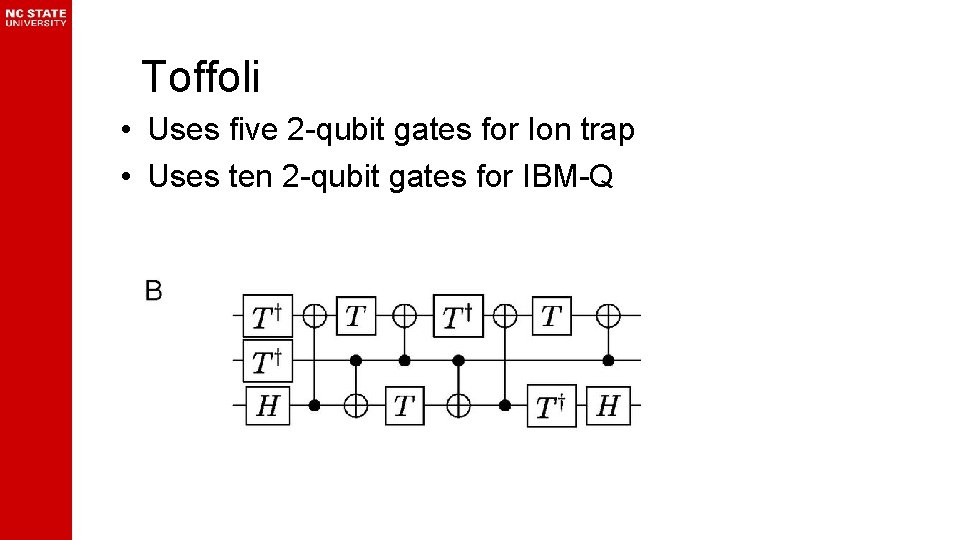
Toffoli • Uses five 2 -qubit gates for Ion trap • Uses ten 2 -qubit gates for IBM-Q
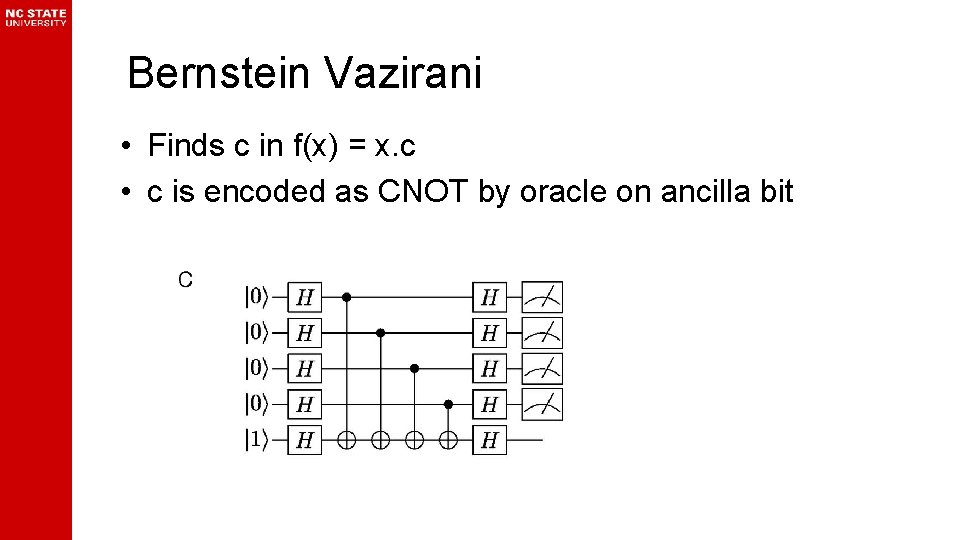
Bernstein Vazirani • Finds c in f(x) = x. c • c is encoded as CNOT by oracle on ancilla bit
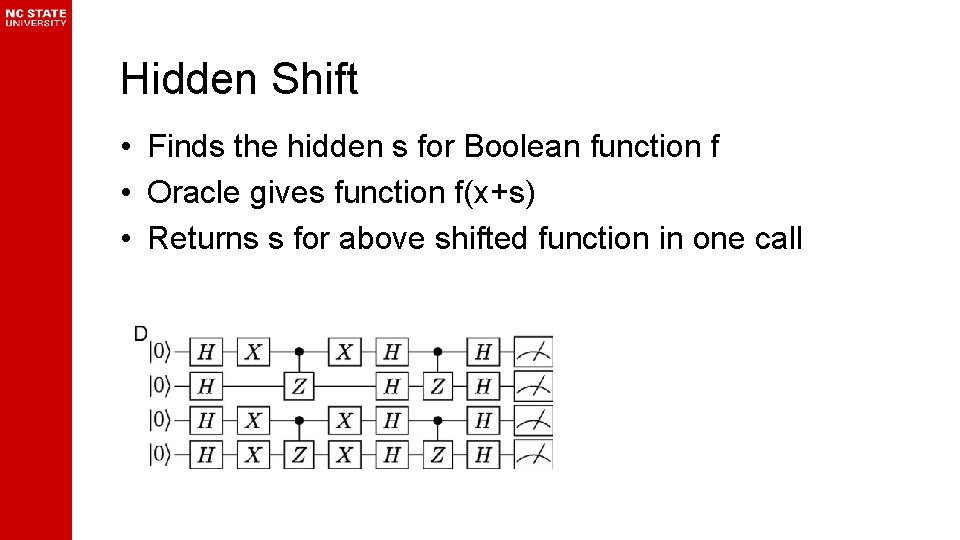
Hidden Shift • Finds the hidden s for Boolean function f • Oracle gives function f(x+s) • Returns s for above shifted function in one call
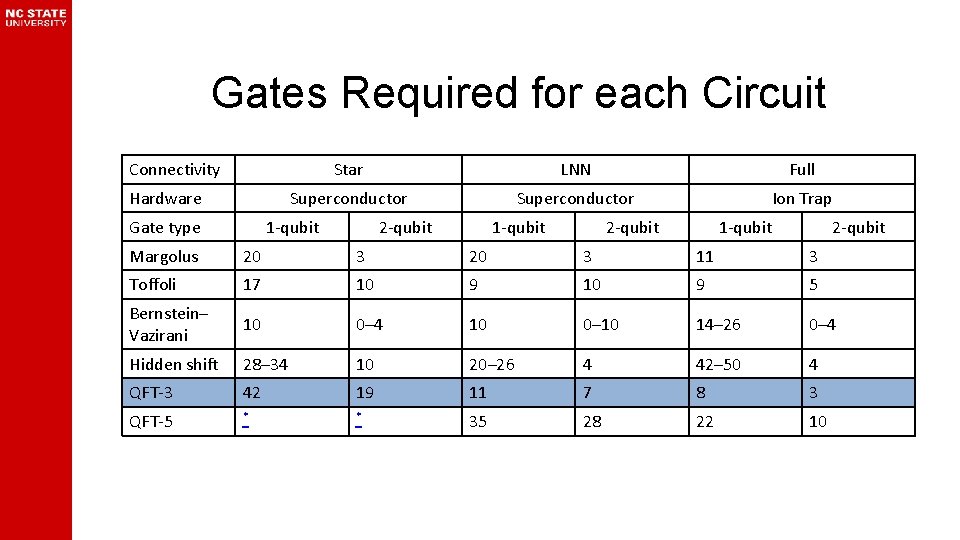
Gates Required for each Circuit Connectivity Hardware Gate type Star LNN Full Superconductor Ion Trap 1 -qubit 2 -qubit Margolus 20 3 11 3 Toffoli 17 10 9 5 Bernstein– Vazirani 10 0– 4 10 0– 10 14– 26 0– 4 Hidden shift 28– 34 10 20– 26 4 42– 50 4 QFT-3 42 19 11 7 8 3 QFT-5 * * 35 28 22 10
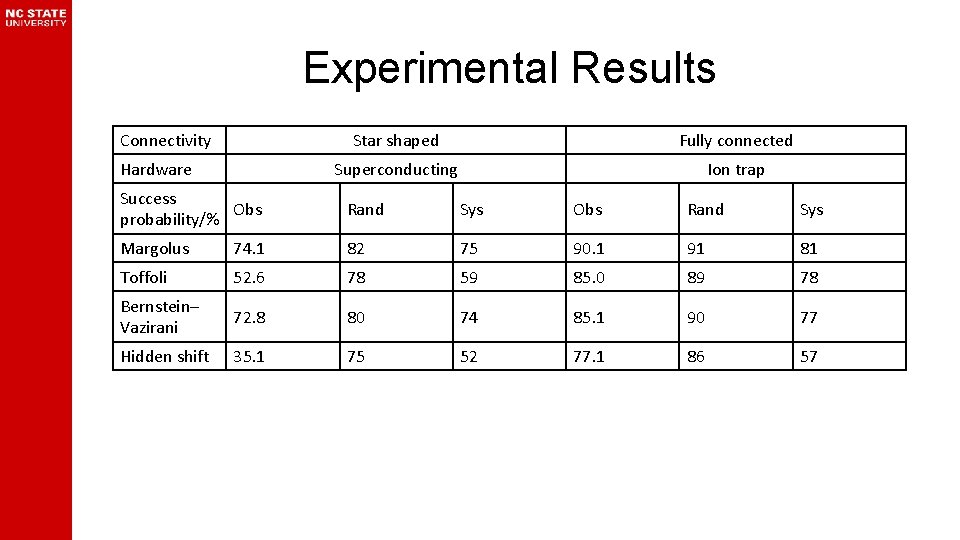
Experimental Results Connectivity Hardware Star shaped Fully connected Superconducting Ion trap Success Obs probability/% Rand Sys Obs Rand Sys Margolus 74. 1 82 75 90. 1 91 81 Toffoli 52. 6 78 59 85. 0 89 78 Bernstein– Vazirani 72. 8 80 74 85. 1 90 77 Hidden shift 35. 1 75 52 77. 1 86 57

Open Problems • Number of qubits is small – Need scalable architecture • Remove cross talk • Maintaining controllability • Ensuring accuracy • Connectivity is an issue • Automated calibration

Thank You

- Slides: 19