
Experimental Baseball Physics Alan M Nathan anathanuiuc edu
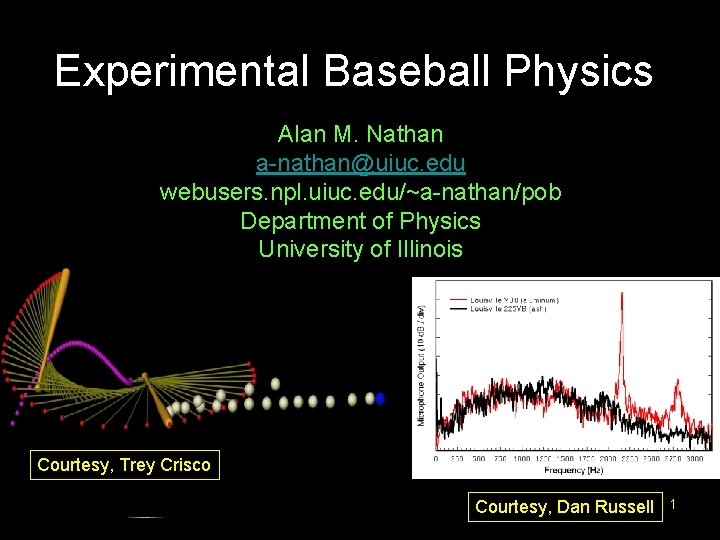
Experimental Baseball Physics Alan M. Nathan a-nathan@uiuc. edu webusers. npl. uiuc. edu/~a-nathan/pob Department of Physics University of Illinois Courtesy, Trey Crisco Courtesy, Dan Russell 1
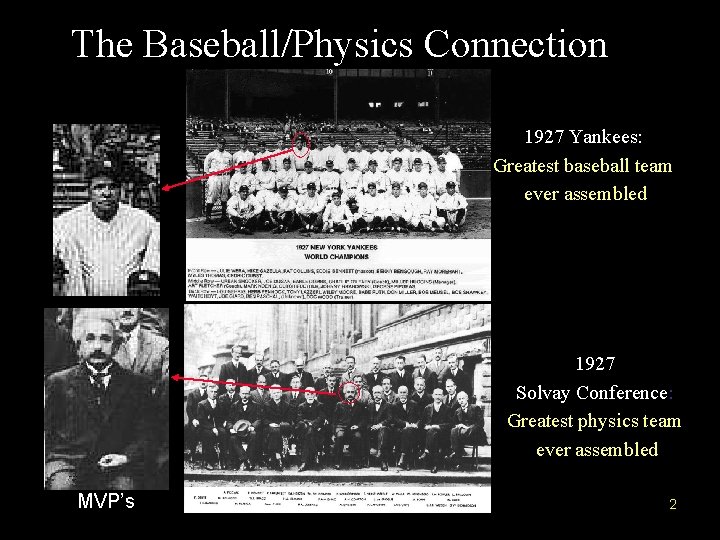
The Baseball/Physics Connection 1927 Yankees: Greatest baseball team ever assembled 1927 Solvay Conference: Greatest physics team ever assembled MVP’s 2
Some Topics I Will Cover • The ball-bat collision • The flight of the baseball 3
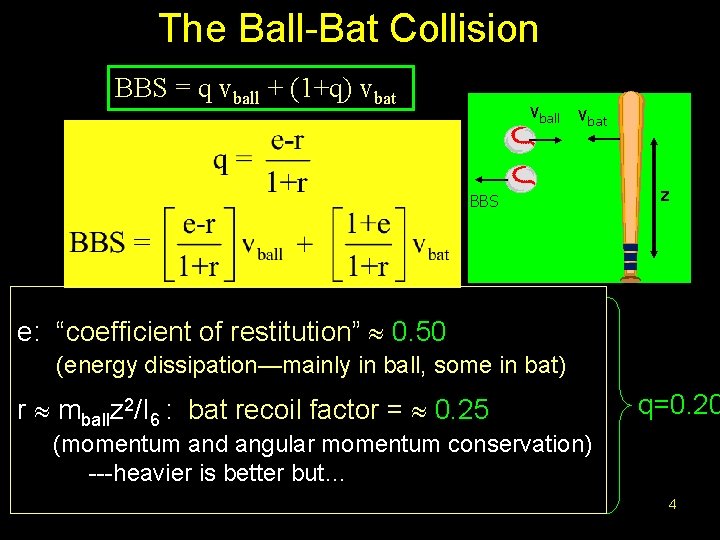
The Ball-Bat Collision BBS = q vball + (1+q) vbat vball vbat BBS z e: “coefficient of restitution” 0. 50 (energy dissipation—mainly in ball, some in bat) r mballz 2/I 6 : bat recoil factor = 0. 25 q=0. 20 (momentum and angular momentum conservation) ---heavier is better but… 4
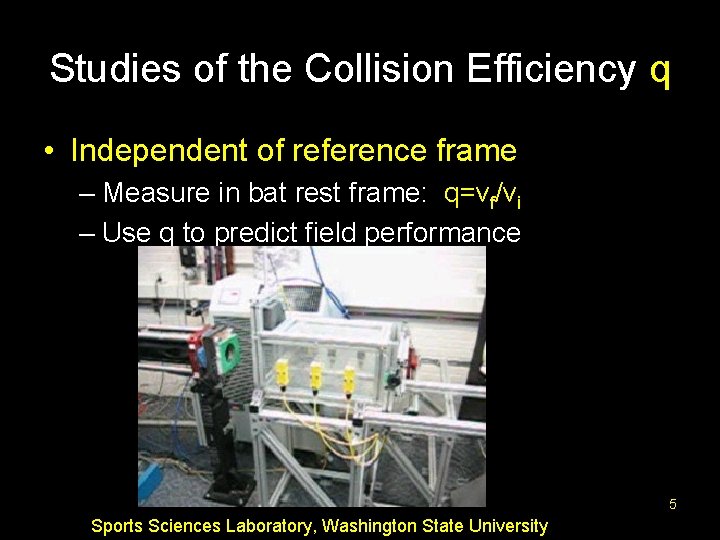
Studies of the Collision Efficiency q • Independent of reference frame – Measure in bat rest frame: q=vf/vi – Use q to predict field performance 5 Sports Sciences Laboratory, Washington State University
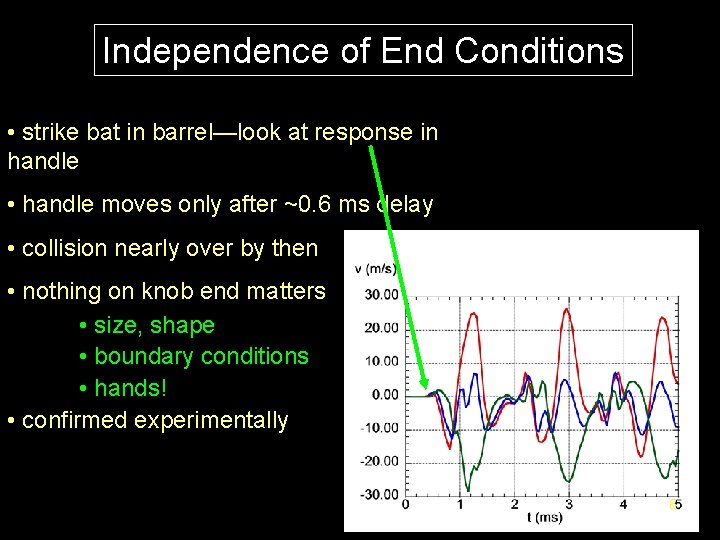
Independence of End Conditions • strike bat in barrel—look at response in handle • handle moves only after ~0. 6 ms delay • collision nearly over by then • nothing on knob end matters • size, shape • boundary conditions • hands! • confirmed experimentally 6
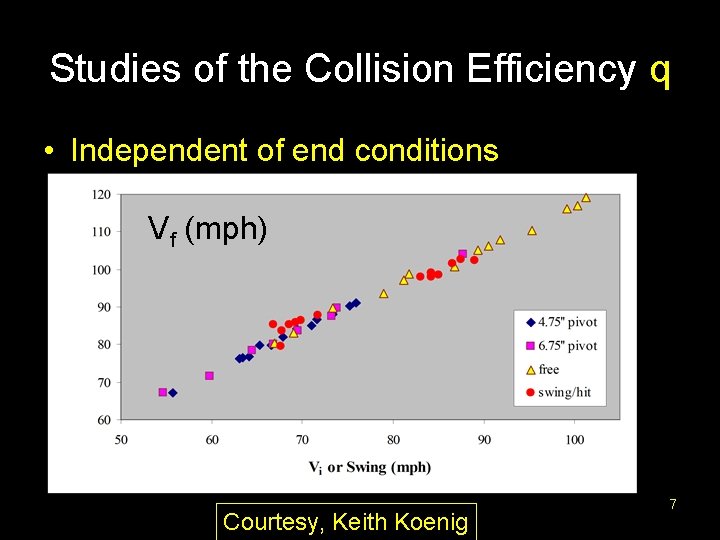
Studies of the Collision Efficiency q • Independent of end conditions Vf (mph) Courtesy, Keith Koenig 7
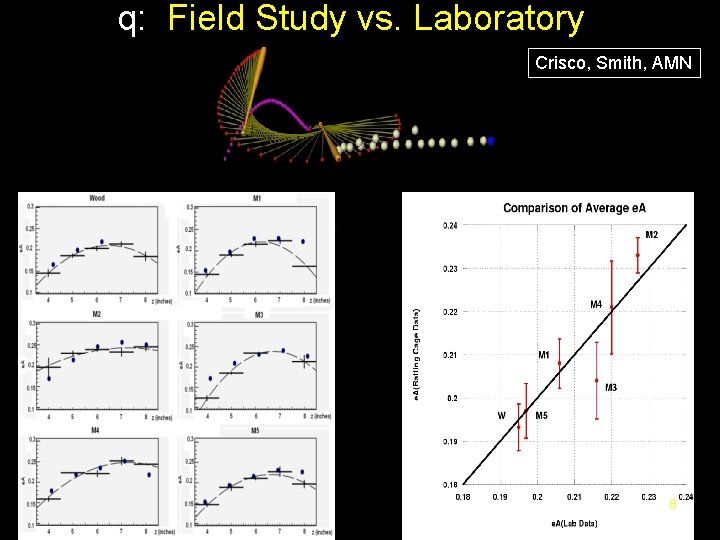
q: Field Study vs. Laboratory Crisco, Smith, AMN 8
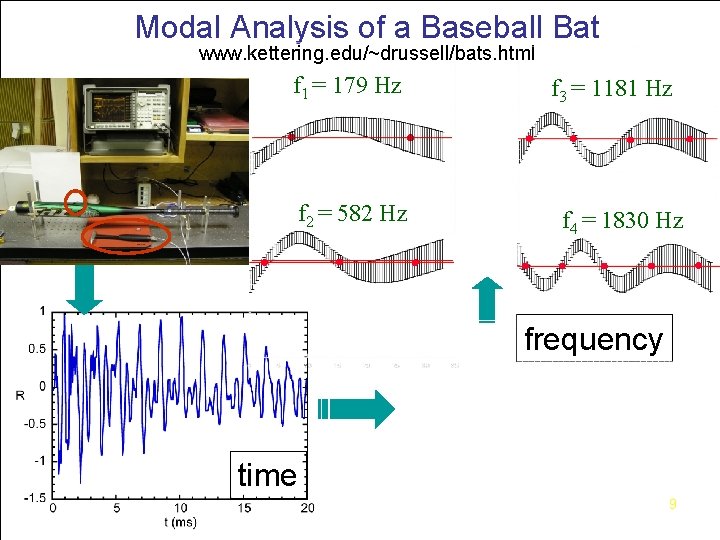
Modal Analysis of a Baseball Bat www. kettering. edu/~drussell/bats. html f 1 = 179 Hz f 2 = 582 Hz f 3 = 1181 Hz f 4 = 1830 Hz frequency time 9
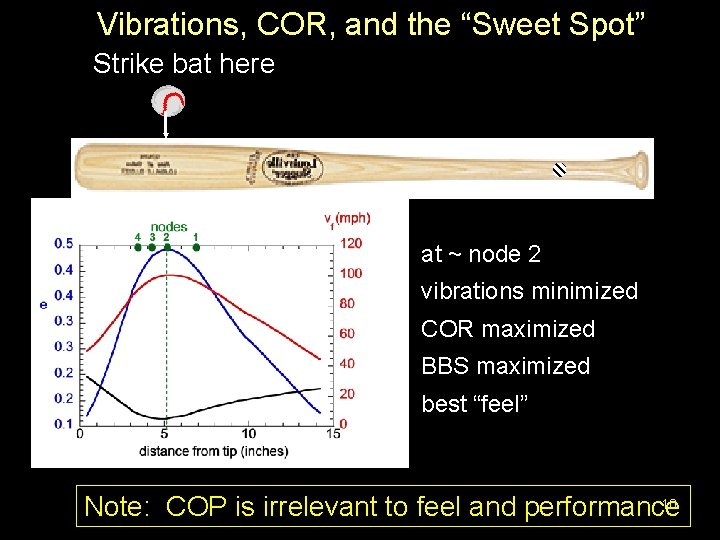
Vibrations, COR, and the “Sweet Spot” Strike bat here at ~ node 2 + vibrations minimized e vf Evib COR maximized BBS maximized best “feel” 10 Note: COP is irrelevant to feel and performance
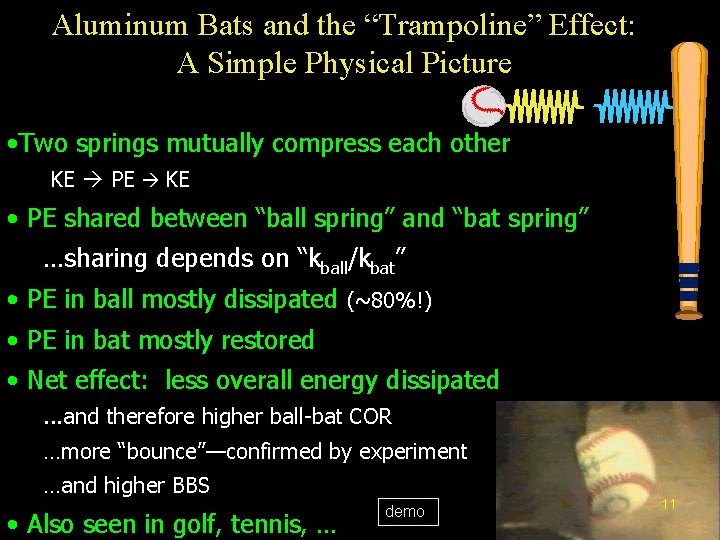
Aluminum Bats and the “Trampoline” Effect: A Simple Physical Picture • Two springs mutually compress each other KE PE KE • PE shared between “ball spring” and “bat spring” …sharing depends on “kball/kbat” • PE in ball mostly dissipated (~80%!) • PE in bat mostly restored • Net effect: less overall energy dissipated. . . and therefore higher ball-bat COR …more “bounce”—confirmed by experiment …and higher BBS • Also seen in golf, tennis, … demo 11
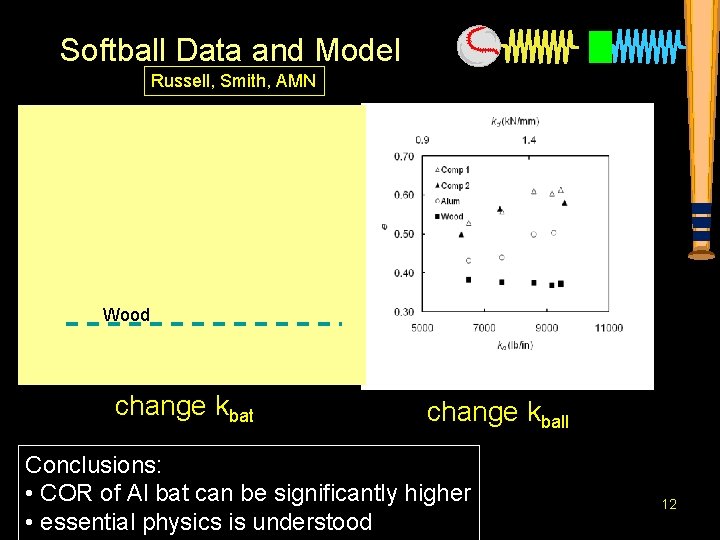
Softball Data and Model Russell, Smith, AMN Wood change kbat change kball Conclusions: • COR of Al bat can be significantly higher • essential physics is understood 12
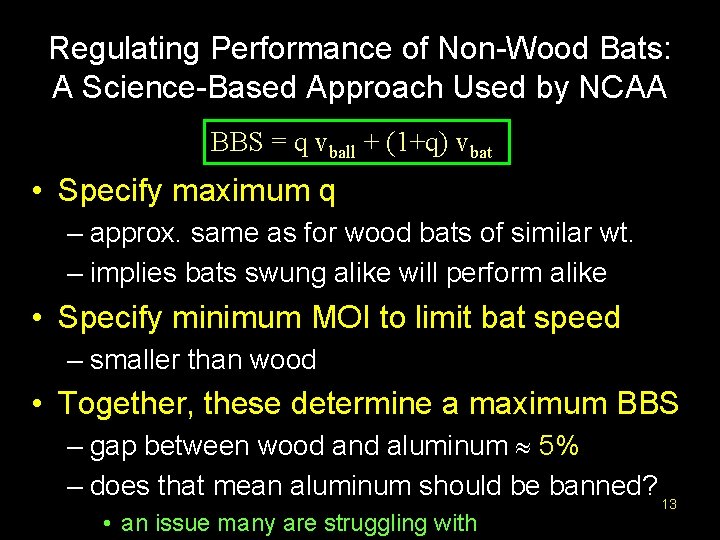
Regulating Performance of Non-Wood Bats: A Science-Based Approach Used by NCAA BBS = q vball + (1+q) vbat • Specify maximum q – approx. same as for wood bats of similar wt. – implies bats swung alike will perform alike • Specify minimum MOI to limit bat speed – smaller than wood • Together, these determine a maximum BBS – gap between wood and aluminum 5% – does that mean aluminum should be banned? 13 • an issue many are struggling with
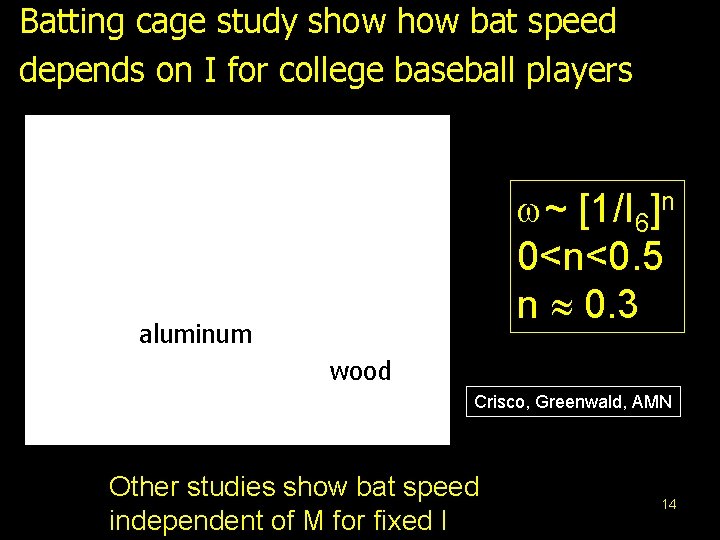
Batting cage study show bat speed depends on I for college baseball players ~ [1/I 6]n 0<n<0. 5 n 0. 3 aluminum wood Crisco, Greenwald, AMN Other studies show bat speed independent of M for fixed I 14
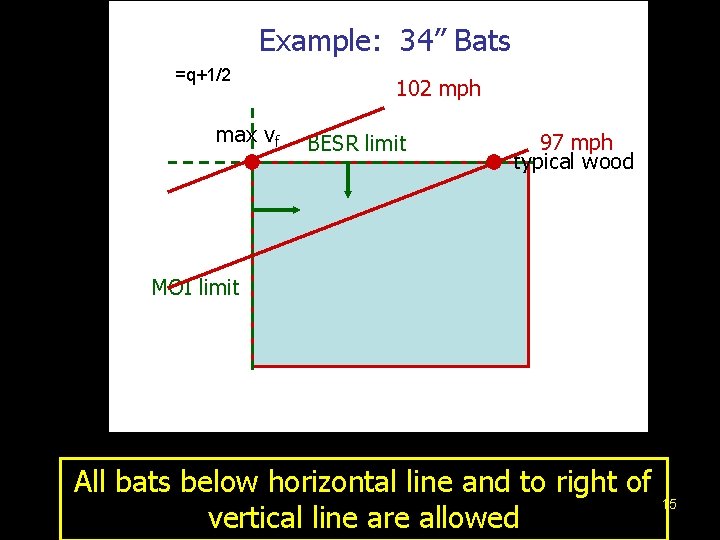
Example: 34” Bats =q+1/2 max vf 102 mph BESR limit 97 mph typical wood MOI limit All bats below horizontal line and to right of vertical line are allowed 15
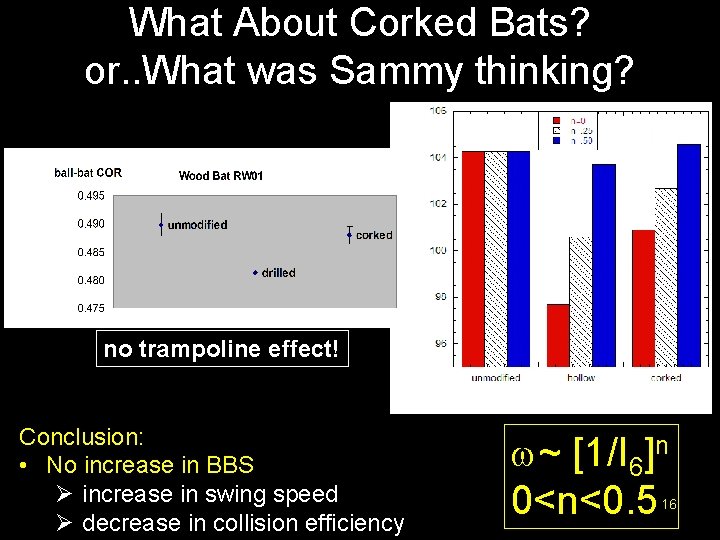
What About Corked Bats? or. . What was Sammy thinking? no trampoline effect! Conclusion: • No increase in BBS Ø increase in swing speed Ø decrease in collision efficiency ~ [1/I 6]n 0<n<0. 5 16
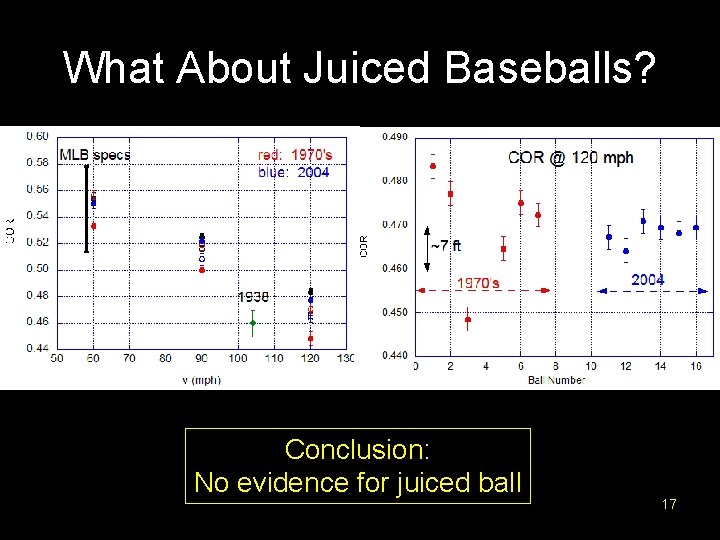
What About Juiced Baseballs? Conclusion: No evidence for juiced ball 17
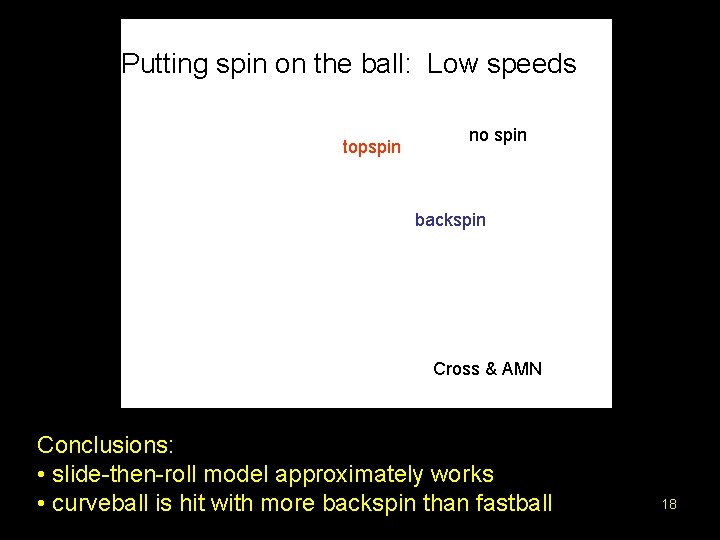
Putting spin on the ball: Low speeds topspin no spin backspin Cross & AMN Conclusions: • slide-then-roll model approximately works • curveball is hit with more backspin than fastball 18
High-Speed Version: Work in Progress 19
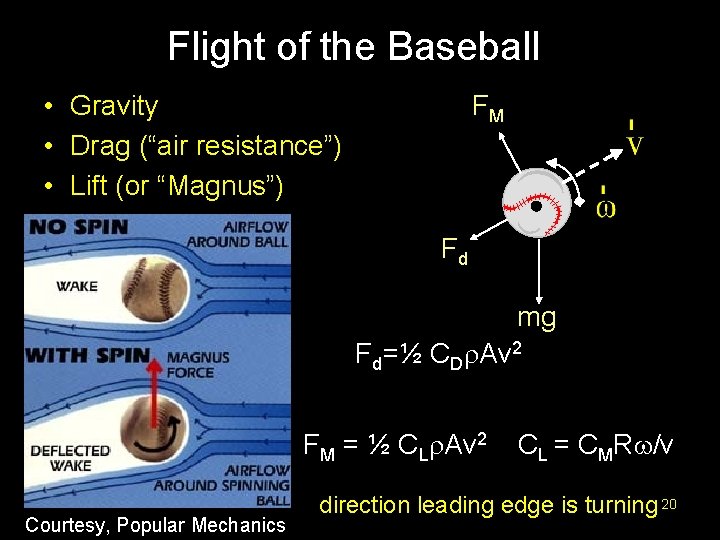
Flight of the Baseball • Gravity • Drag (“air resistance”) • Lift (or “Magnus”) FM Fd mg Fd=½ CD Av 2 FM = ½ CL Av 2 Courtesy, Popular Mechanics CL = CMR /v direction leading edge is turning 20
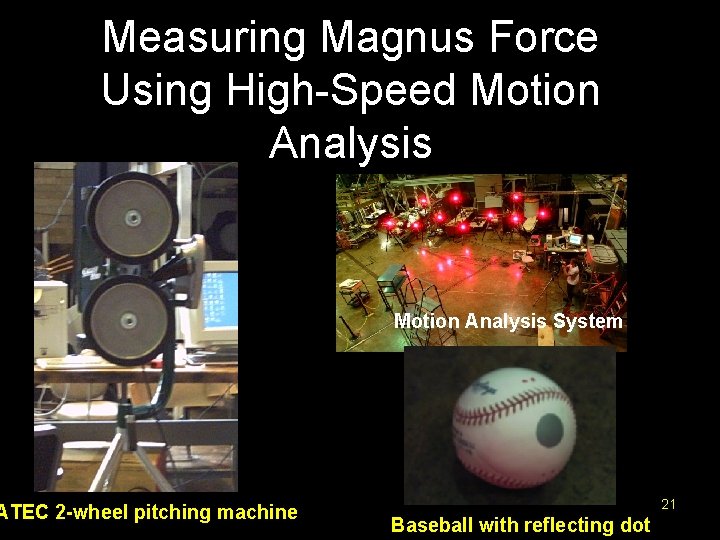
Measuring Magnus Force Using High-Speed Motion Analysis ATEC 2 -wheel pitching machine Motion Analysis System 21 Baseball with reflecting dot
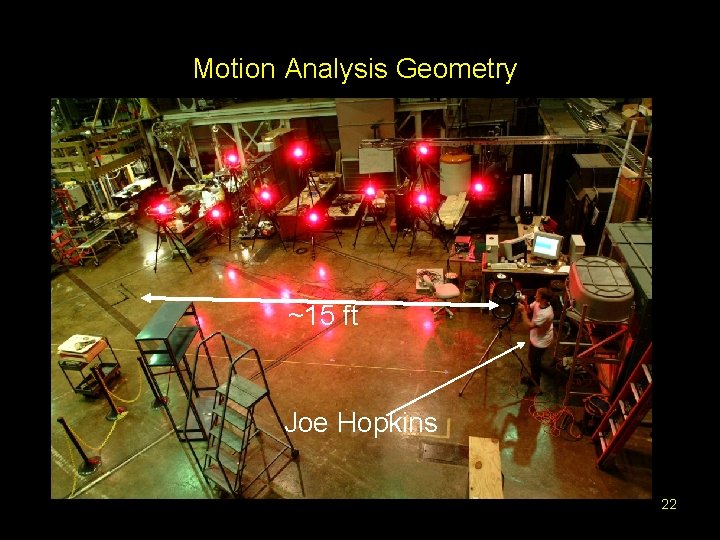
Motion Analysis Geometry ~15 ft Joe Hopkins 22
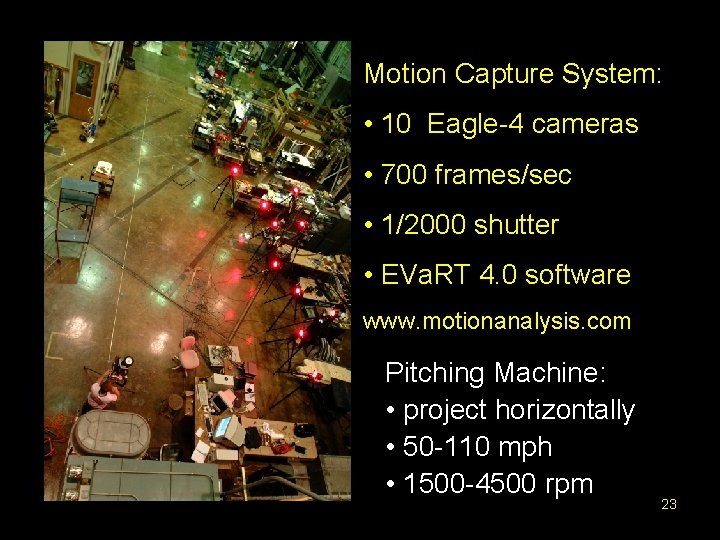
Motion Capture System: • 10 Eagle-4 cameras • 700 frames/sec • 1/2000 shutter • EVa. RT 4. 0 software www. motionanalysis. com Pitching Machine: • project horizontally • 50 -110 mph • 1500 -4500 rpm 23

Typical Data and Fit 24
Results for Lift Coefficient FL= 1/2 ACLv 2 S=r /v 100 mph, 2000 rpm S=0. 17 Conclusions: --data qualitatively consistent (~20%) --RKA model inconsistent with data 25
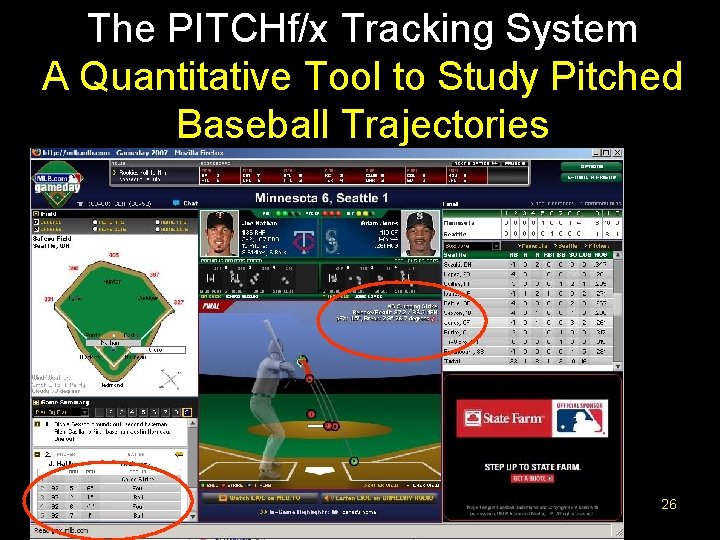
The PITCHf/x Tracking System A Quantitative Tool to Study Pitched Baseball Trajectories 26
How Does PITCHf/x Work? • Two video cameras track baseball in 1/60 -sec intervals – usually “high home” and “high first” – third CF camera used establishes ht. of strike zone • Pattern-recognition software to identify “blobs” • Camera calibration to convert pixels to (x, y, z) – 9 -parameter fit to trajectory – constant acceleration for x(t), y(t), z(t) • Use fit to calculate lots of stuff – The full trajectory – The “break” – Drag and Magnus forces 27
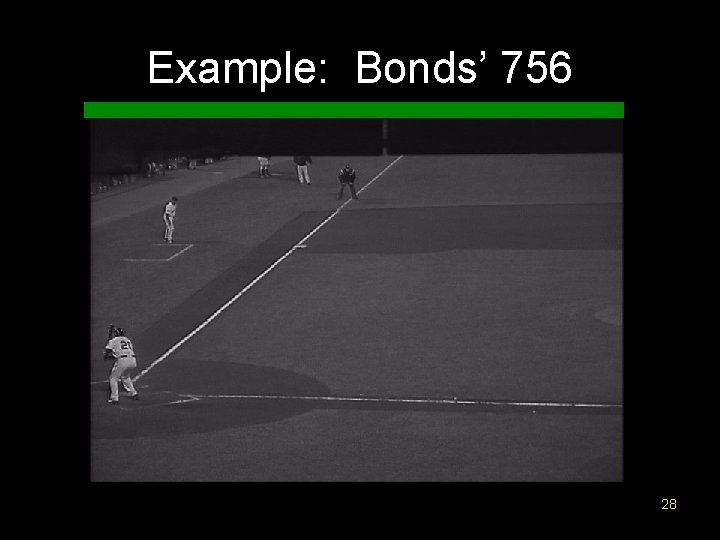
Example: Bonds’ 756 28
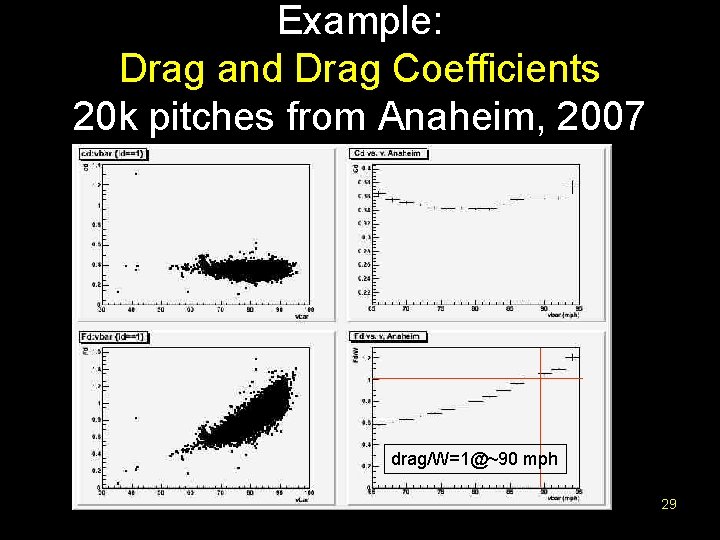
Example: Drag and Drag Coefficients 20 k pitches from Anaheim, 2007 drag/W=1@~90 mph 29
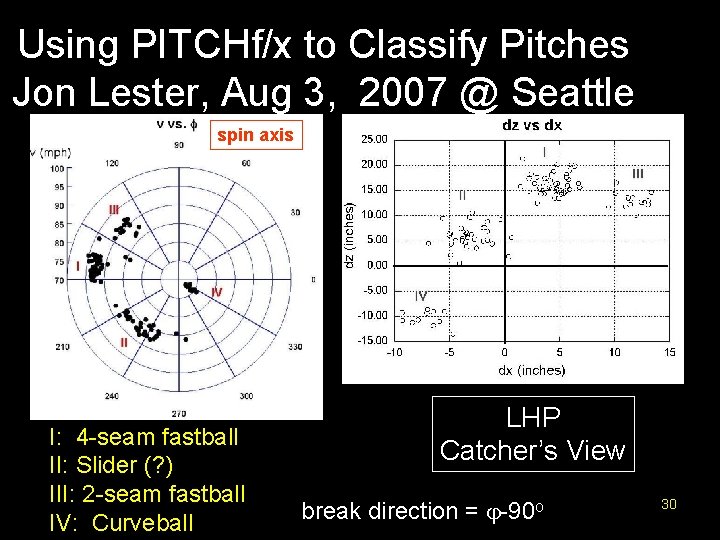
Using PITCHf/x to Classify Pitches Jon Lester, Aug 3, 2007 @ Seattle spin axis I: 4 -seam fastball II: Slider (? ) III: 2 -seam fastball IV: Curveball LHP Catcher’s View break direction = -90 o 30

How Far Did That Home Run Travel? • Ball leaves bat • Hits stands D from home plate, H above ground • How far would it have gone if no obstruction? 31
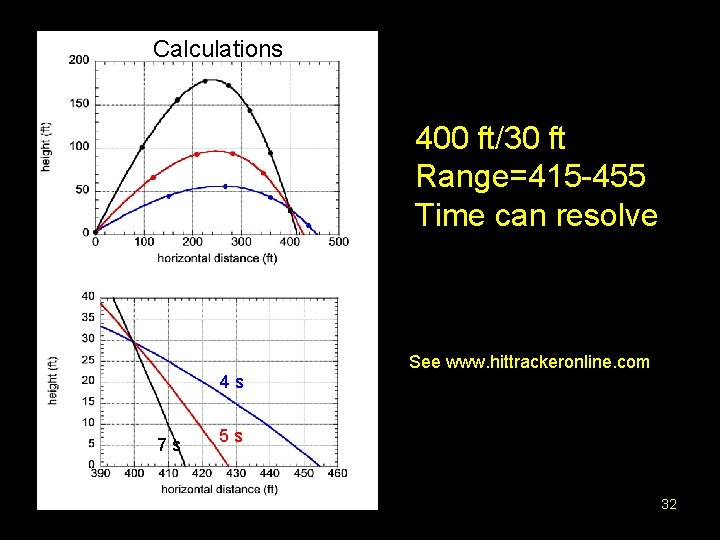
Calculations 400 ft/30 ft Range=415 -455 Time can resolve 4 s 7 s See www. hittrackeronline. com 5 s 32
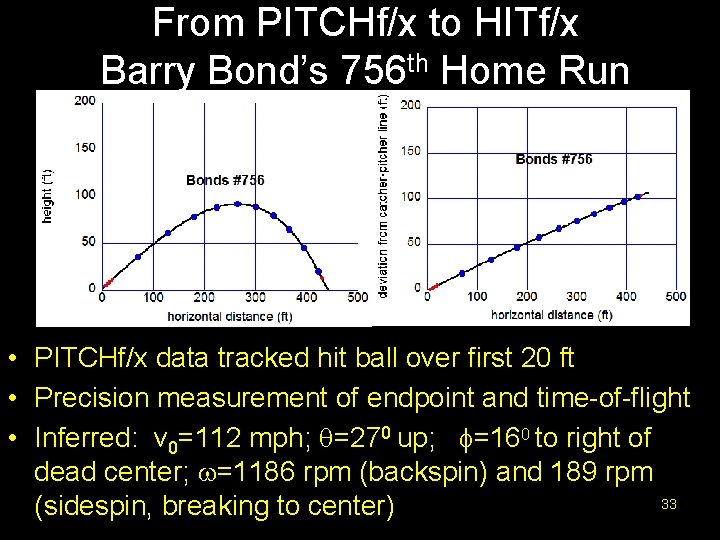
From PITCHf/x to HITf/x Barry Bond’s 756 th Home Run • PITCHf/x data tracked hit ball over first 20 ft • Precision measurement of endpoint and time-of-flight • Inferred: v 0=112 mph; =270 up; =160 to right of dead center; =1186 rpm (backspin) and 189 rpm 33 (sidespin, breaking to center)
Baseball Aerodynamics: Things I would like to know better • Better data on drag – “drag crisis”? – spin-dependent drag? – drag for v>100 mph • Dependence of drag & Magnus on seam orientation, surface roughness, … • Is the spin constant? 34
Trackman: The Wave of the Future see www. trackmangolf. com • Doppler radar to measure radial velocity • 3 -detector array to measure phase – two angles • Sidebands gives spin magnitude • Result: – in principle, full trajectory can be reconstructed, including spin and spin axis – already in use for golf, currently being adapted for baseball 35
Trackman Radar Monopulse Principle (Phase) 36

thanks to Fredrik Tuxen, CTO of Trackman 37
Steroids and Home Run Producton see Roger Tobin, AJP, Jan. 2008 • Steroids increases muscle mass • Increased muscle mass increases swing speed • Increased swing speed increase BBS • Increased BBS means longer fly balls • Longer fly balls means more home runs 38
To have 10% HR’s, there must be a lot of near-HR’s Elite hitters: HR/BBIP = ~10% Thanks to Roger Tobin 39
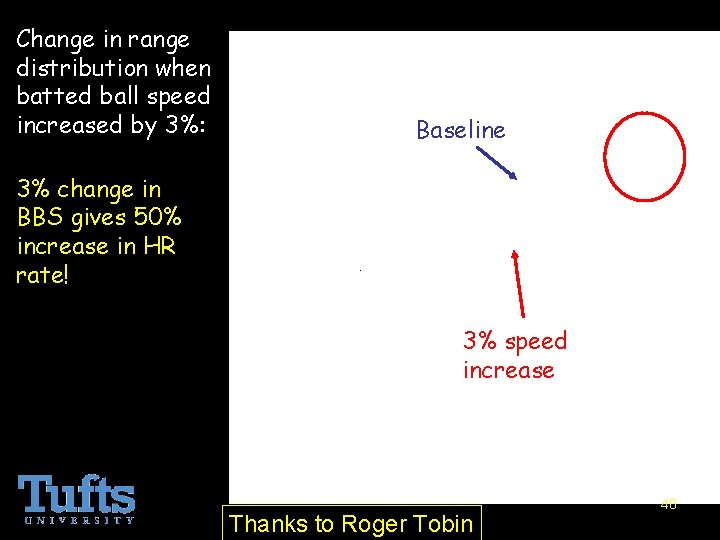
Change in range distribution when batted ball speed increased by 3%: Baseline 3% change in BBS gives 50% increase in HR rate! 3% speed increase Thanks to Roger Tobin 40
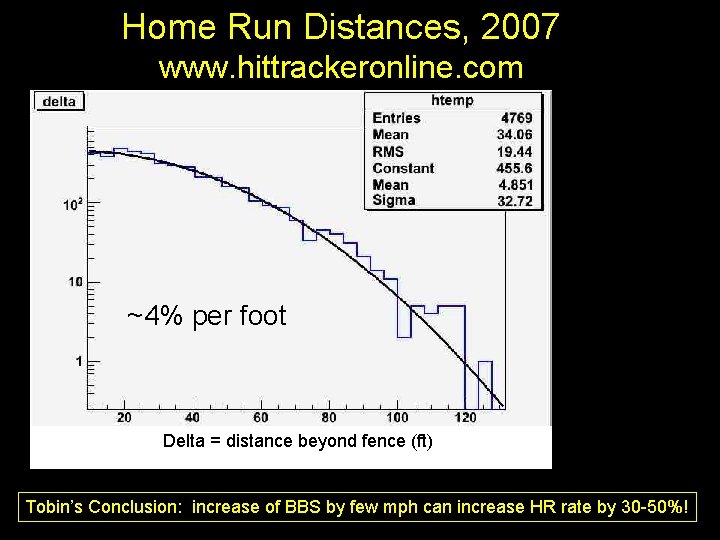
Home Run Distances, 2007 www. hittrackeronline. com ~4% per foot Delta = distance beyond fence (ft) Tobin’s Conclusion: increase of BBS by few mph can increase HR rate by 30 -50%!
Work in Progress • Collision experiments & calculations to elucidate trampoline effect • New studies of aerodynamics using Trackman and PITCHf/x • Experiments on high-speed oblique collisions • A book, with Aussi Rod Cross Thanks for the invitation and your attention 42
- Slides: 42