
EXPERIMENTAL AND NUMERICAL VIBRATION ANALYSIS OF PRINTED CIRCUIT

EXPERIMENTAL AND NUMERICAL VIBRATION ANALYSIS OF PRINTED CIRCUIT BOARDS Richard Bachoo 1* Shurland Balliram 2 Jacqueline Bridge 3 ICon. ETech-2020, Faculty of Engineering, The UWI, St. Augustine, Trinidad and Tobago

INTRODUCTION/RATIONALE • Printed circuit boards (PCBs) are modules which are incorporated in a wide range of industrial equipment and machinery • PCBs situated in dynamic environments may be prone to failure from excessive amounts of cyclical stresses arising from harmonic or random vibration sources • The ability to numerically model and predict the dynamic behaviour of PCBs and associated components is therefore a valuable tool for analysts concerned with PCB reliability • Experimental vibration analysis and the finite element method (FEM) are used to investigate the changes in resonant behaviour of a PCB as the mass, location and stiffness of electronic components vary ICon. ETech-2020, Faculty of Engineering, The UWI, St. Augustine, Trinidad and Tobago
LITERATURE REVIEW AND OBJECTIVES Experimental Methods Numerical Methods Analytical Methods Hybrid Studies OBJECTIVES: • Modify and build a printed circuit board with soldered electronic components such that it represents a generic circuit in typical industrial applications. • Using a commercial finite element package, simulate models of the circuit board and the connected electronic components to predict vibration response levels due to harmonic and random excitation sources. • Compare theoretically obtained vibration levels with experimentally determined values to quantify the accuracy of the simulated models. • To investigate the influence of electronic components on the natural frequency and mode shapes of the Printed Circuit Board. ICon. ETech-2020, Faculty of Engineering, The UWI, St. Augustine, Trinidad and Tobago

METHODOLOGY Description of the PCB • The selected PCB functions as an adjustable direct current (DC) regulated power supply when built-up with all the soldered components. Table 1. Properties of the bare printed circuit board (PCB) and solder. ICon. ETech-2020, Faculty of Engineering, The UWI, St. Augustine, Trinidad and Tobago
METHODOLOGY Experimental measurements • Harmonic and random vibration testing were done for each of the four phases • Lab. VIEW© 2018 was used to generate either a pure sinusoid or band-limited Gaussian white noise. • NIUSB 6211 converted the digital signal to analogue and a power amplifier sent the signal to an electromagnetic shaker. • The shaker is rigidly connected to the geometric centre of the PCB • Vibration measurements were taken with an accelerometer. • NIUSB 6009 functioned as an analog to digital converter (ADC) and the accelerometer data was stored and processed using a program written in Lab. VIEW© 2018. ICon. ETech-2020, Faculty of Engineering, The UWI, St. Augustine, Trinidad and Tobago
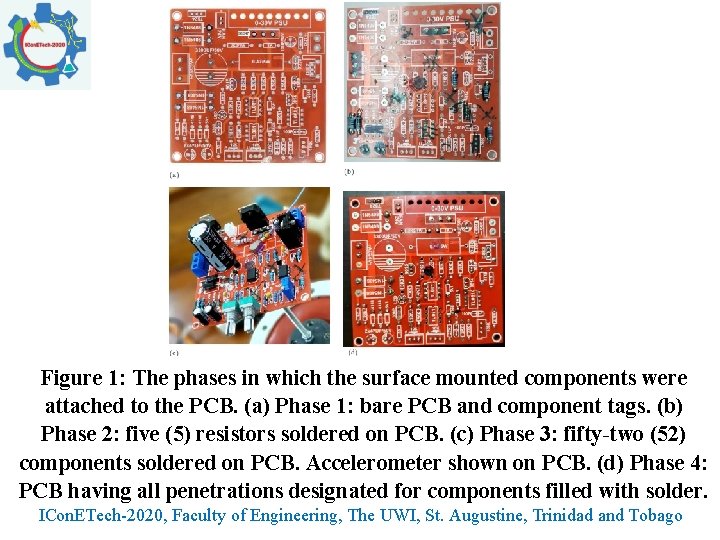
Figure 1: The phases in which the surface mounted components were attached to the PCB. (a) Phase 1: bare PCB and component tags. (b) Phase 2: five (5) resistors soldered on PCB. (c) Phase 3: fifty-two (52) components soldered on PCB. Accelerometer shown on PCB. (d) Phase 4: PCB having all penetrations designated for components filled with solder. ICon. ETech-2020, Faculty of Engineering, The UWI, St. Augustine, Trinidad and Tobago
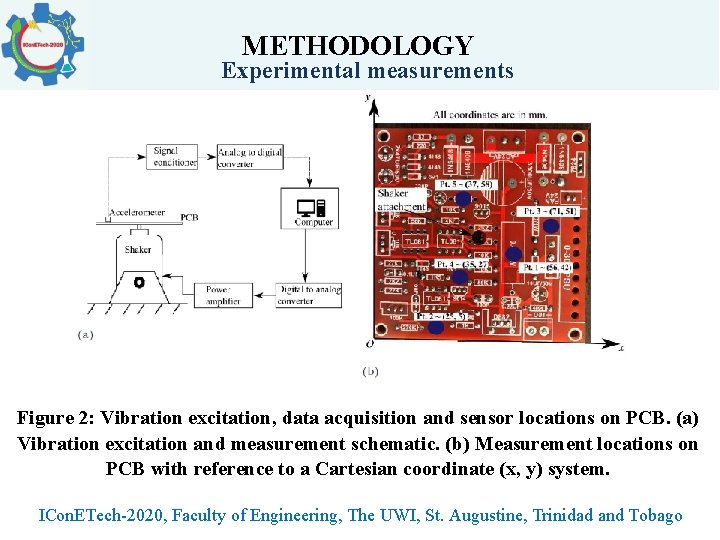
METHODOLOGY Experimental measurements Figure 2: Vibration excitation, data acquisition and sensor locations on PCB. (a) Vibration excitation and measurement schematic. (b) Measurement locations on PCB with reference to a Cartesian coordinate (x, y) system. ICon. ETech-2020, Faculty of Engineering, The UWI, St. Augustine, Trinidad and Tobago

METHODOLOGY Finite Element Modelling • Finite element models are generated for the first three phases in Figs. 1 a-d using Ansys Mechanical APDL 18©. • The bare PCB and solder material which fills the board’s penetrations are modelled using Shell 181 elements. • The copper leads and surface mounted components are modelled using Solid 186 elements. • The boundary conditions of the PCB are such that the outer edges are all free. • The diametric penetration which is rigidly connected to the shaker is treated as being completely fixed (Fig. 3 a). • The excitation induced by the electrodynamic shaker can then be simulated in the FEM as either a harmonic or random basedisplacement. ICon. ETech-2020, Faculty of Engineering, The UWI, St. Augustine, Trinidad and Tobago
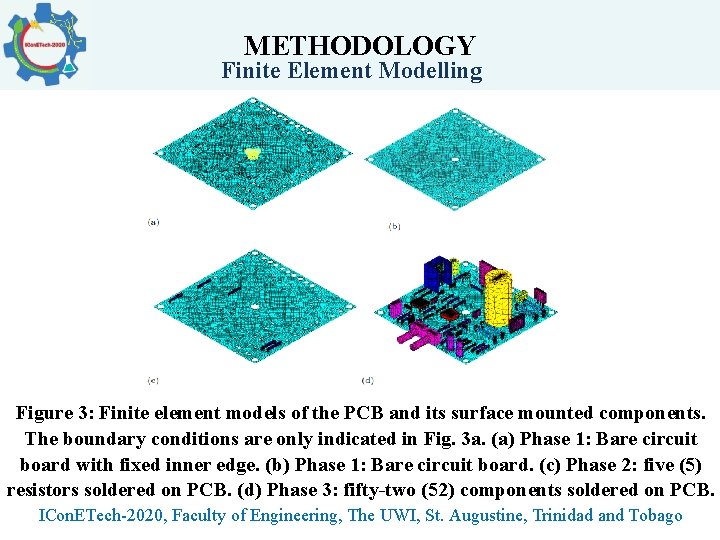
METHODOLOGY Finite Element Modelling Figure 3: Finite element models of the PCB and its surface mounted components. The boundary conditions are only indicated in Fig. 3 a. (a) Phase 1: Bare circuit board with fixed inner edge. (b) Phase 1: Bare circuit board. (c) Phase 2: five (5) resistors soldered on PCB. (d) Phase 3: fifty-two (52) components soldered on PCB. ICon. ETech-2020, Faculty of Engineering, The UWI, St. Augustine, Trinidad and Tobago
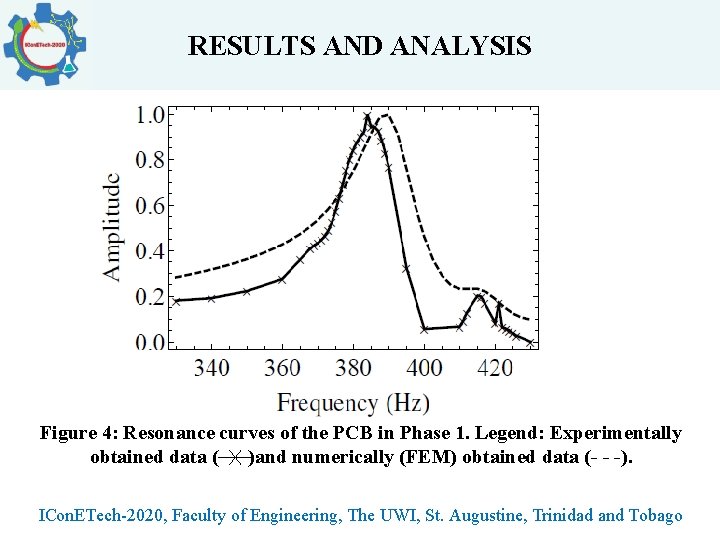
RESULTS AND ANALYSIS Figure 4: Resonance curves of the PCB in Phase 1. Legend: Experimentally obtained data ( )and numerically (FEM) obtained data (- - -). ICon. ETech-2020, Faculty of Engineering, The UWI, St. Augustine, Trinidad and Tobago
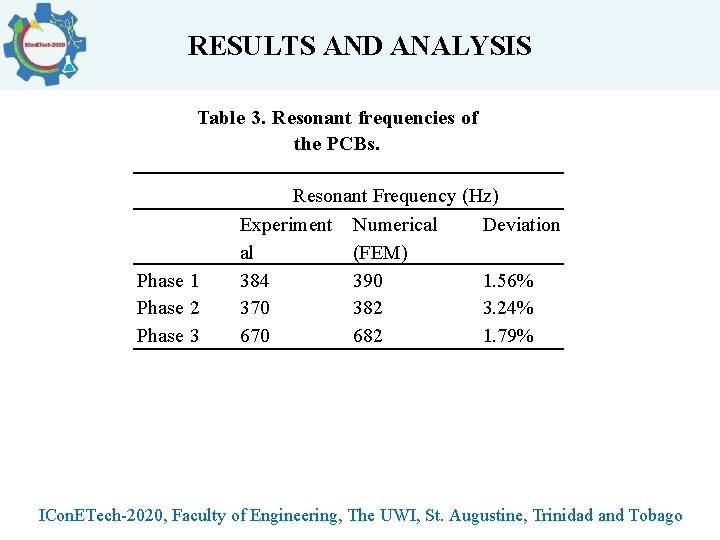
RESULTS AND ANALYSIS Table 3. Resonant frequencies of the PCBs. Phase 1 Phase 2 Phase 3 Resonant Frequency (Hz) Experiment Numerical Deviation al (FEM) 384 390 1. 56% 370 382 3. 24% 670 682 1. 79% ICon. ETech-2020, Faculty of Engineering, The UWI, St. Augustine, Trinidad and Tobago
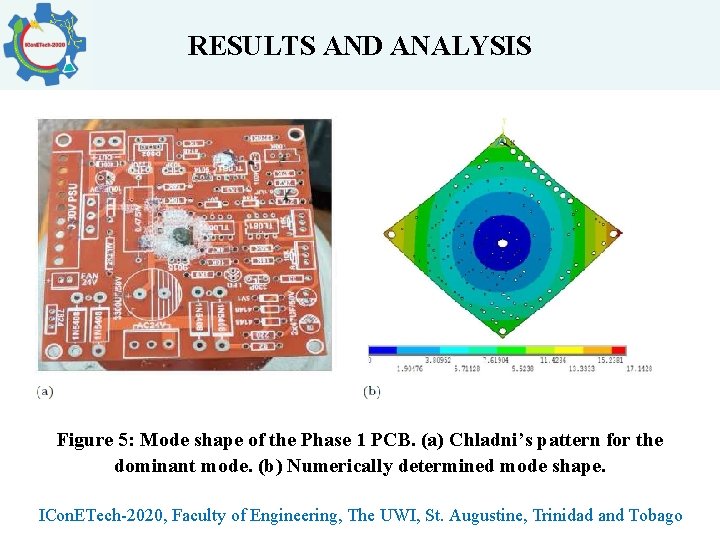
RESULTS AND ANALYSIS Figure 5: Mode shape of the Phase 1 PCB. (a) Chladni’s pattern for the dominant mode. (b) Numerically determined mode shape. ICon. ETech-2020, Faculty of Engineering, The UWI, St. Augustine, Trinidad and Tobago
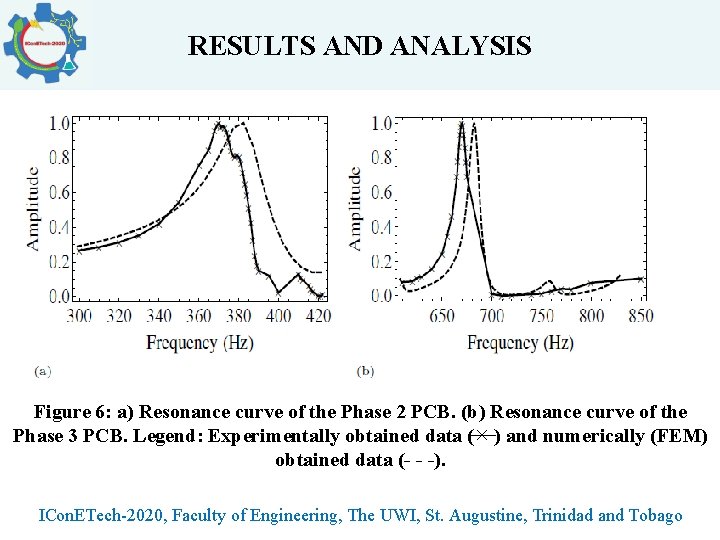
RESULTS AND ANALYSIS Figure 6: a) Resonance curve of the Phase 2 PCB. (b) Resonance curve of the Phase 3 PCB. Legend: Experimentally obtained data ( ) and numerically (FEM) obtained data (- - -). ICon. ETech-2020, Faculty of Engineering, The UWI, St. Augustine, Trinidad and Tobago
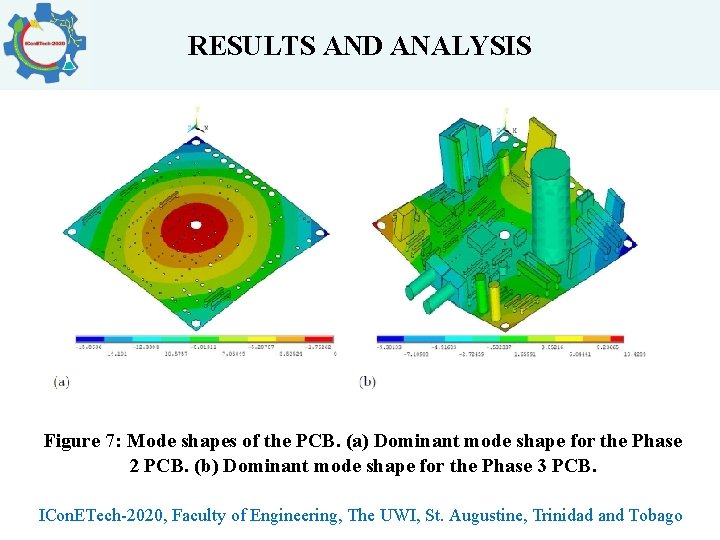
RESULTS AND ANALYSIS Figure 7: Mode shapes of the PCB. (a) Dominant mode shape for the Phase 2 PCB. (b) Dominant mode shape for the Phase 3 PCB. ICon. ETech-2020, Faculty of Engineering, The UWI, St. Augustine, Trinidad and Tobago
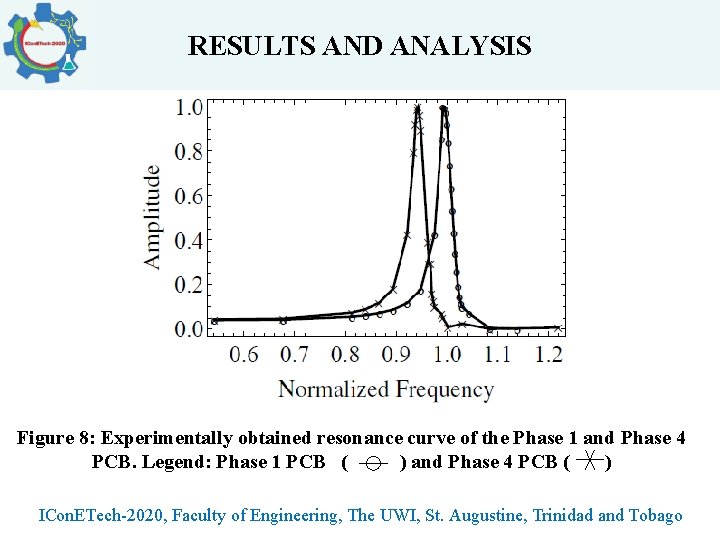
RESULTS AND ANALYSIS Figure 8: Experimentally obtained resonance curve of the Phase 1 and Phase 4 PCB. Legend: Phase 1 PCB ( ) and Phase 4 PCB ( ) ICon. ETech-2020, Faculty of Engineering, The UWI, St. Augustine, Trinidad and Tobago
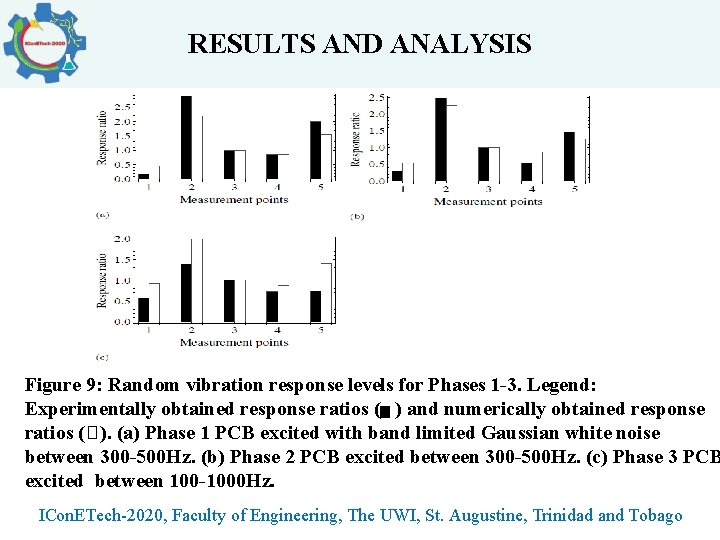
RESULTS AND ANALYSIS Figure 9: Random vibration response levels for Phases 1 -3. Legend: Experimentally obtained response ratios ( ) and numerically obtained response ratios ( ). (a) Phase 1 PCB excited with band limited Gaussian white noise between 300 -500 Hz. (b) Phase 2 PCB excited between 300 -500 Hz. (c) Phase 3 PCB excited between 100 -1000 Hz. ICon. ETech-2020, Faculty of Engineering, The UWI, St. Augustine, Trinidad and Tobago

CONCLUSION • For boards with a small number of soldered components the mass effect dominates the stiffness effects and the natural frequency is reduced compared to a bare PCB. The mode shapes of both boards are also shown to be almost identical. • For a PCB with a large number of soldered components the increased number of localized stiffness points dominates the localized mass effect and the natural frequency increases significantly. The mode shape for the densely populated board also differs significantly from that of the bare PCB. • Experimentally, that the effects of the solder material reduce the resonant frequency of a PCB. • The study also generates finite element models for three of the four PCB cases studied and good agreement with the experimental results is obtained. ICon. ETech-2020, Faculty of Engineering, The UWI, St. Augustine, Trinidad and Tobago
REFERENCES • R. S. Li. 2011. “A methodology for fatigue prediction of electronic components un- der random vibration load. ” Journal of Electronic Packaging 123(4): 3942 -400. • W. Thomson. 1993. Theory of vibration with applications. Prentice hall • E. Suhir. 2000. “Predicted fundamental vibration frequency of a heavy electronic component mounted on a printed circuit board. ” Journal of Electronic Packaging 122(1): 3 -5. • B. Aytekin, H. N. Ozguven 2008. “Vibration analysis of a simply supported PCB with a component-an analytical approach. ” 10 th Electronics Packaging Technology Conference 1178 -1183. ICon. ETech-2020, Faculty of Engineering, The UWI, St. Augustine, Trinidad and Tobago

THANK YOU! ICon. ETech-2020, Faculty of Engineering, The UWI, St. Augustine, Trinidad and Tobago
- Slides: 19