
Experimental analysis of whistle noise in a particle
- Slides: 1
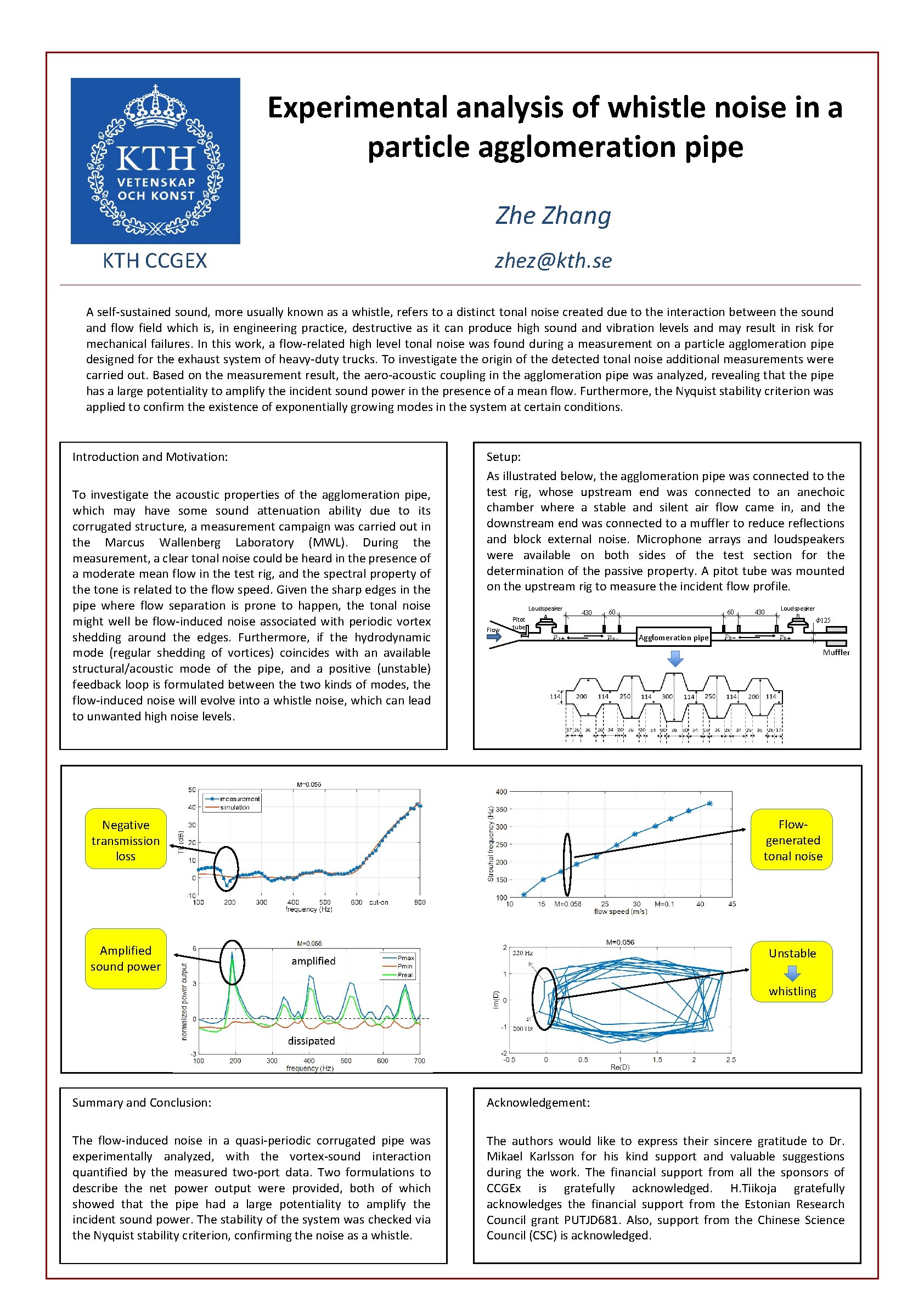
Experimental analysis of whistle noise in a particle agglomeration pipe Zhang KTH CCGEX zhez@kth. se A self-sustained sound, more usually known as a whistle, refers to a distinct tonal noise created due to the interaction between the sound and flow field which is, in engineering practice, destructive as it can produce high sound and vibration levels and may result in risk for mechanical failures. In this work, a flow-related high level tonal noise was found during a measurement on a particle agglomeration pipe designed for the exhaust system of heavy-duty trucks. To investigate the origin of the detected tonal noise additional measurements were carried out. Based on the measurement result, the aero-acoustic coupling in the agglomeration pipe was analyzed, revealing that the pipe has a large potentiality to amplify the incident sound power in the presence of a mean flow. Furthermore, the Nyquist stability criterion was applied to confirm the existence of exponentially growing modes in the system at certain conditions. Introduction and Motivation: To investigate the acoustic properties of the agglomeration pipe, which may have some sound attenuation ability due to its corrugated structure, a measurement campaign was carried out in the Marcus Wallenberg Laboratory (MWL). During the measurement, a clear tonal noise could be heard in the presence of a moderate mean flow in the test rig, and the spectral property of the tone is related to the flow speed. Given the sharp edges in the pipe where flow separation is prone to happen, the tonal noise might well be flow-induced noise associated with periodic vortex shedding around the edges. Furthermore, if the hydrodynamic mode (regular shedding of vortices) coincides with an available structural/acoustic mode of the pipe, and a positive (unstable) feedback loop is formulated between the two kinds of modes, the flow-induced noise will evolve into a whistle noise, which can lead to unwanted high noise levels. Setup: As illustrated below, the agglomeration pipe was connected to the test rig, whose upstream end was connected to an anechoic chamber where a stable and silent air flow came in, and the downstream end was connected to a muffler to reduce reflections and block external noise. Microphone arrays and loudspeakers were available on both sides of the test section for the determination of the passive property. A pitot tube was mounted on the upstream rig to measure the incident flow profile. Flow Loudspeaker A Pitot tube 430 60 60 430 Loudspeaker B Ф 125 Agglomeration pipe Muffler Negative transmission loss Flowgenerated tonal noise Amplified sound power Unstable whistling Summary and Conclusion: Acknowledgement: The flow-induced noise in a quasi-periodic corrugated pipe was experimentally analyzed, with the vortex-sound interaction quantified by the measured two-port data. Two formulations to describe the net power output were provided, both of which showed that the pipe had a large potentiality to amplify the incident sound power. The stability of the system was checked via the Nyquist stability criterion, confirming the noise as a whistle. The authors would like to express their sincere gratitude to Dr. Mikael Karlsson for his kind support and valuable suggestions during the work. The financial support from all the sponsors of CCGEx is gratefully acknowledged. H. Tiikoja gratefully acknowledges the financial support from the Estonian Research Council grant PUTJD 681. Also, support from the Chinese Science Council (CSC) is acknowledged.