
Experimental Activities at University of Tokyo K Ozawa

- Slides: 27
Experimental Activities at University of Tokyo K. Ozawa (University of Tokyo)
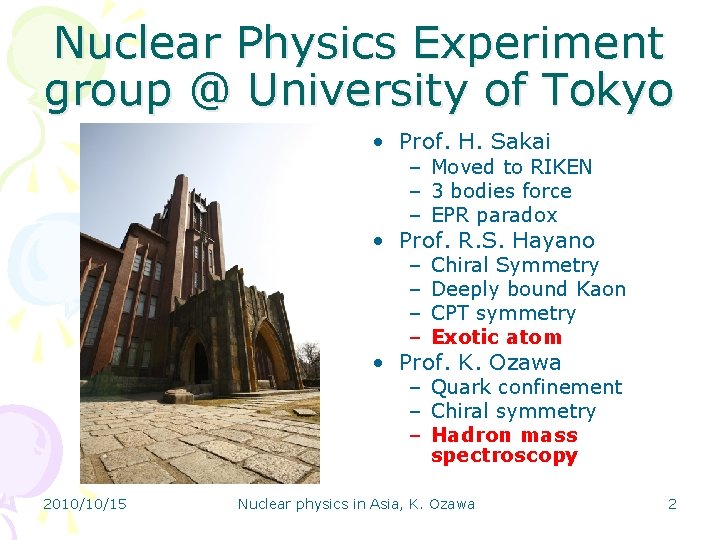
Nuclear Physics Experiment group @ University of Tokyo • Prof. H. Sakai – Moved to RIKEN – 3 bodies force – EPR paradox • Prof. R. S. Hayano – – Chiral Symmetry Deeply bound Kaon CPT symmetry Exotic atom • Prof. K. Ozawa – Quark confinement – Chiral symmetry – Hadron mass spectroscopy 2010/10/15 Nuclear physics in Asia, K. Ozawa 2
HADRON MASS SPECTROSCOPY 2010/10/15 Nuclear physics in Asia, K. Ozawa 3
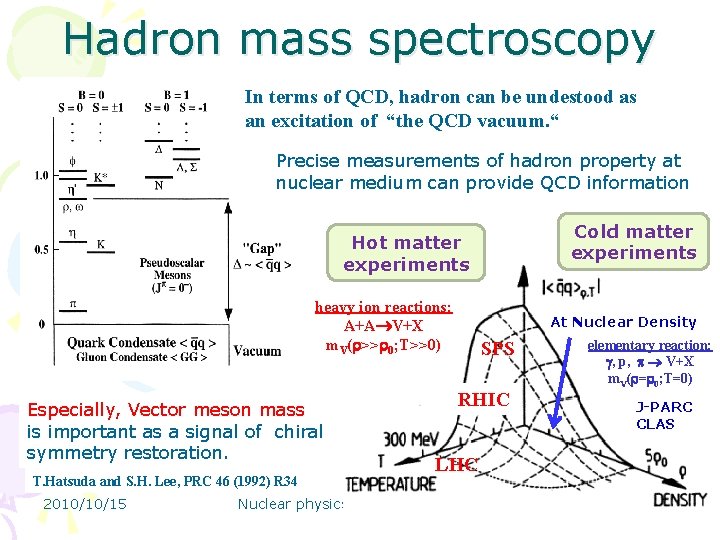
Hadron mass spectroscopy In terms of QCD, hadron can be undestood as an excitation of “the QCD vacuum. “ Precise measurements of hadron property at nuclear medium can provide QCD information Cold matter experiments Hot matter experiments heavy ion reactions: A+A V+X m. V( >> 0; T>>0) Especially, Vector meson mass is important as a signal of chiral symmetry restoration. T. Hatsuda and S. H. Lee, PRC 46 (1992) R 34 2010/10/15 At Nuclear Density SPS RHIC elementary reaction: , p, V+X m. V( = 0; T=0) J-PARC CLAS LHC Nuclear physics in Asia, K. Ozawa 4
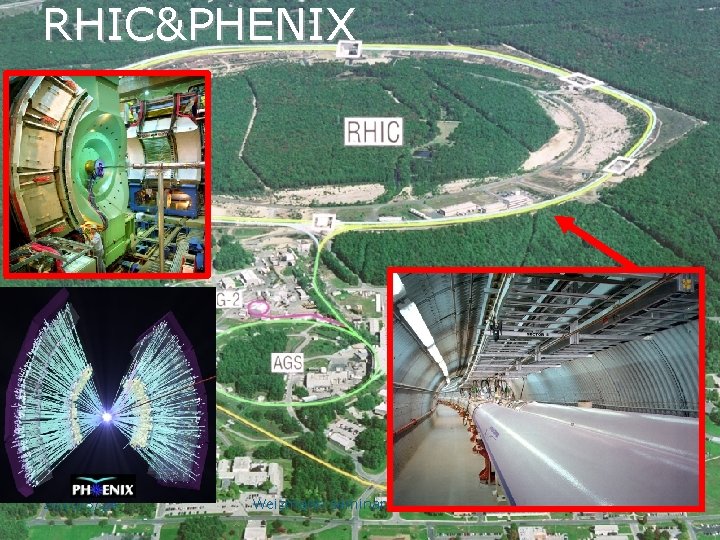
RHIC&PHENIX 2010/5/24 Weizmann seminar, K. Ozawa 5
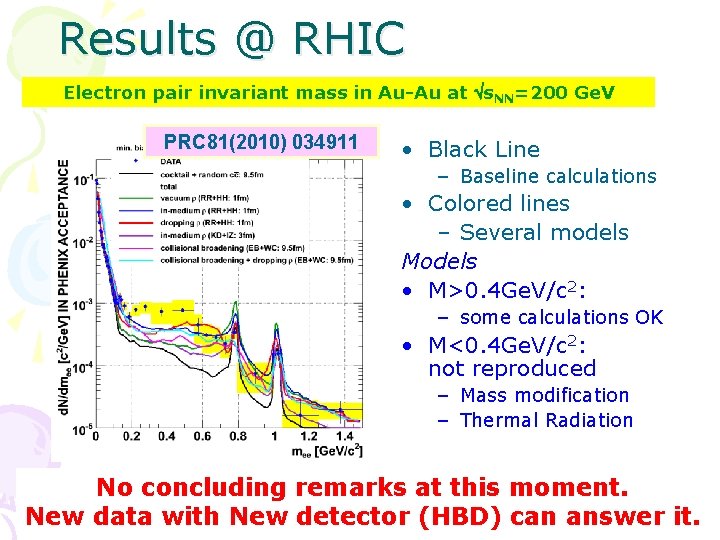
Results @ RHIC Electron pair invariant mass in Au-Au at s. NN=200 Ge. V PRC 81(2010) 034911 • Black Line – Baseline calculations • Colored lines – Several models Models • M>0. 4 Ge. V/c 2: – some calculations OK • M<0. 4 Ge. V/c 2: not reproduced – Mass modification – Thermal Radiation No concluding remarks at this moment. 6 Nuclear physics in Asia, K. Ozawa New data with New detector (HBD) can answer it. 2010/10/15
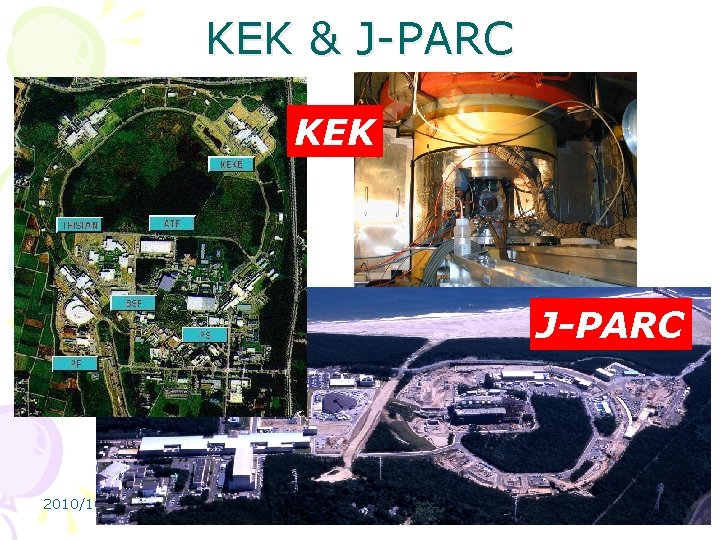
KEK & J-PARC KEK J-PARC 2010/10/15 Nuclear physics in Asia, K. Ozawa 7
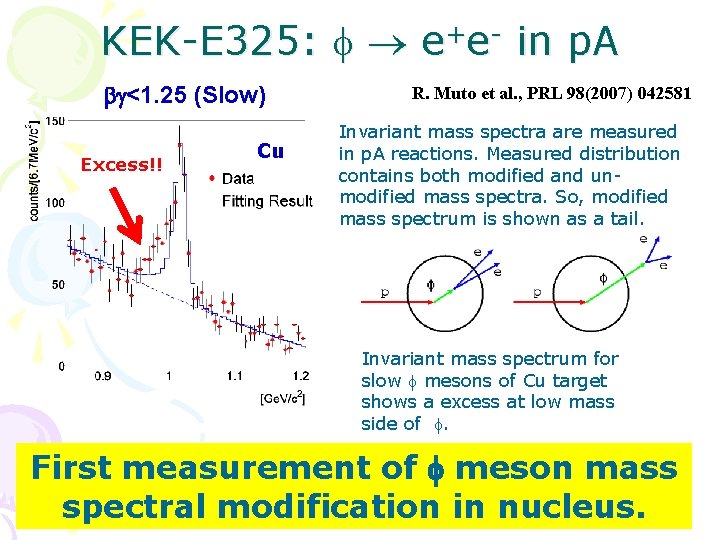
KEK-E 325: f e+e- in p. A b <1. 25 (Slow) Excess!! Cu R. Muto et al. , PRL 98(2007) 042581 Invariant mass spectra are measured in p. A reactions. Measured distribution contains both modified and unmodified mass spectra. So, modified mass spectrum is shown as a tail. Invariant mass spectrum for slow f mesons of Cu target shows a excess at low mass side of f. First measurement of f meson mass 2010/10/15 Nuclear physics in Asia, K. Ozawa spectral modification in nucleus. 8
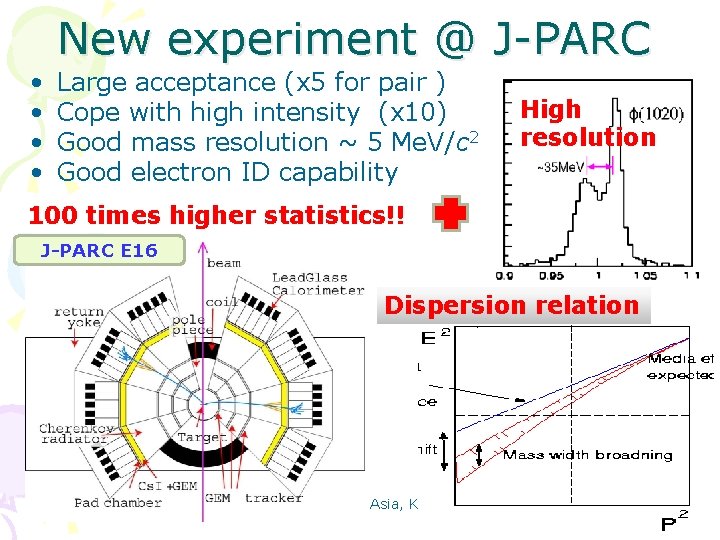
New experiment @ J-PARC • • Large acceptance (x 5 for pair ) Cope with high intensity (x 10) Good mass resolution ~ 5 Me. V/c 2 Good electron ID capability High resolution 100 times higher statistics!! J-PARC E 16 Dispersion relation 2010/10/15 Nuclear physics in Asia, K. Ozawa 9
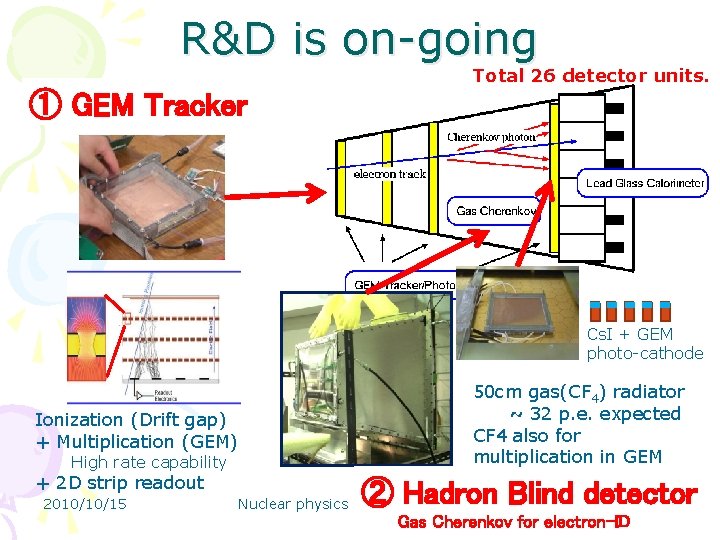
R&D is on-going Total 26 detector units. ① GEM Tracker Cs. I + GEM photo-cathode Ionization (Drift gap) + Multiplication (GEM) High rate capability + 2 D strip readout 2010/10/15 50 cm gas(CF 4) radiator ~ 32 p. e. expected CF 4 also for multiplication in GEM ② Hadron Blind detector 10 Nuclear physics in Asia, K. Ozawa Gas Cherenkov for electron-ID
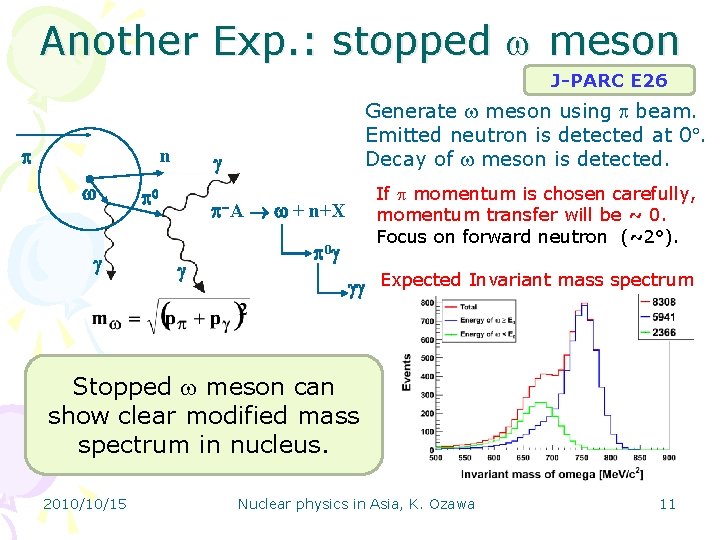
Another Exp. : stopped w meson J-PARC E 26 n Generate w meson using p beam. Emitted neutron is detected at 0. Decay of w meson is detected. 0 -A If p momentum is chosen carefully, momentum transfer will be ~ 0. Focus on forward neutron (~2°). + n+X 0 Expected Invariant mass spectrum Stopped w meson can show clear modified mass spectrum in nucleus. 2010/10/15 Nuclear physics in Asia, K. Ozawa 11
EXOTIC ATOM 2010/10/15 Nuclear physics in Asia, K. Ozawa 12
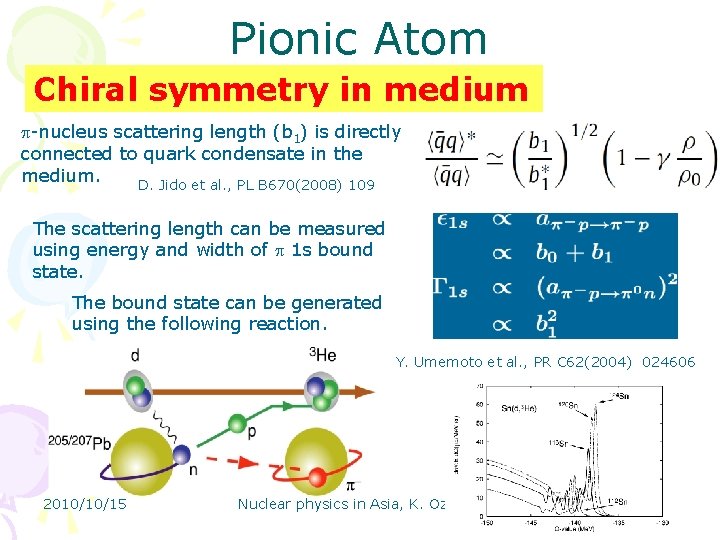
Pionic Atom Chiral symmetry in medium p-nucleus scattering length (b 1) is directly connected to quark condensate in the medium. D. Jido et al. , PL B 670(2008) 109 The scattering length can be measured using energy and width of p 1 s bound state. The bound state can be generated using the following reaction. Y. Umemoto et al. , PR C 62(2004) 024606 2010/10/15 Nuclear physics in Asia, K. Ozawa 13
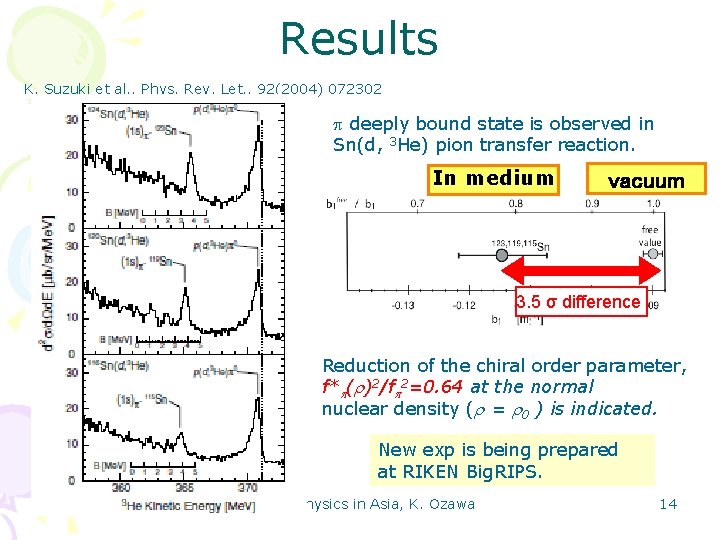
Results K. Suzuki et al. , Phys. Rev. Let. , 92(2004) 072302 p deeply bound state is observed in Sn(d, 3 He) pion transfer reaction. In medium vacuum 3. 5 σ difference Reduction of the chiral order parameter, f*p(r)2/fp 2=0. 64 at the normal nuclear density (r = r 0 ) is indicated. New exp is being prepared at RIKEN Big. RIPS. 2010/10/15 Nuclear physics in Asia, K. Ozawa 14
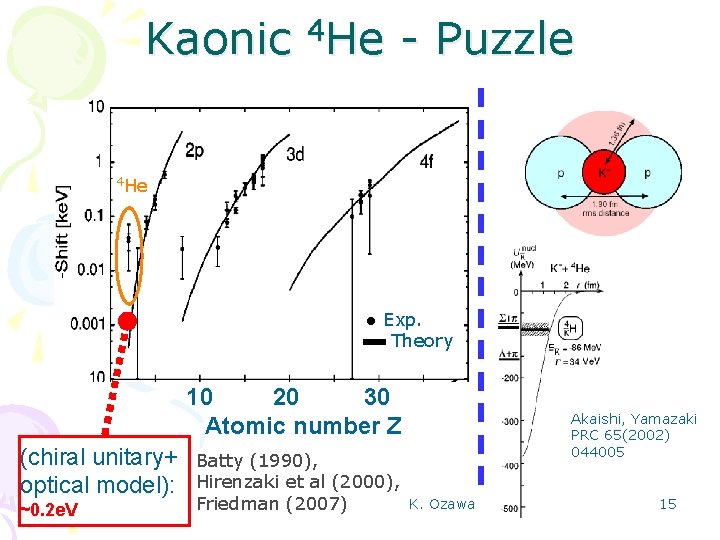
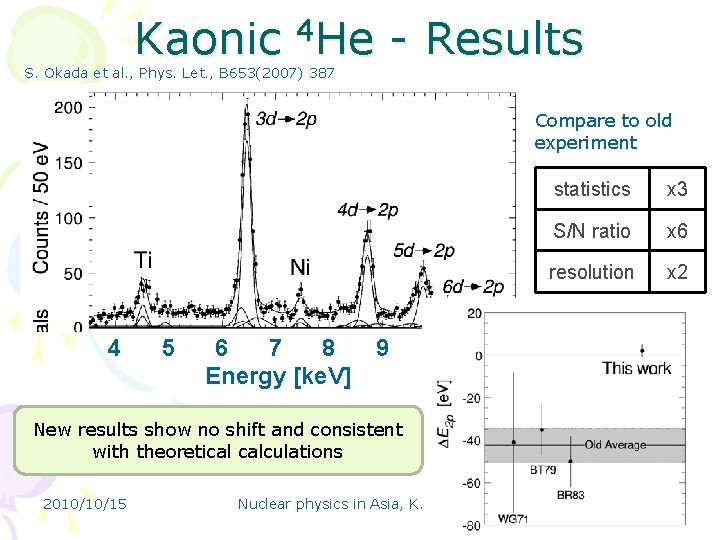
Kaonic 4 He - Puzzle 4 He ● Exp. Theory 10 20 30 Atomic number Z (chiral unitary+ optical model): 2010/10/15 ~0. 2 e. V Batty (1990), Hirenzaki et al (2000), Nuclear(2007) physics in Asia, K. Ozawa Friedman Akaishi, Yamazaki PRC 65(2002) 044005 15
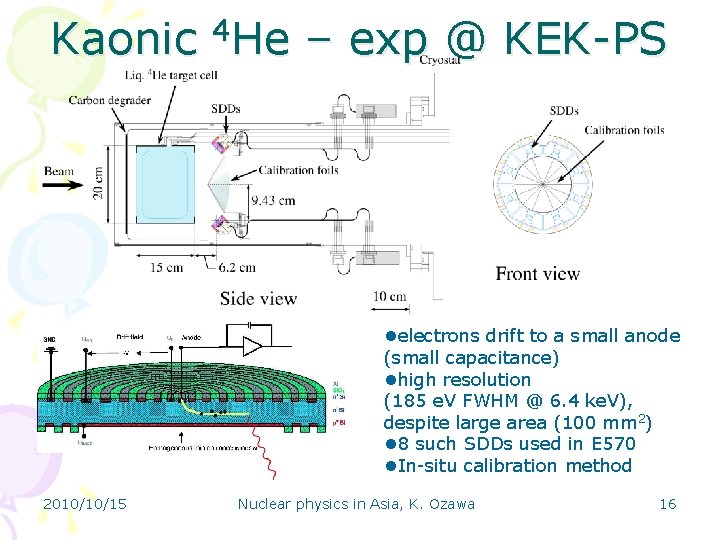
Kaonic 4 He – exp @ KEK-PS lelectrons drift to a small anode (small capacitance) lhigh resolution (185 e. V FWHM @ 6. 4 ke. V), despite large area (100 mm 2) l 8 such SDDs used in E 570 l. In-situ calibration method 2010/10/15 Nuclear physics in Asia, K. Ozawa 16
Kaonic 4 He - Results S. Okada et al. , Phys. Let. , B 653(2007) 387 Compare to old experiment 4 5 6 7 8 Energy [ke. V] 9 10 statistics x 3 S/N ratio x 6 resolution x 2 11 New results show no shift and consistent with theoretical calculations 2010/10/15 Nuclear physics in Asia, K. Ozawa 17
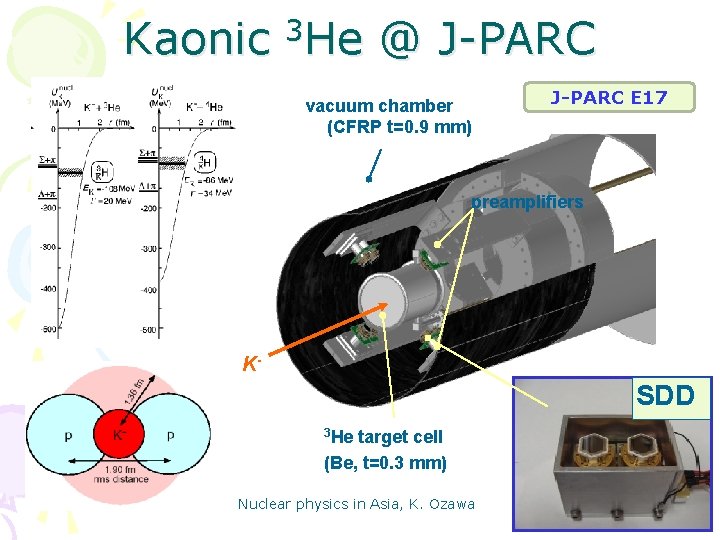
Kaonic 3 He @ J-PARC vacuum chamber (CFRP t=0. 9 mm) J-PARC E 17 preamplifiers K- SDD 3 He target cell (Be, t=0. 3 mm) 2010/10/15 Nuclear physics in Asia, K. Ozawa 18
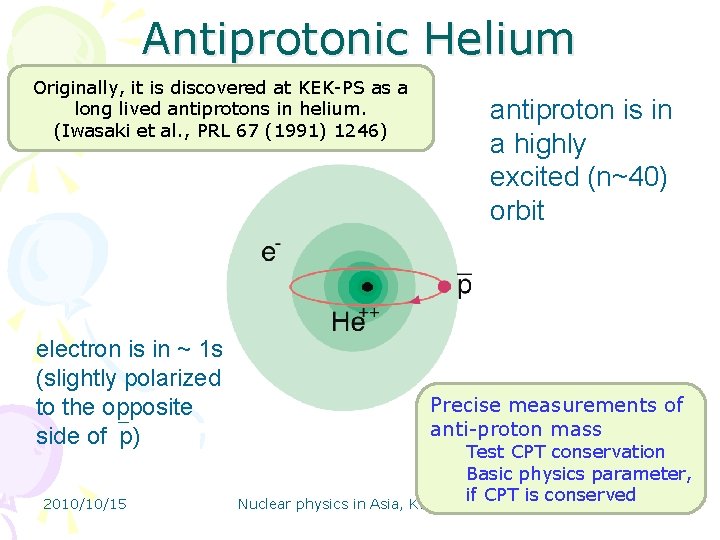
Antiprotonic Helium Originally, it is discovered at KEK-PS as a long lived antiprotons in helium. (Iwasaki et al. , PRL 67 (1991) 1246) electron is in ~ 1 s (slightly polarized to the opposite side of`p) 2010/10/15 antiproton is in a highly excited (n~40) orbit Precise measurements of anti-proton mass Test CPT conservation Basic physics parameter, if CPT is conserved 19 Nuclear physics in Asia, K. Ozawa
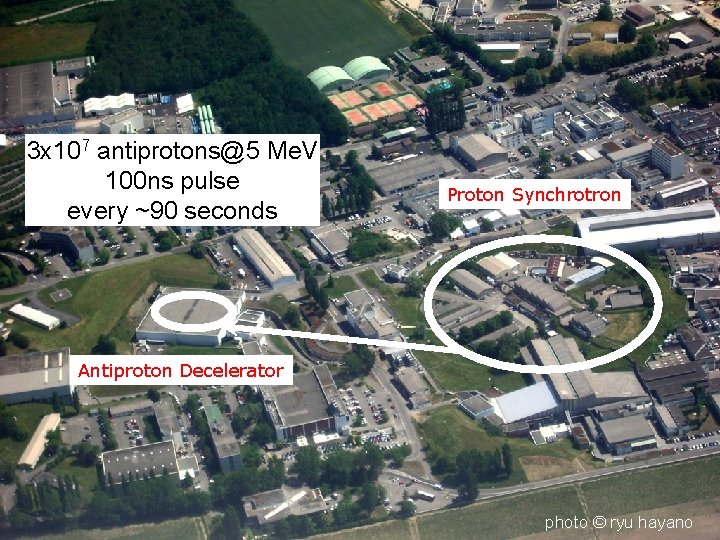
3 x 10⁷ antiprotons@5 Me. V 100 ns pulse every ~90 seconds Proton Synchrotron Antiproton Decelerator photo © ryu hayano
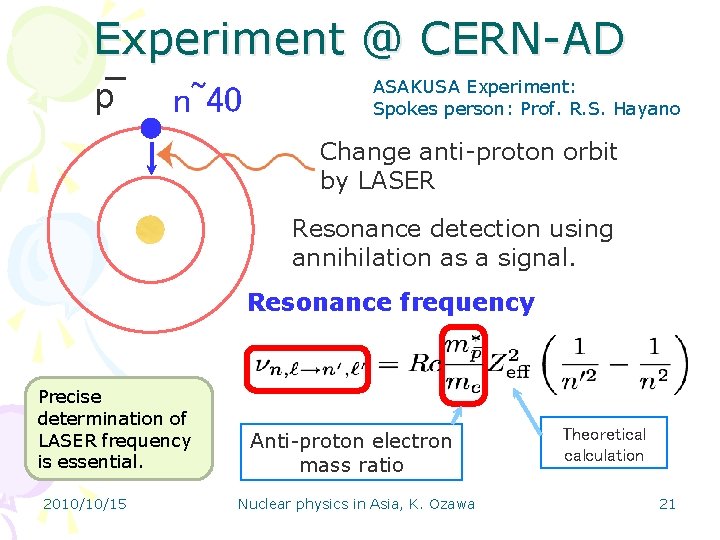
Experiment @ CERN-AD p n~40 ASAKUSA Experiment: Spokes person: Prof. R. S. Hayano Change anti-proton orbit by LASER Resonance detection using annihilation as a signal. Resonance frequency Precise determination of LASER frequency is essential. 2010/10/15 Anti-proton electron mass ratio Nuclear physics in Asia, K. Ozawa Theoretical calculation 21
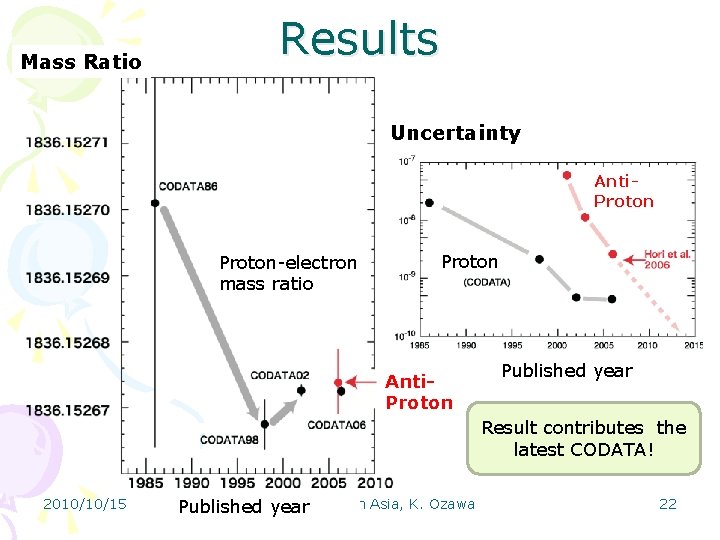
Mass Ratio Results Uncertainty Anti. Proton-electron mass ratio Proton Anti. Proton Published year Result contributes the latest CODATA! 2010/10/15 Nuclear physics in Asia, K. Ozawa Published year 22
Summary • At university of Tokyo, there is a large group to study nuclear physics experimentally. The group covers large variety of physics topics. • Several activities for hadron physics are on-going to study chiral symmetry, nuclear bound state and so on. • Experiments for hadron mass spectroscopy are being prepared at J-PARC. • Study of exotic atom is performed at J-PARC, RIKEN, and CERN. 2010/10/15 Nuclear physics in Asia, K. Ozawa 23
Back up
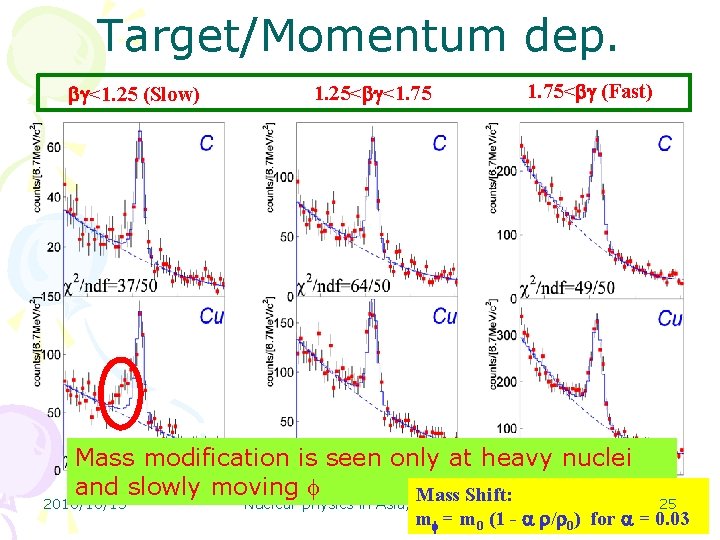
Target/Momentum dep. b <1. 25 (Slow) 1. 25<b <1. 75<b (Fast) Mass modification is seen only at heavy nuclei and slowly moving f Mass Shift: 2010/10/15 Nuclear physics in Asia, K. Ozawa 25 mf = m 0 (1 - / 0) for = 0. 03
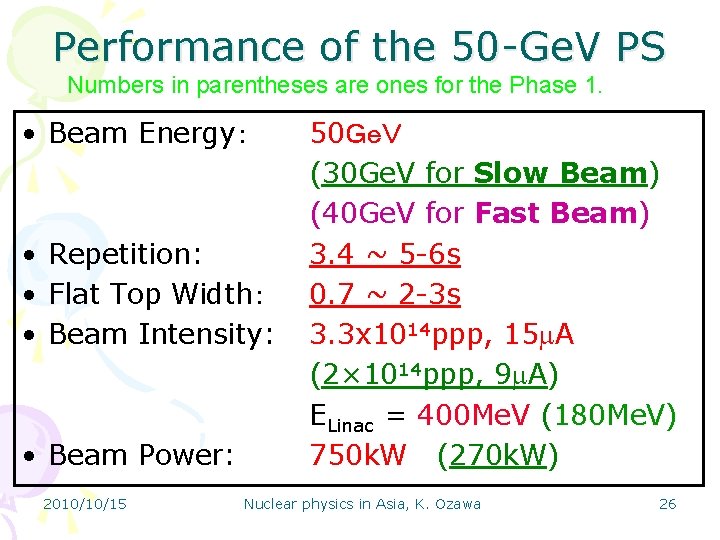
Performance of the 50 -Ge. V PS Numbers in parentheses are ones for the Phase 1. • Beam Energy: • Repetition: • Flat Top Width: • Beam Intensity: • Beam Power: 2010/10/15 50GeV (30 Ge. V for Slow Beam) (40 Ge. V for Fast Beam) 3. 4 ~ 5 -6 s 0. 7 ~ 2 -3 s 3. 3 x 10¹⁴ ppp, 15 m. A (2× 10¹⁴ ppp, 9 m. A) ELinac = 400 Me. V (180 Me. V) 750 k. W (270 k. W) Nuclear physics in Asia, K. Ozawa 26
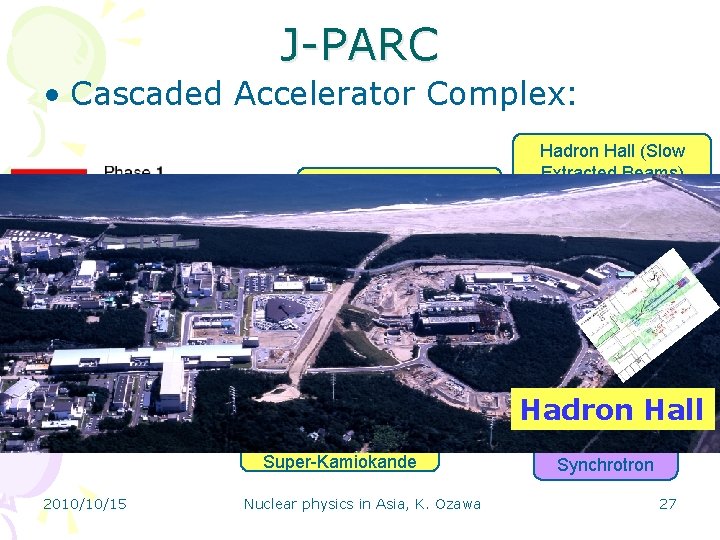
J-PARC • Cascaded Accelerator Complex: Materials and Life Science Facility Hadron Hall (Slow Extracted Beams) 3 Ge. V Rapid Cycling (25 Hz) Synchrotron Linac 2010/10/15 Hadron Hall Neutrino Beamline to Super-Kamiokande Nuclear physics in Asia, K. Ozawa 50 Ge. V Synchrotron 27