
Experiment 4 Estimation of Proteins Biuret Method All
Experiment 4
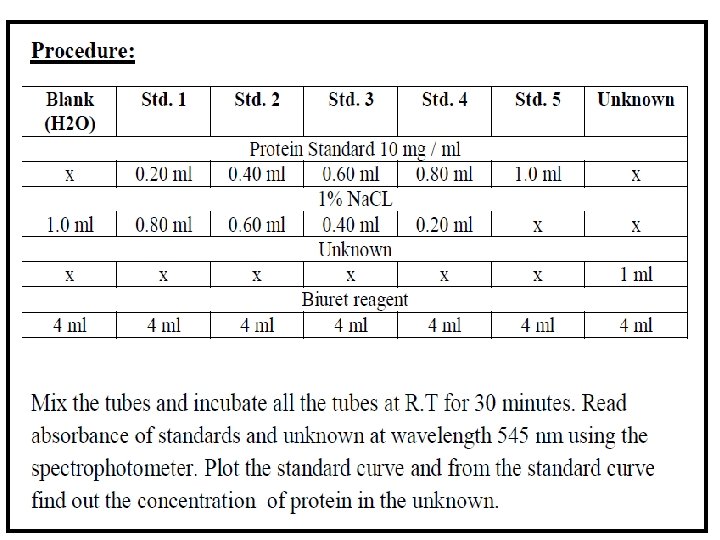
Estimation of Proteins Biuret Method: *All proteins contain a large number of peptide bonds. *When a solution of protein is treated with an alkaline solution of dilute Copper Sulfate, a colored complex is formed between the cupric ion (Cu+2) and the carbonyl ( -C=O) and imine (=N-H) groups of the peptide bonds. *An analogous reaction takes place between the Cu+2 ion and the organic compound biuret, therefore the reaction is called biuret reaction.
*The reaction takes place between the cupric ion and any compound containing at least two NH 2 CO-, NH 2 CH 2 -, NH 2 CS. *Amino acids and dipeptides cannot give the reaction, but triand polypeptides and proteins react to give pink to violet products. *In the biuret reaction one copper ion is linked between 4 and 6 nearby peptide linkages by coordinate bonds, the more protein present, the more peptide bonds available for reaction.
*The intensity of the color produced is proportional to the number of peptide bonds undergoing reaction. Thus, the biuret reaction can be used as the basis for a simple and rapid colorimetric method for determining protein. *Biuret reagent composed of: Copper Sulfate, Rochelle salt (sodium potassium tartrate) used as complexing agent to keep the copper in solution (not precipitate), Na. OH and Potassium iodide to prevent autoreduction of copper.
- Slides: 5