
Experiment 12 Centipede game a Derive the subgame
Experiment 12 § Centipede game a) Derive the subgame perfect Nash equilibrium for the one-shot game (game played only for one round). Prove that the equilibrium you found is indeed one. Are there more Nash equilibria, which are not subgame perfect? © WU IMS 1
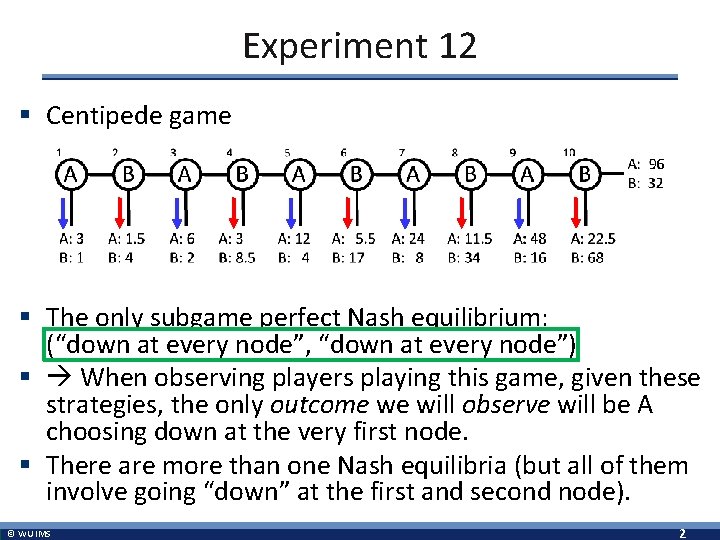
Experiment 12 § Centipede game § The only subgame perfect Nash equilibrium: (“down at every node”, “down at every node”) § When observing players playing this game, given these strategies, the only outcome we will observe will be A choosing down at the very first node. § There are more than one Nash equilibria (but all of them involve going “down” at the first and second node). © WU IMS 2
Experiment 12 § Data b) Analyze the data set of experiment 12. How do participants behave? Do you observe different behavior over time, over the 3 rounds of the game? c) How would you explain the behavior of participants? © WU IMS 3
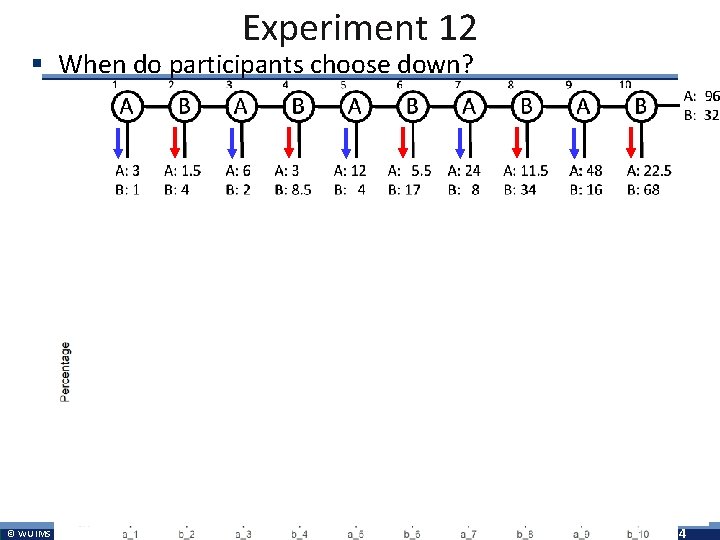
Experiment 12 § When do participants choose down? © WU IMS 4
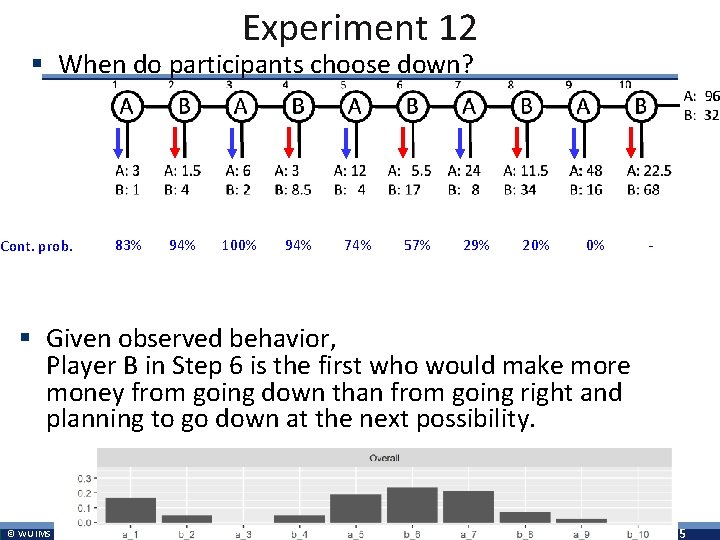
Experiment 12 § When do participants choose down? 83% Cont. prob. A 5. 7 Exp $ if here & ↓next B 94% 8. 5 100% 11. 5 94% 13. 6 74% 16. 0 57% 15. 4 29% 18. 8 20% 0% - 16. 0 § Given observed behavior, Player B in Step 6 is the first who would make more money from going down than from going right and planning to go down at the next possibility. © WU IMS 5
Limited depth of reasoning § How far can you think? § Cognitive psychology: • short term memory capacity limit of 7± 2 “chunks” • Embedding creates cognitive problems Four levels: “The movie that the script that the novel that the producer whom she thanked discovered became was made into was applauded by the critics. ” § k-level thinking models • Players have different levels of rationality, which can be expressed by a level k. • Level-0 players play some simple strategy which is not dependent on other players’ behavior. Examples: random, just cooperate, . . . • Level-k>0 -players play a best response to the distribution of players of levels 0 to k-1. © WU IMS 6
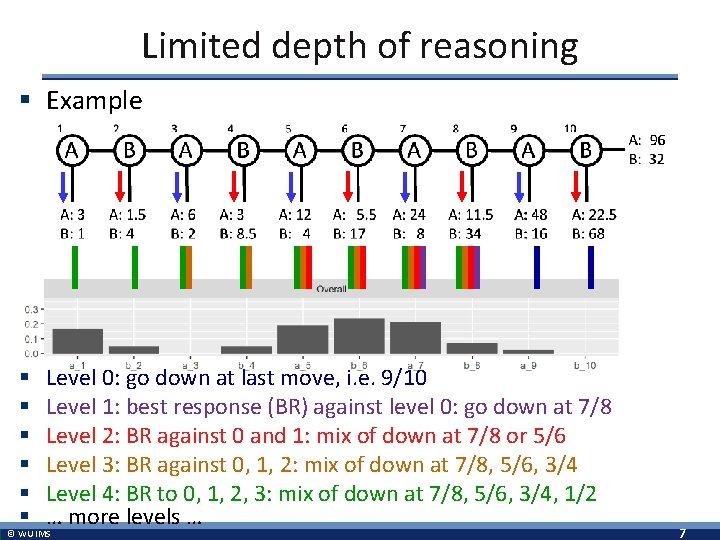
Limited depth of reasoning § Example § § § Level 0: go down at last move, i. e. 9/10 Level 1: best response (BR) against level 0: go down at 7/8 Level 2: BR against 0 and 1: mix of down at 7/8 or 5/6 Level 3: BR against 0, 1, 2: mix of down at 7/8, 5/6, 3/4 Level 4: BR to 0, 1, 2, 3: mix of down at 7/8, 5/6, 3/4, 1/2 … more levels … © WU IMS 7
Limited depth of reasoning § What are the issues with this level-k reasoning approach? • All depends on choice of level-0 behavior. (Is it random? Is it an „intuitive“ choice? What does „intuition“ mean? ) • Frequency of levels can be econometrically estimated (maximum likelihood estimation), but should be constant across games. • It‘s not an equilibrium concept. (It‘s always better to have a higher level. ) • The applicability of the model is limited to simple games. (In particular, we cannot use any other tools of game theory to analyze (more complex) games under the assumption of level-k behavior. ) © WU IMS 8
- Slides: 8