
Experiment 1 To investigate the variation of frequency


- Slides: 10
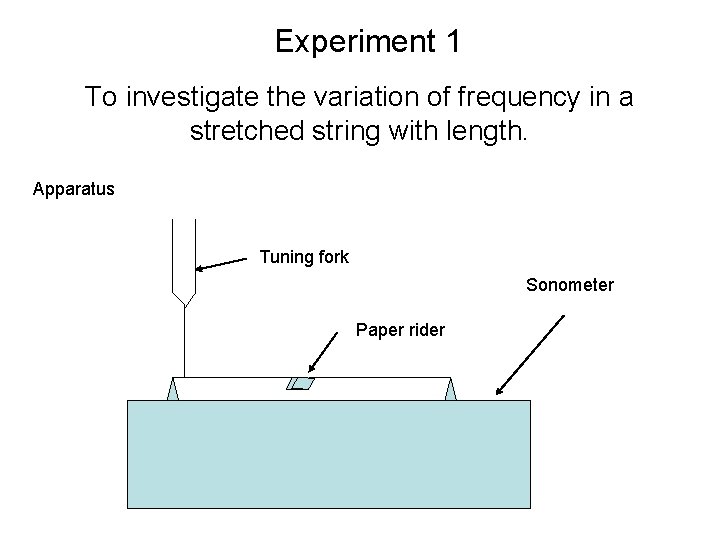
Experiment 1 To investigate the variation of frequency in a stretched string with length. Apparatus Tuning fork Sonometer Paper rider
Method • Leaving the tension unchanged, place a paper rider on the centre of the wire. • Strike a tuning fork and touch the wire at a bridge. • Move the other bridge until the paper rider falls off. • Note the frequency on the fork and the length between the bridges.
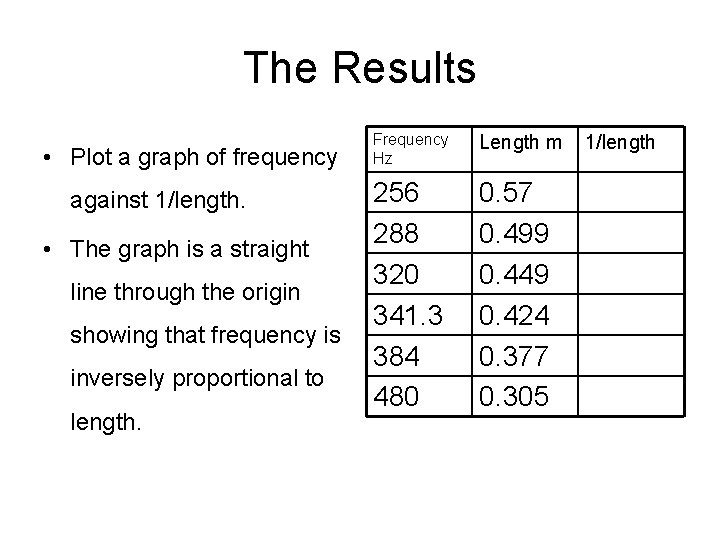
The Results • Plot a graph of frequency against 1/length. • The graph is a straight line through the origin showing that frequency is inversely proportional to length. Frequency Hz Length m 256 288 320 341. 3 384 480 0. 57 0. 499 0. 449 0. 424 0. 377 0. 305 1/length
Precautions 1. Place the paper rider in the centre of the wire. 2. Keep the tension fixed as there can only be 2 variables.
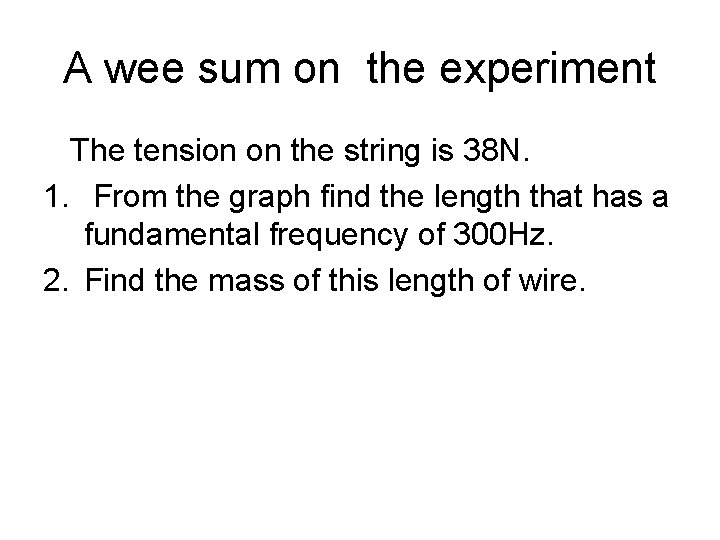
A wee sum on the experiment The tension on the string is 38 N. 1. From the graph find the length that has a fundamental frequency of 300 Hz. 2. Find the mass of this length of wire.
Experiment 2 To investigate the variation of frequency in a stretched string with tension.
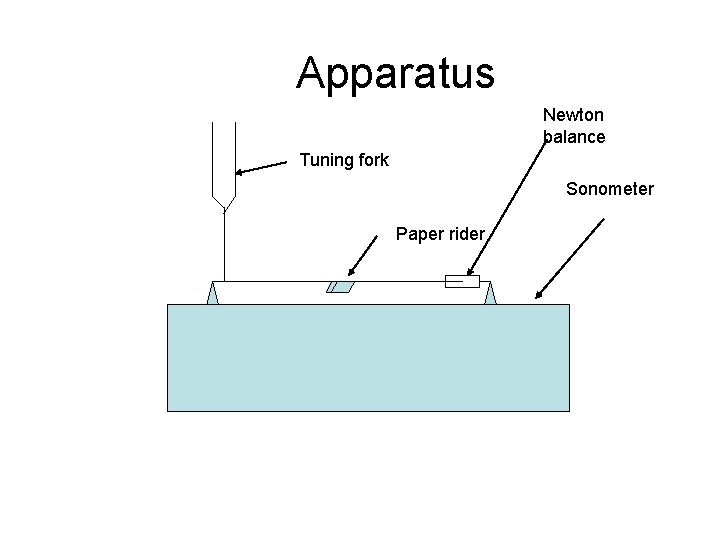
Apparatus Newton balance Tuning fork Sonometer Paper rider
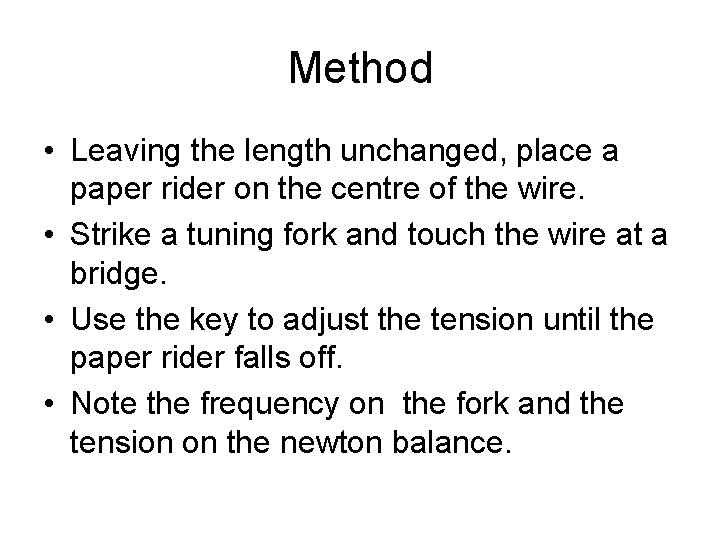
Method • Leaving the length unchanged, place a paper rider on the centre of the wire. • Strike a tuning fork and touch the wire at a bridge. • Use the key to adjust the tension until the paper rider falls off. • Note the frequency on the fork and the tension on the newton balance.
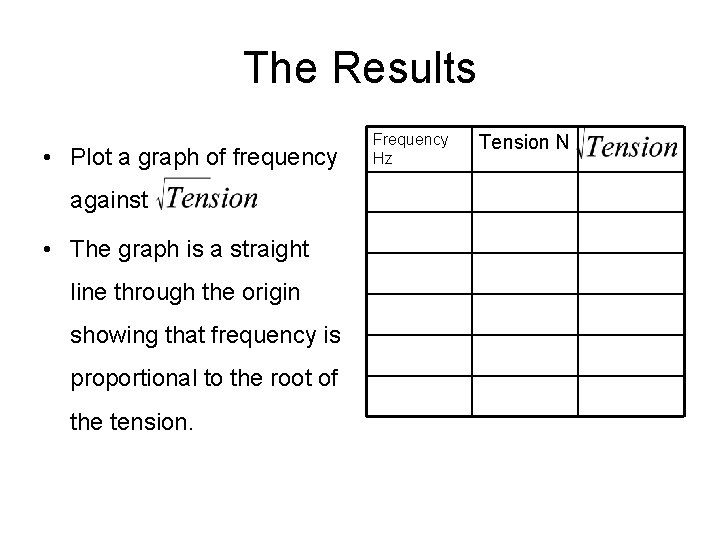
The Results • Plot a graph of frequency against • The graph is a straight line through the origin showing that frequency is proportional to the root of the tension. Frequency Hz Tension N
Precautions 1. Place the paper rider in the centre of the wire. 2. Keep the length fixed as there can only be 2 variables.