
Experiment 1 A dresser drawer contains one pair





- Slides: 20
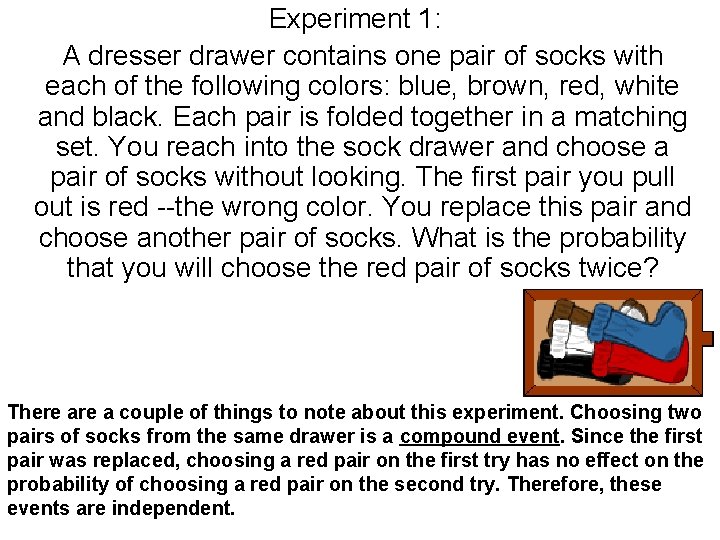
Experiment 1: A dresser drawer contains one pair of socks with each of the following colors: blue, brown, red, white and black. Each pair is folded together in a matching set. You reach into the sock drawer and choose a pair of socks without looking. The first pair you pull out is red --the wrong color. You replace this pair and choose another pair of socks. What is the probability that you will choose the red pair of socks twice? There a couple of things to note about this experiment. Choosing two pairs of socks from the same drawer is a compound event. Since the first pair was replaced, choosing a red pair on the first try has no effect on the probability of choosing a red pair on the second try. Therefore, these events are independent.
Flipbook on Independent and Dependent Events Fold the Flipbook in half on the x axis. Draw a line down the Center of the Front. Label one side Independent and the other Dependent Cut the line that you drew earlier.
Independent Events • Definition: Two events, A and B, are independent if the fact that A occurs does not affect the probability of B occurring. Some other examples of independent events are: • Landing on heads after tossing a coin AND rolling a 5 on a single 6 -sided die. • Choosing a marble from a jar AND landing on heads after tossing a coin. • Choosing a 3 from a deck of cards, replacing it, AND then choosing an ace as the second card. • Rolling a 4 on a single 6 -sided die, AND then rolling a 1 on a second roll of the die.
Independent Events Copy this. • To find the probability of two independent events that occur in sequence, find the probability of each event occurring separately, and then multiply the probabilities. This multiplication rule is defined symbolically below. Note that multiplication is represented by AND. • Multiplication Rule 1: When two events, A and B, are independent, the probability of both occurring is: P(A and B) = P(A) · P(B)
• Experiment 1: A dresser drawer contains one pair of socks of each of the following colors: blue, brown, red, white and black. Each pair is folded together in matching pairs. You reach into the sock drawer and choose a pair of socks without looking. The first pair you pull out is red -the wrong color. You replace this pair and choose another pair. What is the probability that you will choose the red pair of socks twice? • Probabilities: P(red) = 1/5 • P(red and red) = P(red) · P(red) = 1/5 x 1/5 = 1/25
• A coin is tossed and a single 6 -sided die is rolled. Find the probability of landing on the head side of the coin and rolling a 3 on the die. • A card is chosen at random from a deck of 52 cards. It is then replaced and a second card is chosen. What is the probability of choosing a jack and an eight?
• Summary: The probability of two or more independent events occurring in sequence can be found by computing the probability of each event separately, and then multiplying the results together.
Chelsea Football Club won the league title last year by winning 19 out of 20 home matches and 18 out of 20 away matches. For the upcoming season Chelsea will play the first 2 games at home and the third game away. What is the experimental probability of Chelsea winning all three games?
• 1 st game (home) 19/20 • 2 nd game (home) 19/20 • 3 rd game (away) 17/20 • Multiply them up to get total probability of winning all three of these games.
Brain. Pop
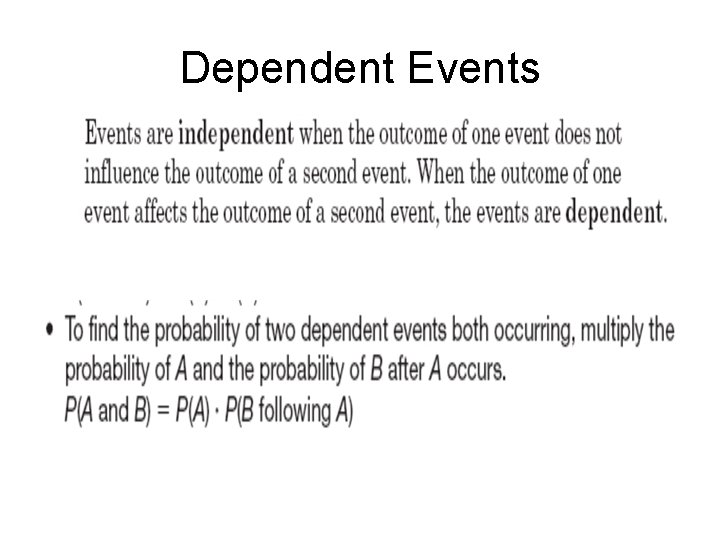
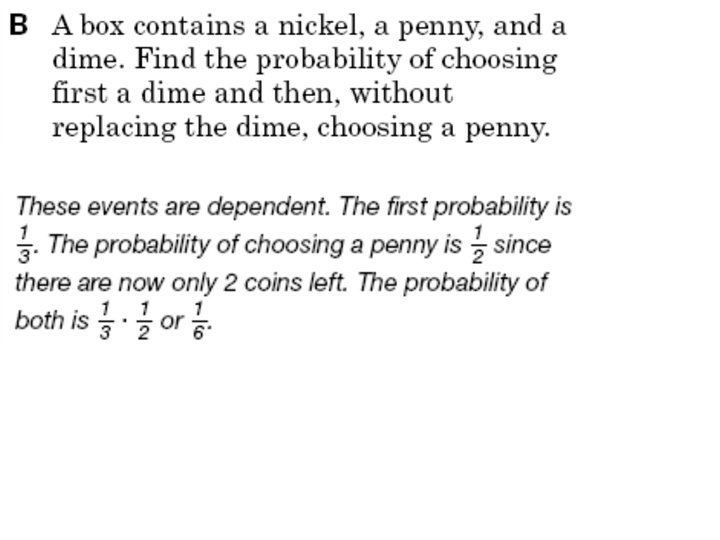
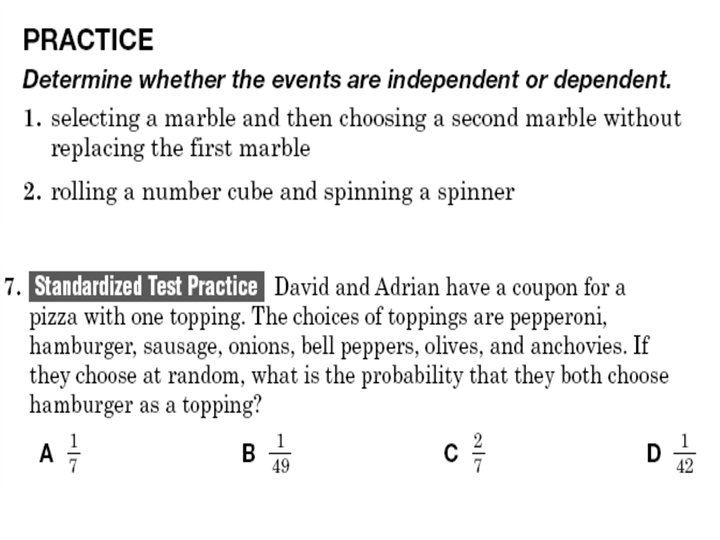
Dependent Events
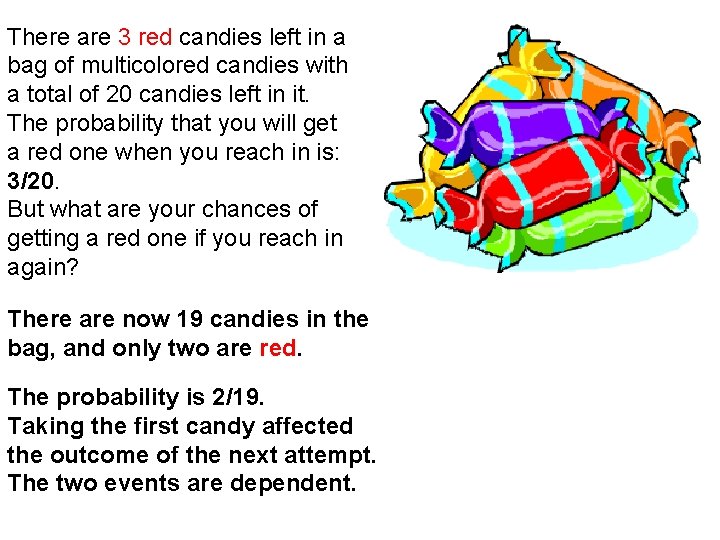
There are 3 red candies left in a bag of multicolored candies with a total of 20 candies left in it. The probability that you will get a red one when you reach in is: 3/20. But what are your chances of getting a red one if you reach in again? There are now 19 candies in the bag, and only two are red. The probability is 2/19. Taking the first candy affected the outcome of the next attempt. The two events are dependent.
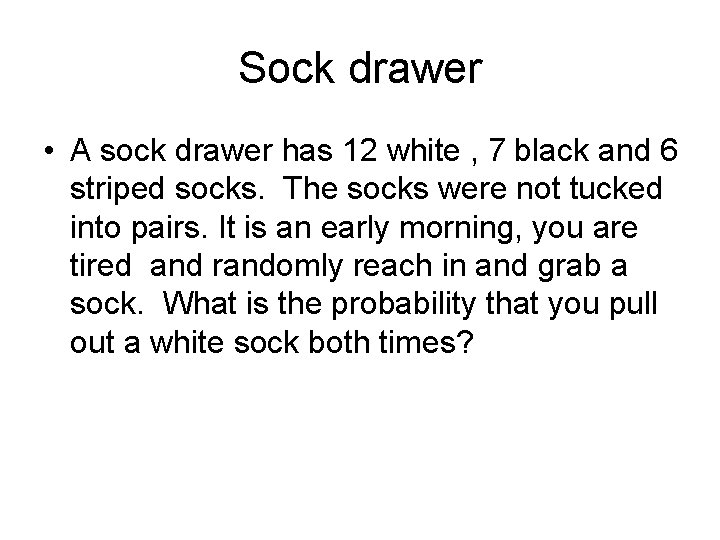
Sock drawer • A sock drawer has 12 white , 7 black and 6 striped socks. The socks were not tucked into pairs. It is an early morning, you are tired and randomly reach in and grab a sock. What is the probability that you pull out a white sock both times?
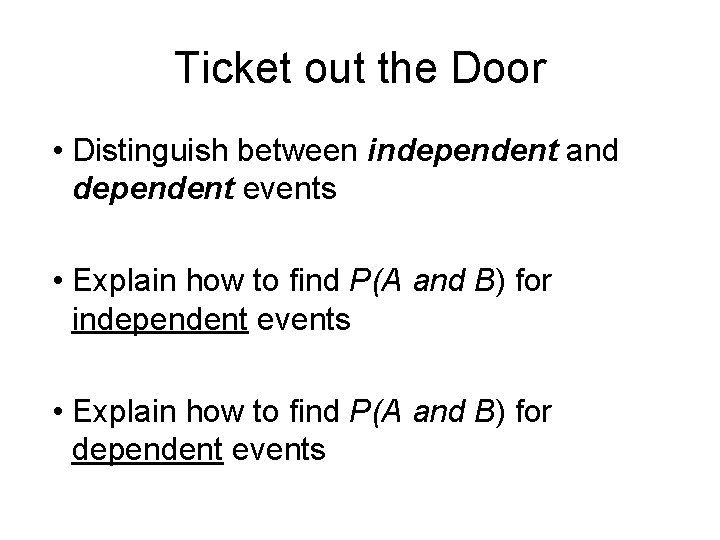
Ticket out the Door • Distinguish between independent and dependent events • Explain how to find P(A and B) for independent events • Explain how to find P(A and B) for dependent events
Workbook 7 Lesson 13. 6 (pg. 179180) all