
Experiential Learning for 4 H Judges Adapted by
Experiential Learning for 4 -H Judges Adapted by Liz Beiersdorfer, Dearborn County 4 -H Youth Development Educator. Presented at Judges and Volunteer Clinic 2017
Objectives • Recognize the five steps of the Experiential Learning Model. • Experience the model. • Understand how Experiential Learning relates to evaluating 4 -H projects. • Apply Experiential Learning to 4 -H project evaluation.
What is Experiential Learning? • Referred to as “Learning by Doing” • Learner experiences a problem or activity and makes sense of the solution on his or her own • Model is divided into five steps, and summarized into three main processes
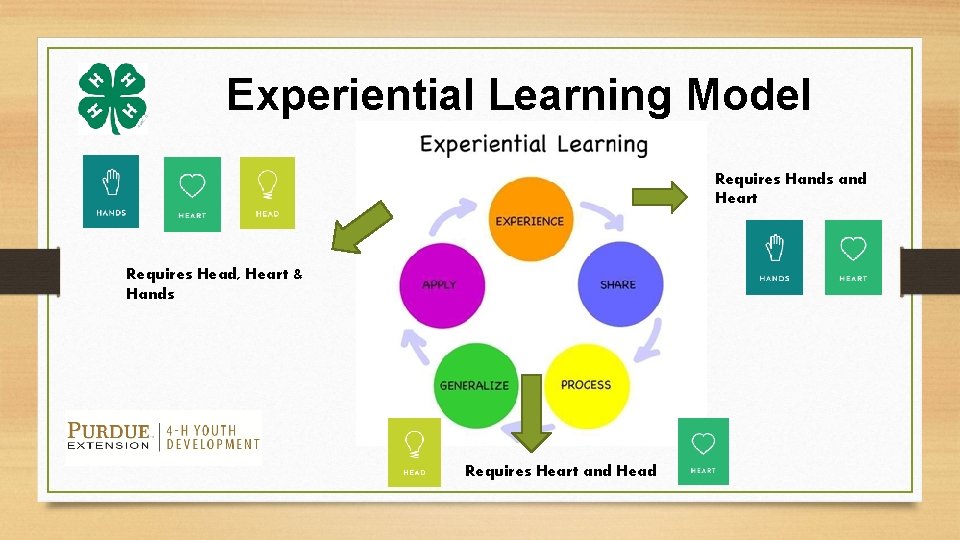
Experiential Learning Model Requires Hands and Heart Requires Head, Heart & Hands Requires Heart and Head
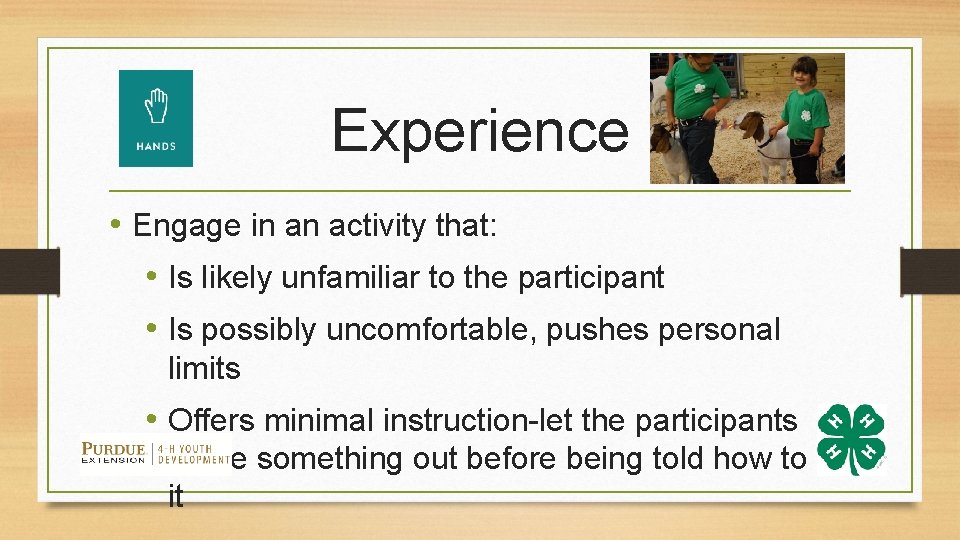
Experience • Engage in an activity that: • Is likely unfamiliar to the participant • Is possibly uncomfortable, pushes personal limits • Offers minimal instruction-let the participants figure something out before being told how to do it
Process (What is Important? & What Life Skill was most important? ) • Analyze and reflect on what happened • What did you learn about yourself? How did you make decisions? What was important? • • Discuss how problems and issues presented themselves Discuss how the problems and issues were addressed and solved Discuss personal experiences of the participants Were there any recurring themes in the process?
Share (What Happened? & What was Done? ) • Participants should be asked what they experienced while doing the activity • Reactions • Observations • Feelings • Encourage discussion and expression of ideas and feelings by asking questions • Have questions ready to guide and aid the discussion or draw attention to items of importance.
Generalize (Identify how to use what’s been learned by project completion) • Relate the experience to “real life. ” • Identify key items learned • Identify key life skills developed • Identify key terms related to the experience
Apply (What’s Next? ) • How can lessons be applied elsewhere? • How will the lessons learned be useful in the future? • Discuss how behaviors and actions can be modified to improve the results. • Discuss how results could be accomplished more efficiently. • Help youth understand they have gained new knowledge and practiced life skills.
Key Points to Remember • Ask open-ended questions • Encourage open and non-threatening discussion • Help youth understand that Failures/Mistakes are a key element to successful learning!
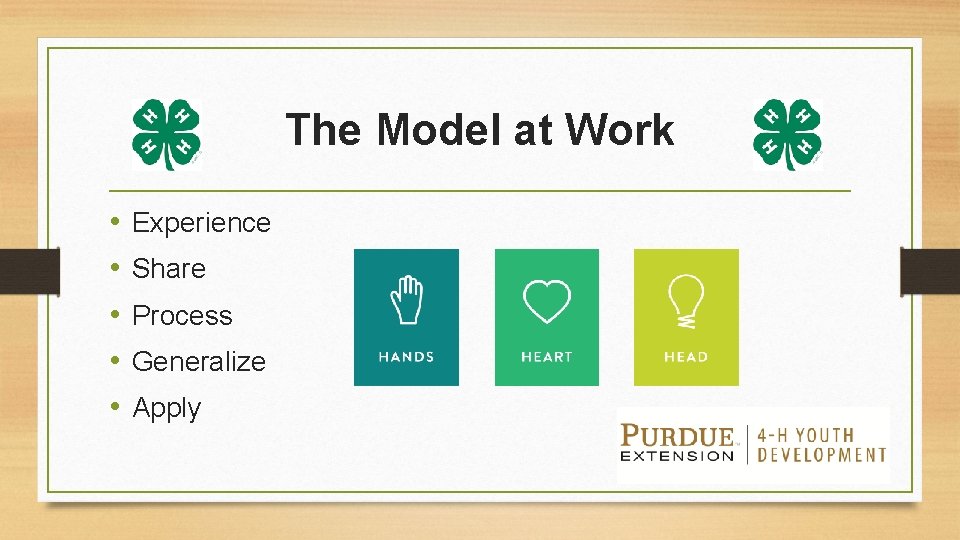
The Model at Work • • • Experience Share Process Generalize Apply
Let’s Experience It! • Experiential Learning: How does smoking or lung disease affect lung capacity and breathing? • Breathe through a straw • Breathe through a coffee stirrer • Compare the difference and share with a neighbor • What if you were walking or doing exercise while breathing through a coffee stirrer?
Applying Experiential Learning to Judging • Let’s pretend the activity you just did, was the basis of a 4 -H’ers Health poster project. • Work in Table Teams and answer the following questions. Refer to the Experiential Model: Experience, Share, Process, Generalize, Apply. Be prepared to share. • What questions could you ask a youth to better understand what they learned? • Help youth determine what was important to remember • Help youth explain how they completed the project and their level of understanding. • Help youth think about how to apply what they learned to future “real life” situations
Let’s Share the Results • What questions do you feel would be helpful to get the information you need to evaluate the 4 -H’er’s project? • • What questions would help the 4 -H’er process what they did? What questions would help the 4 -H’er link life skills to the project? What questions would help the 4 -H’er link knowledge to the future? Any other questions that would help a judge or the 4 -H’er?
Key Elements of Judging Experience • Help Youth develop life skills • • • Learning skills & knowledge Decision making & problem solving Developing positive self-concept Communicating and relating to others Responding to needs of others and “real life” situations
Final Thoughts • Think about how 4 -Hers learn using the Experiential Learning Model. • Come prepared for judging with questions to guide the evaluation process. Consider 4 -H’ers with special needs and consider how best to relate. • Refer to the Experiential Learning Guide booklet, University of Minnesota Extension, for helpful questions. • Treat each child individually, and probe for understanding before making first perception decisions.
Questions? Comments, Yes Please!
Sources • Steve Mc. Kinley-Experiential Learning PPT • Diem, K. G. (2001) Learn by Doing the 4 -H Way. New Brunswick, NJ Rutgers Cooperative Extension • Kock, K (2006) Experiential Learning Model slide show. Noblesville, IN Purdue Cooperative Extension. • Deidrick, J. , Doering, Shirley, Geiser, Donna, Kanengieter, Holly, Piehl, Barb, Stevenson, Anne (2014) Experiential Learning Guide: a field guide for volunteers, mentors, coaches, fair judges, etc.
- Slides: 19