
Experiences Using Windows Azure to Process MODIS Satellite
- Slides: 23
Experiences Using Windows Azure to Process MODIS Satellite Data Jie Li 1, Youngryel Ryu 2, Deb Agarwal 3 , Keith Jackson 3 , Marty Humphrey 1, Catharine van Ingen 4 University of Virginia e. Science Group 1 University of California, Berkeley 2 Lawrence Berkeley National Lab 3 Microsoft Research 4 Microsoft Cloud Futures 2010 April 9, 2010 1
Outline Background Azure. MODIS Framework Overview Dynamic Scalability & Fault Tolerance Conclusions & Future Work 2
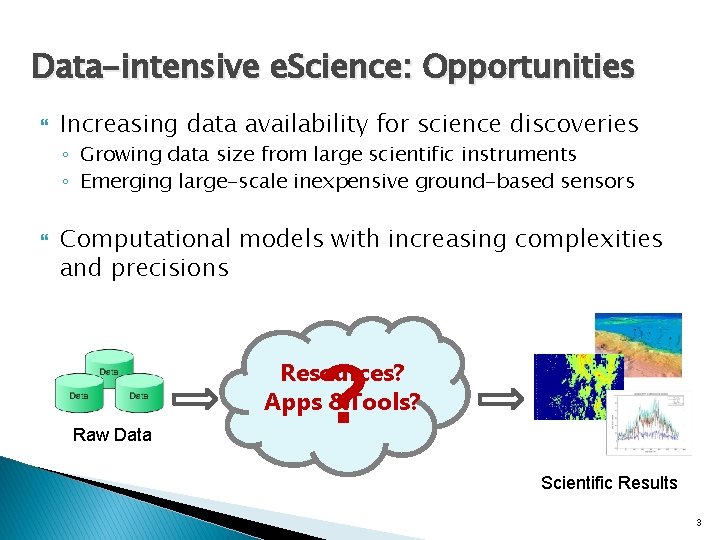
Data-intensive e. Science: Opportunities Increasing data availability for science discoveries ◦ Growing data size from large scientific instruments ◦ Emerging large-scale inexpensive ground-based sensors Computational models with increasing complexities and precisions ? Resources? Apps &Tools? Raw Data Scientific Results 3
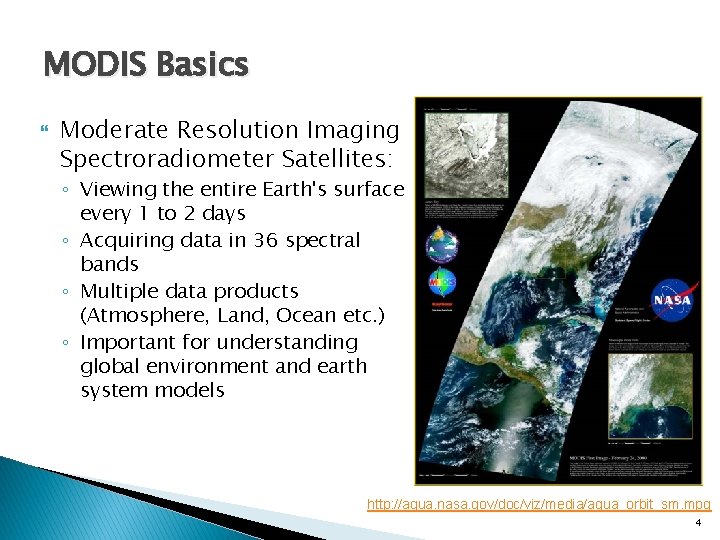
MODIS Basics Moderate Resolution Imaging Spectroradiometer Satellites: ◦ Viewing the entire Earth's surface every 1 to 2 days ◦ Acquiring data in 36 spectral bands ◦ Multiple data products (Atmosphere, Land, Ocean etc. ) ◦ Important for understanding global environment and earth system models http: //aqua. nasa. gov/doc/viz/media/aqua_orbit_sm. mpg 4
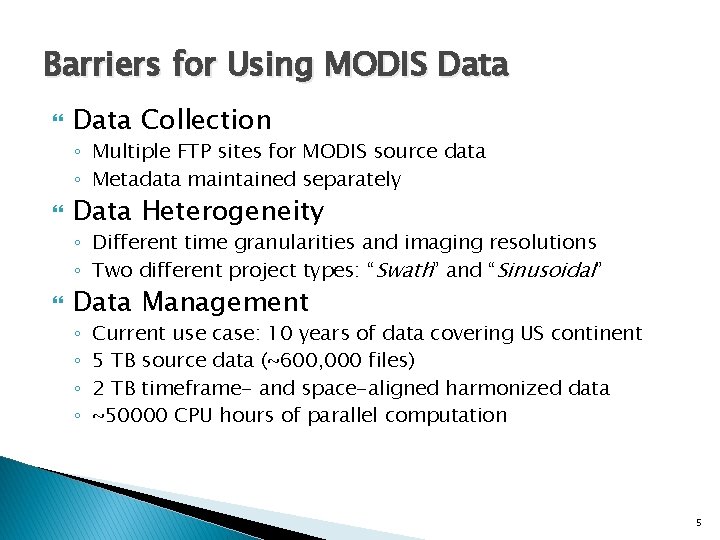
Barriers for Using MODIS Data Collection ◦ Multiple FTP sites for MODIS source data ◦ Metadata maintained separately Data Heterogeneity ◦ Different time granularities and imaging resolutions ◦ Two different project types: “Swath” and “Sinusoidal” Data Management ◦ ◦ Current use case: 10 years of data covering US continent 5 TB source data (~600, 000 files) 2 TB timeframe- and space-aligned harmonized data ~50000 CPU hours of parallel computation 5
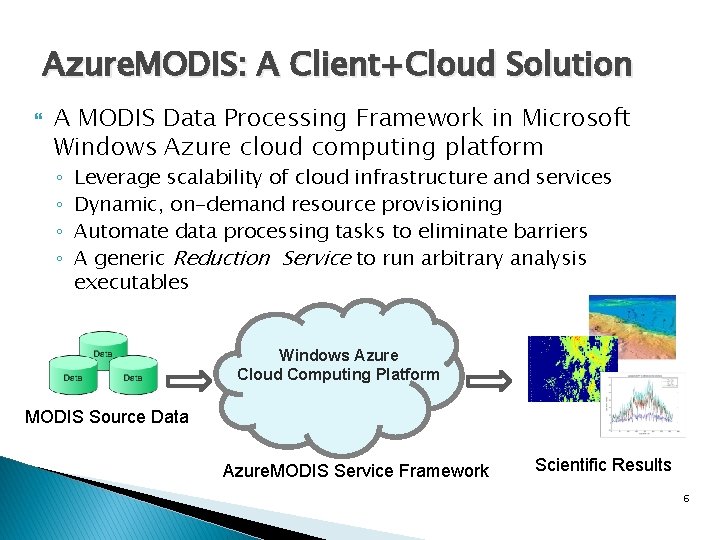
Azure. MODIS: A Client+Cloud Solution A MODIS Data Processing Framework in Microsoft Windows Azure cloud computing platform ◦ ◦ Leverage scalability of cloud infrastructure and services Dynamic, on-demand resource provisioning Automate data processing tasks to eliminate barriers A generic Reduction Service to run arbitrary analysis executables Windows Azure Cloud Computing Platform MODIS Source Data Azure. MODIS Service Framework Scientific Results 6
Outline Background Azure. MODIS Framework Overview Dynamic Scalability & Fault Tolerance Conclusions & Future Work 7
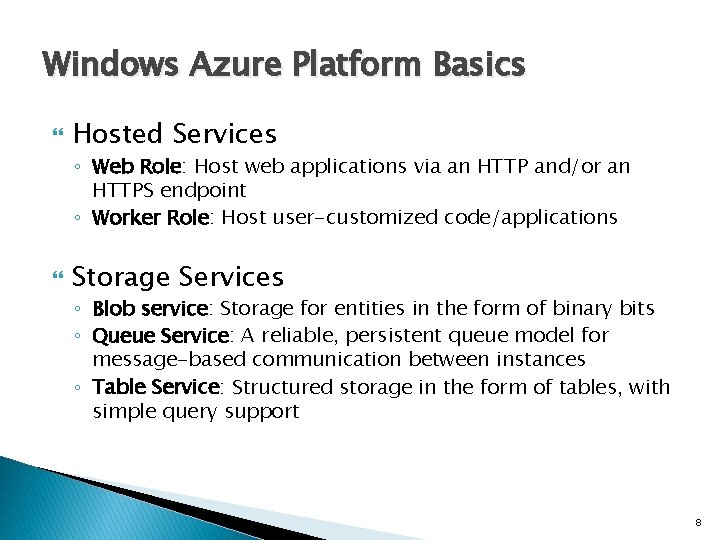
Windows Azure Platform Basics Hosted Services ◦ Web Role: Host web applications via an HTTP and/or an HTTPS endpoint ◦ Worker Role: Host user-customized code/applications Storage Services ◦ Blob service: Storage for entities in the form of binary bits ◦ Queue Service: A reliable, persistent queue model for message-based communication between instances ◦ Table Service: Structured storage in the form of tables, with simple query support 8
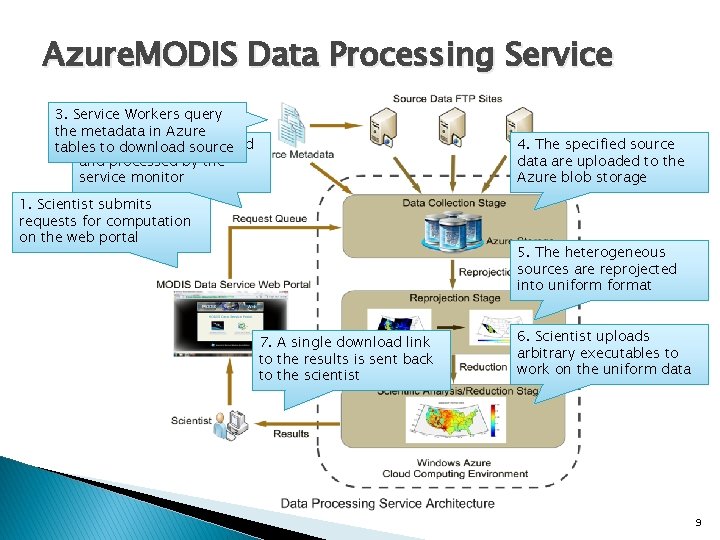
Azure. MODIS Data Processing Service 3. Service Workers query the metadata in Azure 2. The request issource received tables to download and processed by the service monitor 4. The specified source data are uploaded to the Azure blob storage 1. Scientist submits requests for computation on the web portal 5. The heterogeneous sources are reprojected into uniformat 7. A single download link to the results is sent back to the scientist 6. Scientist uploads arbitrary executables to work on the uniform data 9
Azure. MODIS Data Service Demo http: //modisazure. cloudapp. net/ 10
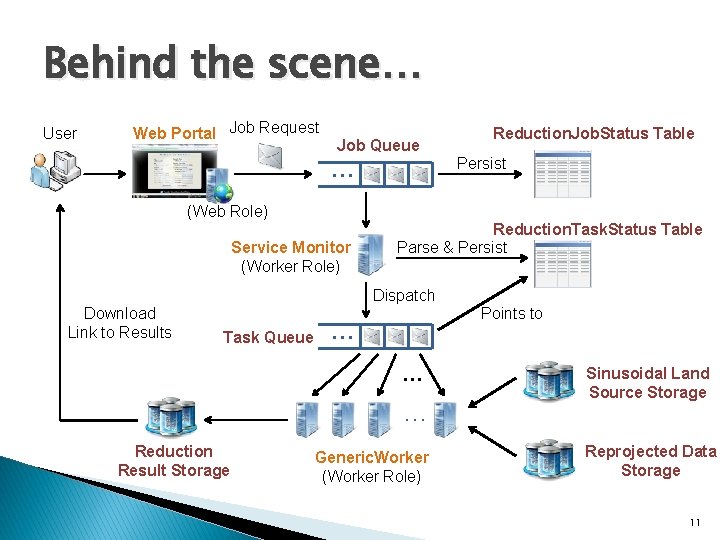
Behind the scene… User Web Portal Job Request Job Queue Reduction. Job. Status Table Persist … (Web Role) Service Monitor (Worker Role) Reduction. Task. Status Table Parse & Persist Dispatch Download Link to Results Task Queue Points to … … … Reduction Result Storage Generic. Worker (Worker Role) Sinusoidal Land Source Storage Reprojected Data Storage 11
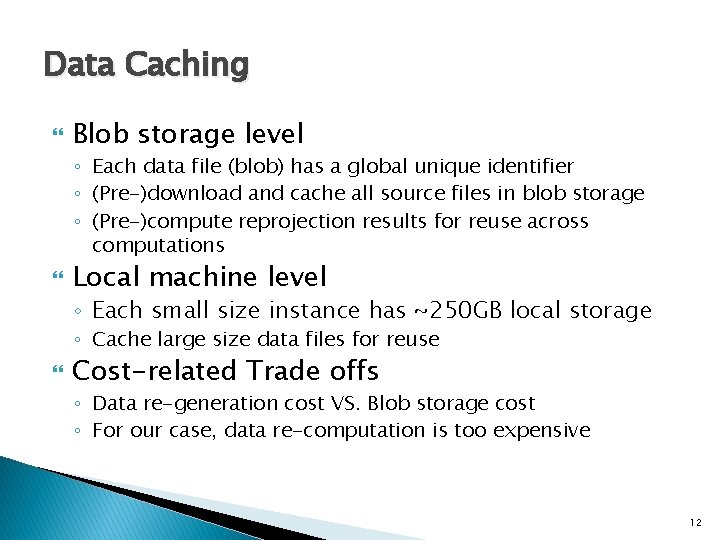
Data Caching Blob storage level ◦ Each data file (blob) has a global unique identifier ◦ (Pre-)download and cache all source files in blob storage ◦ (Pre-)compute reprojection results for reuse across computations Local machine level ◦ Each small size instance has ~250 GB local storage ◦ Cache large size data files for reuse Cost-related Trade offs ◦ Data re-generation cost VS. Blob storage cost ◦ For our case, data re-computation is too expensive 12
Reduction Service Scientists upload their analysis binary tools upon request for the reduction service Benefits ◦ Scientists can easily debug and refine scientific models in their code ◦ Separate system code debugging from science code debugging A 2 nd reduction stage to support more comprehensive computation flows 13
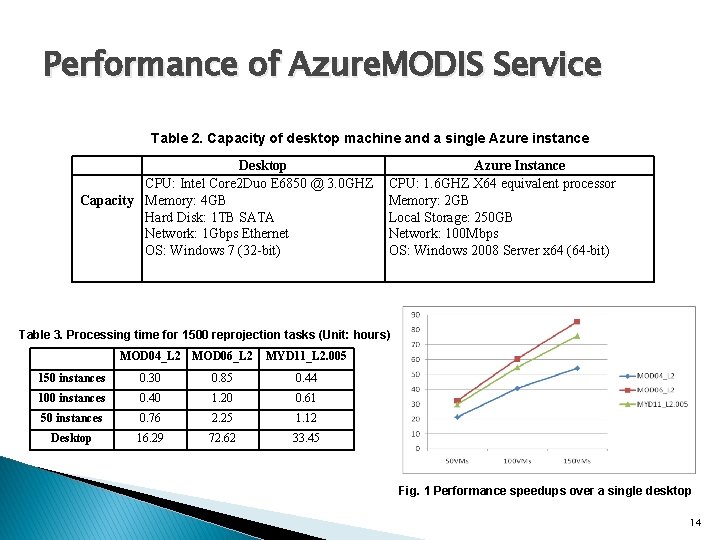
Performance of Azure. MODIS Service Table 2. Capacity of desktop machine and a single Azure instance Desktop CPU: Intel Core 2 Duo E 6850 @ 3. 0 GHZ Capacity Memory: 4 GB Hard Disk: 1 TB SATA Network: 1 Gbps Ethernet OS: Windows 7 (32 -bit) Azure Instance CPU: 1. 6 GHZ X 64 equivalent processor Memory: 2 GB Local Storage: 250 GB Network: 100 Mbps OS: Windows 2008 Server x 64 (64 -bit) Table 3. Processing time for 1500 reprojection tasks (Unit: hours) MOD 04_L 2 MOD 06_L 2 MYD 11_L 2. 005 150 instances 0. 30 0. 85 0. 44 100 instances 0. 40 1. 20 0. 61 50 instances 0. 76 2. 25 1. 12 Desktop 16. 29 72. 62 33. 45 Fig. 1 Performance speedups over a single desktop 14
Outline Project Background Azure. MODIS Framework Overview Dynamic Scalability & Fault Tolerance Conclusions & Future Work 15
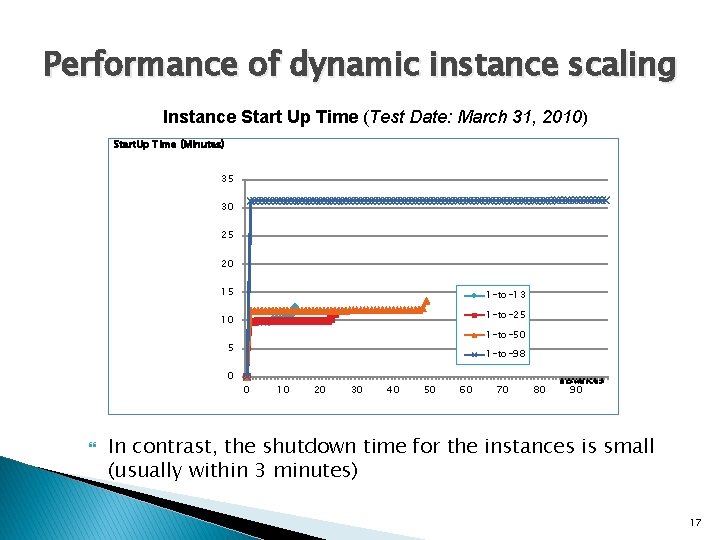
Dynamic Scalability Use the Azure Management API to dynamically scale up/down instances according to work loads Dynamic instance shutdown could be a problem ◦ Azure decides which instance to shutdown ◦ Instances may be shutdown during task execution Currently, computing instance usage are charged by hours ◦ Use CPU hours wisely when applying dynamic scaling strategies 16
Performance of dynamic instance scaling Instance Start Up Time (Test Date: March 31, 2010) Start. Up Time (Minutes) 35 30 25 20 15 1 -to-13 1 -to-25 10 1 -to-50 5 0 1 -to-98 0 10 20 30 40 50 60 70 80 Instances 90 In contrast, the shutdown time for the instances is small (usually within 3 minutes) 17
Fault Tolerance Tasks can fail for many reasons ◦ Broken or missing source data files — Unrecoverable ◦ Reduction tool may crash due to code bug — Unrecoverable ◦ Failures caused by system instability — Recoverable Customized task retry policies ◦ Task with timeout failures will be resent to the task queue ◦ Task with exceptions caught will be immediately resent ◦ Task canceled after 2 retries (Totally 3 executions) Why not just use queue message visibility settings for failure recovery? 18
Service Monitoring & Diagnosing (Demo) http: //modisazure. cloudapp. net/ 19
Outline Project Background Azure. MODIS Framework Overview Dynamic Scalability & Fault Tolerance Conclusions & Future Work 20
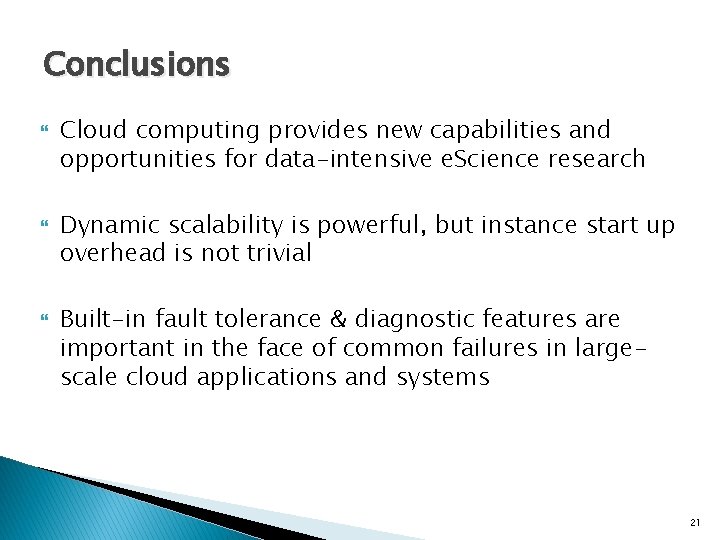
Conclusions Cloud computing provides new capabilities and opportunities for data-intensive e. Science research Dynamic scalability is powerful, but instance start up overhead is not trivial Built-in fault tolerance & diagnostic features are important in the face of common failures in largescale cloud applications and systems 21
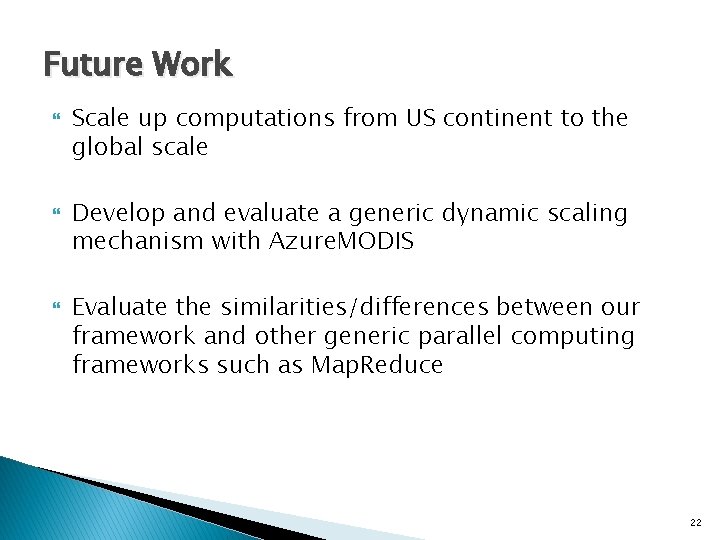
Future Work Scale up computations from US continent to the global scale Develop and evaluate a generic dynamic scaling mechanism with Azure. MODIS Evaluate the similarities/differences between our framework and other generic parallel computing frameworks such as Map. Reduce 22
Thank you! & Questions? 23