
Experiences on innovative feedback techniques THE USE OF
Experiences on innovative feedback techniques: THE USE OF AUDIO FEEDBACK FOR A LARGE MSC ON-LINE COHORT IN THE SCHOOL OF COMPUTER SCIENCE. Bernadette-Marie Byrne, Renuga Jayakumar, Andrew Pyper.
Audio Feedback Why? To improve the student experience of feedback and improve our University’s scores in this area. Which courses? This year (2017/2018) MSc on-line course in Contemporary Issues in Information Technology – approximately 100 students. How? Using Audacity (open source software) to upload feedback files to Study. Net in MP 3 files.
The assessment First coursework – presentation with notes (10 slides with notes pages) “Internet access should be a fundamental human right equivalent to other fundamental rights such as the right to life and the right to free speech. ” Or “How has the use of Information Technology led to a need for intellectual property rights? ” Second coursework (essay). Encryption wars: The privacy debate raging in your smartphone. Discuss the SOCIAL, LEGAL, ETHICAL and PROFESSIONAL implications for IT Professionals with reference to a case study.
Traditional v Audio Traditional Feedback – example of written feedback from presentation coursework : “Very good structured presentation. Your points were presented clearly and could be followed easily. Your points were supported by relevant evidence and referenced where appropriate. Very good level of knowledge and understanding demonstrated. The breadth & depth of your research is appropriate to your topic. You have integrated material from your sources appropriately in your presentation. Very good evaluation of alternative views or options. Very good use of reasoning to justify conclusions. Very good balanced summary of conclusions with some personal insight and reflection on future recommendations. 60%. (Given to students with Postgraduate marking scheme)” Audio Feedback – example from presentation coursework – click here to play:
Student Reaction Examples: “I'd be inclined to agree that it doesn't seem fair that half the group got what sounds like extremely detailed feedback and the other half did not. I appreciate that the other half will be getting this new style of feedback for our second piece of coursework, however, that does not really allow us to implement the feedback in work related to this module. “ “I'd like to add that the feedback was really constructive and very encouraging. am a strong believer that the level of feedback should be consistent across all students. Being part of those who didn't get the audio, I feel that it is completely unfair as the level of feedback received was minimal and just a highlighted marking scheme. ” “How can there be such a contrast between the level of detail provided? ” “Some students now have an advantage over those who didn't receive the audio file. ” “Thank you for taking the time to record an audio it was helpful! “
Challenges Some students who did not have audio feedback complained! Getting used to the Technology from the marker’s point of view. More enjoyable – but takes slightly longer from marker’s point of view. Should be easier with Canvas to link audio files.
Future Work We have ethical approval for future studies (student interviews and questionnaires) for modules in 2018/2019. At the end of 2019 we should have a body of data for analysis and publication.
Results so far 12 responses were received so far in the survey. Some comments from the survey for audio feedback : It felt more personal than written feedback the audio feedback was really pleasant to listen to and i was able to connect more with the module and the tutor because of it. The extra effort that obviously goes into making a recording makes you feel like the tutors care about their students. Audio feedback clearly articulated what I can improve upon in the future. Extremely useful mp 3 file. The audio feedback felt very genuine. In an online programme where all communication is done virtually the tutor's voiced feedback put a human touch in the module, which is enormously appreciated. It also pointed out a few strengths and weaknesses of my course work, and suggestion for improving my score in the subsequent course work; i. e. the ill-planned structure of the presentation and the amount of evidence needed to support my argument.
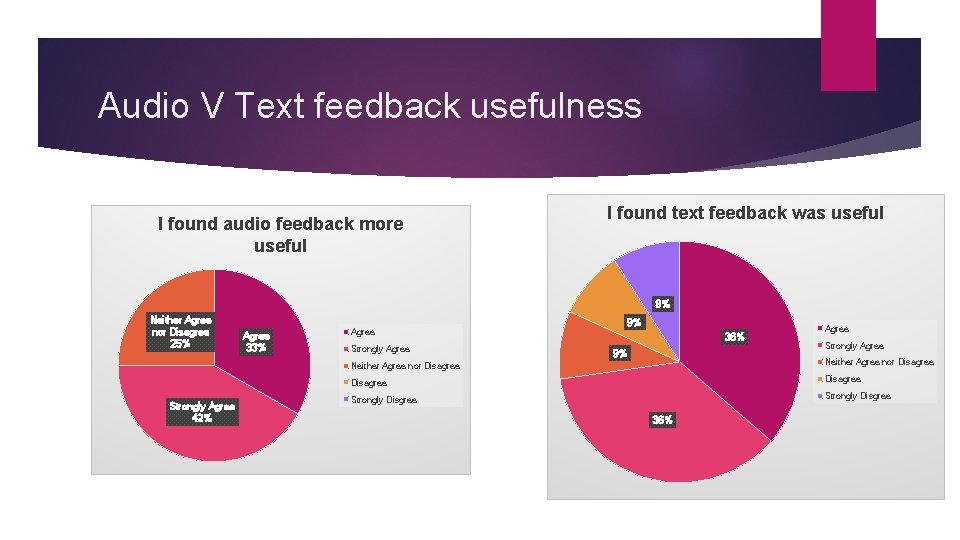
Audio V Text feedback usefulness I found audio feedback more useful I found text feedback was useful 9% Neither Agree nor Disagree 25% Strongly Agree 42% Agree 33% Agree Strongly Agree 9% 36% 9% Agree Strongly Agree Neither Agree nor Disagree Strongly Disgree 36%
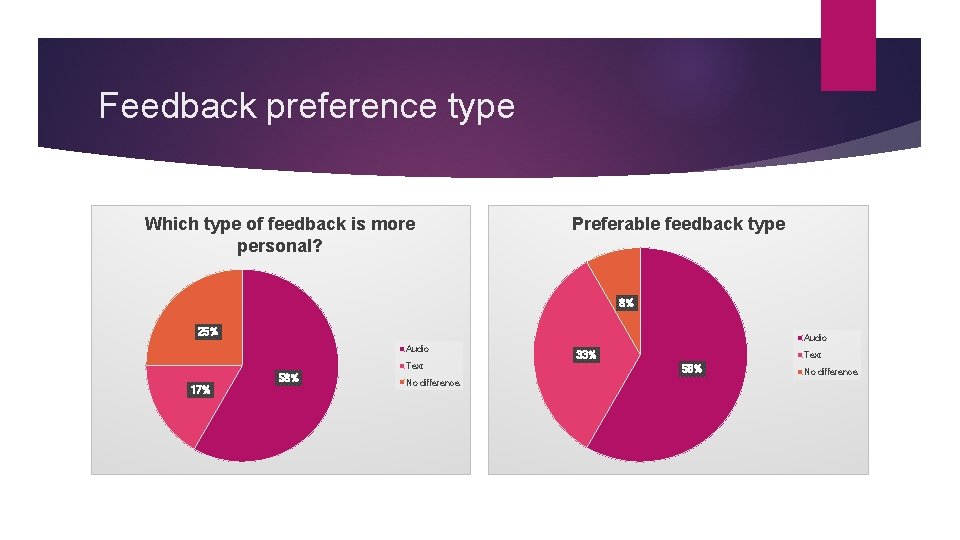
Feedback preference type Which type of feedback is more personal? Preferable feedback type 8% 25% Audio Text 58% 17% No difference 33% Text 58% No difference
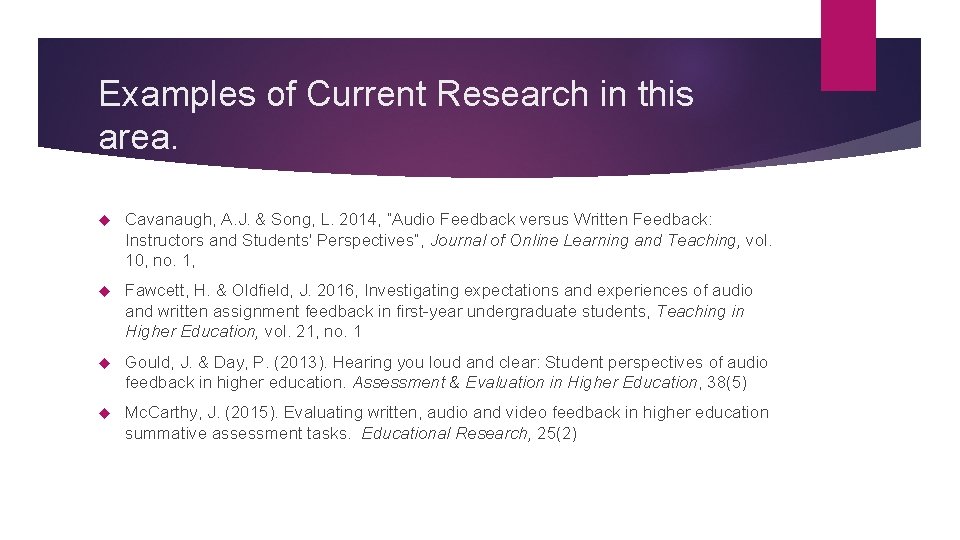
Examples of Current Research in this area. Cavanaugh, A. J. & Song, L. 2014, “Audio Feedback versus Written Feedback: Instructors and Students' Perspectives”, Journal of Online Learning and Teaching, vol. 10, no. 1, Fawcett, H. & Oldfield, J. 2016, Investigating expectations and experiences of audio and written assignment feedback in first-year undergraduate students, Teaching in Higher Education, vol. 21, no. 1 Gould, J. & Day, P. (2013). Hearing you loud and clear: Student perspectives of audio feedback in higher education. Assessment & Evaluation in Higher Education, 38(5) Mc. Carthy, J. (2015). Evaluating written, audio and video feedback in higher education summative assessment tasks. Educational Research, 25(2)
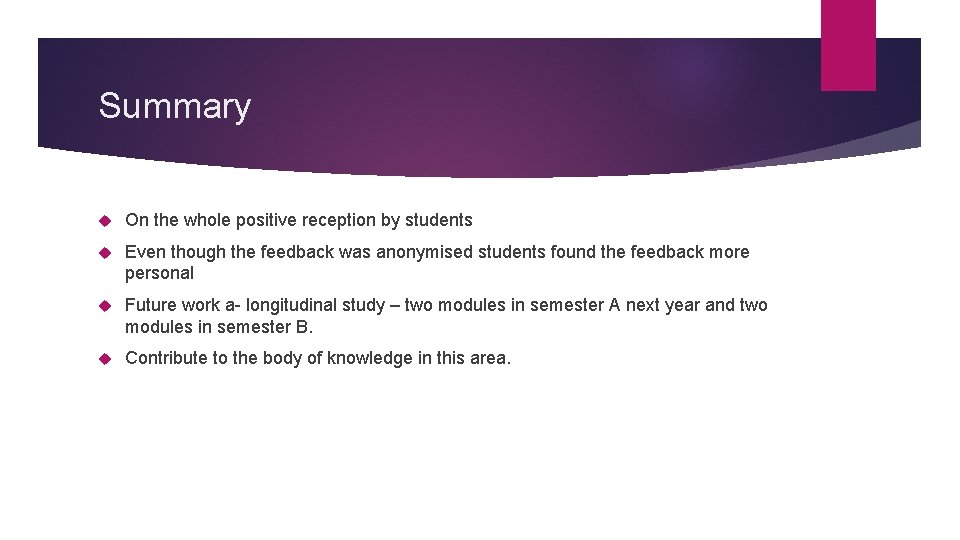
Summary On the whole positive reception by students Even though the feedback was anonymised students found the feedback more personal Future work a- longitudinal study – two modules in semester A next year and two modules in semester B. Contribute to the body of knowledge in this area.
- Slides: 12