
Experiences of Discontinuing Antipsychotic Medication Withdrawal Methods Supports







- Slides: 42
Experiences of Discontinuing Antipsychotic Medication Withdrawal Methods, Supports, and Success Dr Miriam Larsen-Barr, DClin. Psy Email mbar 114@aucklanduni. ac. nz Te Pou Mental-Health Research Symposium AUT, Auckland, 1 Dec 2017
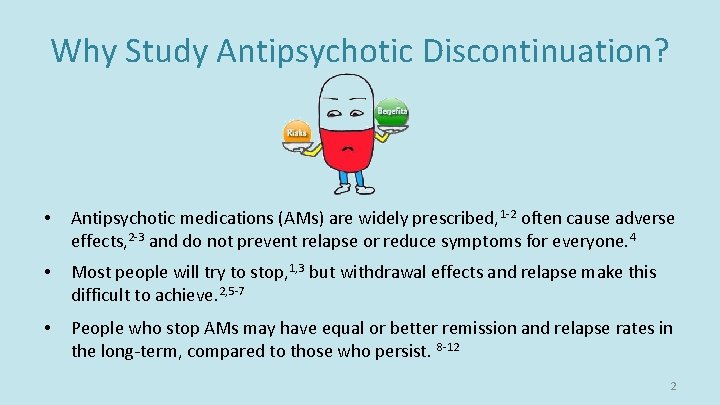
Why Study Antipsychotic Discontinuation? • Antipsychotic medications (AMs) are widely prescribed, 1 -2 often cause adverse effects, 2 -3 and do not prevent relapse or reduce symptoms for everyone. 4 • Most people will try to stop, 1, 3 but withdrawal effects and relapse make this difficult to achieve. 2, 5 -7 • People who stop AMs may have equal or better remission and relapse rates in the long-term, compared to those who persist. 8 -12 2
“There is enough evidence concerning the adverse effects of antipsychotics on physical health to compel psychiatrists to act. […] Long-term ‘maintenance’ treatment with antipsychotics is based on hope rather than evidence. ” – Murray, R. 2017 13 3
Gaps in the Evidence • We know little about what is needed for safe, successful withdrawal – Only four qualitative studies to date; all highlight the subjective importance of psycho-social factors such as coping and support. 5, 12, 14, 15 – Only three studies explore factors associated with success. 7, 8, 12 – No research asking people who successfully stop how they manage. • Few resources for clinicians, service-users or their families, all based largely on clinical and personal experience, which recommend… – Gradual withdrawal – Support – Coping strategies 4
The Experiences of Antipsychotic Medication Study 1. The Experiences of Antipsychotic Medication (AM) Survey - Online anonymous survey open to NZ adults, 18 years+, who take or have taken oral AMs for at least three months, for any reason. - 144 people on their current functioning, and experience of taking AMs. - 105 people on their most recent attempt to stop taking AMs. - Recruited via service-user networks, radio, word of mouth 2. The Successful Discontinuation Interviews - 7 NZ women who had stopped AMs for over a year on how they maintained their wellbeing during and after withdrawal - Recruited via the survey Ethics approval granted by the University of Auckland Human Participants Ethics Committee.
Data Analysis Study One • Content analysis to categorise qualitative data – – Reported outcomes of Successfully Stopping or Resuming AMs (Success ) Withdrawal Effects and Relapse Presence and Forms of Support during Withdrawal Strategies for Coping during Withdrawal • Content categories dichotomised for further analysis • After thesis: a series of two-by-two Pearson’s Chi Square crosstabulations to test whether withdrawal methods and support are independently associated with relapse and success. Study Two: Thematic analysis 6
Study One Exploring experiences of attempted discontinuation
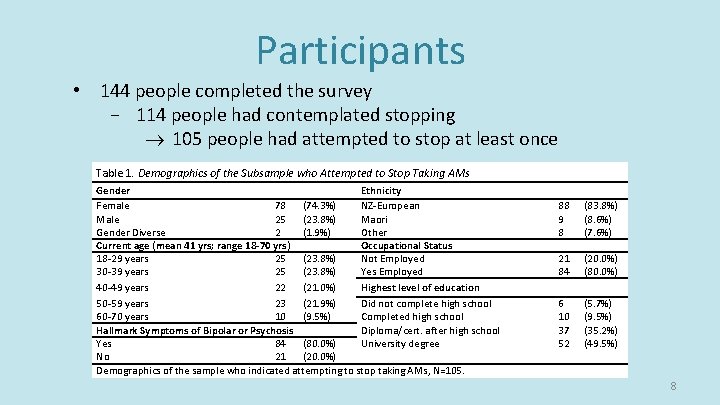
Participants • 144 people completed the survey - 114 people had contemplated stopping ® 105 people had attempted to stop at least once Table 1. Demographics of the Subsample who Attempted to Stop Taking AMs Gender Ethnicity Female 78 (74. 3%) NZ-European Male 25 (23. 8%) Maori Gender Diverse 2 (1. 9%) Other Current age (mean 41 yrs; range 18 -70 yrs) Occupational Status 18 -29 years 25 (23. 8%) Not Employed 30 -39 years 25 (23. 8%) Yes Employed 40 -49 years 22 (21. 0%) Highest level of education 50 -59 years 23 (21. 9%) Did not complete high school 60 -70 years 10 (9. 5%) Completed high school Hallmark Symptoms of Bipolar or Psychosis Diploma/cert. after high school Yes 84 (80. 0%) University degree No 21 (20. 0%) Demographics of the sample who indicated attempting to stop taking AMs, N=105. 88 9 8 (83. 8%) (8. 6%) (7. 6%) 21 84 (20. 0%) (80. 0%) 6 10 37 52 (5. 7%) (9. 5%) (35. 2%) (49. 5%) 8
Medication Information Table 2. Medication Information for the Sample Who Tried to Stop AMs Age started AMs (mean 29 yrs; range 12 -63 yrs) Under 18 years 15 (14. 4%) 18 -29 years 47 (45. 2%) Multiple attempts to stop First attempt to stop Previous attempts to stop 30 -39 years 23 (22. 1%) Age at last attempt (mean 36 yrs; range 16 -70 yrs) 40 -49 years 50 -65 years Most recent or current AM type(s) Typical AM only Atypical AM only Both typical and atypical AM Concurrent polypharmacy – psych meds No, single oral AM only Yes polypharmacy 12 (11. 5%) 7 (6. 7%) Under 18 years 18 -29 years 30 -39 years 40 -49 years 50 -70 years Current use of AMs No current use of AMs Current use of AMs 9 (8. 8%) 90 (88. 2%) 3 (2. 9%) 22 (21. 0%) 76 (72. 4%) 37 (35. 2%) 67 (63. 8%) 1 (1. 0%) 35 (34. 3%) 27 (26. 5%) 22 (21. 6%) 17 (16. 7%) 53 (50. 5%) 52 (49. 5%) Medication information for the sample who indicated attempting to stop taking AMs, N=105. 9
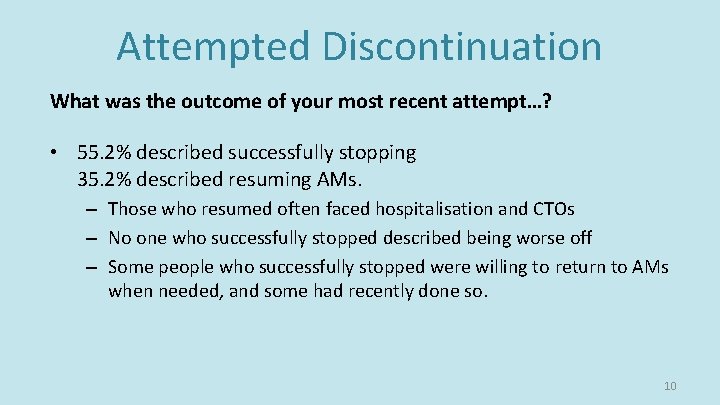
Attempted Discontinuation What was the outcome of your most recent attempt…? • 55. 2% described successfully stopping 35. 2% described resuming AMs. – Those who resumed often faced hospitalisation and CTOs – No one who successfully stopped described being worse off – Some people who successfully stopped were willing to return to AMs when needed, and some had recently done so. 10
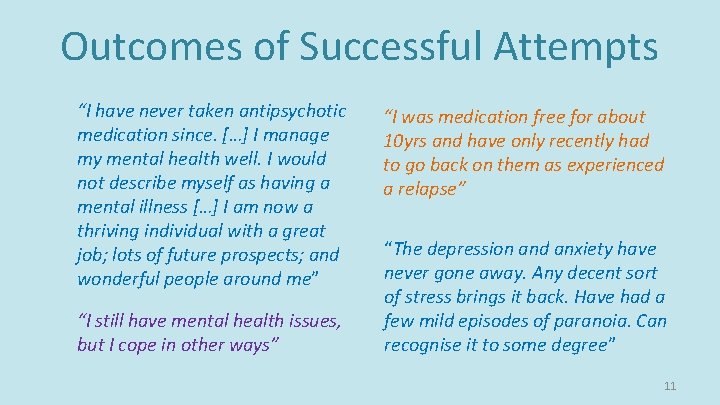
Outcomes of Successful Attempts “I have never taken antipsychotic medication since. […] I manage my mental health well. I would not describe myself as having a mental illness […] I am now a thriving individual with a great job; lots of future prospects; and wonderful people around me” “I still have mental health issues, but I cope in other ways” “I was medication free for about 10 yrs and have only recently had to go back on them as experienced a relapse” “The depression and anxiety have never gone away. Any decent sort of stress brings it back. Have had a few mild episodes of paranoia. Can recognise it to some degree” 11
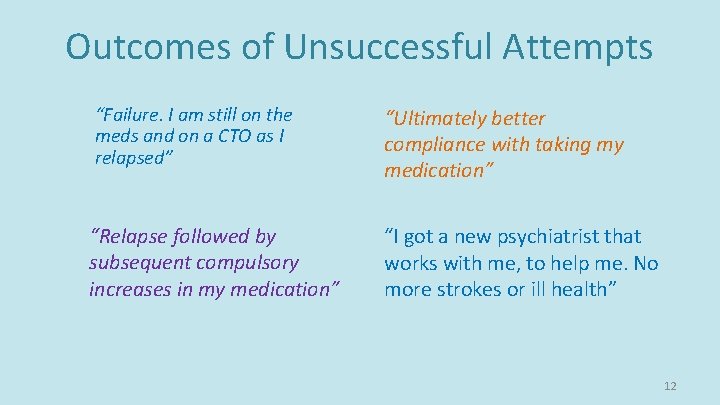
Outcomes of Unsuccessful Attempts “Failure. I am still on the meds and on a CTO as I relapsed” “Ultimately better compliance with taking my medication” “Relapse followed by subsequent compulsory increases in my medication” “I got a new psychiatrist that works with me, to help me. No more strokes or ill health” 12
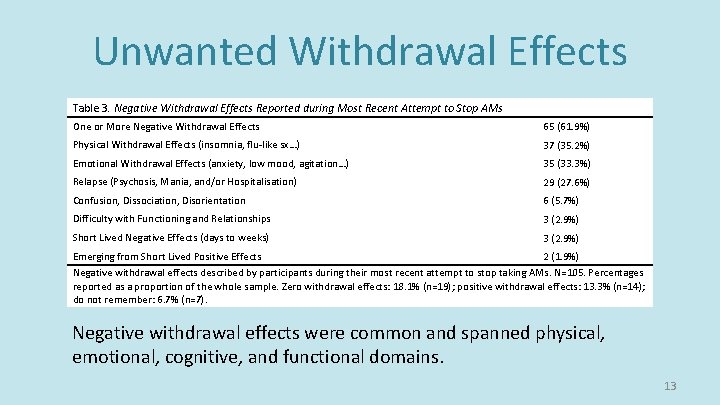
Unwanted Withdrawal Effects Table 3. Negative Withdrawal Effects Reported during Most Recent Attempt to Stop AMs One or More Negative Withdrawal Effects 65 (61. 9%) Physical Withdrawal Effects (insomnia, flu-like sx…) 37 (35. 2%) Emotional Withdrawal Effects (anxiety, low mood, agitation…) 35 (33. 3%) Relapse (Psychosis, Mania, and/or Hospitalisation) 29 (27. 6%) Confusion, Dissociation, Disorientation 6 (5. 7%) Difficulty with Functioning and Relationships 3 (2. 9%) Short Lived Negative Effects (days to weeks) 3 (2. 9%) Emerging from Short Lived Positive Effects 2 (1. 9%) Negative withdrawal effects described by participants during their most recent attempt to stop taking AMs. N=105. Percentages reported as a proportion of the whole sample. Zero withdrawal effects: 18. 1% (n=19); positive withdrawal effects: 13. 3% (n=14); do not remember: 6. 7% (n=7). Negative withdrawal effects were common and spanned physical, emotional, cognitive, and functional domains. 13
Withdrawal Methods, Relapse and Success • 56. 2% stopped abruptly or reduced in 1 month or less (n=59) • 30. 5% reduced gradually across more than 1 month (n=32) – Less likely to report relapse (ϕ = -. 223, p =. 044) – More likely to successfully stop (ϕ =. 279, p =. 011) – Less likely to report current use (ϕ = -. 295, p =. 005) 14
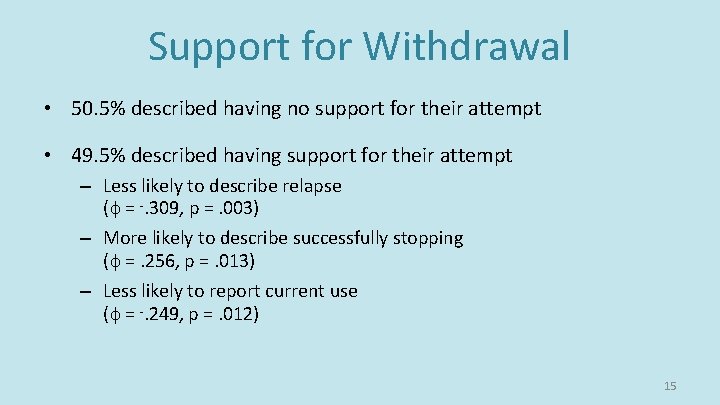
Support for Withdrawal • 50. 5% described having no support for their attempt • 49. 5% described having support for their attempt – Less likely to describe relapse (ϕ = -. 309, p =. 003) – More likely to describe successfully stopping (ϕ =. 256, p =. 013) – Less likely to report current use (ϕ = -. 249, p =. 012) 15
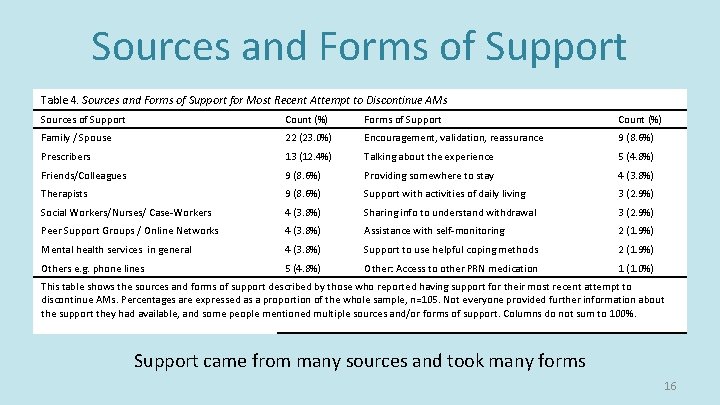
Sources and Forms of Support Table 4. Sources and Forms of Support for Most Recent Attempt to Discontinue AMs Sources of Support Count (%) Forms of Support Count (%) Family / Spouse 22 (23. 0%) Encouragement, validation, reassurance 9 (8. 6%) Prescribers 13 (12. 4%) Talking about the experience 5 (4. 8%) Friends/Colleagues 9 (8. 6%) Providing somewhere to stay 4 (3. 8%) Therapists 9 (8. 6%) Support with activities of daily living 3 (2. 9%) Social Workers/Nurses/ Case-Workers 4 (3. 8%) Sharing info to understand withdrawal 3 (2. 9%) Peer Support Groups / Online Networks 4 (3. 8%) Assistance with self-monitoring 2 (1. 9%) Mental health services in general 4 (3. 8%) Support to use helpful coping methods 2 (1. 9%) Others e. g. phone lines 5 (4. 8%) Other: Access to other PRN medication 1 (1. 0%) This table shows the sources and forms of support described by those who reported having support for their most recent attempt to discontinue AMs. Percentages are expressed as a proportion of the whole sample, n=105. Not everyone provided further information about the support they had available, and some people mentioned multiple sources and/or forms of support. Columns do not sum to 100%. Support came from many sources and took many forms 16
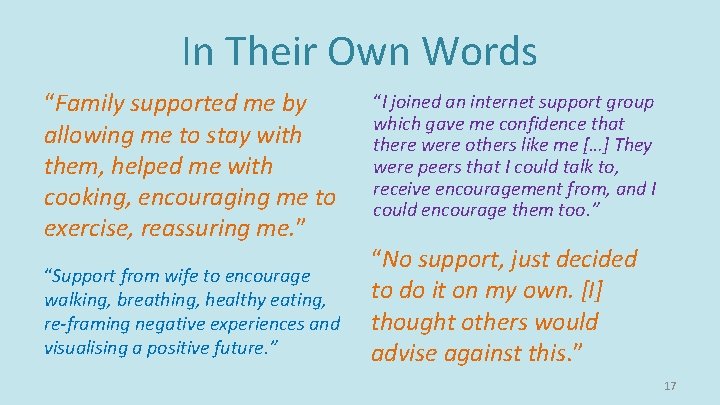
In Their Own Words “Family supported me by allowing me to stay with them, helped me with cooking, encouraging me to exercise, reassuring me. ” “Support from wife to encourage walking, breathing, healthy eating, re-framing negative experiences and visualising a positive future. ” “I joined an internet support group which gave me confidence that there were others like me […] They were peers that I could talk to, receive encouragement from, and I could encourage them too. ” “No support, just decided to do it on my own. [I] thought others would advise against this. ” 17
Study Two Successful discontinuation interviews
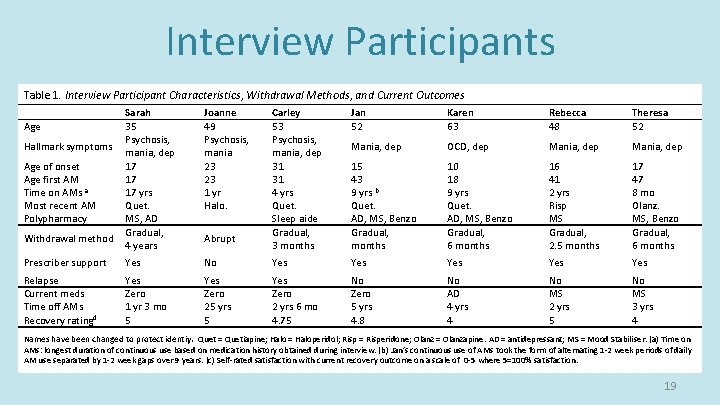
Interview Participants Table 1. Interview Participant Characteristics, Withdrawal Methods, and Current Outcomes Sarah 35 Psychosis, mania, dep 17 17 17 yrs Quet. MS, AD Gradual, 4 years Joanne 49 Psychosis, mania 23 23 1 yr Halo. Prescriber support Yes Relapse Current meds Time off AMs Recovery ratingd Yes Zero 1 yr 3 mo 5 Age Hallmark symptoms Age of onset Age first AM Time on AMs a Most recent AM Polypharmacy Withdrawal method Carley 53 Psychosis, mania, dep 31 31 4 yrs Quet. Sleep aide Gradual, 3 months Jan 52 Karen 63 Rebecca 48 Theresa 52 Mania, dep OCD, dep Mania, dep 15 43 9 yrs b Quet. AD, MS, Benzo Gradual, months 10 18 9 yrs Quet. AD, MS, Benzo Gradual, 6 months 16 41 2 yrs Risp MS Gradual, 2. 5 months 17 47 8 mo Olanz. MS, Benzo Gradual, 6 months No Yes Yes Yes Zero 25 yrs 5 Yes Zero 2 yrs 6 mo 4. 75 No Zero 5 yrs 4. 8 No AD 4 yrs 4 No MS 2 yrs 5 No MS 3 yrs 4 Abrupt Names have been changed to protect identiy. Quet = Quetiapine; Halo = Haloperidol; Risp = Risperidone; Olanz = Olanzapine. AD = antidepressant; MS = Mood Stabiliser. (a) Time on AMs: longest duration of continuous use based on medication history obtained during interview. (b) Jan’s continuous use of AMs took the form of alternating 1 -2 week periods of daily AM use separated by 1 -2 week gaps over 9 years. (c) Self-rated satisfaction with current recovery outcome on a scale of 0 -5 where 5=100% satisfaction. 19
Withdrawal Methods in Practice Multiple applications of gradual withdrawal • Reducing the daily dose, observing the response, waiting to stabilise before making further reductions and returning to a prior dose if needed. – – • Sarah reduced over 4 years, 25 mg steps, psychiatrist, therapist + key-worker support Carly reduced over 3 months, pill-cutter, GP + special supplement with web/ph support Karen reduced over 6 months, pill-cutter then shaver, private psychiatrist + therapist Theresa reduced over 6 months, 25% steps, psychiatrist support Switching to PRN use of reducing frequency – Jan switched to PRN use faded out over a period of months, psychiatrist then GP + therapist support – Rebecca reduced to alternating days for 2 weeks, then PRN use for anxiety, which she faded out over 2 months, private psychiatrist support • Abrupt Withdrawal – Joanne stopped abruptly without any planning or supports in place. She went through months of florid psychosis, with two episodes and breakthrough symptoms of reducing frequency over the next few years, without resuming AMs. 20
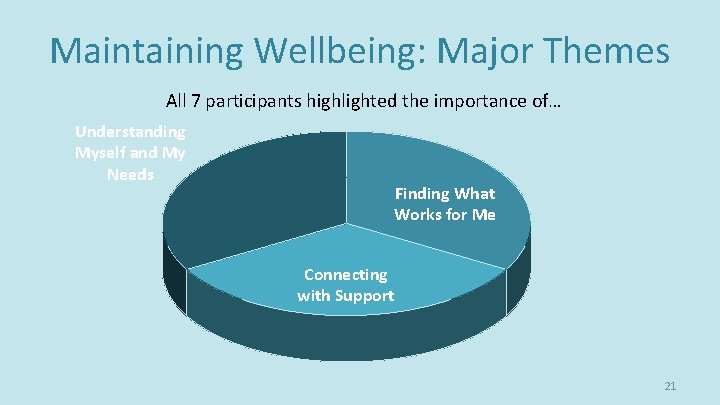
Maintaining Wellbeing: Major Themes All 7 participants highlighted the importance of… Understanding Myself and My Needs Finding What Works for Me Connecting with Support 21
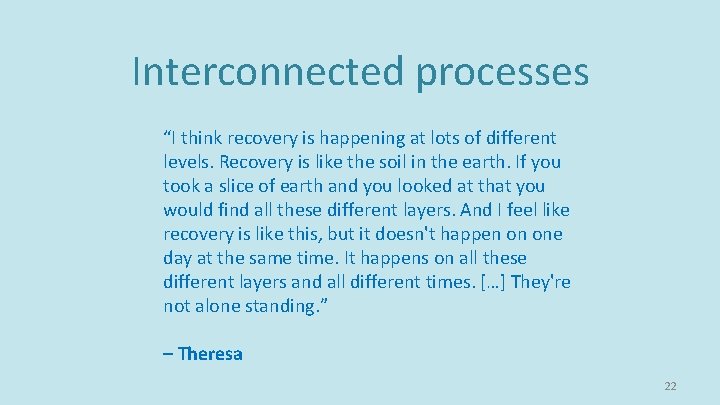
Interconnected processes “I think recovery is happening at lots of different levels. Recovery is like the soil in the earth. If you took a slice of earth and you looked at that you would find all these different layers. And I feel like recovery is like this, but it doesn't happen on one day at the same time. It happens on all these different layers and all different times. […] They're not alone standing. ” – Theresa 22
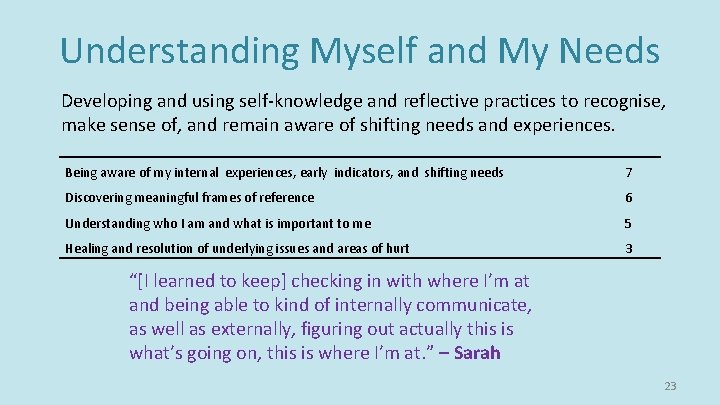
Understanding Myself and My Needs Developing and using self-knowledge and reflective practices to recognise, make sense of, and remain aware of shifting needs and experiences. Being aware of my internal experiences, early indicators, and shifting needs 7 Discovering meaningful frames of reference 6 Understanding who I am and what is important to me 5 Healing and resolution of underlying issues and areas of hurt 3 “[I learned to keep] checking in with where I’m at and being able to kind of internally communicate, as well as externally, figuring out actually this is what’s going on, this is where I’m at. ” – Sarah 23
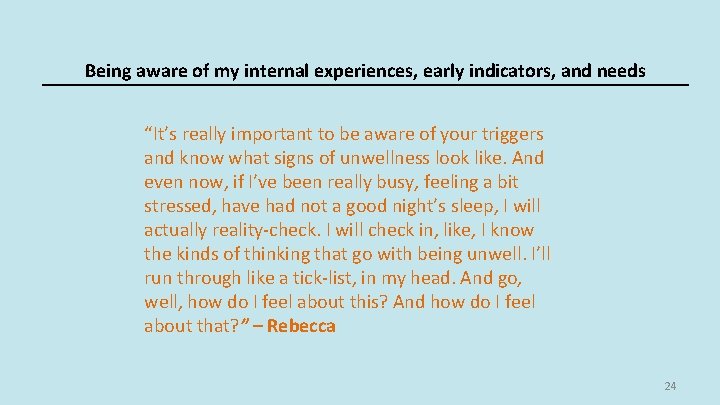
Being aware of my internal experiences, early indicators, and needs “It’s really important to be aware of your triggers and know what signs of unwellness look like. And even now, if I’ve been really busy, feeling a bit stressed, have had not a good night’s sleep, I will actually reality-check. I will check in, like, I know the kinds of thinking that go with being unwell. I’ll run through like a tick-list, in my head. And go, well, how do I feel about this? And how do I feel about that? ” – Rebecca 24
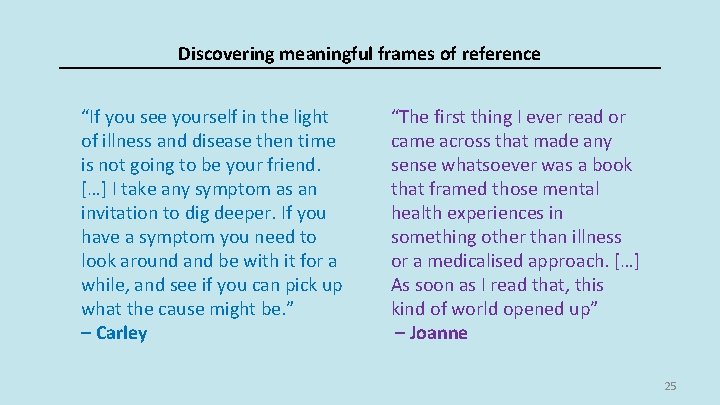
Discovering meaningful frames of reference “If you see yourself in the light of illness and disease then time is not going to be your friend. […] I take any symptom as an invitation to dig deeper. If you have a symptom you need to look around and be with it for a while, and see if you can pick up what the cause might be. ” – Carley “The first thing I ever read or came across that made any sense whatsoever was a book that framed those mental health experiences in something other than illness or a medicalised approach. […] As soon as I read that, this kind of world opened up” – Joanne 25
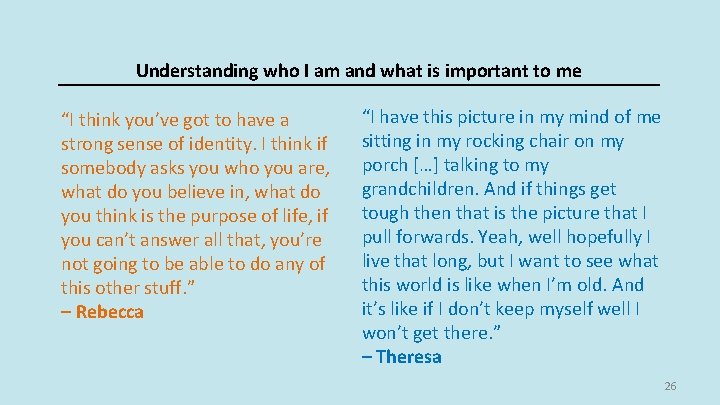
Understanding who I am and what is important to me “I think you’ve got to have a strong sense of identity. I think if somebody asks you who you are, what do you believe in, what do you think is the purpose of life, if you can’t answer all that, you’re not going to be able to do any of this other stuff. ” – Rebecca “I have this picture in my mind of me sitting in my rocking chair on my porch […] talking to my grandchildren. And if things get tough then that is the picture that I pull forwards. Yeah, well hopefully I live that long, but I want to see what this world is like when I’m old. And it’s like if I don’t keep myself well I won’t get there. ” – Theresa 26
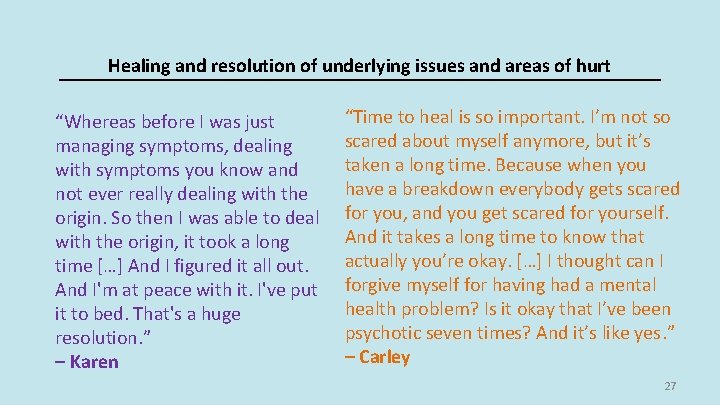
Healing and resolution of underlying issues and areas of hurt “Whereas before I was just managing symptoms, dealing with symptoms you know and not ever really dealing with the origin. So then I was able to deal with the origin, it took a long time […] And I figured it all out. And I'm at peace with it. I've put it to bed. That's a huge resolution. ” – Karen “Time to heal is so important. I’m not so scared about myself anymore, but it’s taken a long time. Because when you have a breakdown everybody gets scared for you, and you get scared for yourself. And it takes a long time to know that actually you’re okay. […] I thought can I forgive myself for having had a mental health problem? Is it okay that I’ve been psychotic seven times? And it’s like yes. ” – Carley 27
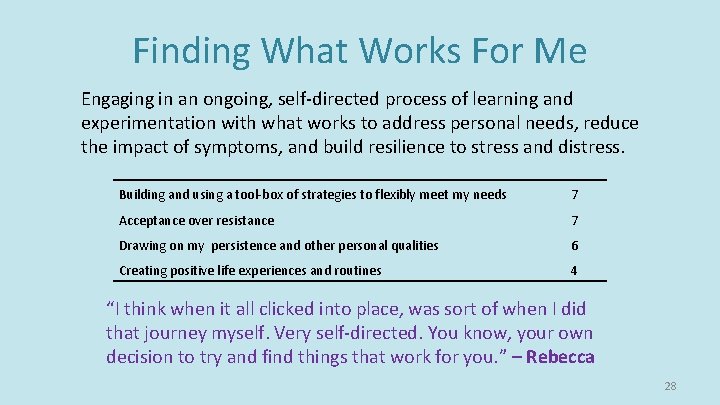
Finding What Works For Me Engaging in an ongoing, self-directed process of learning and experimentation with what works to address personal needs, reduce the impact of symptoms, and build resilience to stress and distress. Building and using a tool-box of strategies to flexibly meet my needs 7 Acceptance over resistance 7 Drawing on my persistence and other personal qualities 6 Creating positive life experiences and routines 4 “I think when it all clicked into place, was sort of when I did that journey myself. Very self-directed. You know, your own decision to try and find things that work for you. ” – Rebecca 28
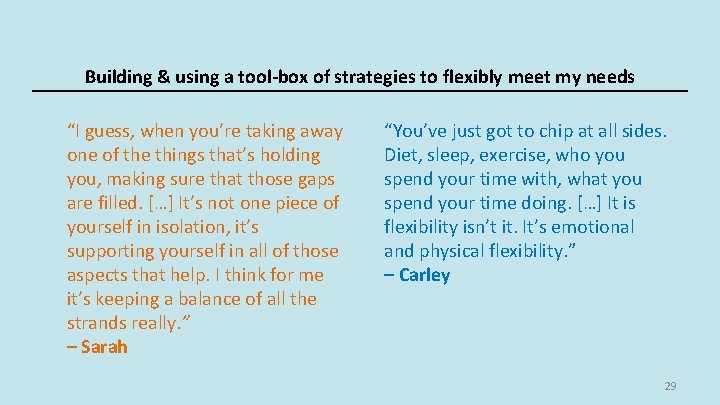
Building & using a tool-box of strategies to flexibly meet my needs “I guess, when you’re taking away one of the things that’s holding you, making sure that those gaps are filled. […] It’s not one piece of yourself in isolation, it’s supporting yourself in all of those aspects that help. I think for me it’s keeping a balance of all the strands really. ” – Sarah “You’ve just got to chip at all sides. Diet, sleep, exercise, who you spend your time with, what you spend your time doing. […] It is flexibility isn’t it. It’s emotional and physical flexibility. ” – Carley 29
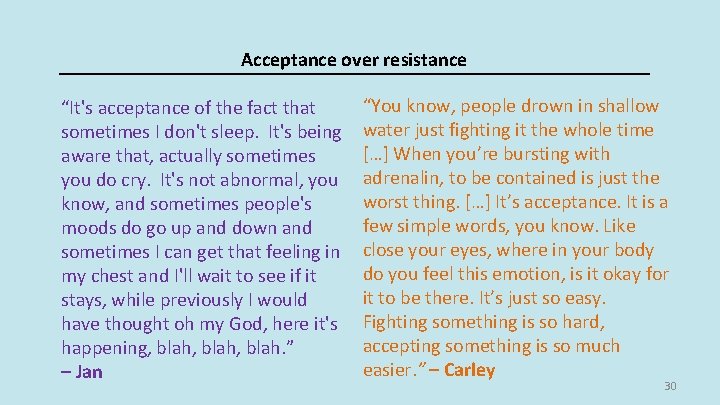
Acceptance over resistance “It's acceptance of the fact that sometimes I don't sleep. It's being aware that, actually sometimes you do cry. It's not abnormal, you know, and sometimes people's moods do go up and down and sometimes I can get that feeling in my chest and I'll wait to see if it stays, while previously I would have thought oh my God, here it's happening, blah, blah. ” – Jan “You know, people drown in shallow water just fighting it the whole time […] When you’re bursting with adrenalin, to be contained is just the worst thing. […] It’s acceptance. It is a few simple words, you know. Like close your eyes, where in your body do you feel this emotion, is it okay for it to be there. It’s just so easy. Fighting something is so hard, accepting something is so much easier. ” – Carley 30
Drawing on my persistence and personal qualities “In my mother’s line there is a kind of long line of rebels. I always have been like that right from when I was little. There’s just something that’s like, I am my own person and I’ll fit your school system and I’ll fit your whatever but something deep down will always forge my own way. ” – Joanne 31
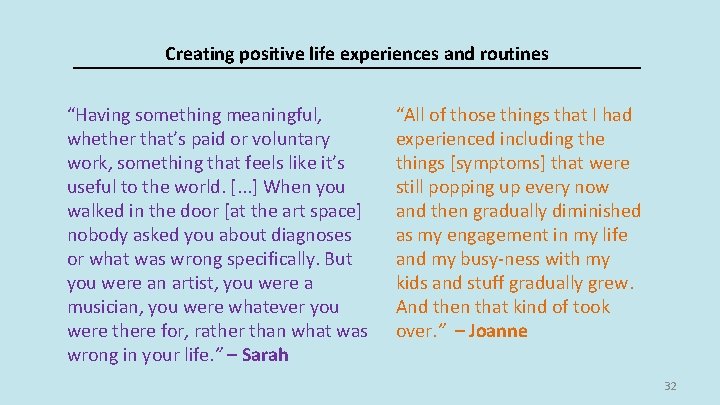
Creating positive life experiences and routines “Having something meaningful, whether that’s paid or voluntary work, something that feels like it’s useful to the world. [. . . ] When you walked in the door [at the art space] nobody asked you about diagnoses or what was wrong specifically. But you were an artist, you were a musician, you were whatever you were there for, rather than what was wrong in your life. ” – Sarah “All of those things that I had experienced including the things [symptoms] that were still popping up every now and then gradually diminished as my engagement in my life and my busy-ness with my kids and stuff gradually grew. And then that kind of took over. ” – Joanne 32
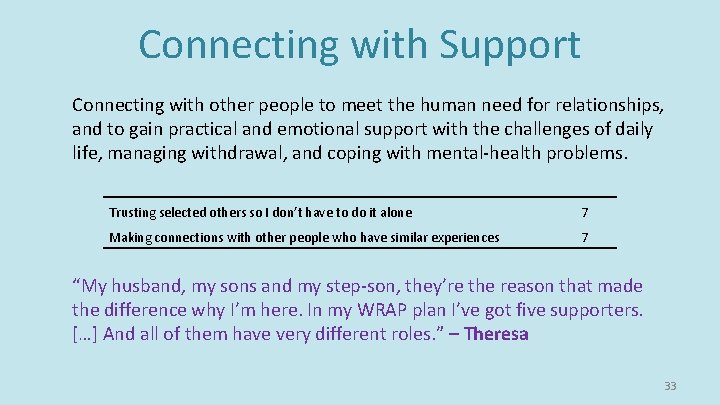
Connecting with Support Connecting with other people to meet the human need for relationships, and to gain practical and emotional support with the challenges of daily life, managing withdrawal, and coping with mental-health problems. Trusting selected others so I don’t have to do it alone 7 Making connections with other people who have similar experiences 7 “My husband, my sons and my step-son, they’re the reason that made the difference why I’m here. In my WRAP plan I’ve got five supporters. […] And all of them have very different roles. ” – Theresa 33
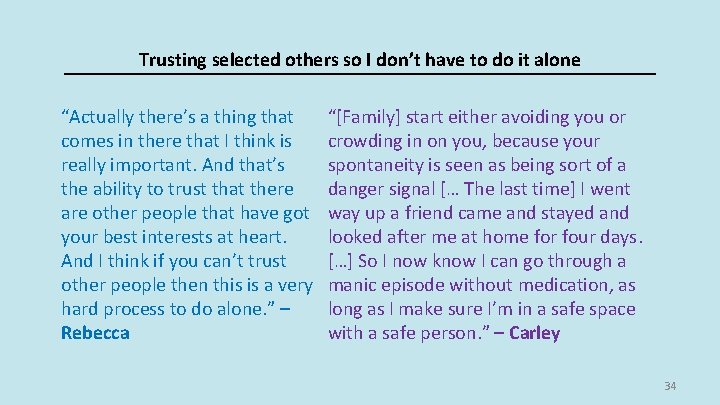
Trusting selected others so I don’t have to do it alone “Actually there’s a thing that comes in there that I think is really important. And that’s the ability to trust that there are other people that have got your best interests at heart. And I think if you can’t trust other people then this is a very hard process to do alone. ” – Rebecca “[Family] start either avoiding you or crowding in on you, because your spontaneity is seen as being sort of a danger signal [… The last time] I went way up a friend came and stayed and looked after me at home for four days. […] So I now know I can go through a manic episode without medication, as long as I make sure I’m in a safe space with a safe person. ” – Carley 34
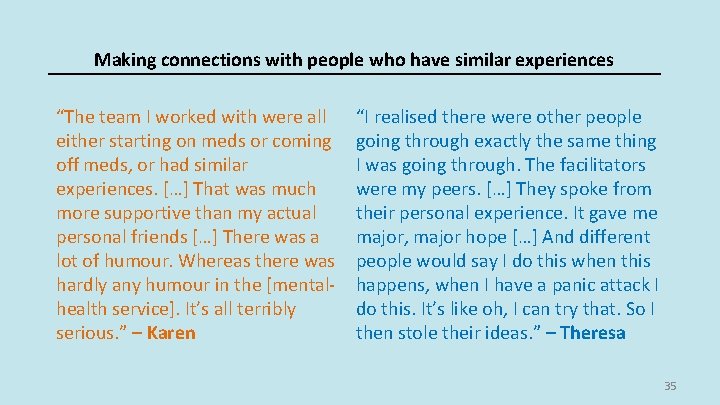
Making connections with people who have similar experiences “The team I worked with were all either starting on meds or coming off meds, or had similar experiences. […] That was much more supportive than my actual personal friends […] There was a lot of humour. Whereas there was hardly any humour in the [mentalhealth service]. It’s all terribly serious. ” – Karen “I realised there were other people going through exactly the same thing I was going through. The facilitators were my peers. […] They spoke from their personal experience. It gave me major, major hope […] And different people would say I do this when this happens, when I have a panic attack I do this. It’s like oh, I can try that. So I then stole their ideas. ” – Theresa 35
Maintaining Wellbeing During and After Withdrawal Symptoms, Triggers, Early Signs Medication Effects Withdrawal Methods Frames of Reference Needs, Values, Identity Supportive Connections What Works For Me Knowledge and Learning Efforts to Manage Coping Strategies Help-Seeking Strategies Addressing Physical Needs Adjusting Withdrawal Meaningful Activities Awareness and Self-Reflection Context Connecting with Support Situational Stressors Resource Availability Support Options Medication Factors 36
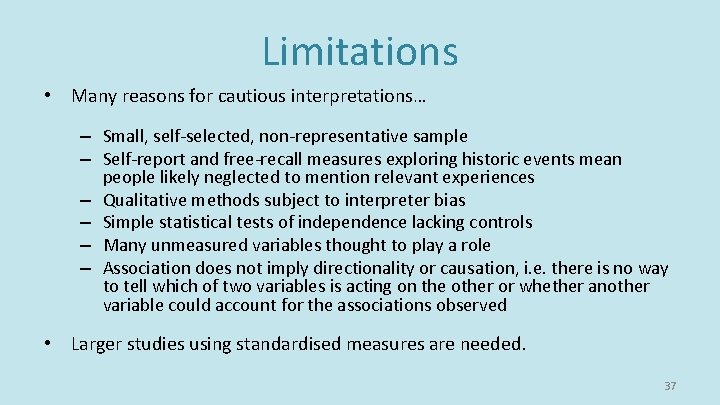
Limitations • Many reasons for cautious interpretations… – Small, self-selected, non-representative sample – Self-report and free-recall measures exploring historic events mean people likely neglected to mention relevant experiences – Qualitative methods subject to interpreter bias – Simple statistical tests of independence lacking controls – Many unmeasured variables thought to play a role – Association does not imply directionality or causation, i. e. there is no way to tell which of two variables is acting on the other or whether another variable could account for the associations observed • Larger studies using standardised measures are needed. 37
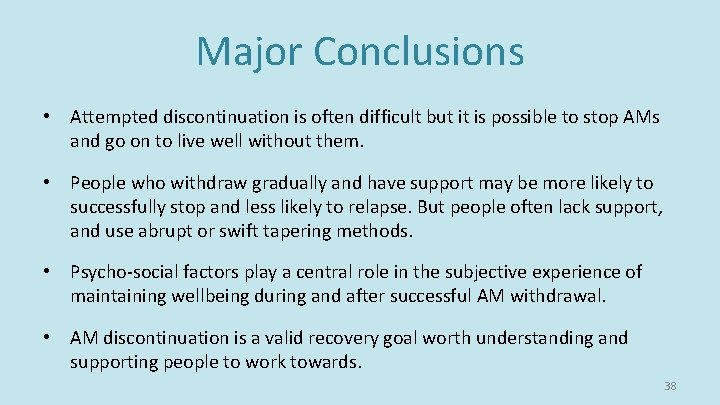
Major Conclusions • Attempted discontinuation is often difficult but it is possible to stop AMs and go on to live well without them. • People who withdraw gradually and have support may be more likely to successfully stop and less likely to relapse. But people often lack support, and use abrupt or swift tapering methods. • Psycho-social factors play a central role in the subjective experience of maintaining wellbeing during and after successful AM withdrawal. • AM discontinuation is a valid recovery goal worth understanding and supporting people to work towards. 38
Acknowledgements • Supervisor: Prof Fred Seymour, University of Auckland • Secondary Supervisor: Dr Kerry Gibson, University of Auckland • Expert Advisor: Prof John Read, University of East London 39
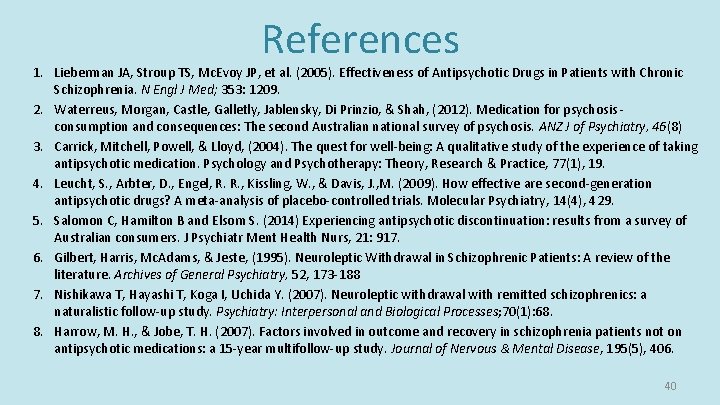
References 1. Lieberman JA, Stroup TS, Mc. Evoy JP, et al. (2005). Effectiveness of Antipsychotic Drugs in Patients with Chronic Schizophrenia. N Engl J Med; 353: 1209. 2. Waterreus, Morgan, Castle, Galletly, Jablensky, Di Prinzio, & Shah, (2012). Medication for psychosis consumption and consequences: The second Australian national survey of psychosis. ANZ J of Psychiatry, 46(8) 3. Carrick, Mitchell, Powell, & Lloyd, (2004). The quest for well-being: A qualitative study of the experience of taking antipsychotic medication. Psychology and Psychotherapy: Theory, Research & Practice, 77(1), 19. 4. Leucht, S. , Arbter, D. , Engel, R. R. , Kissling, W. , & Davis, J. , M. (2009). How effective are second-generation antipsychotic drugs? A meta-analysis of placebo-controlled trials. Molecular Psychiatry, 14(4), 429. 5. Salomon C, Hamilton B and Elsom S. (2014) Experiencing antipsychotic discontinuation: results from a survey of Australian consumers. J Psychiatr Ment Health Nurs, 21: 917. 6. Gilbert, Harris, Mc. Adams, & Jeste, (1995). Neuroleptic Withdrawal in Schizophrenic Patients: A review of the literature. Archives of General Psychiatry, 52, 173 -188 7. Nishikawa T, Hayashi T, Koga I, Uchida Y. (2007). Neuroleptic withdrawal with remitted schizophrenics: a naturalistic follow-up study. Psychiatry: Interpersonal and Biological Processes; 70(1): 68. 8. Harrow, M. H. , & Jobe, T. H. (2007). Factors involved in outcome and recovery in schizophrenia patients not on antipsychotic medications: a 15 -year multifollow-up study. Journal of Nervous & Mental Disease, 195(5), 406. 40
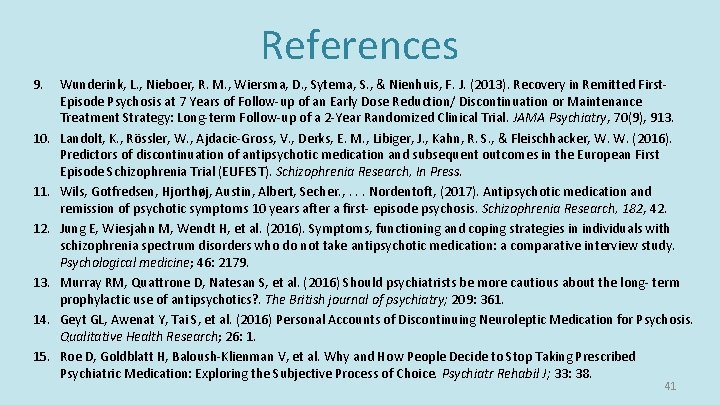
References 9. 10. 11. 12. 13. 14. 15. Wunderink, L. , Nieboer, R. M. , Wiersma, D. , Sytema, S. , & Nienhuis, F. J. (2013). Recovery in Remitted First. Episode Psychosis at 7 Years of Follow-up of an Early Dose Reduction/ Discontinuation or Maintenance Treatment Strategy: Long-term Follow-up of a 2 -Year Randomized Clinical Trial. JAMA Psychiatry, 70(9), 913. Landolt, K. , Rössler, W. , Ajdacic-Gross, V. , Derks, E. M. , Libiger, J. , Kahn, R. S. , & Fleischhacker, W. W. (2016). Predictors of discontinuation of antipsychotic medication and subsequent outcomes in the European First Episode Schizophrenia Trial (EUFEST). Schizophrenia Research, In Press. Wils, Gotfredsen, Hjorthøj, Austin, Albert, Secher. , . . . Nordentoft, (2017). Antipsychotic medication and remission of psychotic symptoms 10 years after a first- episode psychosis. Schizophrenia Research, 182, 42. Jung E, Wiesjahn M, Wendt H, et al. (2016). Symptoms, functioning and coping strategies in individuals with schizophrenia spectrum disorders who do not take antipsychotic medication: a comparative interview study. Psychological medicine; 46: 2179. Murray RM, Quattrone D, Natesan S, et al. (2016) Should psychiatrists be more cautious about the long- term prophylactic use of antipsychotics? . The British journal of psychiatry; 209: 361. Geyt GL, Awenat Y, Tai S, et al. (2016) Personal Accounts of Discontinuing Neuroleptic Medication for Psychosis. Qualitative Health Research; 26: 1. Roe D, Goldblatt H, Baloush-Klienman V, et al. Why and How People Decide to Stop Taking Prescribed Psychiatric Medication: Exploring the Subjective Process of Choice. Psychiatr Rehabil J; 33: 38. 41
Full Text Online* Experiencing Antipsychotic Medication: from first prescriptions to attempted discontinuation www. researchgate. net/publication/309485009_Experiencing_Antipsychotic_ Medication_From_First_Prescriptions_to_Attempted_Discontinuation * Qualitative discontinuation findings only. The statistical analyses presented here were carried out following the doctoral study and are awaiting publication. Email mbar 114@aucklanduni. ac. nz 42