
Experience vs Lecture Which is better By Michelle

Experience vs. Lecture, Which is better? ? By Michelle S. Hester A ED 615 Dr. Franklin December 12, 2006
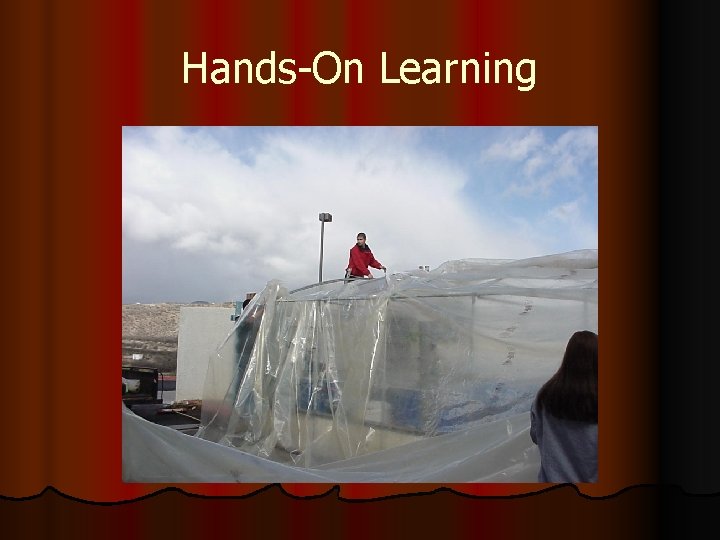
Hands-On Learning

Hands-on Learning

Hands-on Learning
Valuable Experience l My kids can learn about greenhouse management from the textbook, but in this case they “learned by doing, ” within the class.
All about me… Michelle Sofia Hester (maiden name Boomhower, isn’t it great? ) Married for almost 6 years. Agriculture Education Instructor at Rio Rico High School. Seeking my Masters of Science in Agricultural Education. Grew up in Rio Rico. Dad was in FFA, but there was no Ag. Ed. in Nogales, but I teach it now, so Ag. Ed. is now “full circle” in my family. l Saw need for effective Agricultural Education in Rio Rico l l l Students need career skills—many go to work in produce because of general industry in area, need work skills to actively contribute to the community. l Agricultural education was weak in Rio Rico—needed more active FFA, and participation in SAE work. l
Chapter 1 l Experiential Learning: better than traditional teaching. l Ag. Ed. provides experiential learning experiences better than any other program. l Research is needed to prove that Ag. Ed. is the better model. l This project will test the effectiveness of the Ag. Ed. model vs. traditional teaching.
Chapter 1 --Purpose l The purpose of this study is to prove that the agricultural education model of handson learning is the most effective way of teaching students in a way that will guarantee that they retain valuable and applicable science information.
Chapter 1 --Objectives l The objectives of this study are: 1. 2. 3. To determine if there is a significant difference between the two cohort classes after each trial. To determine if certain variables play a role in the differences between the separate assessment scores. To prove that the agricultural education model of teaching increases the retention of material when compared to traditional teaching methods.
Chapter 1—Limitations and Assumptions l Limitations Class size: Each class size is different, which might decrease validity. l Type of student: My classes are full of Special Education students with modifications: Resource and Life Skills students. l Remedy: Matching of students in courses. l l Assumptions Students who are absent will make every effort to make up work. l Students have a small amount of background experience from middle school. l
Chapter 1 --Definitions l Ag. Ed. = Agricultural Education l Independent Variable = Teaching method. l Two Independent Variables: Experiential Learning of Ag. Ed. Model, and Traditional Teaching Method. l Dependent Variable = Scores on posttests, and scores on final assessments 4 weeks later.
Chapter 2—What do we know? l The Ag. Ed. model of teaching uses a experiential, or problemsolving, approach to teaching. l Inquiry-based learning requires that students do more than memorize simple facts and reproduce them, and instead creates opportunities for students to identify and apply information (Parr, Edwards 2004). l Inquiry-based learning does not necessarily increase retention, but it creates more positive attitudes about science among students (Johnson, Wardlow, and Franklin 1997). l Students in high school agriscience programs not only achieve higher scores on achievement tests, but they also reach higher cognitive levels of thinking (Bloom, Englehardt, Furst, Hill, and Krathwohl, 1956; and Newcomb and Trefs, 1987).
Chapter 2—What do we know? (cont) l SAE participation is positively related to a student’s achievement in agriscience (Cheek, Arrington, Carter, and Randall 1993). SAE is true experiential learning. l Agricultural and Natural Resource students do as well on achievement tests as seniors who take regular science classes (Connors and Elliot, 2005). l We know that more research needs to be done to determine if experiential learning and the problemsolving approach to teaching agriscience is more effective at improving retention of science principles.
Chapter 2—Importance? l Hopefully, this research will help others see how important Agricultural Education is when it comes to student achievement, and that it is just as valuable, if not more, than regular science classes.
Chapter 2 --Contributions l Potential Contributions to Ag. Ed. : 1. 2. 3. 4. Will help support the idea that agricultural education is a vital component of the high school experience. Will hopefully show that students in agricultural education can be just as successful, if not more, than students in regular science classes. Will potentially be ammunition in the battle against any future attempts to remove agricultural education from high school curriculum. Will also demonstrate that agricultural education contributes to high school students’ learning of State science standards (Units are cell parts and organelle functions, which are also parts of agriscience standards.
Chapter 3—Procedures and Research Design l Research Method: Experimental l l l Specifically: Random Matching Pretest-Posttest Design. Two classes, both Applied Biological Systems I, will be tested. Students were randomly placed in classes. Combination of freshmen/sophomore students. Students in classes were matched based on classification (resource, life skills, regular. ) Two units (Cell Parts and Organelle Function). Both groups will be pretested. For one unit, Group 1 (7 th period) will be taught using Ag. Ed. model. Group 2 (8 th period) will be taught using traditional teaching methods (lecture, worksheet, etc. ) Both groups posttested. Process reversed for unit 2. After 4 weeks, students will be reassessed, to determine retention. Averages will be calculated, and ANOVA will be used to determine significance.
Chapter 3 --Population l l l 33 Students in 7 th period, 27 students in 8 th period. 11 Resource students in 7 th period. 6 Life skills students in 8 th period (students with mental and physical disabilities) Primarily hispanic population (community located 8 miles north of the Mexican border. ) Minority in school is white and other; however, few white students in class (mostly mexican-american, if any) and one black student. Not very diverse, but might have implications on achievement of students whose primary language is not English.
Chapter 3—Reliability and Validity l Reliability Questions for assessment will be directly made from lessons, or taken from other exams for same material. l Will ensure that tests will truly be testing unit material. l l Validity Results will be direct scores of student knowledge. l Validity will only be an issue in the case of differences in scores of students whose exams are modified due to special education IEP requirements. l
References l l l Boone, Jr. , H. N. (1990). Effect of Problem Solving Approach to Teaching on Student Achievement and Retention. Journal of Agricultural Education, 18 -26. Chiasson, T. C. & Burnett, M. F. (2001). The Influence of Enrollment in Agriscience Courses on the Science Achievement of High School Students. Journal of Agricultural Education, 42(1), 61 -71. Dyer, J. E. & Osborne, E. (1996). Effects of Teaching Approach on Achievement of Agricultural Education Students with Varying Learning Styles. Journal of Agricultural Education, 37(3), 43 -51. Dyer, J. E. & Osborne, E. W. (1996). Effects of Teaching Approach on Problem Solving Ability of Agricultural Education Students with Varying Learning Styles. Journal of Agricultural Education, 37(4), 38 -45. Flowers, J. , & Osborne, E. W. (1987). The Problem Solving and Subject Matter Approaches to Teaching Vocational Agriculture: Effects on Student Achievement and Retention. Journal of Agricultural Education, 20 -26, 52.
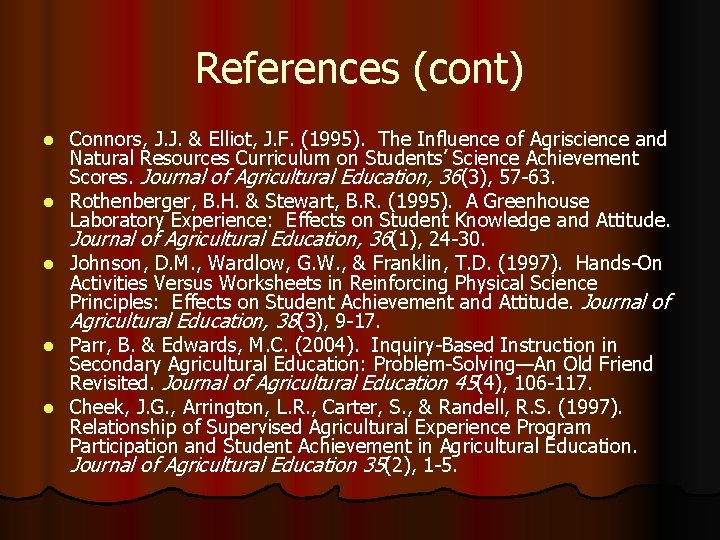
References (cont) l l l Connors, J. J. & Elliot, J. F. (1995). The Influence of Agriscience and Natural Resources Curriculum on Students’ Science Achievement Scores. Journal of Agricultural Education, 36(3), 57 -63. Rothenberger, B. H. & Stewart, B. R. (1995). A Greenhouse Laboratory Experience: Effects on Student Knowledge and Attitude. Journal of Agricultural Education, 36(1), 24 -30. Johnson, D. M. , Wardlow, G. W. , & Franklin, T. D. (1997). Hands-On Activities Versus Worksheets in Reinforcing Physical Science Principles: Effects on Student Achievement and Attitude. Journal of Agricultural Education, 38(3), 9 -17. Parr, B. & Edwards, M. C. (2004). Inquiry-Based Instruction in Secondary Agricultural Education: Problem-Solving—An Old Friend Revisited. Journal of Agricultural Education 45(4), 106 -117. Cheek, J. G. , Arrington, L. R. , Carter, S. , & Randell, R. S. (1997). Relationship of Supervised Agricultural Experience Program Participation and Student Achievement in Agricultural Education. Journal of Agricultural Education 35(2), 1 -5.

Any Questions? ?
- Slides: 21