
EXPERIENCE IN USING ELECTRONIC TEXTBOOKS Frank Schindler University
EXPERIENCE IN USING ELECTRONIC TEXTBOOKS Frank Schindler University of Maryland University College European Division Heidelberg, Germany

TEXTBOOKS WE USE at the UMUC • Traditional paper • Electronic (interactive menus, hypertext, multimedia, animation, applets)

PAPER TEXTBOOKS vs E-TEXTBOOKS Advantages of Paper Textbooks • easy to manipulate • easy to study from

PAPER TEXTBOOKS vs E-TEXTBOOKS Disadvantages of Paper Textbooks • Do not offer enough of detail • Hard to distribute • Expensive – cost of 1 st copy and cost of each other copy
PAPER TEXTBOOKS vs E-TEXTBOOKS Advantage of E-Textbooks • • • Offer as much detail as needed Global access over Internet Relatively cheap Allow hyperlinks, multimedia, animation Support self-testing with sample answers
PAPER TEXTBOOKS vs E-TEXTBOOKS Disadvantages of E-Texts • • • Can not be downloaded onto local PC Not available in printed format Sluggish access if multimedia involved Hard – expensive to develop Missing integration with rest of class
QUALITY OF E-TEXTBOOKS can be monitored via online, anonymouos students course evaluations. They can be used to • Test quality of E-Textbooks • Test quality of distance education
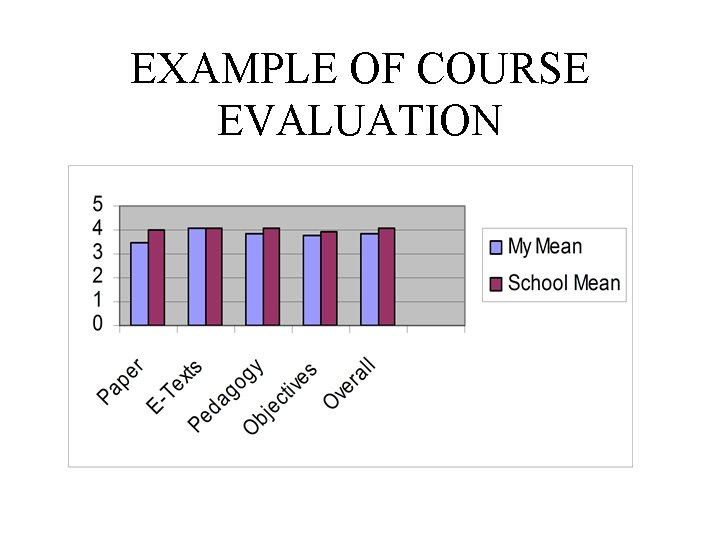
EXAMPLE OF COURSE EVALUATION
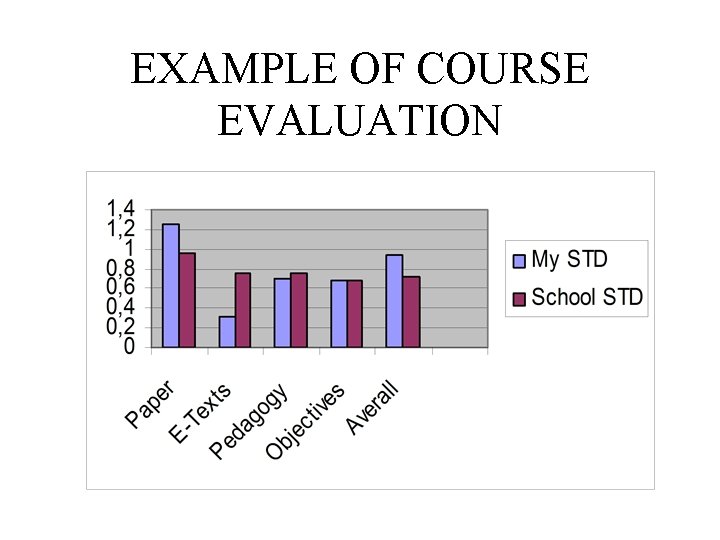
EXAMPLE OF COURSE EVALUATION
E-TEXTBOOKS at the UMUC Provide interactive menus and consists of 6 modules. Each of them contains • • • Module objectives Overview of covered concepts Commentary Self-assessment tests glossary
CONCLUSIONS • Paper textbooks should be supplemented by CDs with sample course materials • E-texts should be provided on CDs for sale to students • E-texts should have a some sort of paper version
FUTURE TRENDS In forseeable future both technologies - paper and e-textbooks will merge together
OPEN ISSUES for E-TEXTBOOKS • How to sell them on CDs – copyright law • How to print them • How to better integrate them with rest of the class – conferences, study groups, chat
LIVE EXAMPLES
- Slides: 14