
Expected Value Examples Sample question 1 You buy

Expected Value Examples
Sample question 1 You buy one $10 raffle ticket for a new car valued at $15, 000. Two thousand tickets are sold. What is the expected value of your gain?
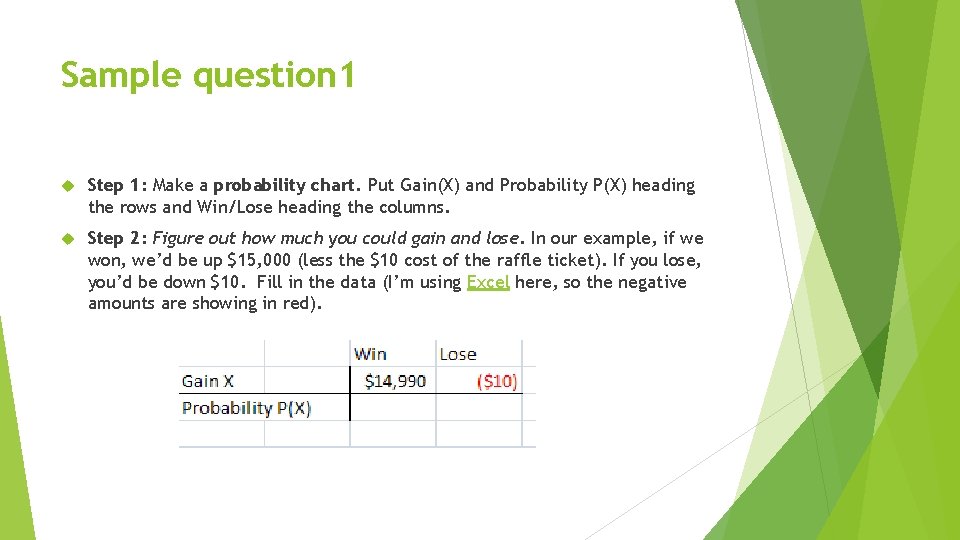
Sample question 1 Step 1: Make a probability chart. Put Gain(X) and Probability P(X) heading the rows and Win/Lose heading the columns. Step 2: Figure out how much you could gain and lose. In our example, if we won, we’d be up $15, 000 (less the $10 cost of the raffle ticket). If you lose, you’d be down $10. Fill in the data (I’m using Excel here, so the negative amounts are showing in red).
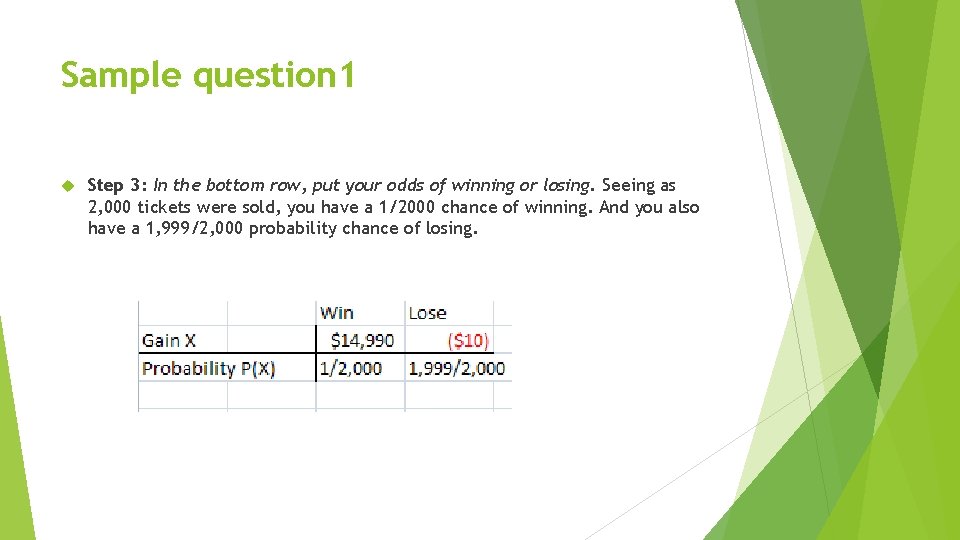
Sample question 1 Step 3: In the bottom row, put your odds of winning or losing. Seeing as 2, 000 tickets were sold, you have a 1/2000 chance of winning. And you also have a 1, 999/2, 000 probability chance of losing.
Sample question 1 Step 4: Multiply the gains (X) in the top row by the Probabilities (P) in the bottom row. $14, 990 * 1/2000 = $7. 495, (-$10)*(1, 999/2, 000)= -$9. 995 Step 5: Add the two values together: $7. 495 + -$9. 995 = -$2. 5.
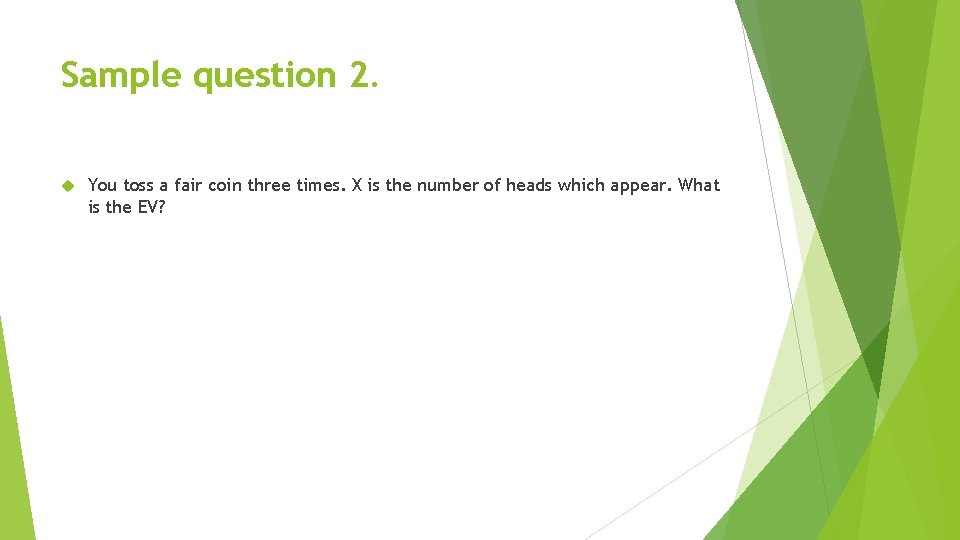
Sample question 2. You toss a fair coin three times. X is the number of heads which appear. What is the EV?
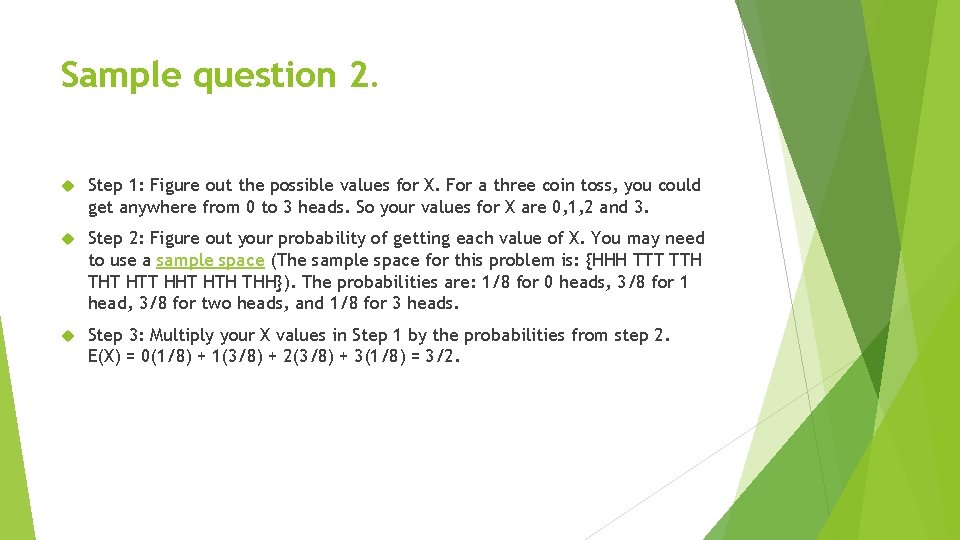
Sample question 2. Step 1: Figure out the possible values for X. For a three coin toss, you could get anywhere from 0 to 3 heads. So your values for X are 0, 1, 2 and 3. Step 2: Figure out your probability of getting each value of X. You may need to use a sample space (The sample space for this problem is: {HHH TTT TTH THT HTT HHT HTH THH}). The probabilities are: 1/8 for 0 heads, 3/8 for 1 head, 3/8 for two heads, and 1/8 for 3 heads. Step 3: Multiply your X values in Step 1 by the probabilities from step 2. E(X) = 0(1/8) + 1(3/8) + 2(3/8) + 3(1/8) = 3/2.
- Slides: 7