
Expectation to Nuclear Emulsion Technique for New Application

- Slides: 22
Expectation to Nuclear Emulsion Technique for New Application in Nuclear Engineering T. Iguchi, K. Morishima, T. Naka, J. Kawarabayashi, K. Watanabe Nagoya Univ.
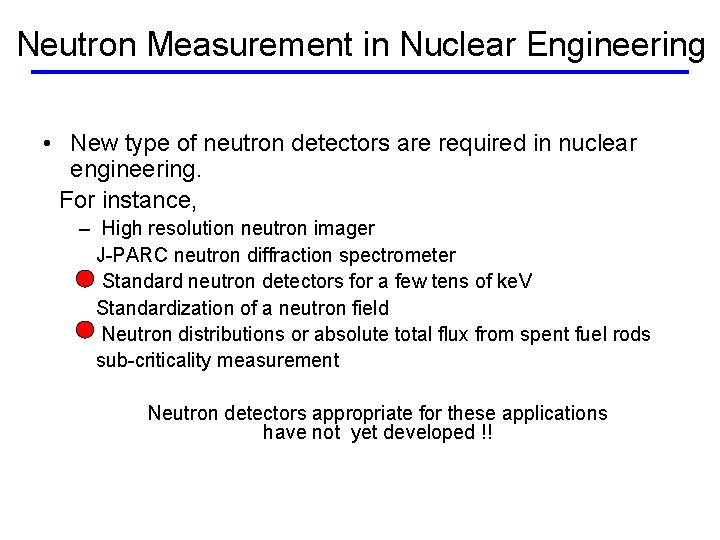
Neutron Measurement in Nuclear Engineering • New type of neutron detectors are required in nuclear engineering. For instance, – High resolution neutron imager J-PARC neutron diffraction spectrometer – Standard neutron detectors for a few tens of ke. V Standardization of a neutron field – Neutron distributions or absolute total flux from spent fuel rods sub-criticality measurement Neutron detectors appropriate for these applications have not yet developed !!
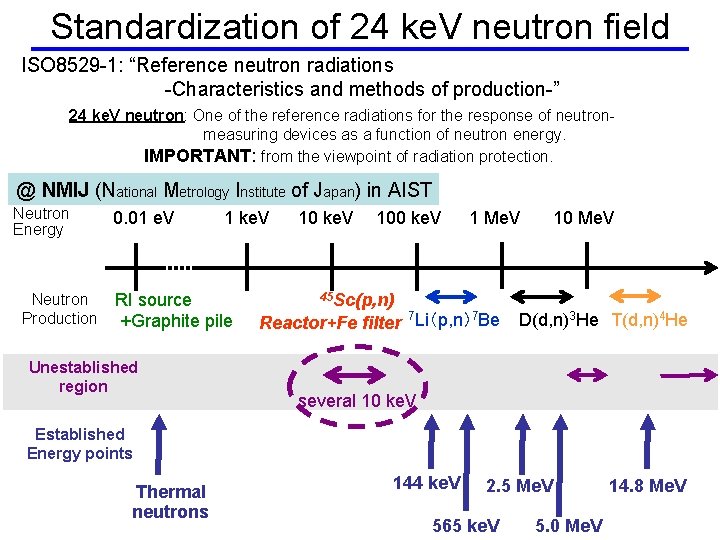
Standardization of 24 ke. V neutron field ISO 8529 -1: “Reference neutron radiations -Characteristics and methods of production-” 24 ke. V neutron: One of the reference radiations for the response of neutronmeasuring devices as a function of neutron energy. IMPORTANT: from the viewpoint of radiation protection. @ NMIJ (National Metrology Institute of Japan) in AIST Neutron Energy Neutron Production 0. 01 e. V 1 ke. V RI source +Graphite pile Unestablished region 10 ke. V 100 ke. V 1 Me. V 45 Sc(p, n) Reactor+Fe filter 7 Li(p, n)7 Be 10 Me. V D(d, n)3 He T(d, n)4 He several 10 ke. V Established Energy points Thermal neutrons 144 ke. V 2. 5 Me. V 565 ke. V 5. 0 Me. V 14. 8 Me. V
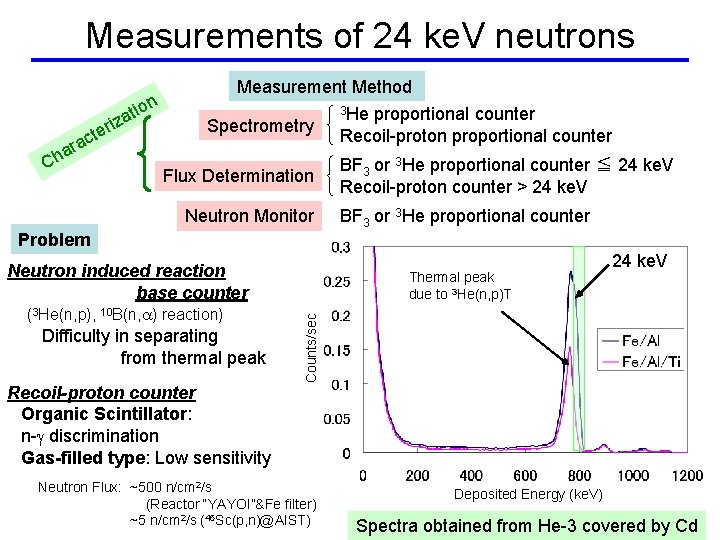
Measurements of 24 ke. V neutrons t n tio a z eri c ara Ch Measurement Method Spectrometry Flux Determination Neutron Monitor Problem Neutron induced reaction base counter Difficulty in separating from thermal peak Recoil-proton counter Organic Scintillator: n-g discrimination Gas-filled type: Low sensitivity proportional counter Recoil-proton proportional counter BF 3 or 3 He proportional counter ≦ 24 ke. V Recoil-proton counter > 24 ke. V BF 3 or 3 He proportional counter Thermal peak due to 3 He(n, p)T 24 ke. V Counts/sec (3 He(n, p), 10 B(n, a) reaction) 3 He Neutron Flux: ~500 n/cm 2/s (Reactor “YAYOI”&Fe filter) ~5 n/cm 2/s (45 Sc(p, n)@AIST) Deposited Energy (ke. V) Spectra obtained from He-3 covered by Cd
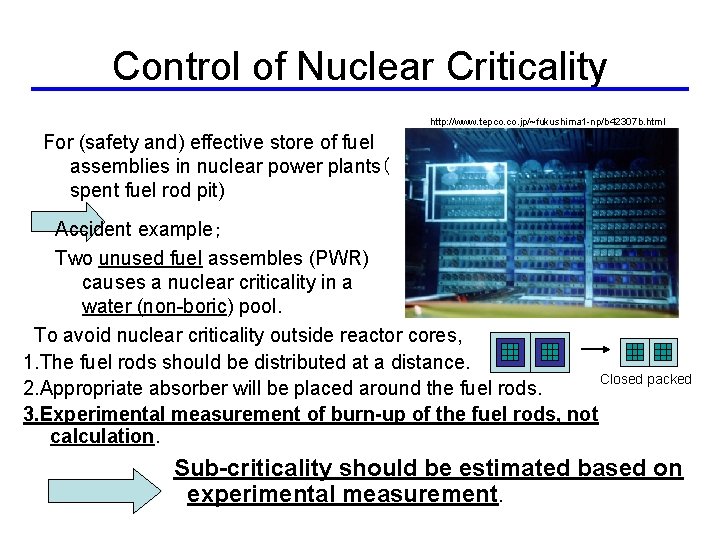
Control of Nuclear Criticality http: //www. tepco. jp/~fukushima 1 -np/b 42307 b. html For (safety and) effective store of fuel assemblies in nuclear power plants( spent fuel rod pit) Accident example; Two unused fuel assembles (PWR) causes a nuclear criticality in a water (non-boric) pool. To avoid nuclear criticality outside reactor cores, 1. The fuel rods should be distributed at a distance. Closed packed 2. Appropriate absorber will be placed around the fuel rods. 3. Experimental measurement of burn-up of the fuel rods, not calculation. Sub-criticality should be estimated based on experimental measurement.
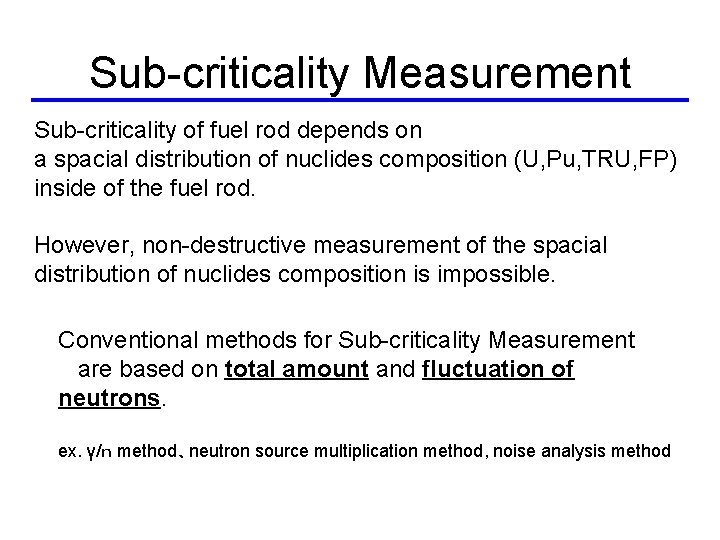
Sub-criticality Measurement Sub-criticality of fuel rod depends on a spacial distribution of nuclides composition (U, Pu, TRU, FP) inside of the fuel rod. However, non-destructive measurement of the spacial distribution of nuclides composition is impossible. Conventional methods for Sub-criticality Measurement are based on total amount and fluctuation of neutrons. ex. γ/n method、neutron source multiplication method, noise analysis method
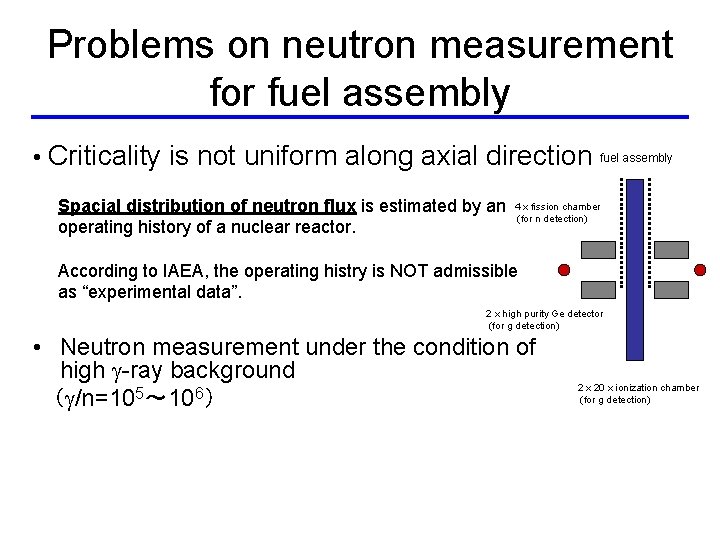
Problems on neutron measurement for fuel assembly • Criticality is not uniform along axial direction According to IAEA, the operating histry is NOT admissible as “experimental data”. ●●●●●●●●●●●● 4 x fission chamber (for n detection) ●●●●●●●●●●●● Spacial distribution of neutron flux is estimated by an operating history of a nuclear reactor. fuel assembly 2 x high purity Ge detector (for g detection) • Neutron measurement under the condition of high g-ray background (g/n=105~ 106) 2 x 20 x ionization chamber (for g detection)
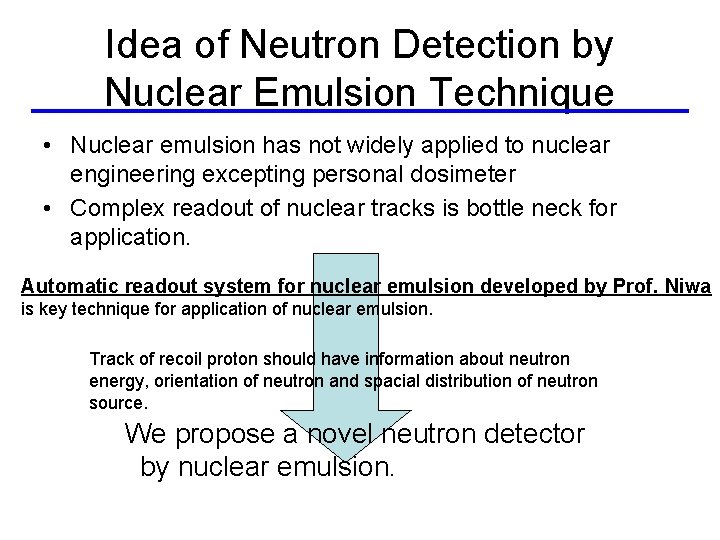
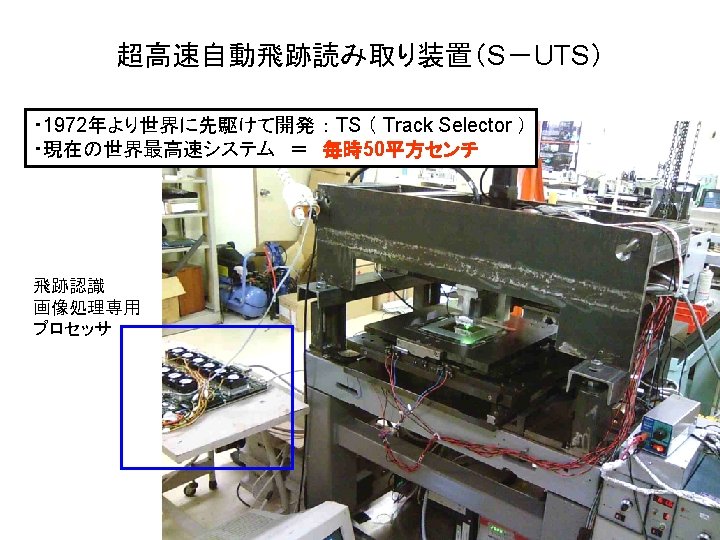
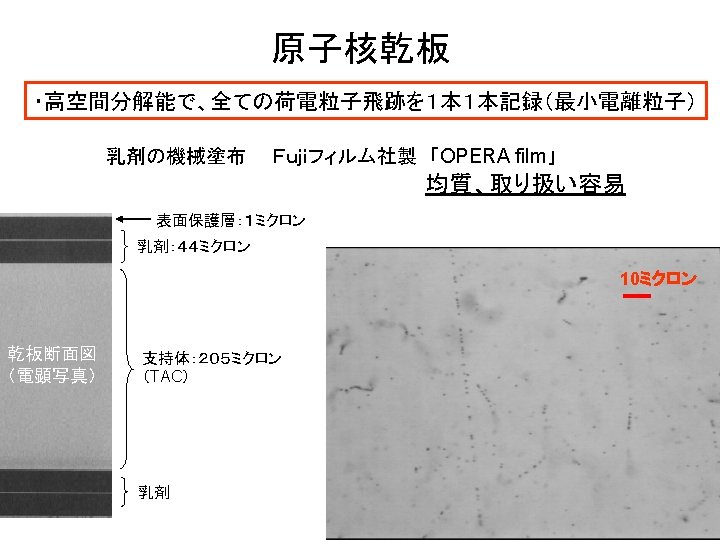
Idea of Neutron Detection by Nuclear Emulsion Technique • Nuclear emulsion has not widely applied to nuclear engineering excepting personal dosimeter • Complex readout of nuclear tracks is bottle neck for application. Automatic readout system for nuclear emulsion developed by Prof. Niwa is key technique for application of nuclear emulsion. Track of recoil proton should have information about neutron energy, orientation of neutron and spacial distribution of neutron source. We propose a novel neutron detector by nuclear emulsion.
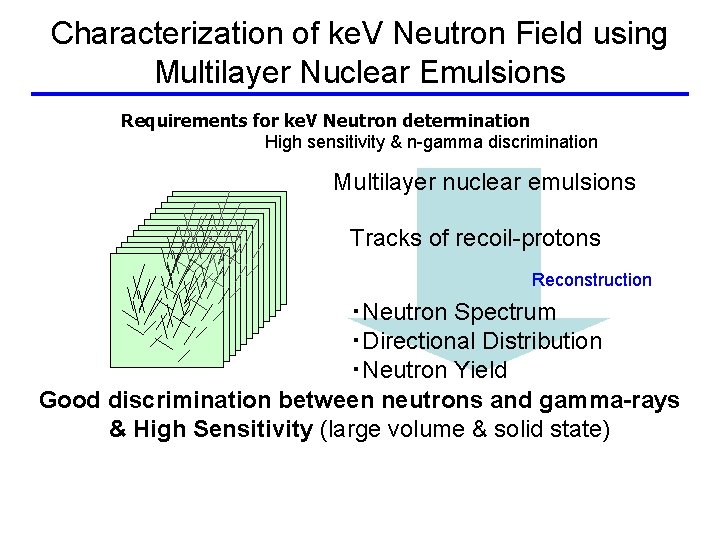
Characterization of ke. V Neutron Field using Multilayer Nuclear Emulsions Requirements for ke. V Neutron determination High sensitivity & n-gamma discrimination Multilayer nuclear emulsions Tracks of recoil-protons Reconstruction ・Neutron Spectrum ・Directional Distribution ・Neutron Yield Good discrimination between neutrons and gamma-rays & High Sensitivity (large volume & solid state)
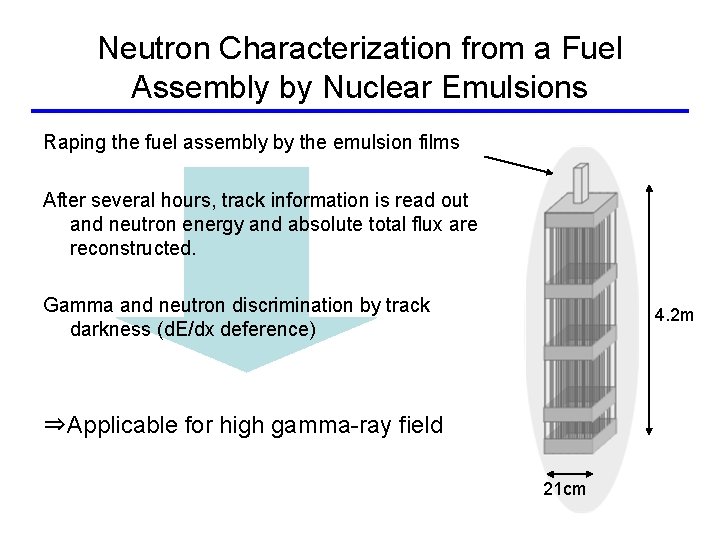
Neutron Characterization from a Fuel Assembly by Nuclear Emulsions Raping the fuel assembly by the emulsion films After several hours, track information is read out and neutron energy and absolute total flux are reconstructed. Gamma and neutron discrimination by track darkness (d. E/dx deference) 4. 2 m ⇒Applicable for high gamma-ray field 21 cm
Requirements for Nuclear Emulsions To apply the nuclear emulsion for these applications, we need to evaluate • sensitivity for ~10 ke. V neutron (range of 10 ke. V proton is order of 10 -7 m) • neutron/gamma discrimination characteristics (n/g ratio is more than 106).
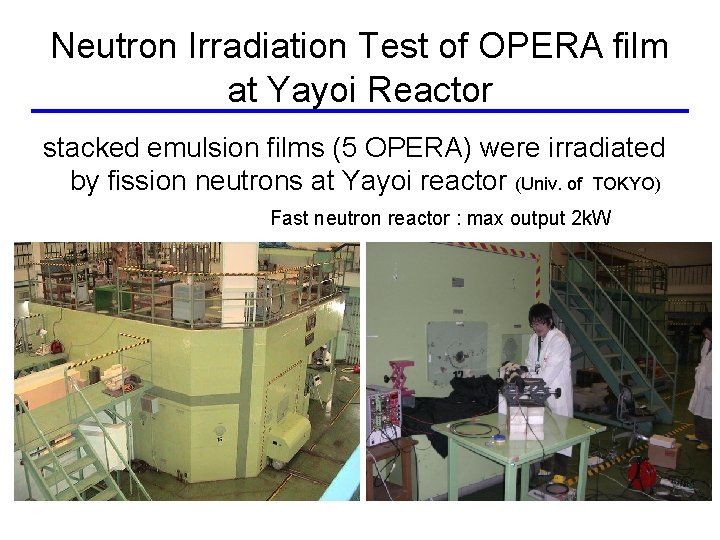
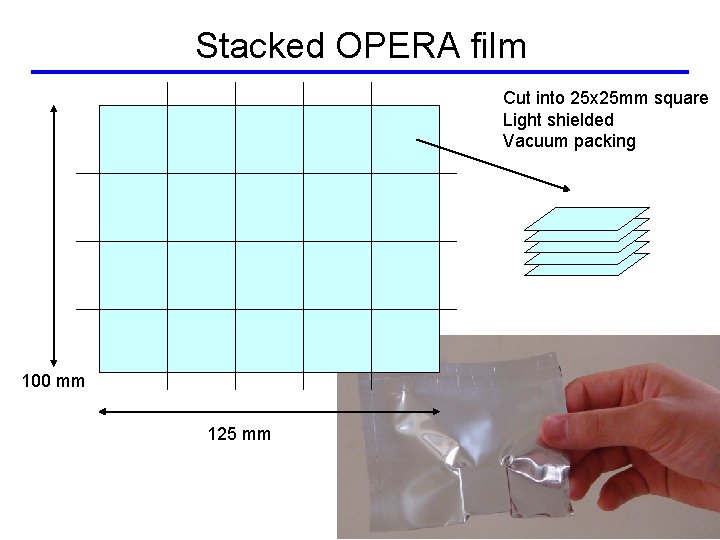
Neutron Irradiation Test of OPERA film at Yayoi Reactor stacked emulsion films (5 OPERA) were irradiated by fission neutrons at Yayoi reactor (Univ. of TOKYO) Fast neutron reactor : max output 2 k. W
Stacked OPERA film Cut into 25 x 25 mm square Light shielded Vacuum packing 100 mm 125 mm
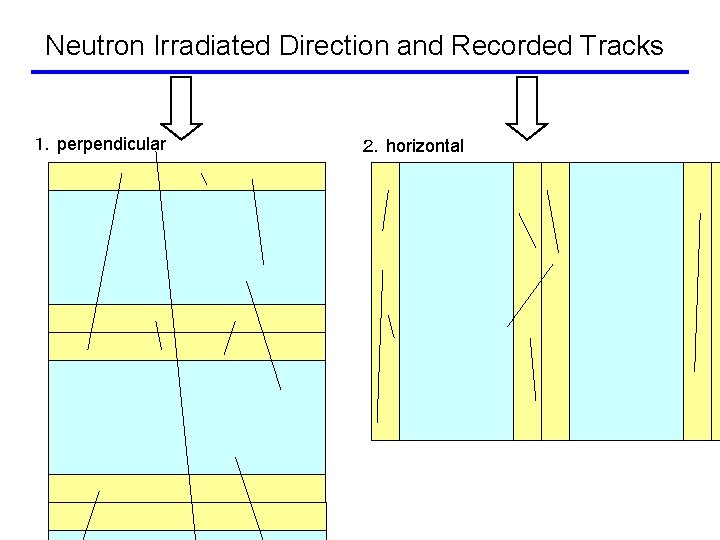
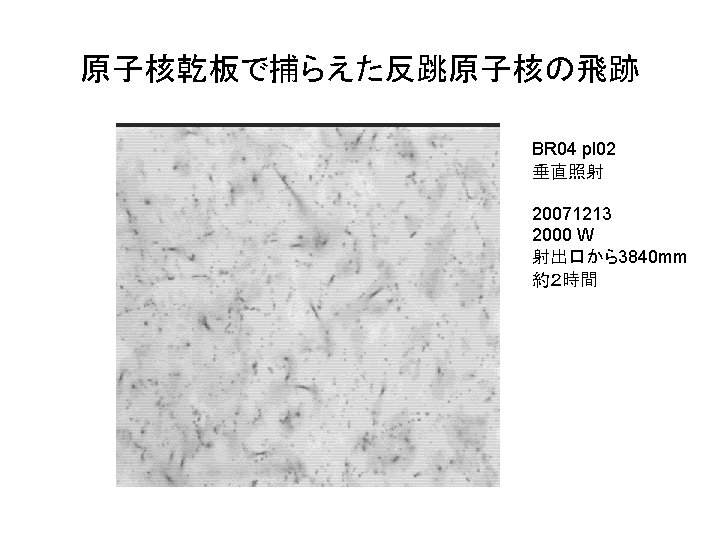
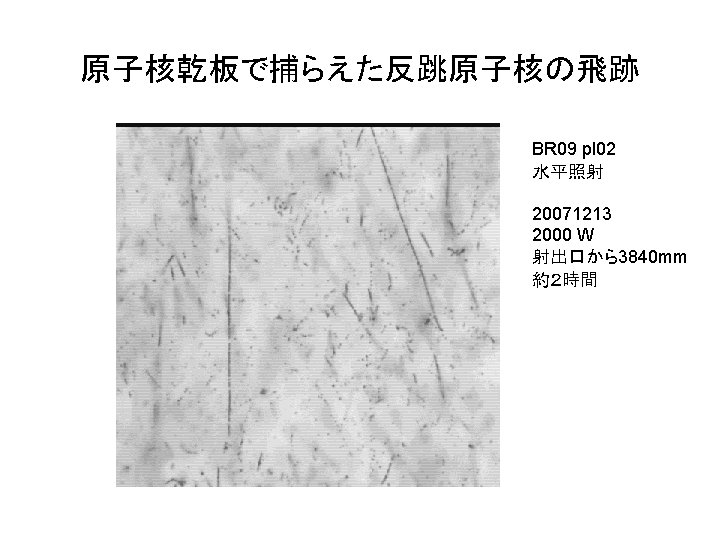
Neutron Irradiated Direction and Recorded Tracks 1.perpendicular 2.horizontal
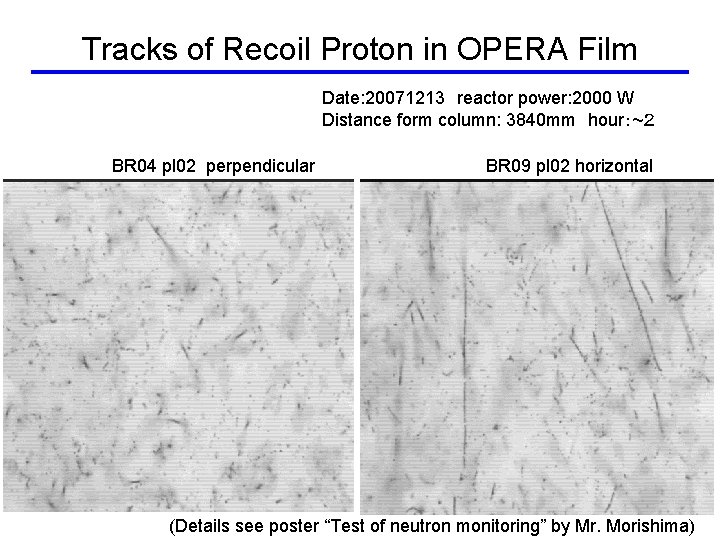
Tracks of Recoil Proton in OPERA Film Date: 20071213 reactor power: 2000 W Distance form column: 3840 mm hour:~2 BR 04 pl 02 perpendicular BR 09 pl 02 horizontal (Details see poster “Test of neutron monitoring” by Mr. Morishima)
Summary • We expect that the nuclear emulsion may show good characteristics as a neutron detector and be applicable for – ~10 ke. V neutron detector – sub-criticality monitor of fuel assembly. by turning the software of automatic readout system and use of NIT to select the neutron tracks. • Study of emulsion as a neutron detector is now launched…
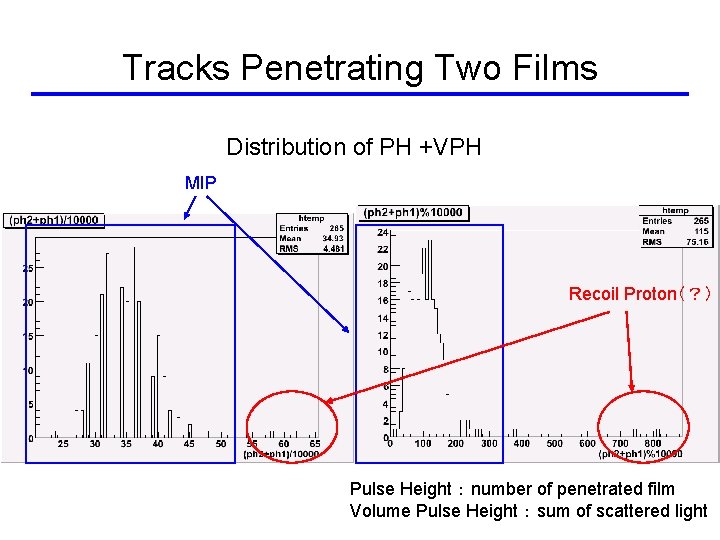
Tracks Penetrating Two Films Distribution of PH +VPH MIP Recoil Proton(?) Pulse Height : number of penetrated film Volume Pulse Height : sum of scattered light