
Expansive Learning Theory as a Tool for Pedagogical
- Slides: 18
Expansive Learning Theory as a Tool for Pedagogical Leadership: Understanding Early Childhood Centres as Dynamic Systems Kate Ord, Lesley Robinson, Sue Smorti, & Janis Carroll-Lind ISCAR Conference: 30 September-3 October 2014
Te Whakapakari Kaiārahi Āhuatanga Ako Kōhunga: Developing Pedagogical Leadership in ECE • This presentation reports on the third of a series of Flagship research studies undertaken by Te Tari Puna Ora o Aotearoa/NZCA • Focus is on effective pedagogical leadership in ECE services • Pedagogical leaders in this study were those with designated responsibility for the learning programme in their centre.
Research and Development Project Two interlinked components to this study: 1. The trialling of a mentoring and coaching methodology aimed at supporting pedagogical leaders to understand their ECE centre as a system and not as a group of individuals and to lead professional learning in their centres 2. The research element whereby insights from the mentoring and coaching programme were investigated and disseminated.
Aims of the Project 1. To trial a professional development methodology informed by ‘third generation’ cultural historical activity theory (Engestrӧm 1987, 2001) that has the potential to support and extend pedagogical leadership in ECE services 2. To explore possible alignment between pedagogical leadership in kaupapa Māori settings, kaupapa Māori research and expansive learning theory.
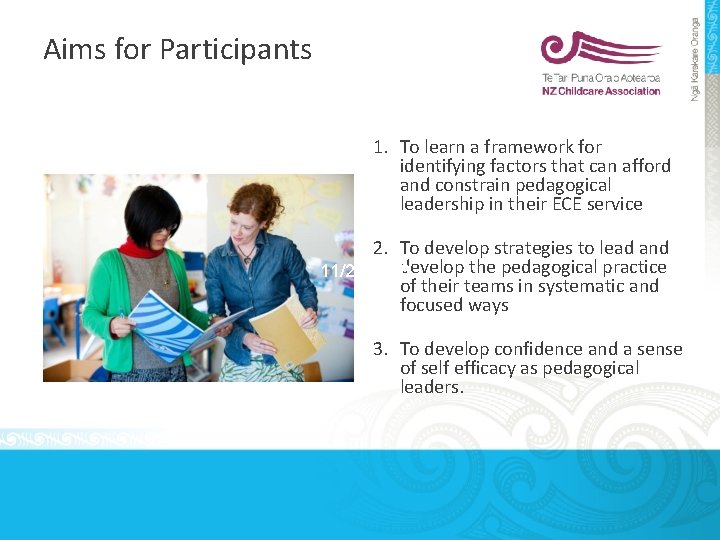
Aims for Participants 1. To learn a framework for identifying factors that can afford and constrain pedagogical leadership in their ECE service 2. To develop strategies to lead and develop the pedagogical practice 11/22/2020 of their teams in systematic and focused ways 3. To develop confidence and a sense of self efficacy as pedagogical leaders.
Research Questions 1. How can pedagogical leadership in ECE settings in Aotearoa/NZ be transformed through knowledge and understanding of expansive learning theory? 2. How can kaupapa Māori pedagogy and leadership be informed and enhanced by expansive learning theory?
Coaching and Mentoring Methodology 1. Monthly cluster workshops, interspersed with individual centre-based consultations (over seven months) 2. Each cluster consisted of a facilitator/researcher, 2 other researchers and the 2 pedagogical leaders from 6 participating centres (4 in kaupapa Māori cluster) 3. Facilitator followed up each workshop with a coaching and mentoring session in participants’ centres 4. Data generated through audio taped workshops and coaching and mentoring sessions.
Purpose of the Coaching and Mentoring Model 1. Participants learnt third generation activity theory/expansive learning methodology in the workshop sessions and were supported to apply the methodology in their own settings 2. Follow-up coaching and mentoring meetings further supported leaders to foster ongoing professional learning (PL) in curriculum and pedagogy at the centre level, through guided use of third generation activity theory 3. Needs analysis prior to the PL programme ascertained participants’ leadership understanding and factors likely to afford and constrain their pedagogical leadership.
• Early in the project we noted examples of participants making sense of and appropriating the model:
Systems approach “Activity theory embraces the idea of organizational learning to expand the unit of analysis of learning beyond the skin of the individual, to examine collectives and organizations as learners” (Engeström & Kerosuo, 2007, p. 336) “Involves thinking in terms of processes rather than structures, relationships rather than components, interconnections rather than separation” (Laszlo, 2012, p. 100).
Complexity, connection and collaboration within the system “I think it was a real eye-opener, more a deep understanding really of leadership, um, … What I really enjoyed was that framework…the CHAT and how it all lined in together and to me, just to see a picture and how it actually linked made sense to me, yeah. ” “It goes in many directions. It goes from the staff to the parents, to the families, to the children, and comes back, and bounces back, and I guess in a triangle form you know, and not always going in one direction all the time…I guess just feeding each other with that collaboration, that teamwork. ”
“There are going to be rules…what makes it really tricky is that they [Tongan , Samoan and Fijian] are three different islands…the rules is to probably…try and be respectful towards those three different islands… ‘Cause in those three different islands there are their own ways of doing things…in order to meet as a team, so it may be ‘OK’ in a Samoan way but it won’t be ‘OK’ to do it in those, so I guess it’s finding a more stable collaboration in order to feed in all of those three. ”
Playing the system rather than the person “…and so then what we did is I was remembered when we were talking about it at our staff meeting about not focussing on the person that happened to be in there at the time. Because she felt really bad anyway and I was saying to the girls actually it’s not anything to do with this person. I want to talk about what actually happened. ” “And then I guess the contradiction came out from our practice and our philosophy and what we believe in and how that transfers in to safety in the bathroom, and so through that process I’m now having to look at like the Ministry of Health regulations and stuff about well this is what we want to do but this is what we’re allowed to do. And can, how can we make the two work together? ”
Using the synergies of the collective “I’ve just had a massive realisation sitting here, the way that we do things, we fly by the seat of our pants. “This [the model] gives us an opportunity to do things systematically so we can predict and we can analyse, and you know do all those things to establish systems, as a ropu [group]”. “We do know what we’re doing but we lack systematic organisation of that, and consistency so what’s happening sometimes we might hit the mark, but I feel that this model offers us a more deliberate systematic approach, to landing where we want to land”.
Seeing the Early Childhood Centre as a System • Tools as mediating artefacts • Appropriation of the model • Using the language • Focus on the object • Emphasis on the collective • Seeing contradiction as a potential for change (expanding the system)
References Engestrӧm, Y. (1987). Learning by expanding: An activity-theoretical approach to developmental research. Helsinki, Finlnad: Orienta-Konsultit. Engestrӧm, Y. (2001). Expansive learning at work: Toward an activity theoretical reconceptualization. Journal of Education and Work, 14(1), 133 -156. Engestrӧm, Y. & Kerosuo H. (2007). From workplace learning to inter-organizational learning and back: The contribution of activity theory. Journal of Workplace Learning, 19(6), 336 -342. Laszlo, K. C. (2012). From systems thinking to systems being: The embodiment of evolutionary leadership. Journal of Organizational Transformation & Social Change, 9(2). Nuttall, J. (2013, April). Affordances and constraints facing ‘Educational Leaders’ in Australian Early Childhood Education Centres. Presentation at the Annual Meeting of the American Educational Research Association, San Francisco, California.
Where to find the report Ord, K. , Mane, J. , Smorti, S. , Carroll-Lind, J. , Robinson, L. , Armstrong-Read, A. , Brown-Cooper, P. , Meredith, E. , Rickard, D. , & Jalal, J. (2013). Te whakapakari kaiārahi āhuatanga ako kōhunga: Developing pedagogical leadership in early childhood education. Wellington, New Zealand: Te Tari Puna Ora o Aotearoa/New Zealand Childcare Association. Available from: https: //nzca. ac. nz/about- us/publications/tewhakapakarikaiarahi- ahuatanga-ako-kohungadeveloping- pedagogical- leadership-in-early-childhoodeducation/
To contact us • • janis. carroll-lind@nzca. ac. nz kate. ord@nzca. ac. nz lesley. robinson@nzca. ac. nz sue. smorti@nzca. ac. nz • www. nzca. ac. nz