
EXPANDING YOUR TEACHING STRATEGY CONSIDERING THE AFFECTIVE DOMAIN
- Slides: 1
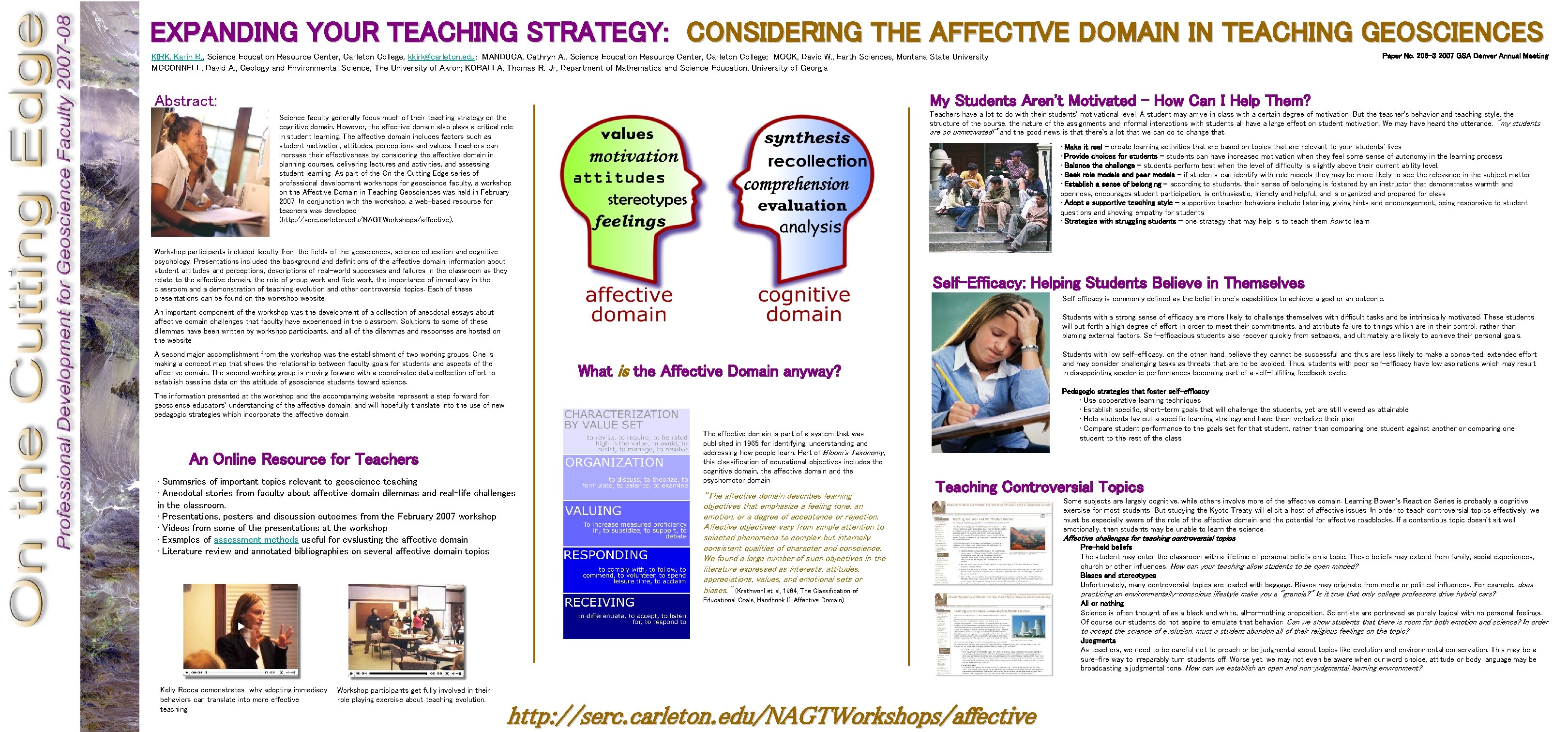
EXPANDING YOUR TEACHING STRATEGY: CONSIDERING THE AFFECTIVE DOMAIN IN TEACHING GEOSCIENCES Paper No. 206 -3 2007 GSA Denver Annual Meeting KIRK, Karin B. , Science Education Resource Center, Carleton College, kkirk@carleton. edu; MANDUCA, Cathryn A. , Science Education Resource Center, Carleton College; MOGK, David W. , Earth Sciences, Montana State University MCCONNELL, David A. , Geology and Environmental Science, The University of Akron; KOBALLA, Thomas R. Jr, Department of Mathematics and Science Education, University of Georgia Abstract: My Students Aren't Motivated – How Can I Help Them? Teachers have a lot to do with their students' motivational level. A student may arrive in class with a certain degree of motivation. But the teacher's behavior and teaching style, the structure of the course, the nature of the assignments and informal interactions with students all have a large effect on student motivation. We may have heard the utterance, "my students are so unmotivated!" and the good news is that there's a lot that we can do to change that. Science faculty generally focus much of their teaching strategy on the cognitive domain. However, the affective domain also plays a critical role in student learning. The affective domain includes factors such as student motivation, attitudes, perceptions and values. Teachers can increase their effectiveness by considering the affective domain in planning courses, delivering lectures and activities, and assessing student learning. As part of the On the Cutting Edge series of professional development workshops for geoscience faculty, a workshop on the Affective Domain in Teaching Geosciences was held in February 2007. In conjunction with the workshop, a web-based resource for teachers was developed (http: //serc. carleton. edu/NAGTWorkshops/affective). • Make it real - create learning activities that are based on topics that are relevant to your students' lives • Provide choices for students - students can have increased motivation when they feel some sense of autonomy in the learning process • Balance the challenge - students perform best when the level of difficulty is slightly above their current ability level. • Seek role models and peer models - if students can identify with role models they may be more likely to see the relevance in the subject matter • Establish a sense of belonging – according to students, their sense of belonging is fostered by an instructor that demonstrates warmth and openness, encourages student participation, is enthusiastic, friendly and helpful, and is organized and prepared for class • Adopt a supportive teaching style - supportive teacher behaviors include listening, giving hints and encouragement, being responsive to student questions and showing empathy for students • Strategize with struggling students - one strategy that may help is to teach them how to learn. Workshop participants included faculty from the fields of the geosciences, science education and cognitive psychology. Presentations included the background and definitions of the affective domain, information about student attitudes and perceptions, descriptions of real-world successes and failures in the classroom as they relate to the affective domain, the role of group work and field work, the importance of immediacy in the classroom and a demonstration of teaching evolution and other controversial topics. Each of these presentations can be found on the workshop website. Self-Efficacy: Helping Students Believe in Themselves Self efficacy is commonly defined as the belief in one's capabilities to achieve a goal or an outcome. An important component of the workshop was the development of a collection of anecdotal essays about affective domain challenges that faculty have experienced in the classroom. Solutions to some of these dilemmas have been written by workshop participants, and all of the dilemmas and responses are hosted on the website. Students with a strong sense of efficacy are more likely to challenge themselves with difficult tasks and be intrinsically motivated. These students will put forth a high degree of effort in order to meet their commitments, and attribute failure to things which are in their control, rather than blaming external factors. Self-efficacious students also recover quickly from setbacks, and ultimately are likely to achieve their personal goals. A second major accomplishment from the workshop was the establishment of two working groups. One is making a concept map that shows the relationship between faculty goals for students and aspects of the affective domain. The second working group is moving forward with a coordinated data collection effort to establish baseline data on the attitude of geoscience students toward science. Students with low self-efficacy, on the other hand, believe they cannot be successful and thus are less likely to make a concerted, extended effort and may consider challenging tasks as threats that are to be avoided. Thus, students with poor self-efficacy have low aspirations which may result in disappointing academic performances becoming part of a self-fulfilling feedback cycle. What is the Affective Domain anyway? Pedagogic strategies that foster self-efficacy • Use cooperative learning techniques • Establish specific, short-term goals that will challenge the students, yet are still viewed as attainable • Help students lay out a specific learning strategy and have them verbalize their plan • Compare student performance to the goals set for that student, rather than comparing one student against another or comparing one student to the rest of the class The information presented at the workshop and the accompanying website represent a step forward for geoscience educators' understanding of the affective domain, and will hopefully translate into the use of new pedagogic strategies which incorporate the affective domain. An Online Resource for Teachers • Summaries of important topics relevant to geoscience teaching • Anecdotal stories from faculty about affective domain dilemmas and real-life challenges in the classroom. • Presentations, posters and discussion outcomes from the February 2007 workshop • Videos from some of the presentations at the workshop • Examples of assessment methods useful for evaluating the affective domain • Literature review and annotated bibliographies on several affective domain topics The affective domain is part of a system that was published in 1965 for identifying, understanding and addressing how people learn. Part of Bloom's Taxonomy, this classification of educational objectives includes the cognitive domain, the affective domain and the psychomotor domain. “The affective domain describes learning objectives that emphasize a feeling tone, an emotion, or a degree of acceptance or rejection. Affective objectives vary from simple attention to selected phenomena to complex but internally consistent qualities of character and conscience. We found a large number of such objectives in the literature expressed as interests, attitudes, appreciations, values, and emotional sets or biases. ” (Krathwohl et al, 1964, The Classification of Teaching Controversial Topics Educational Goals, Handbook II: Affective Domain) Some subjects are largely cognitive, while others involve more of the affective domain. Learning Bowen's Reaction Series is probably a cognitive exercise for most students. But studying the Kyoto Treaty will elicit a host of affective issues. In order to teach controversial topics effectively, we must be especially aware of the role of the affective domain and the potential for affective roadblocks. If a contentious topic doesn't sit well emotionally, then students may be unable to learn the science. Affective challenges for teaching controversial topics Pre-held beliefs The student may enter the classroom with a lifetime of personal beliefs on a topic. These beliefs may extend from family, social experiences, church or other influences. How can your teaching allow students to be open minded? Biases and stereotypes Unfortunately, many controversial topics are loaded with baggage. Biases may originate from media or political influences. For example, does practicing an environmentally-conscious lifestyle make you a "granola? " Is it true that only college professors drive hybrid cars? All or nothing Science is often thought of as a black and white, all-or-nothing proposition. Scientists are portrayed as purely logical with no personal feelings. Of course our students do not aspire to emulate that behavior. Can we show students that there is room for both emotion and science? In order to accept the science of evolution, must a student abandon all of their religious feelings on the topic? Judgments As teachers, we need to be careful not to preach or be judgmental about topics like evolution and environmental conservation. This may be a sure-fire way to irreparably turn students off. Worse yet, we may not even be aware when our word choice, attitude or body language may be broadcasting a judgmental tone. How can we establish an open and non-judgmental learning environment? Kelly Rocca demonstrates why adopting immediacy behaviors can translate into more effective teaching. Workshop participants get fully involved in their role playing exercise about teaching evolution. http: //serc. carleton. edu/NAGTWorkshops/affective