
Expanding the Circle Restorative Practices in Special Education


- Slides: 29
Expanding the Circle: Restorative Practices in Special Education Diana Cruz, Dispute Resolution Specialist Candace Hawkins, Policy Analyst Leila Peterson, School. Talk DC March 7, 2017 2: 30 pm – 3: 45 pm ET (11: 30 -12: 45 PT) Note: The presentation is currently available on the CADRE website http: //www. cadreworks. org/events/expanding-circle-restorativepractices-special-education Technical Stuff: Ø Please enter any questions or technical difficulties into the questions box. Ø Thank you, in advance, for taking the time to respond to the brief survey at the end of the webinar! 1
What is Restorative Justice? “Restorative justice promotes values and principles that use inclusive, collaborative approaches for being in community. ” • Validates the experiences and needs of everyone • Focuses on relationship and community • Promotes healing over alienation The Little Book of Restorative Discipline for Schools, Amstutz & Mullet (2005) 2
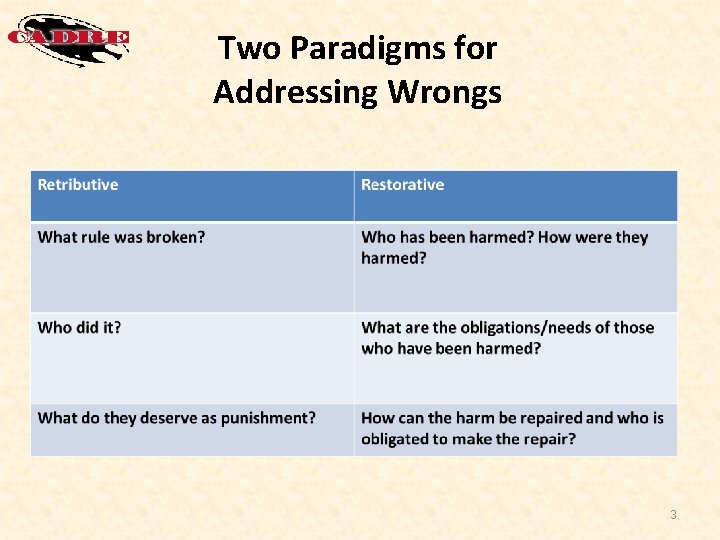
Two Paradigms for Addressing Wrongs 3
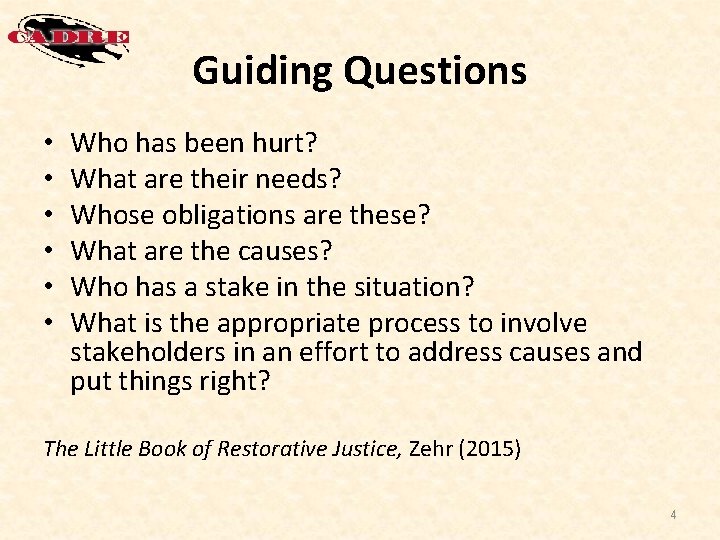
Guiding Questions • • • Who has been hurt? What are their needs? Whose obligations are these? What are the causes? Who has a stake in the situation? What is the appropriate process to involve stakeholders in an effort to address causes and put things right? The Little Book of Restorative Justice, Zehr (2015) 4
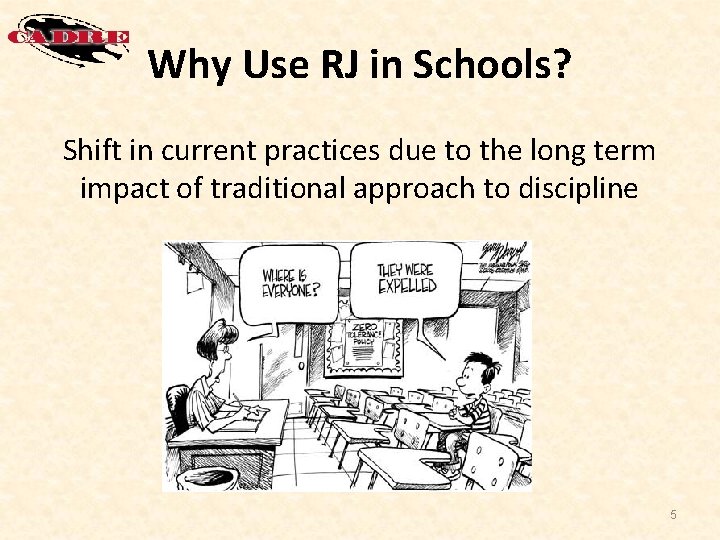
Why Use RJ in Schools? Shift in current practices due to the long term impact of traditional approach to discipline 5
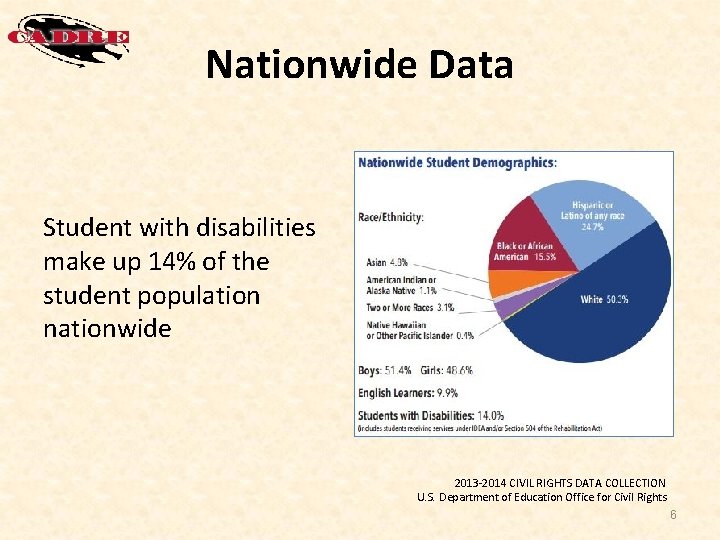
Nationwide Data Student with disabilities make up 14% of the student population nationwide 2013 -2014 CIVIL RIGHTS DATA COLLECTION U. S. Department of Education Office for Civil Rights 6
The Effects of Suspension and Expulsion Young students who are expelled or suspended are as much as 10 times more likely to: – drop out of high school – experience grade retention – hold negative school attitudes – face incarceration U. S. DEPARTMENT OF HEALTH AND HUMAN SERVICES U. S. DEPARTMENT OF EDUCATION POLICY STATEMENT ON EXPULSION AND SUSPENSION POLICIES IN EARLY CHILDHOOD SETTINGS 7
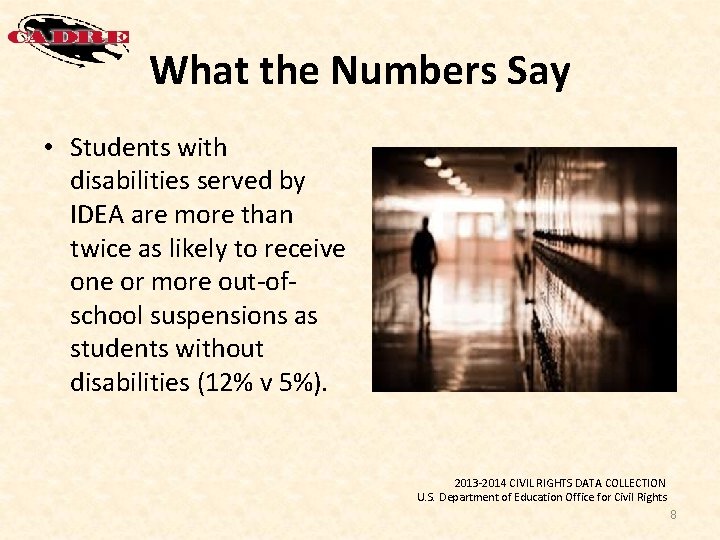
What the Numbers Say • Students with disabilities served by IDEA are more than twice as likely to receive one or more out-ofschool suspensions as students without disabilities (12% v 5%). 2013 -2014 CIVIL RIGHTS DATA COLLECTION U. S. Department of Education Office for Civil Rights 8
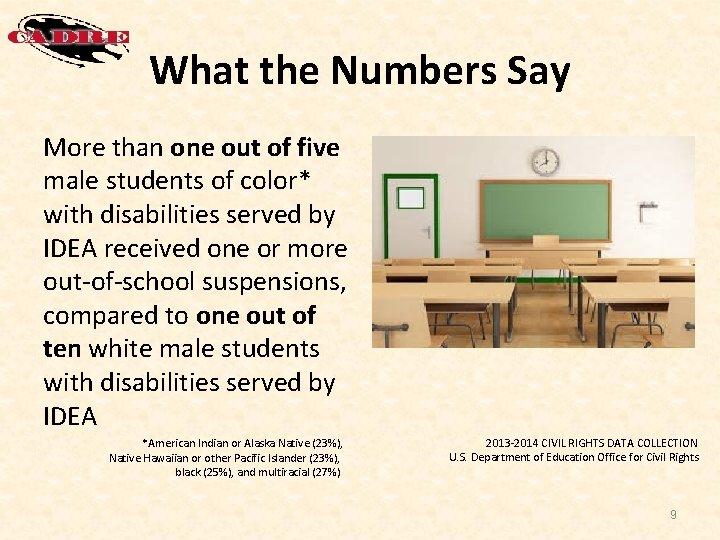
What the Numbers Say More than one out of five male students of color* with disabilities served by IDEA received one or more out-of-school suspensions, compared to one out of ten white male students with disabilities served by IDEA *American Indian or Alaska Native (23%), Native Hawaiian or other Pacific Islander (23%), black (25%), and multiracial (27%) 2013 -2014 CIVIL RIGHTS DATA COLLECTION U. S. Department of Education Office for Civil Rights 9
What the Numbers Say • Black students are 1. 9 times as likely to be expelled from school without educational services as white students • Black students are 2. 2 times as likely to receive a referral to law enforcement or be subject to a school-related arrest as white students 10
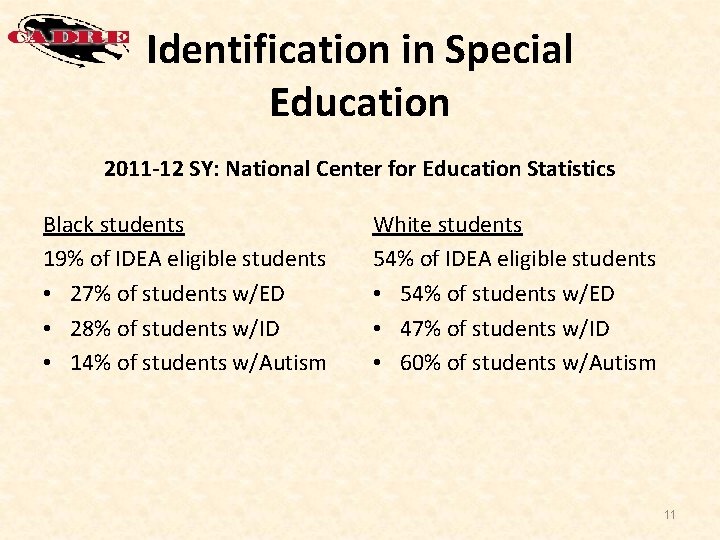
Identification in Special Education 2011 -12 SY: National Center for Education Statistics Black students 19% of IDEA eligible students • 27% of students w/ED • 28% of students w/ID • 14% of students w/Autism White students 54% of IDEA eligible students • 54% of students w/ED • 47% of students w/ID • 60% of students w/Autism 11
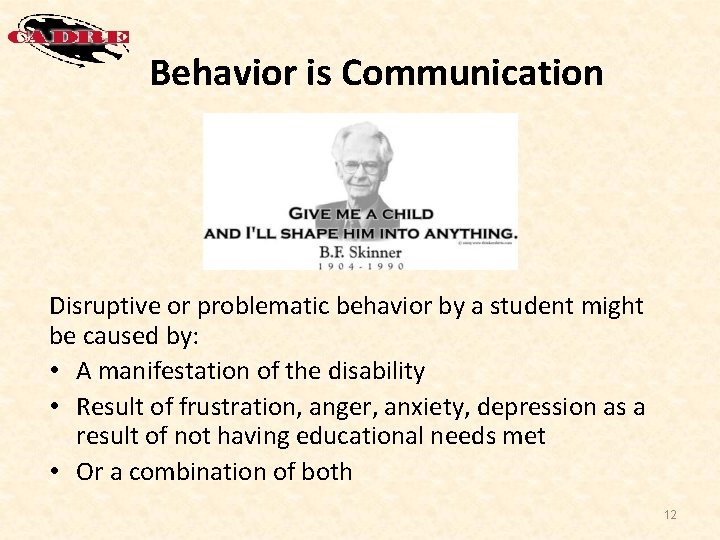
Behavior is Communication Disruptive or problematic behavior by a student might be caused by: • A manifestation of the disability • Result of frustration, anger, anxiety, depression as a result of not having educational needs met • Or a combination of both 12
Flipping the Switch • Too often problematic behavior flips the switch to a focus on controlling or punishing behavior • Addressing educational needs becomes secondary 13
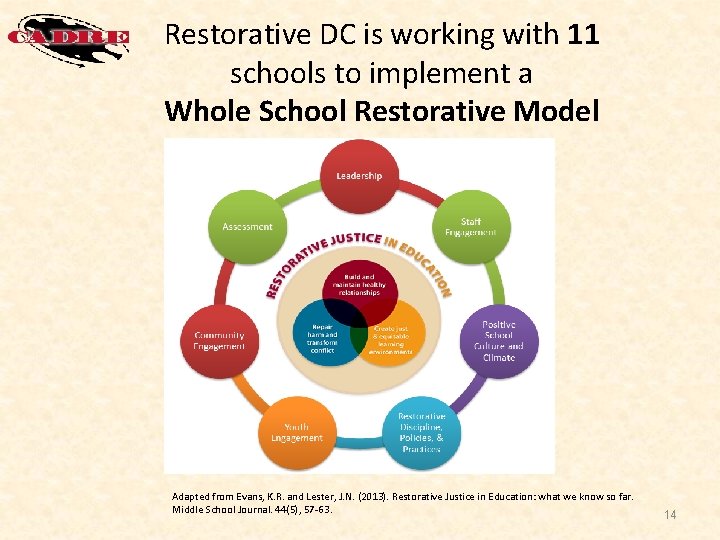
Restorative DC is working with 11 schools to implement a Whole School Restorative Model Adapted from Evans, K. R. and Lester, J. N. (2013). Restorative Justice in Education: what we know so far. Middle School Journal. 44(5), 57 -63. 14
Why restorative practices for sped processes? • Team members (especially parents) have lots of feelings around the special education experience • Helps team move from letter-of-the-law to spirit-of-the-law • Good practice is good practice 15
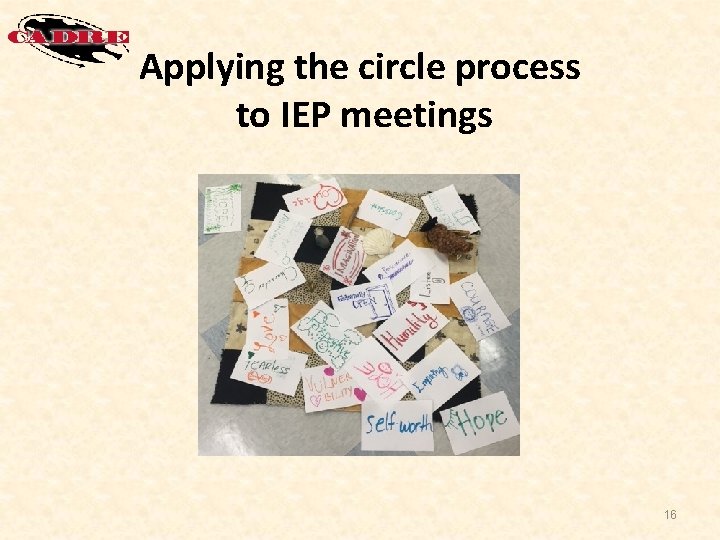
Applying the circle process to IEP meetings 16
Meeting Set up Circular Seating: equality and connectedness & improves focus and visibility • Plan for documentation, while still keeping the integrity of the circle and the focus on the centerpiece. (Ex: laptop vs. flip chart, or both) Centerpiece: Include items representing the values of the core self, the foundational principles, a shared vision. • Focus the meeting on the student and values of inclusion and education. ALL can contribute items. (Ex. student work, photos, personal items) Talking piece: Support the sanctity of the space, full expression of emotions, thoughtful reflection, and equal voice. • Involve students and families in creating or choosing what will be used 17
Keeping the Circle Facilitator/Keeper: Creates and maintains a space for speaking honestly and openly. Does not control issues or outcomes. • Do not have the person responsible for this student’s IEP be the facilitator. Values/Guidelines: voluntariness, confidentiality, safety, openness • Can be established before or during circle 18
Key Elements of the flow (agenda) Opening Ceremony – marks the circle as a special space Explain the process/Set guidelines – involve participants Guiding Questions – per student/family-centered IEP process • Get acquainted • Storytelling • Explore issues and concerns • Clarify future Agreements – made by consensus, can everyone live with it? Closing Ceremony – acknowledge, affirm connections, convey hope 19
Tips for Restorative Approaches in IEP Meetings • Choose an IEP meeting that you don’t expect to be too complicated or contentious • Provide all participants with advance notice • Keep in mind that you may have to spend extra time with students, families, and school staff to prepare them • Consider student-led approach for guidance in how to prepare and involve the student • Allow adequate time for the meeting NOTE: We assume the involvement of an experienced RJ practitioner 20
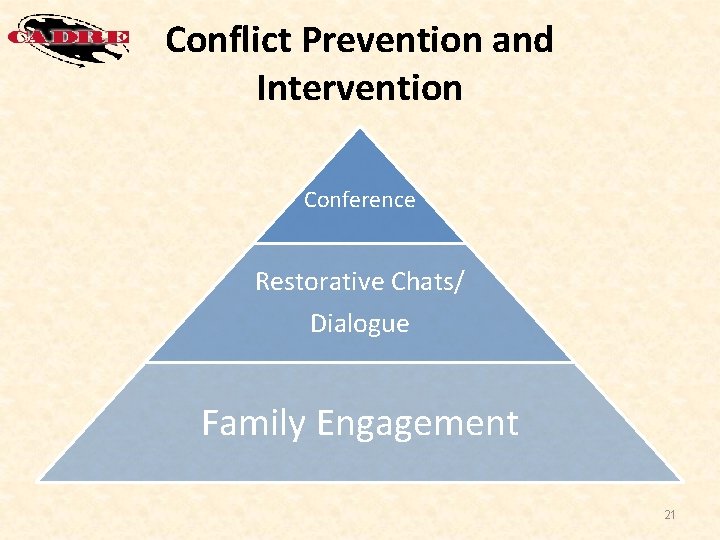
Conflict Prevention and Intervention Conference Restorative Chats/ Dialogue Family Engagement 21
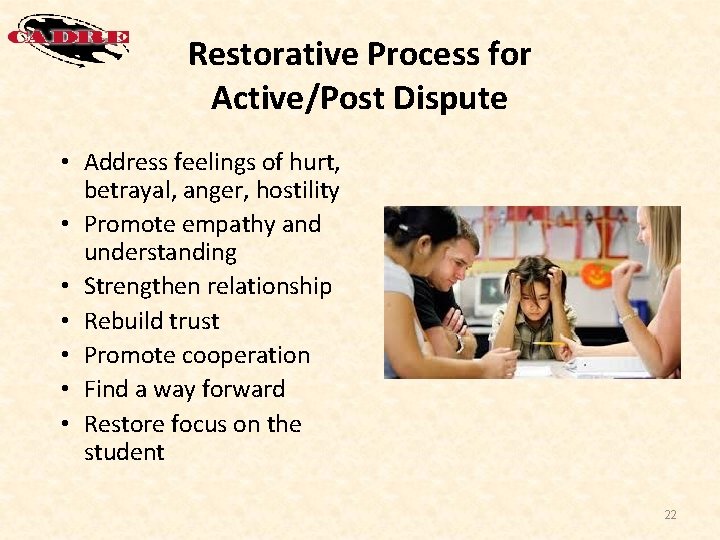
Restorative Process for Active/Post Dispute • Address feelings of hurt, betrayal, anger, hostility • Promote empathy and understanding • Strengthen relationship • Rebuild trust • Promote cooperation • Find a way forward • Restore focus on the student 22
Restorative Questions • • What happened? What has it been like for you? What did you want to happen? What has been the worst part? What is needed to make you feel better? What can I do to help? What can we do to make sure this doesn’t happen again? Restorative Practices and Special Needs, Burnett & Thorsborne (2015) 23
Questions/Comments Contact: Diana Cruz: dcruz@directionservice. org Candace Hawkins: chawkins@directionservice. org Leila Peterson: leila. peterson@schooltalkdc. org
Thank you for joining us! Please take a few minutes to respond to this brief survey about your experience: Webinar Survey https: //www. surveymonkey. com/r/expandingcircle 25
Upcoming Webinar Written State Complaints: Issues, Outcomes, and Remedies from A Road Less Traveled June 6, 2017 11: 30 -12: 45 PST Presenter: Perry Zirkel, University Professor Emeritus of Education and Law, Lehigh University Registration Open Soon – Check the CADRE Website! 26
Restorative Practices Strengthening Family Engagement • Parent involvement at home and at school has a measurable impact on student performance in school, and is particularly important for English learners and students from low-income families. • Improved communication between teachers and parents increases student engagement as measured by homework completion rates, on-task behavior and class participation. • At-risk behaviors such as alcohol use, violence and other antisocial behaviors decrease as parent involvement increases. (Thigpen & Freedburg, 2014) 27
Restorative Questioning to Engage Families • • What do you expect from the school? What do you think of the school? What are the barriers to your involvement? What do you expect from parents? Restorative Practices and Special Needs, Burnett & Thorsborne (2015) 28
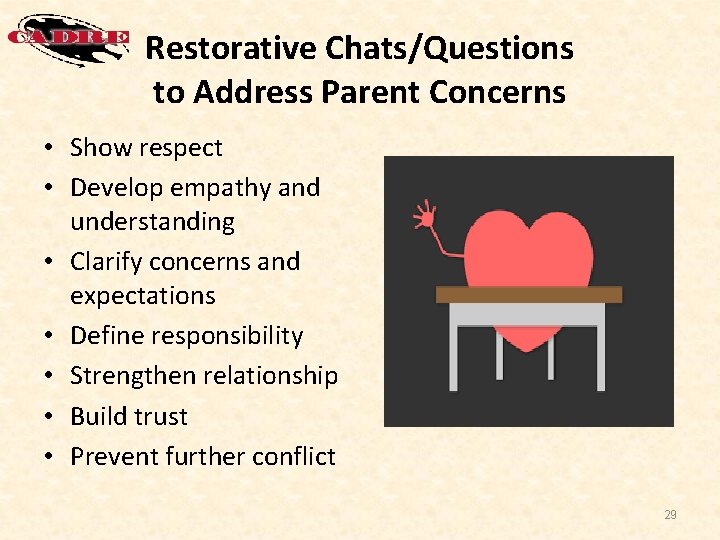
Restorative Chats/Questions to Address Parent Concerns • Show respect • Develop empathy and understanding • Clarify concerns and expectations • Define responsibility • Strengthen relationship • Build trust • Prevent further conflict 29