
Expanding Maritime Domain Awareness Capabilities in the Arctic
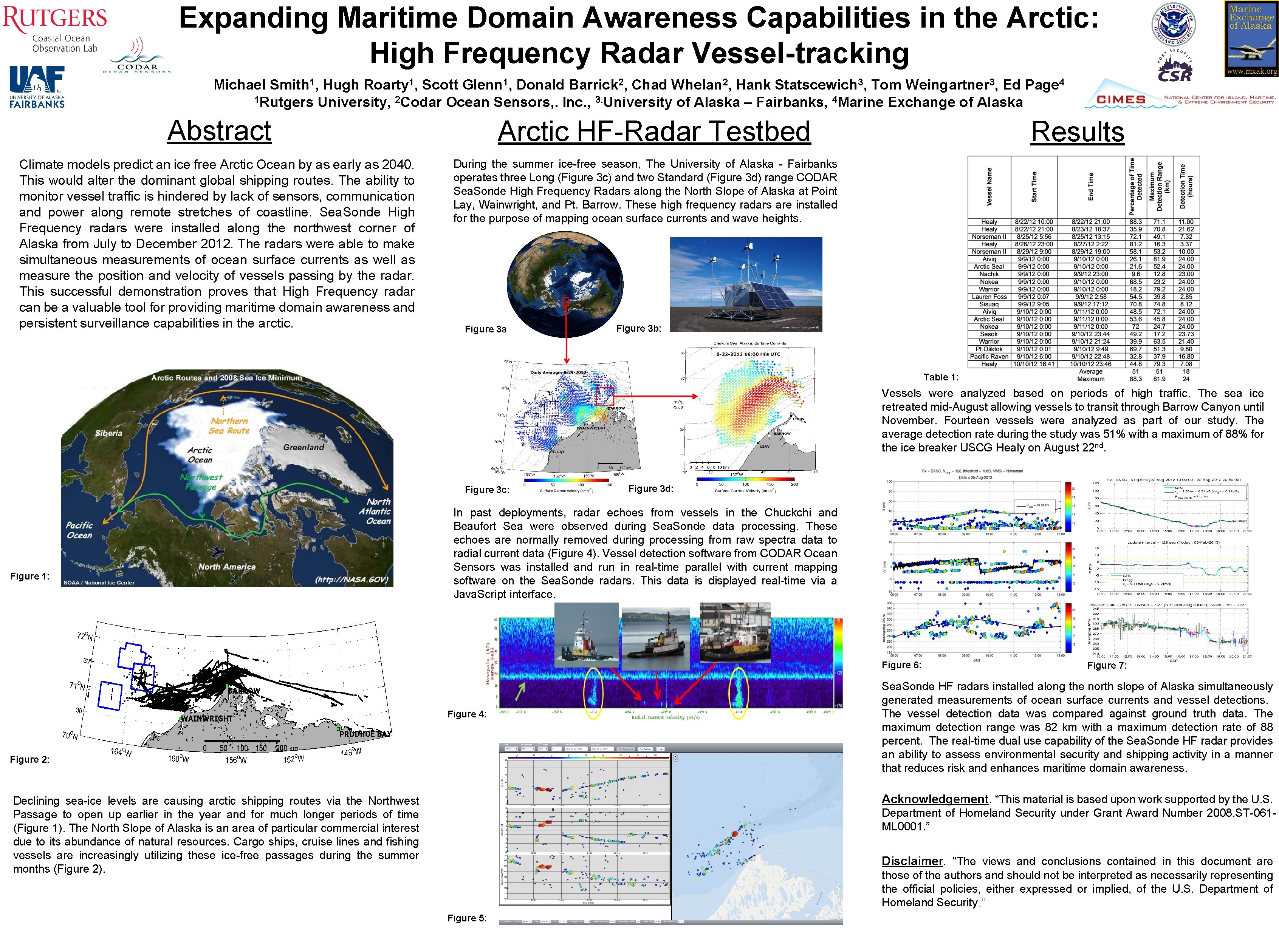
Expanding Maritime Domain Awareness Capabilities in the Arctic: High Frequency Radar Vessel-tracking Michael Smith 1, Hugh Roarty 1, Scott Glenn 1, Donald Barrick 2, Chad Whelan 2, Hank Statscewich 3, Tom Weingartner 3, Ed Page 4 1 Rutgers University, 2 Codar Ocean Sensors, . Inc. , 3. University of Alaska – Fairbanks, 4 Marine Exchange of Alaska Abstract Climate models predict an ice free Arctic Ocean by as early as 2040. This would alter the dominant global shipping routes. The ability to monitor vessel traffic is hindered by lack of sensors, communication and power along remote stretches of coastline. Sea. Sonde High Frequency radars were installed along the northwest corner of Alaska from July to December 2012. The radars were able to make simultaneous measurements of ocean surface currents as well as measure the position and velocity of vessels passing by the radar. This successful demonstration proves that High Frequency radar can be a valuable tool for providing maritime domain awareness and persistent surveillance capabilities in the arctic. Arctic HF-Radar Testbed Results During the summer ice-free season, The University of Alaska - Fairbanks operates three Long (Figure 3 c) and two Standard (Figure 3 d) range CODAR Sea. Sonde High Frequency Radars along the North Slope of Alaska at Point Lay, Wainwright, and Pt. Barrow. These high frequency radars are installed for the purpose of mapping ocean surface currents and wave heights. Figure 3 a Figure 3 b: Table 1: Vessels were analyzed based on periods of high traffic. The sea ice retreated mid-August allowing vessels to transit through Barrow Canyon until November. Fourteen vessels were analyzed as part of our study. The average detection rate during the study was 51% with a maximum of 88% for the ice breaker USCG Healy on August 22 nd. Figure 3 c: Figure 1: Figure 3 d: In past deployments, radar echoes from vessels in the Chuckchi and Beaufort Sea were observed during Sea. Sonde data processing. These echoes are normally removed during processing from raw spectra data to radial current data (Figure 4). Vessel detection software from CODAR Ocean Sensors was installed and run in real-time parallel with current mapping software on the Sea. Sonde radars. This data is displayed real-time via a Java. Script interface. Figure 6: Figure 4: Figure 2: Figure 7: Sea. Sonde HF radars installed along the north slope of Alaska simultaneously generated measurements of ocean surface currents and vessel detections. The vessel detection data was compared against ground truth data. The maximum detection range was 82 km with a maximum detection rate of 88 percent. The real-time dual use capability of the Sea. Sonde HF radar provides an ability to assess environmental security and shipping activity in a manner that reduces risk and enhances maritime domain awareness. Acknowledgement. “This material is based upon work supported by the U. S. Declining sea-ice levels are causing arctic shipping routes via the Northwest Passage to open up earlier in the year and for much longer periods of time (Figure 1). The North Slope of Alaska is an area of particular commercial interest due to its abundance of natural resources. Cargo ships, cruise lines and fishing vessels are increasingly utilizing these ice-free passages during the summer months (Figure 2). Department of Homeland Security under Grant Award Number 2008. ST-061 ML 0001. ” Disclaimer. “The views and conclusions contained in this document are those of the authors and should not be interpreted as necessarily representing the official policies, either expressed or implied, of the U. S. Department of Homeland Security. ” Figure 5:
- Slides: 1