
Expander Lockfree Cache for a Concurrent Data Structure


- Slides: 23
Expander: Lock-free Cache for a Concurrent Data Structure POOJA AGGARWAL (IBM RESEARCH, BANGALORE) SMRUTI R. SARANGI (IIT DELHI) 1
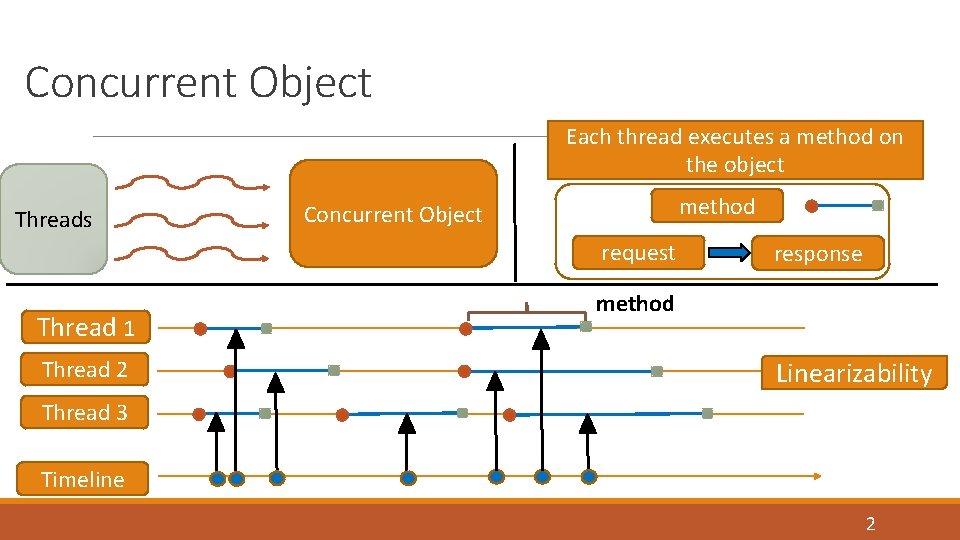
Concurrent Object Each thread executes a method on the object Threads method Concurrent Object request Thread 1 Thread 2 response method Linearizability Thread 3 Timeline 2
Blocking vs Non-blocking Algorithms Blocking algorithm with a lock val = acc. balance += 100 unlock return val Non-blocking algorithm val = acc. balance. fetch. And. Add (100) return val 3
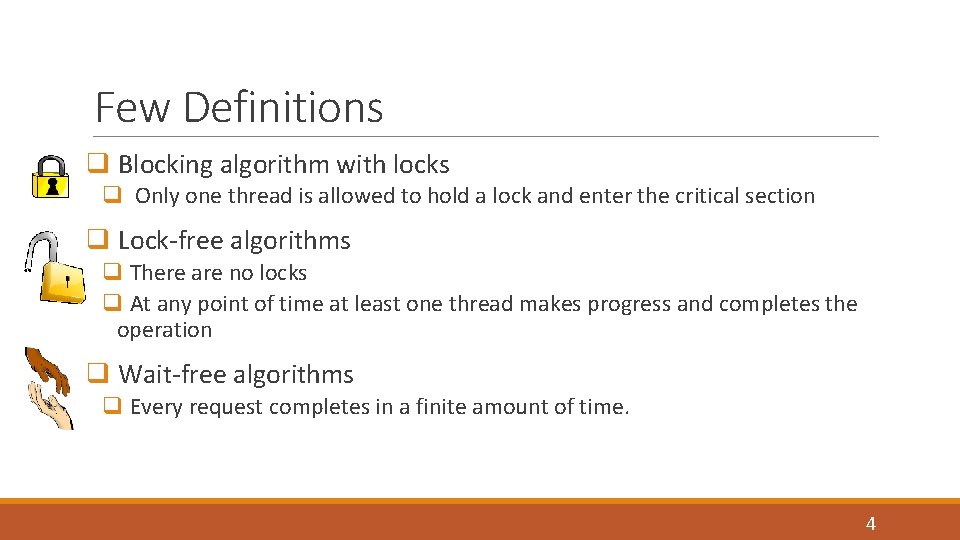
Few Definitions q Blocking algorithm with locks q Only one thread is allowed to hold a lock and enter the critical section q Lock-free algorithms q There are no locks q At any point of time at least one thread makes progress and completes the operation q Wait-free algorithms q Every request completes in a finite amount of time. 4
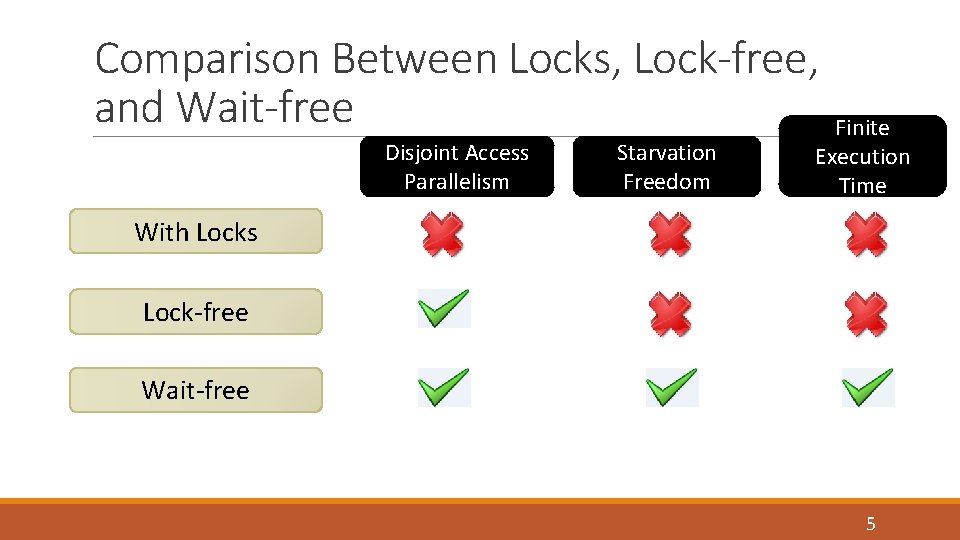
Comparison Between Locks, Lock-free, and Wait-free Disjoint Access Parallelism Starvation Freedom Finite Execution Time With Locks Lock-free Wait-free 5
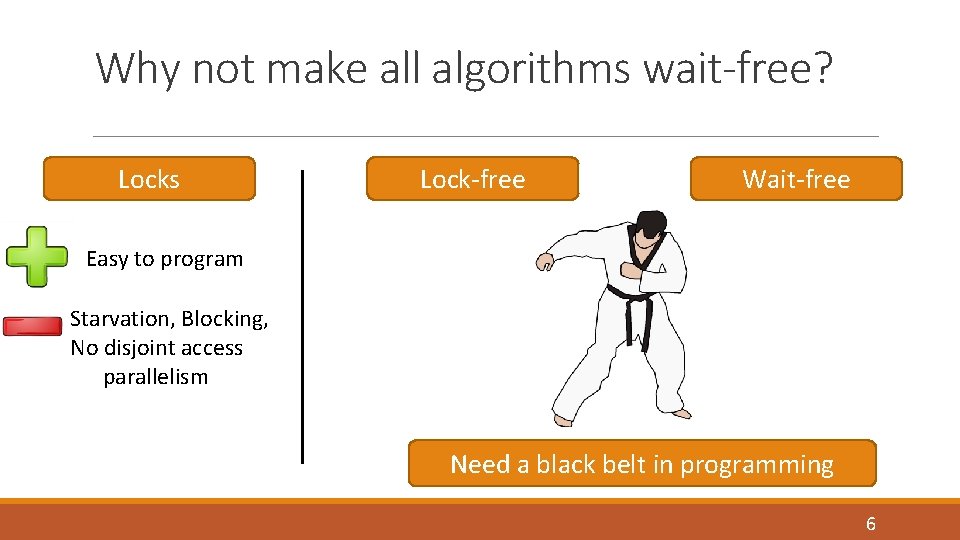
Why not make all algorithms wait-free? Locks Lock-free Wait-free Easy to program Starvation, Blocking, No disjoint access parallelism Need a black belt in programming 6
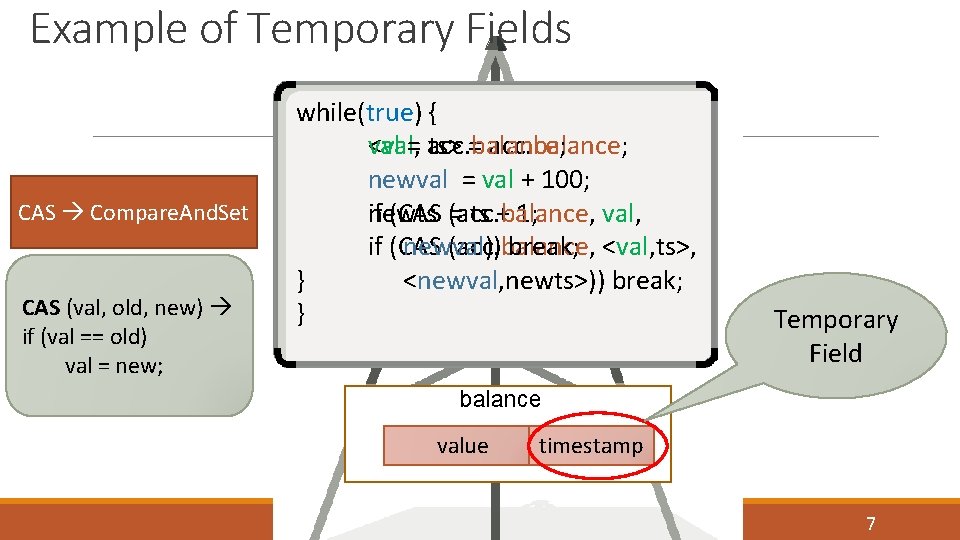
Example of Temporary Fields CAS Compare. And. Set CAS (val, old, new) if (val == old) val = new; while(true) { <val, ts> = acc. balance; val = acc. balance; newval = val + 100; newts = ts + 1; if (CAS (acc. balance, val, if (CAS (acc. balance, newval)) break; <val, ts>, <newval, newts>)) break; } } Temporary Field balance value timestamp 7
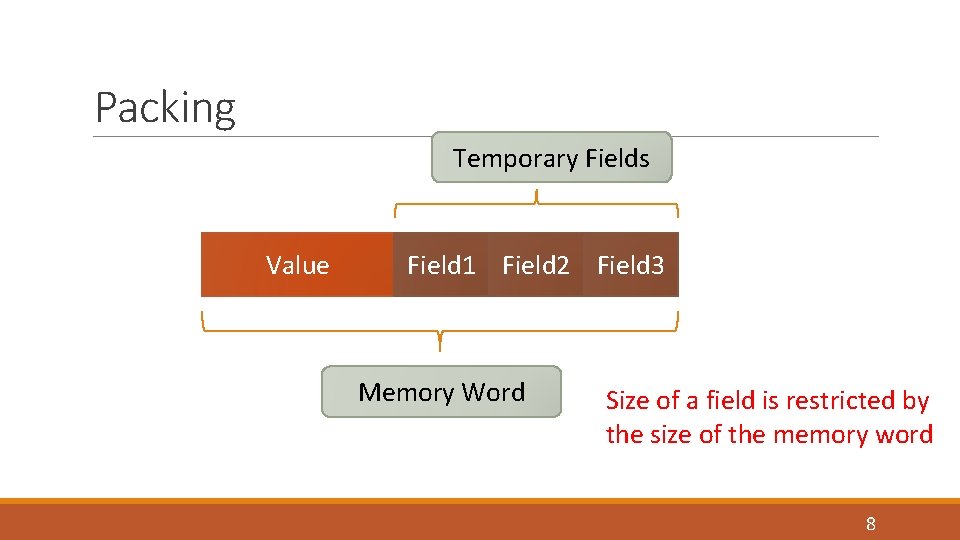
Packing Temporary Fields Value Field 1 Field 2 Field 3 Memory Word Size of a field is restricted by the size of the memory word 8
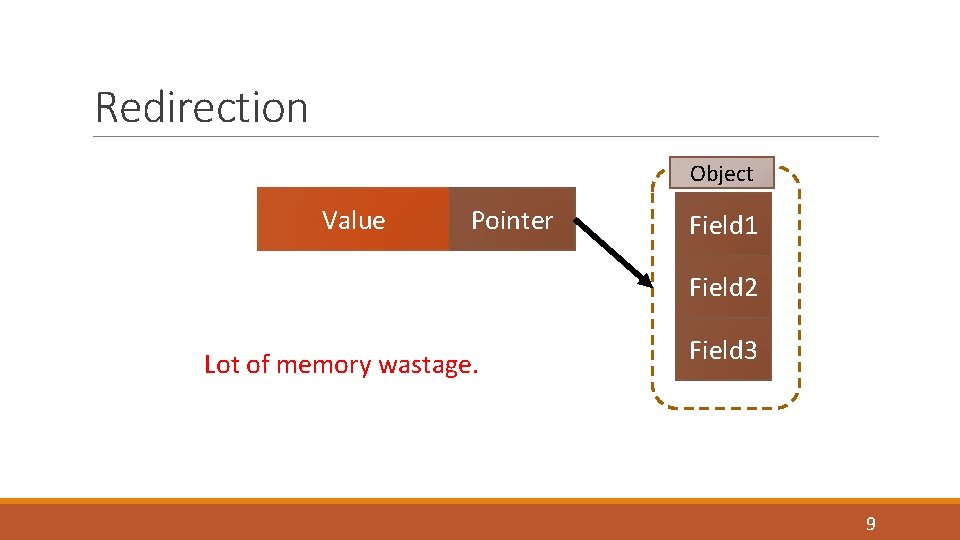
Redirection Object Value Pointer Field 1 Field 2 Lot of memory wastage. Field 3 9
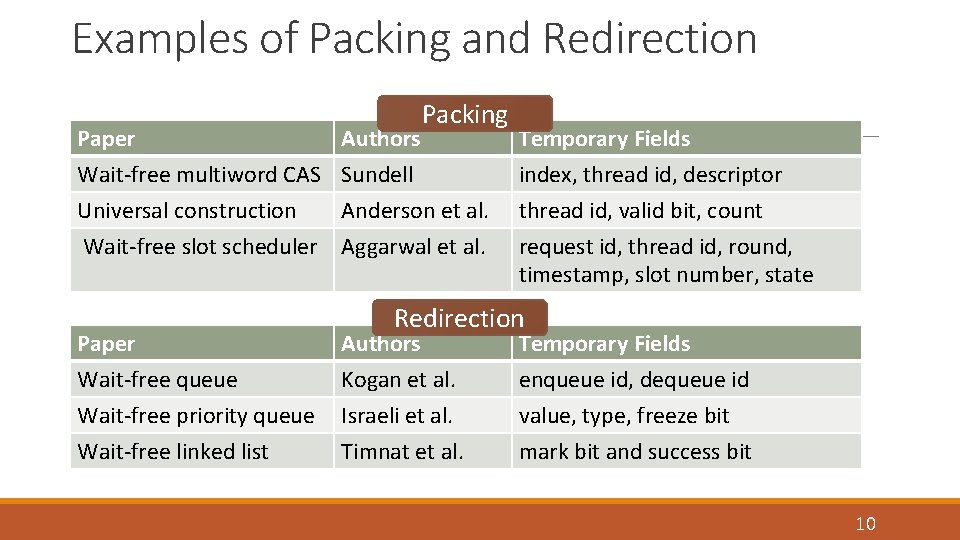
Examples of Packing and Redirection Paper Wait-free multiword CAS Universal construction Wait-free slot scheduler Paper Wait-free queue Wait-free priority queue Wait-free linked list Packing Authors Sundell Anderson et al. Aggarwal et al. Temporary Fields index, thread id, descriptor thread id, valid bit, count request id, thread id, round, timestamp, slot number, state Redirection Authors Kogan et al. Israeli et al. Timnat et al. Temporary Fields enqueue id, dequeue id value, type, freeze bit mark bit and success bit 10
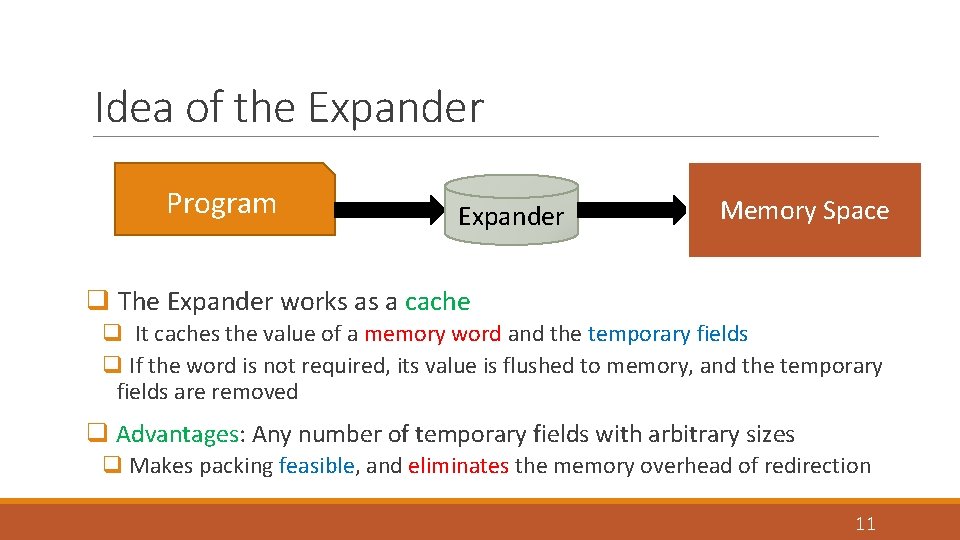
Idea of the Expander Program Expander Memory Space q The Expander works as a cache q It caches the value of a memory word and the temporary fields q If the word is not required, its value is flushed to memory, and the temporary fields are removed q Advantages: Any number of temporary fields with arbitrary sizes q Makes packing feasible, and eliminates the memory overhead of redirection 11
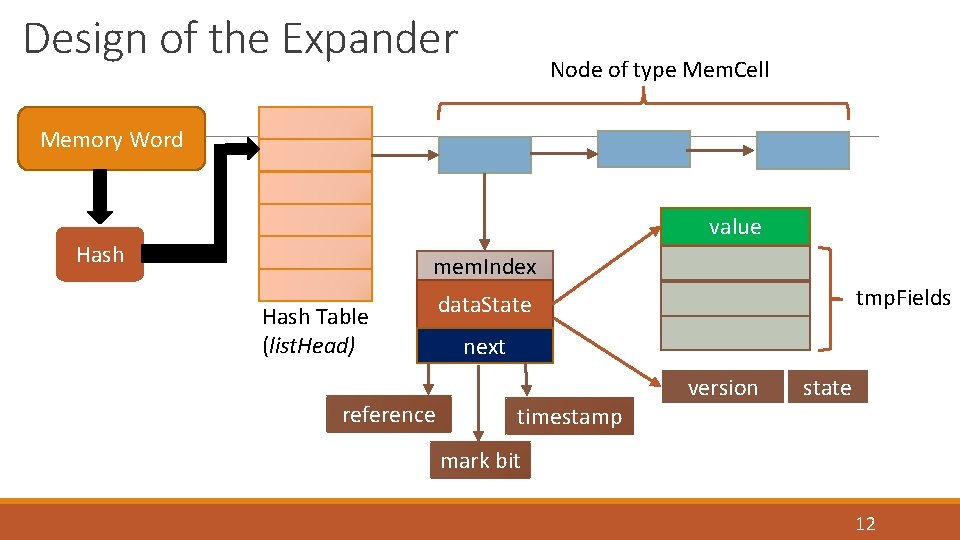
Design of the Expander Node of type Mem. Cell Memory Word value Hash mem. Index Hash Table (list. Head) reference tmp. Fields data. State next version state timestamp mark bit 12
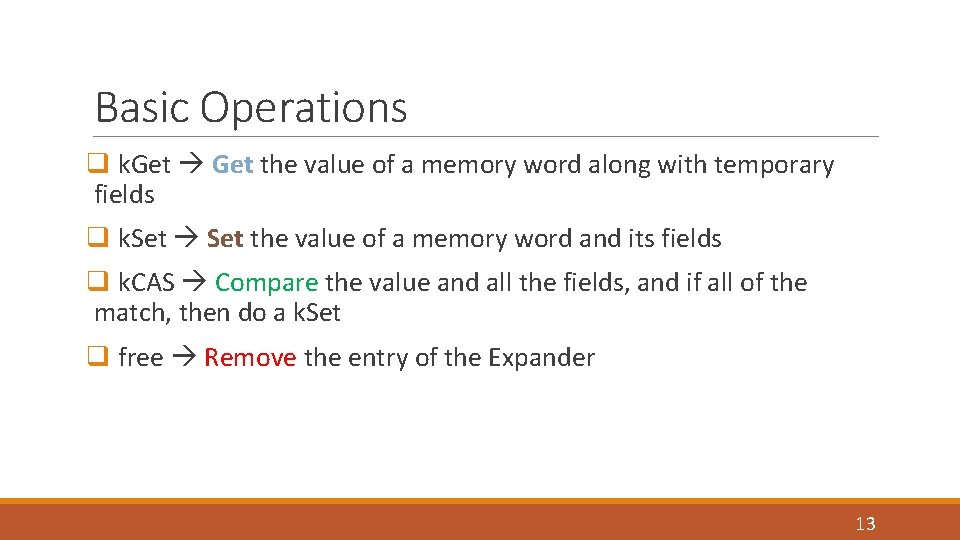
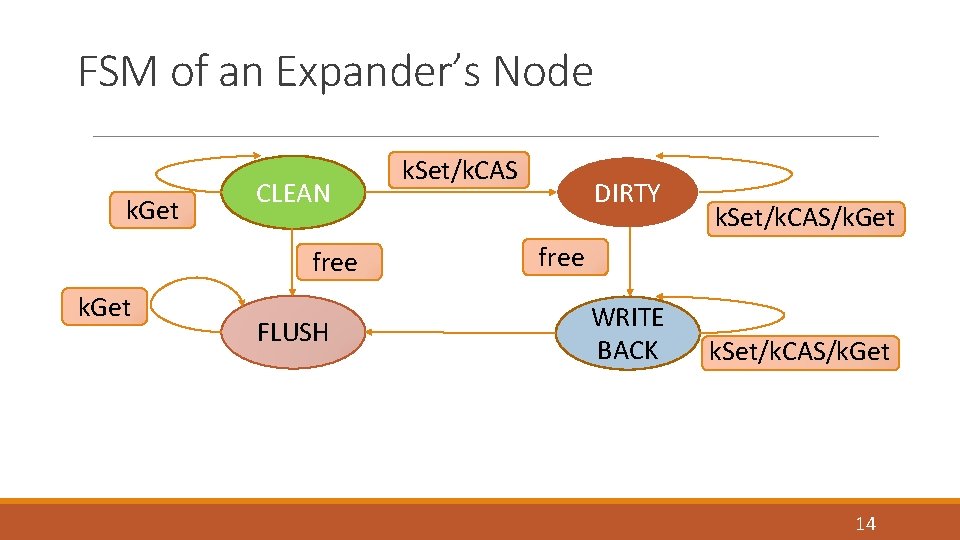
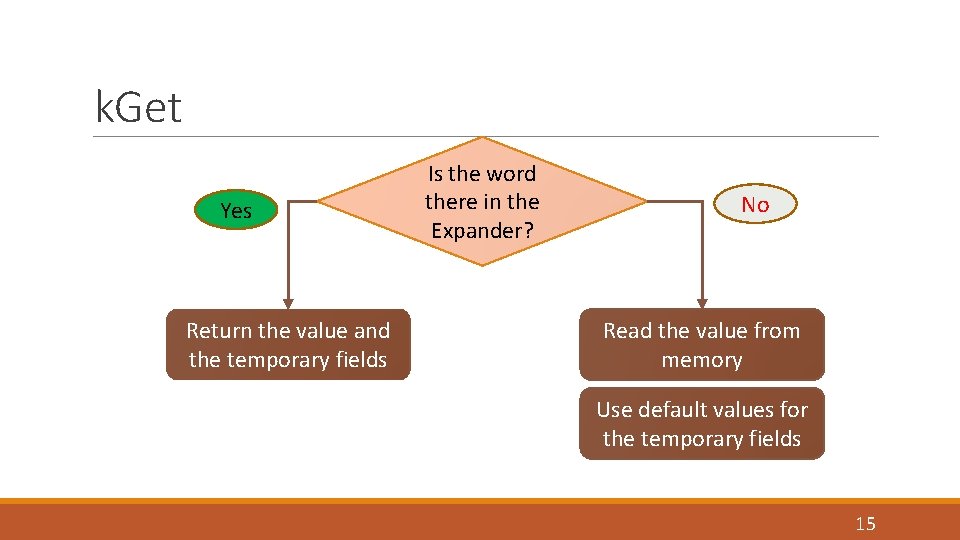
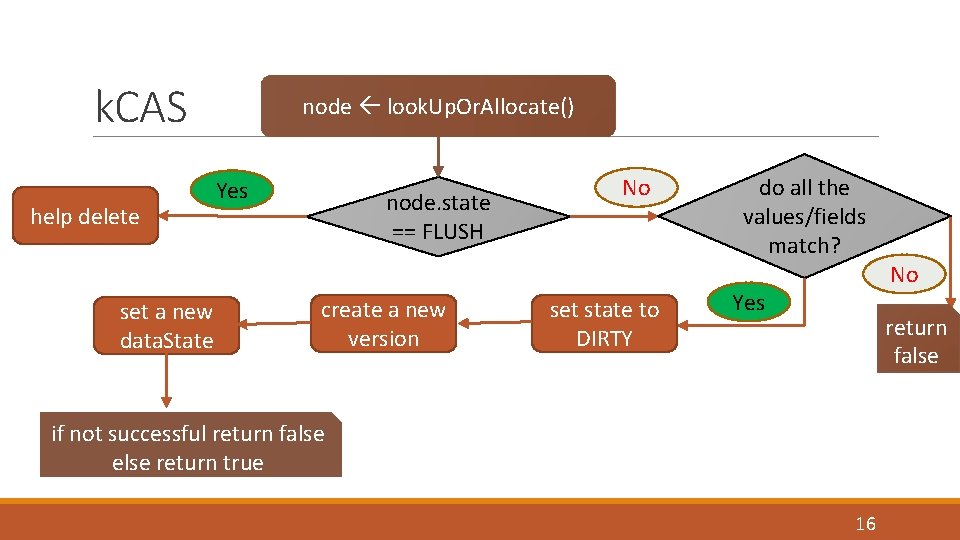
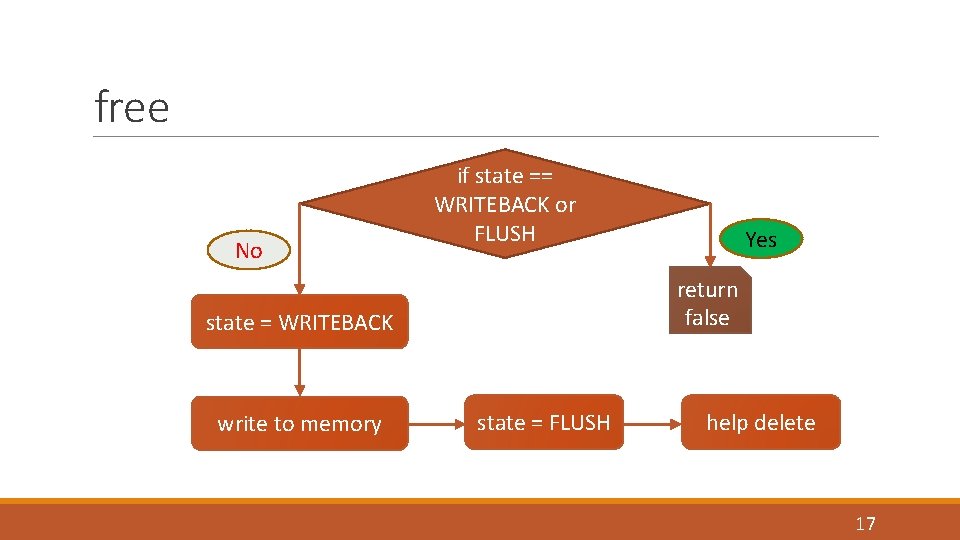
Basic Operations q k. Get the value of a memory word along with temporary fields q k. Set the value of a memory word and its fields q k. CAS Compare the value and all the fields, and if all of the match, then do a k. Set q free Remove the entry of the Expander 13
FSM of an Expander’s Node k. Get CLEAN free k. Get FLUSH k. Set/k. CAS DIRTY k. Set/k. CAS/k. Get free WRITE BACK k. Set/k. CAS/k. Get 14
k. Get Yes Return the value and the temporary fields Is the word there in the Expander? No Read the value from memory Use default values for the temporary fields 15
k. CAS help delete set a new data. State node look. Up. Or. Allocate() Yes node. state == FLUSH create a new version No set state to DIRTY do all the values/fields match? Yes No return false if not successful return false else return true 16
free No if state == WRITEBACK or FLUSH return false state = WRITEBACK write to memory Yes state = FLUSH help delete 17
Proofs and Example q All methods are linearizable and lock-free q If we consider a special set of wait-free algorithms where a request is guaranteed to complete if at least one thread handling it has completed N steps the algorithm remains wait-free with the Expander q The paper shows a wait-free queue with the Expander – code changes in only 8 lines 18
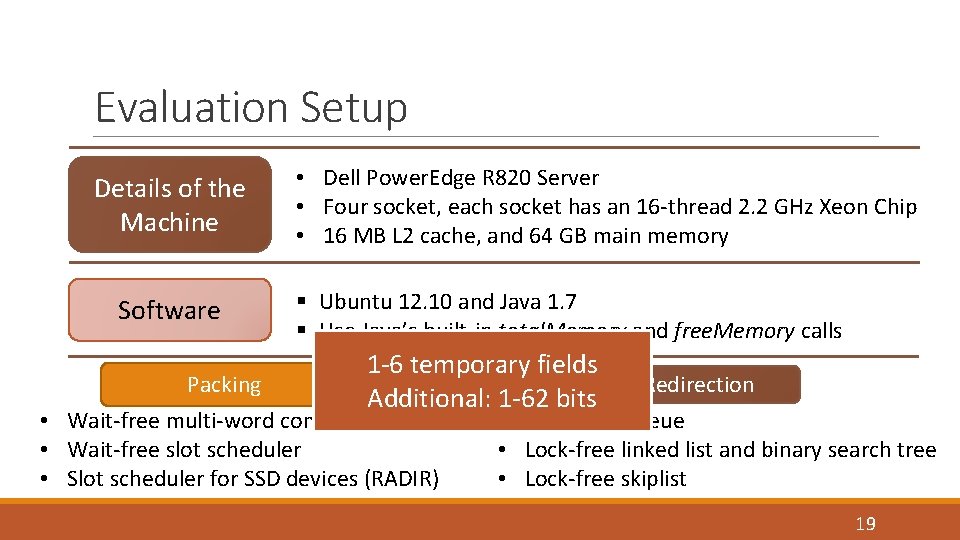
Evaluation Setup Details of the Machine Software • Dell Power. Edge R 820 Server • Four socket, each socket has an 16 -thread 2. 2 GHz Xeon Chip • 16 MB L 2 cache, and 64 GB main memory § Ubuntu 12. 10 and Java 1. 7 § Use Java’s built-in total. Memory and free. Memory calls 1 -6 temporary fields Additional: 1 -62 bits Packing • Wait-free multi-word compare-and-set • Wait-free slot scheduler • Slot scheduler for SSD devices (RADIR) Redirection • Wait-free queue • Lock-free linked list and binary search tree • Lock-free skiplist 19
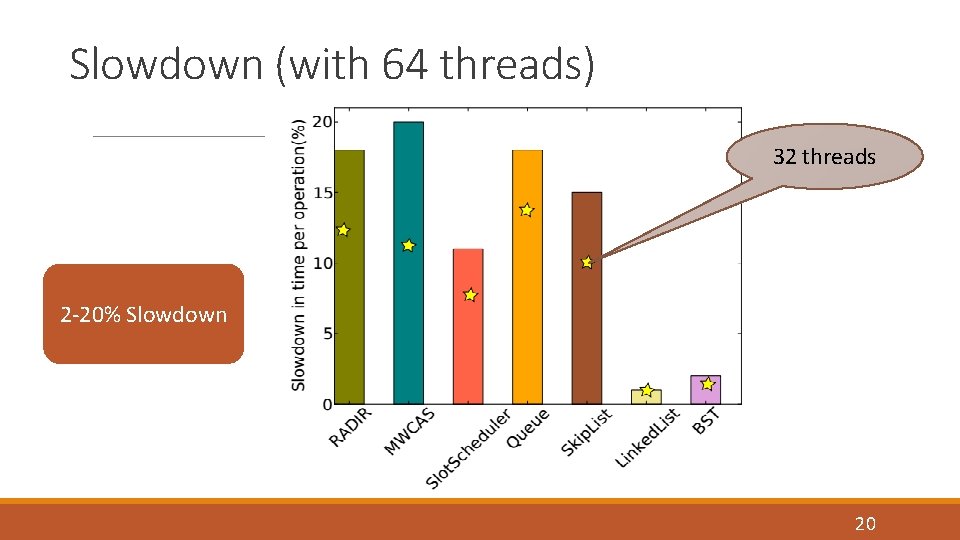
Slowdown (with 64 threads) 32 threads 2 -20% Slowdown 20
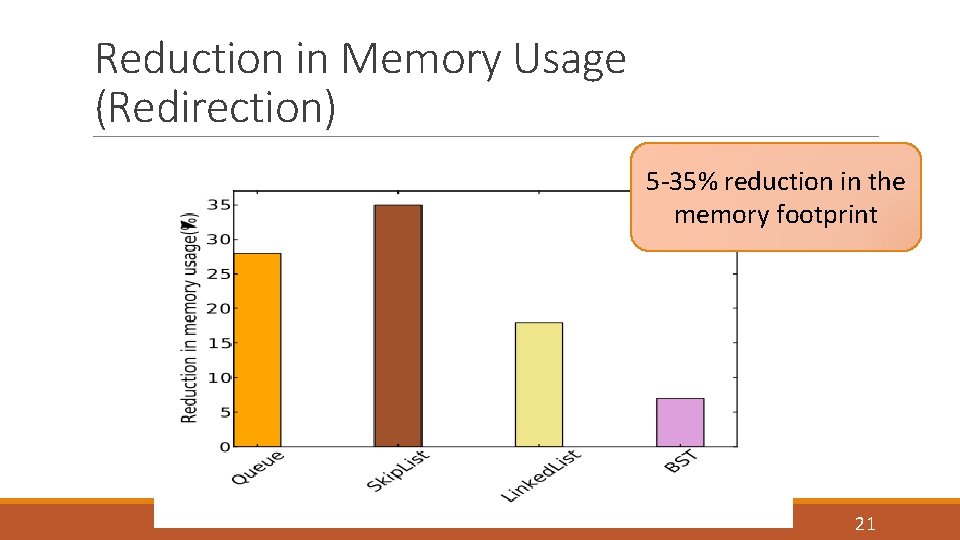
Reduction in Memory Usage (Redirection) 5 -35% reduction in the memory footprint 21
Conclusions q The Expander has many advantages q Makes algorithms with packing feasible q Reduces the memory footprint of algorithms with redirection by up to 35% q Minimal modifications in the code q Most wait-free algorithms remain wait-free with the Expander 22
23