
Exotic phases of the Kondo lattice and holography
- Slides: 49
Exotic phases of the Kondo lattice, and holography Stanford, July 15, 2010 Talk online: sachdev. physics. harvard. edu HARVARD
Outline 1. The Anderson/Kondo lattice models Luttinger’s theorem 2. Fractionalized Fermi liquids Metallic spin-liquid states 3. A mean field theory of a fractionalized Fermi liquid Marginal Fermi liquid physics 4. An Ad. S/CFT perspective Holographic metals as fractionalized Fermi liquids
Outline 1. The Anderson/Kondo lattice models Luttinger’s theorem 2. Fractionalized Fermi liquids Metallic spin-liquid states 3. A mean field theory of a fractionalized Fermi liquid Marginal Fermi liquid physics 4. An Ad. S/CFT perspective Holographic metals as fractionalized Fermi liquids
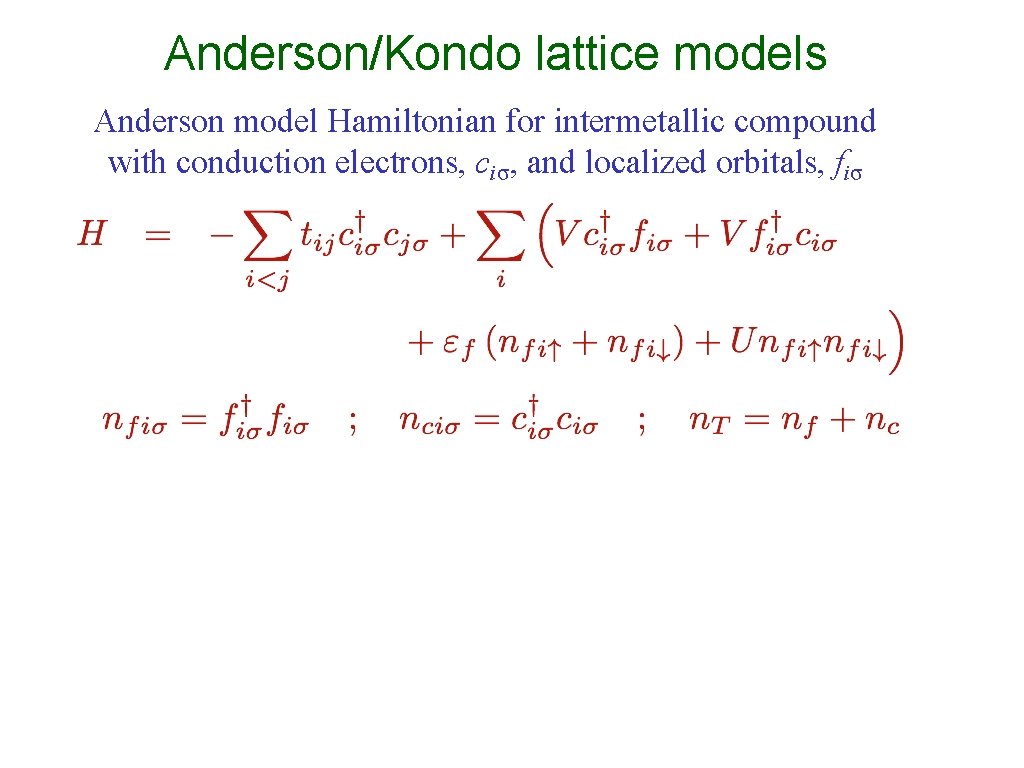
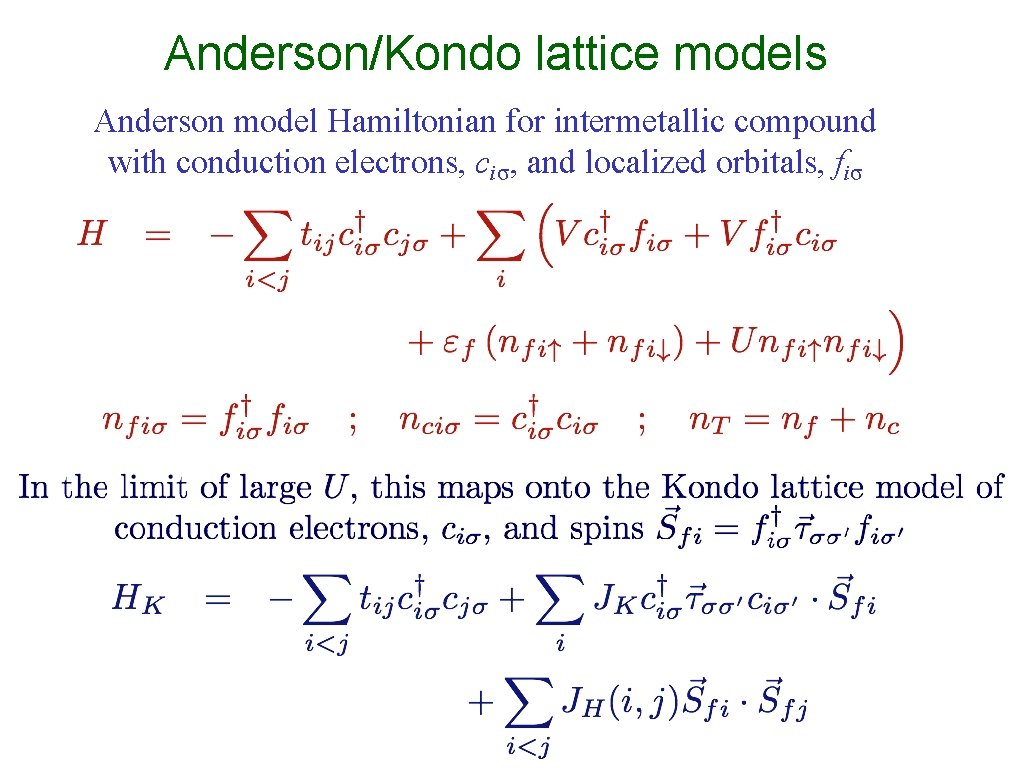
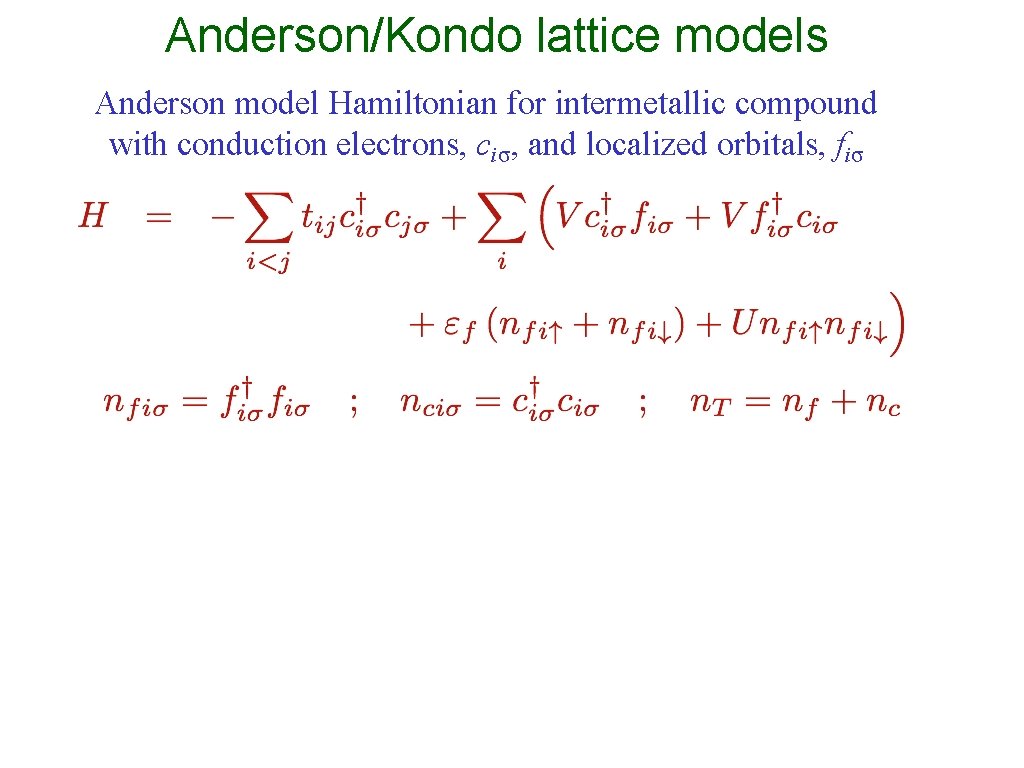
Anderson/Kondo lattice models Anderson model Hamiltonian for intermetallic compound with conduction electrons, ciσ , and localized orbitals, fiσ
Anderson/Kondo lattice models Anderson model Hamiltonian for intermetallic compound with conduction electrons, ciσ , and localized orbitals, fiσ
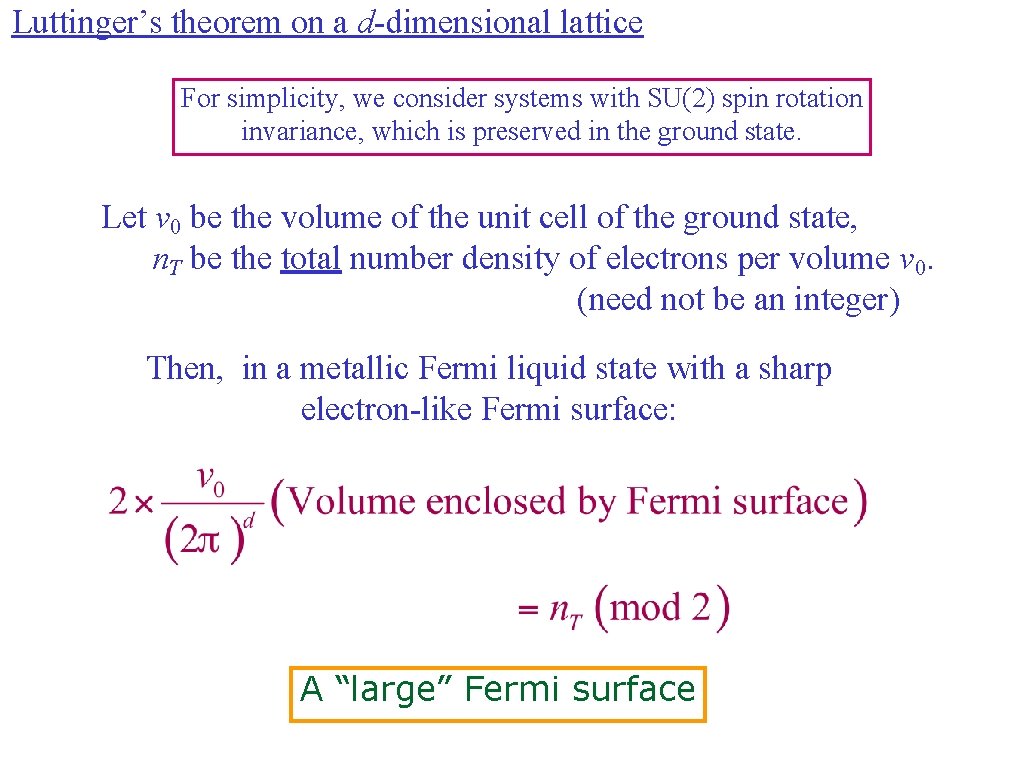
Luttinger’s theorem on a d-dimensional lattice For simplicity, we consider systems with SU(2) spin rotation invariance, which is preserved in the ground state. Let v 0 be the volume of the unit cell of the ground state, n. T be the total number density of electrons per volume v 0. (need not be an integer) Then, in a metallic Fermi liquid state with a sharp electron-like Fermi surface: A “large” Fermi surface
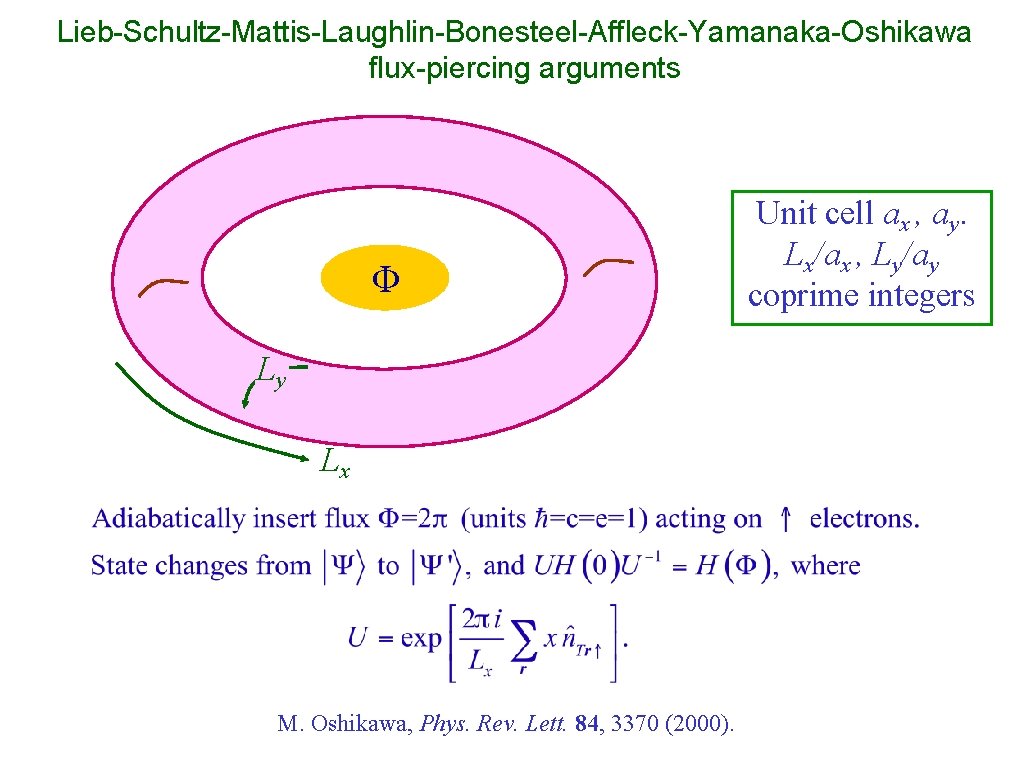
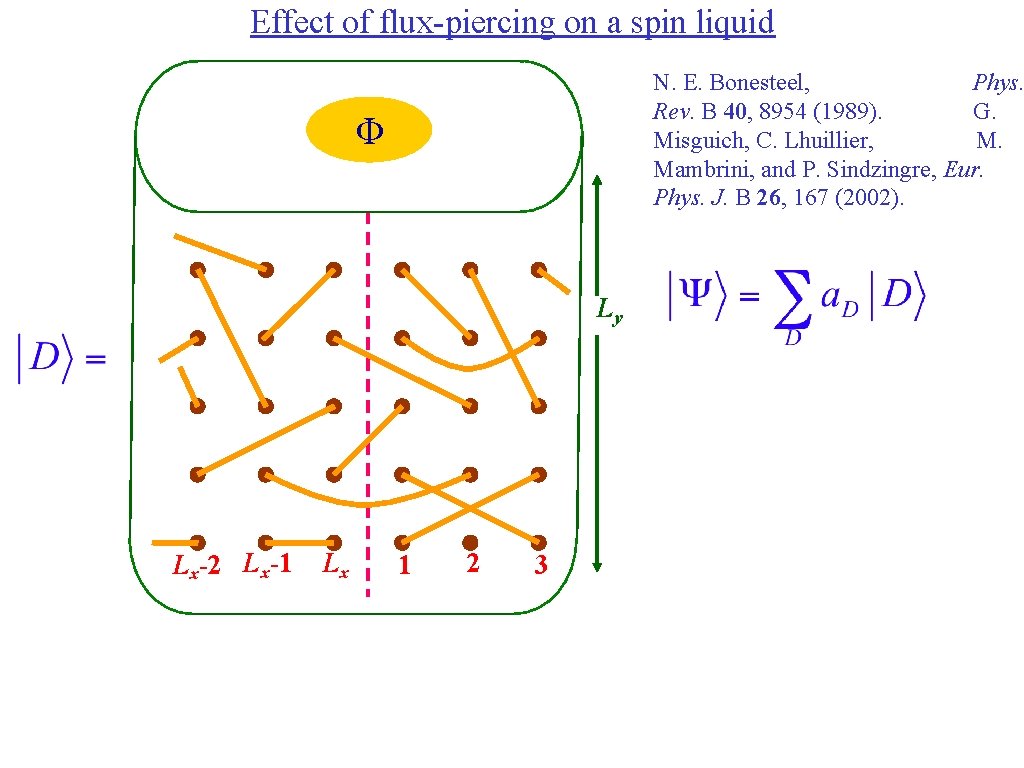
Lieb-Schultz-Mattis-Laughlin-Bonesteel-Affleck-Yamanaka-Oshikawa flux-piercing arguments Φ Ly Lx M. Oshikawa, Phys. Rev. Lett. 84, 3370 (2000). Unit cell ax , ay. Lx/ax , Ly/ay coprime integers
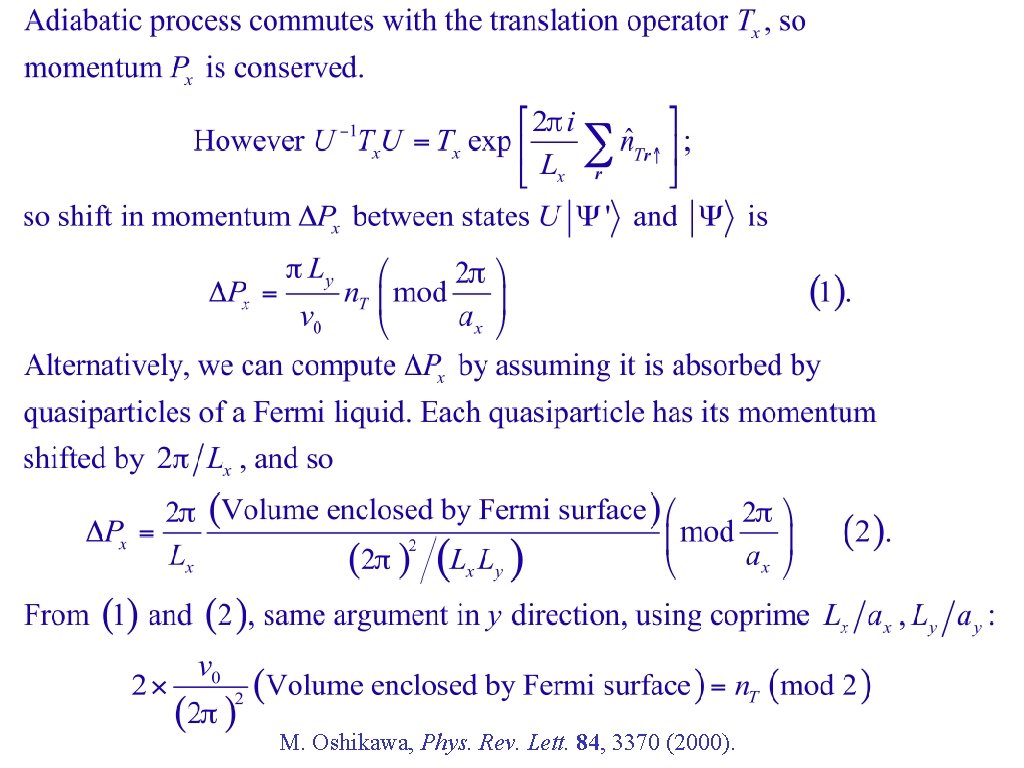
M. Oshikawa, Phys. Rev. Lett. 84, 3370 (2000).
Anderson/Kondo lattice models Anderson model Hamiltonian for intermetallic compound with conduction electrons, ciσ , and localized orbitals, fiσ
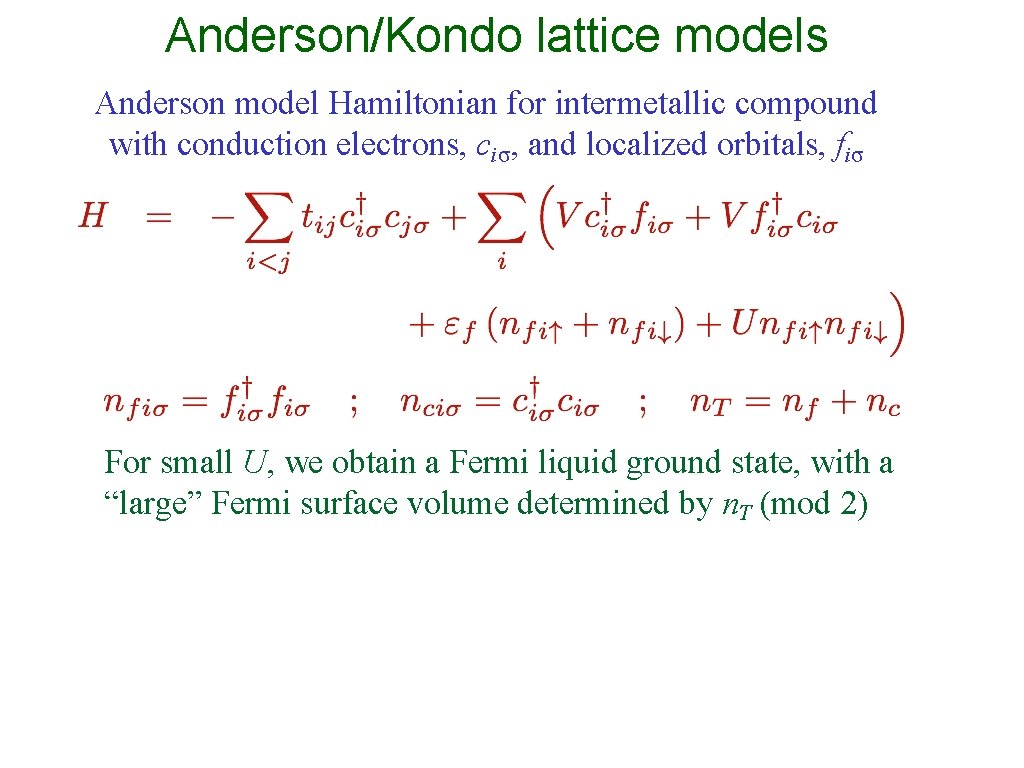
Anderson/Kondo lattice models Anderson model Hamiltonian for intermetallic compound with conduction electrons, ciσ , and localized orbitals, fiσ For small U, we obtain a Fermi liquid ground state, with a “large” Fermi surface volume determined by n. T (mod 2)
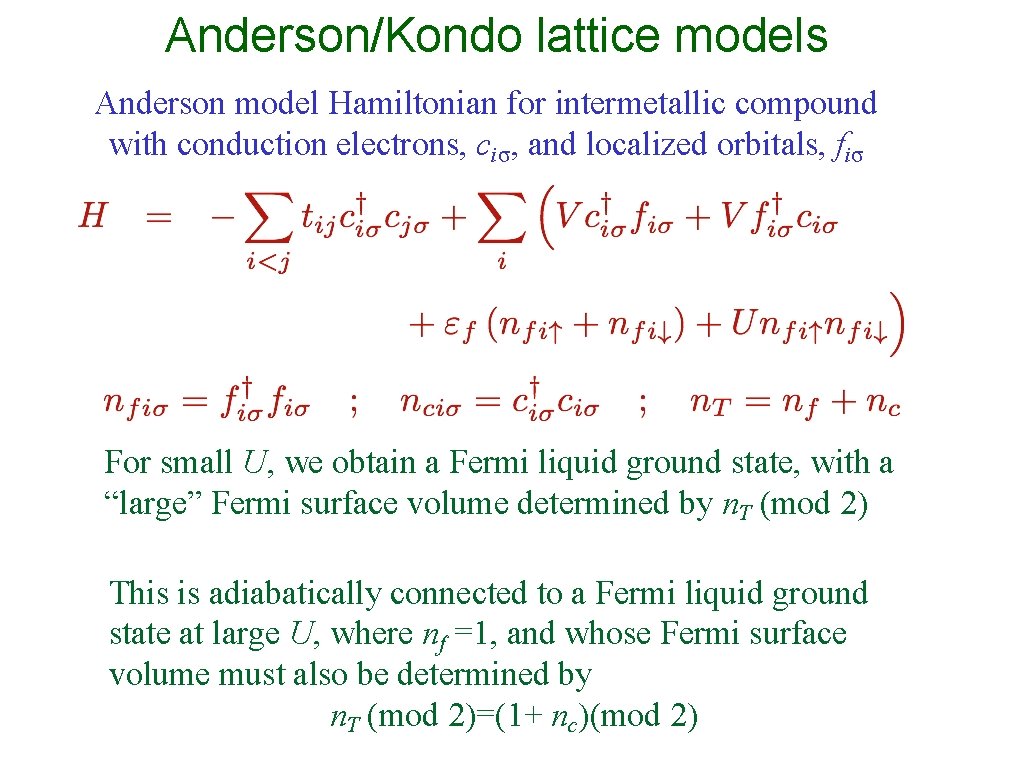
Anderson/Kondo lattice models Anderson model Hamiltonian for intermetallic compound with conduction electrons, ciσ , and localized orbitals, fiσ For small U, we obtain a Fermi liquid ground state, with a “large” Fermi surface volume determined by n. T (mod 2) This is adiabatically connected to a Fermi liquid ground state at large U, where nf =1, and whose Fermi surface volume must also be determined by n. T (mod 2)=(1+ nc)(mod 2)
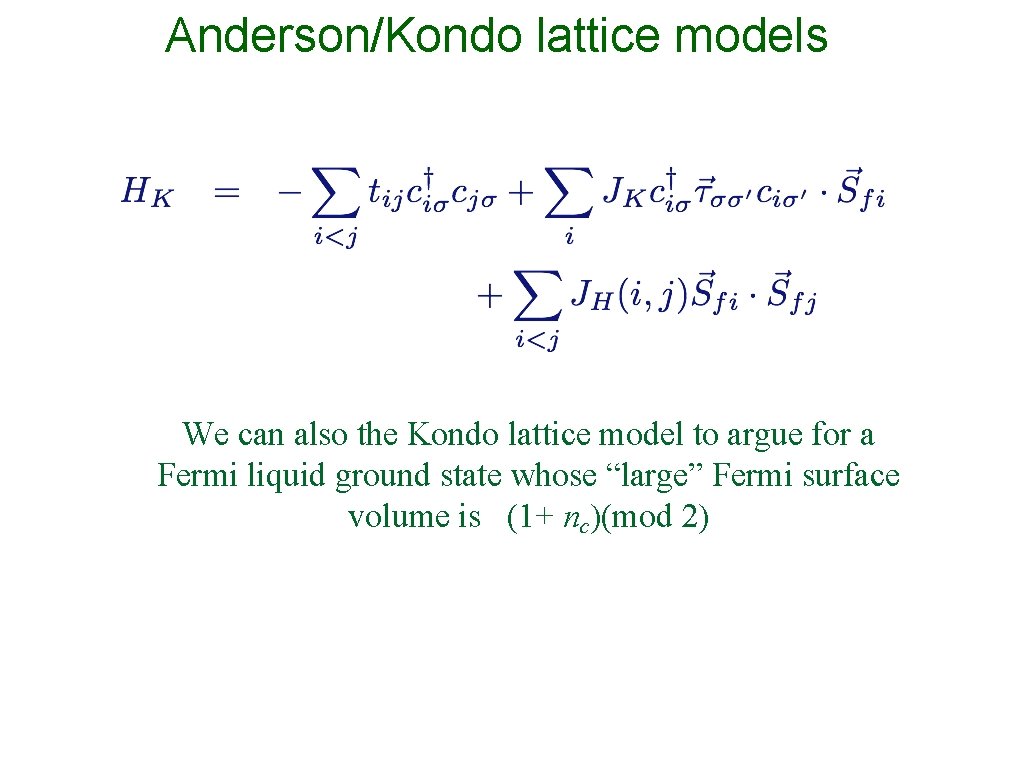
Anderson/Kondo lattice models We can also the Kondo lattice model to argue for a Fermi liquid ground state whose “large” Fermi surface volume is (1+ nc)(mod 2)
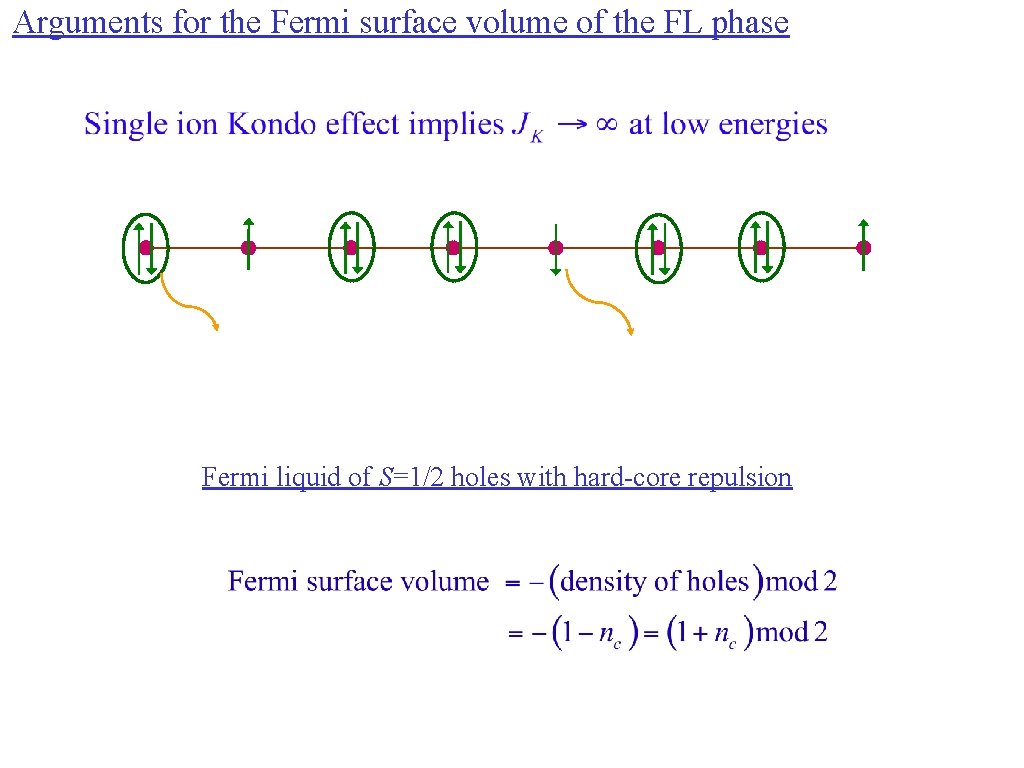
Arguments for the Fermi surface volume of the FL phase Fermi liquid of S=1/2 holes with hard-core repulsion
Outline 1. The Anderson/Kondo lattice models Luttinger’s theorem 2. Fractionalized Fermi liquids Metallic spin-liquid states 3. A mean field theory of a fractionalized Fermi liquid Marginal Fermi liquid physics 4. An Ad. S/CFT perspective Holographic metals as fractionalized Fermi liquids
Outline 1. The Anderson/Kondo lattice models Luttinger’s theorem 2. Fractionalized Fermi liquids Metallic spin-liquid states 3. A mean field theory of a fractionalized Fermi liquid Marginal Fermi liquid physics 4. An Ad. S/CFT perspective Holographic metals as fractionalized Fermi liquids
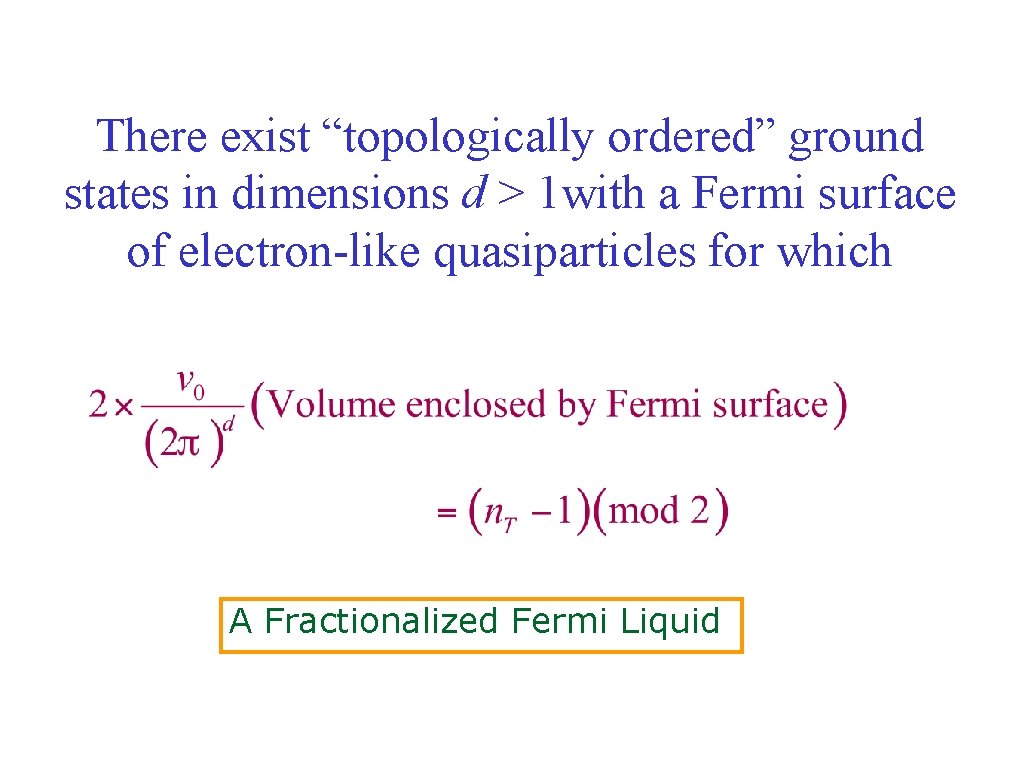
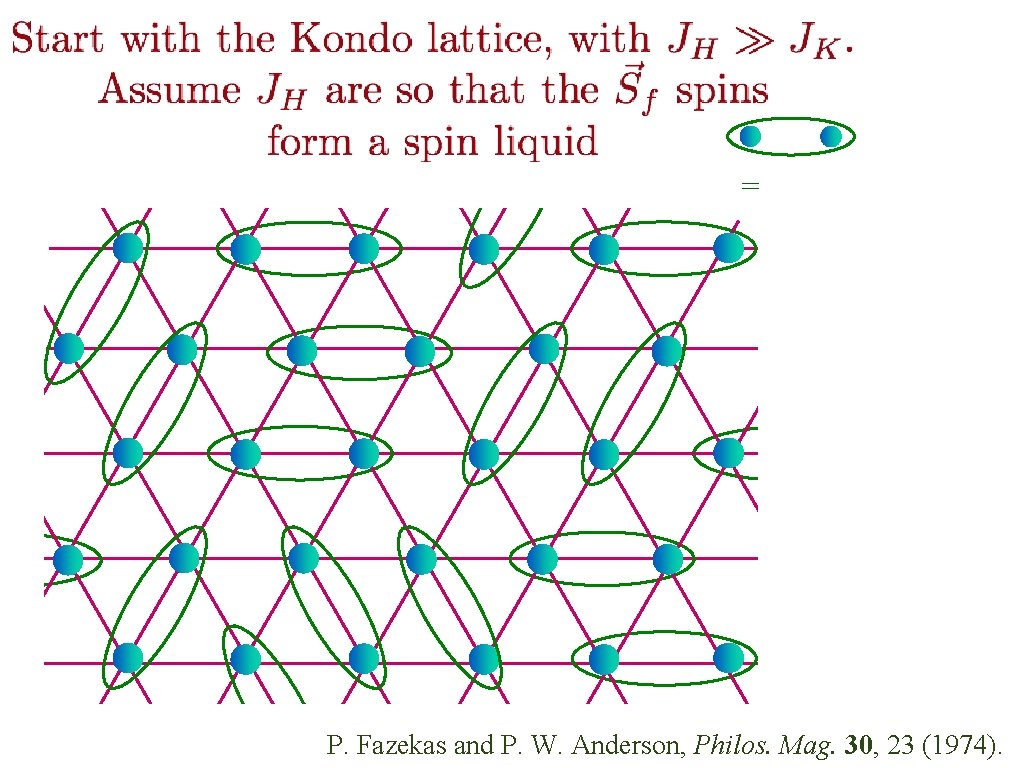
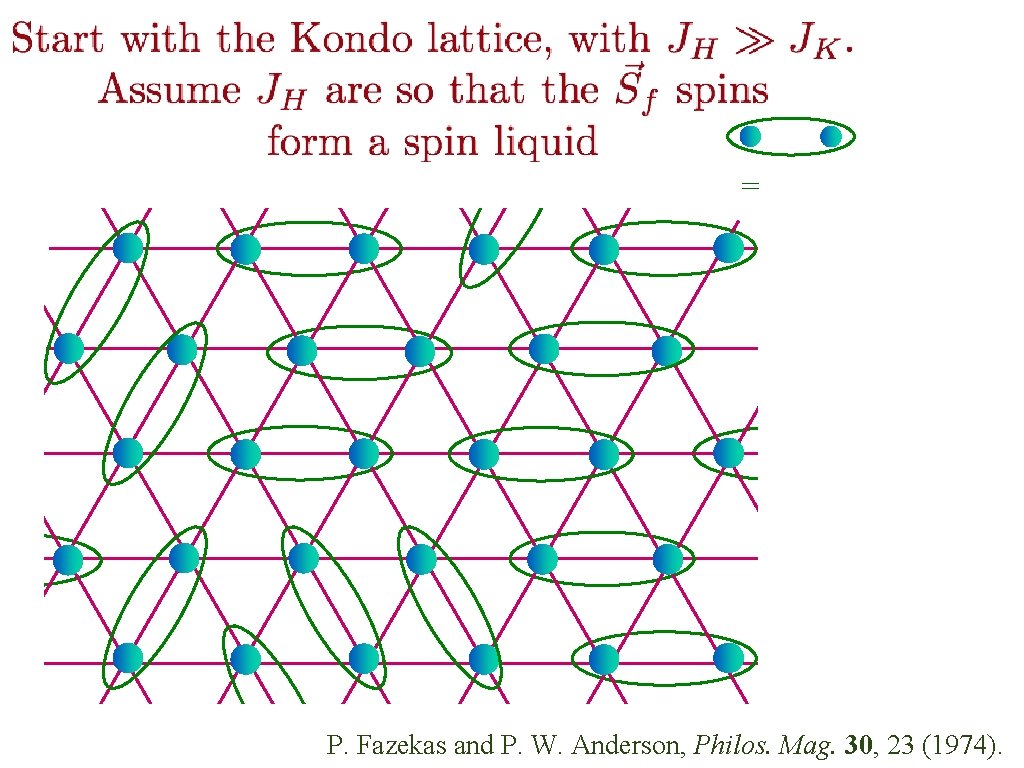
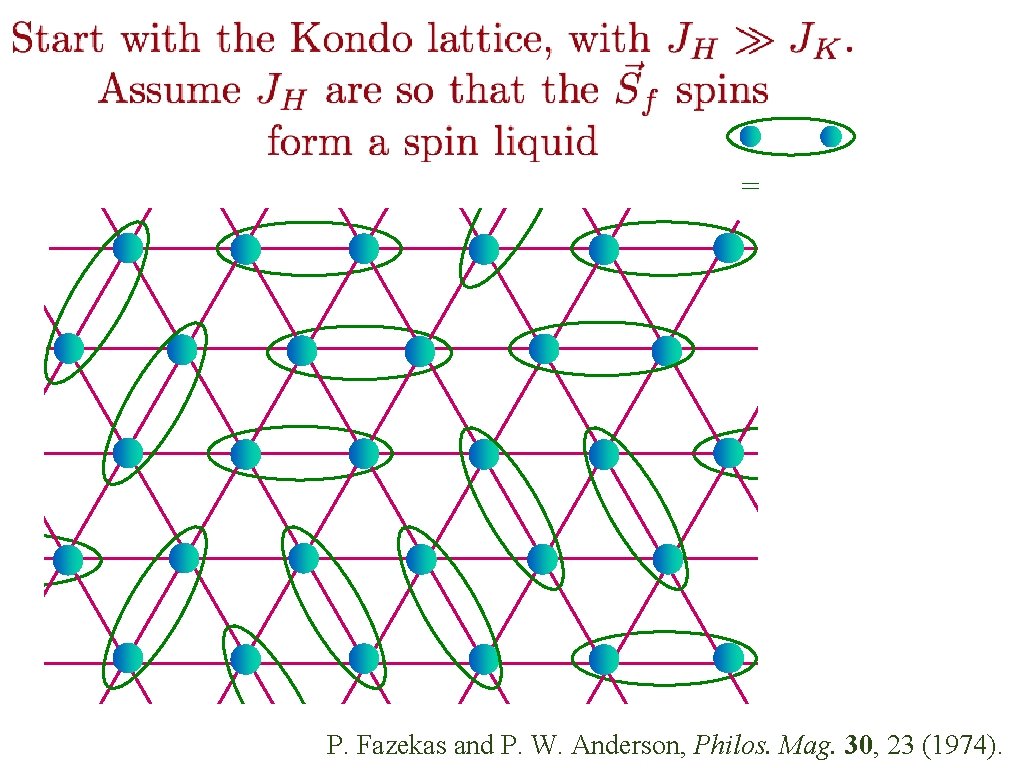
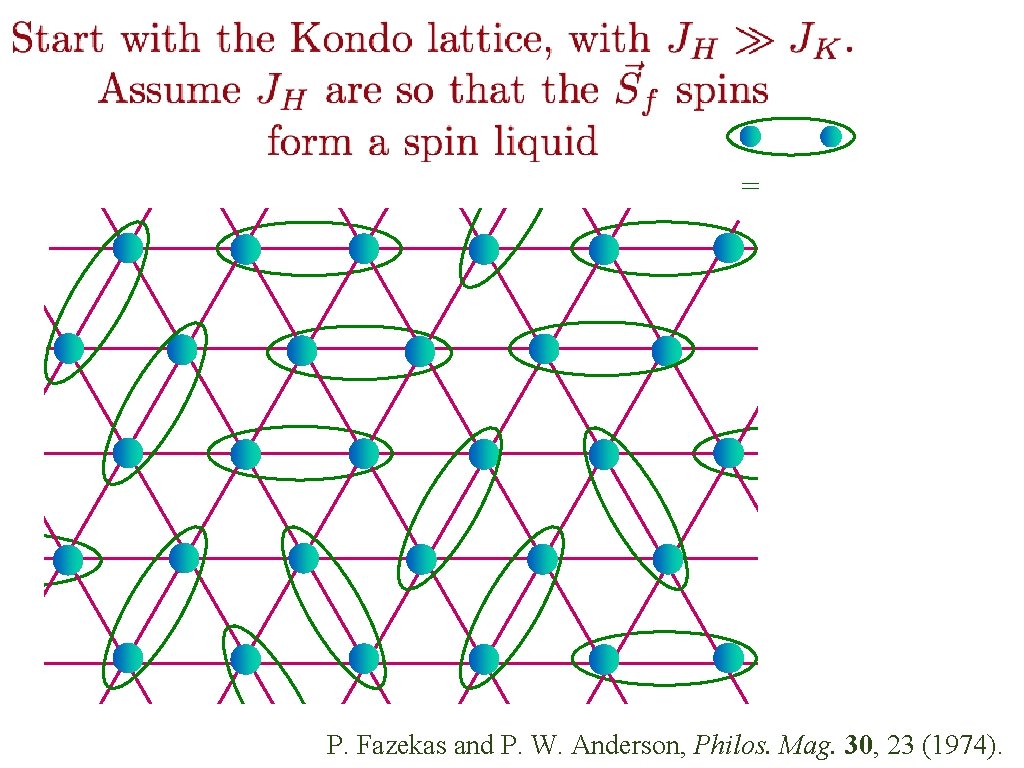
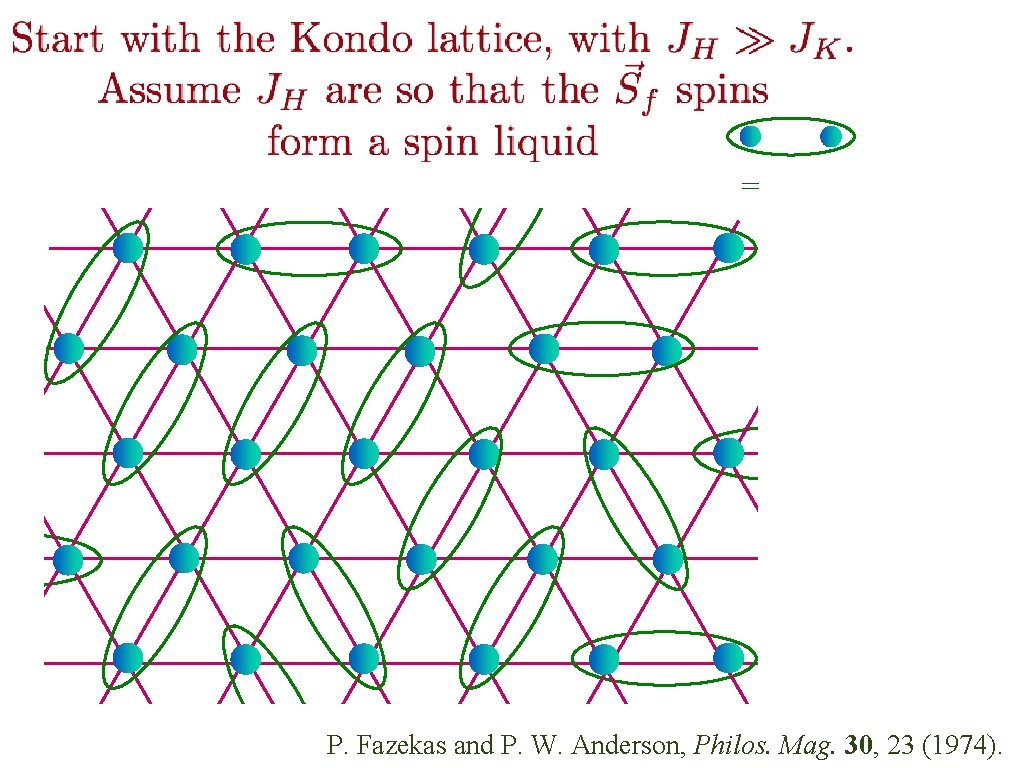
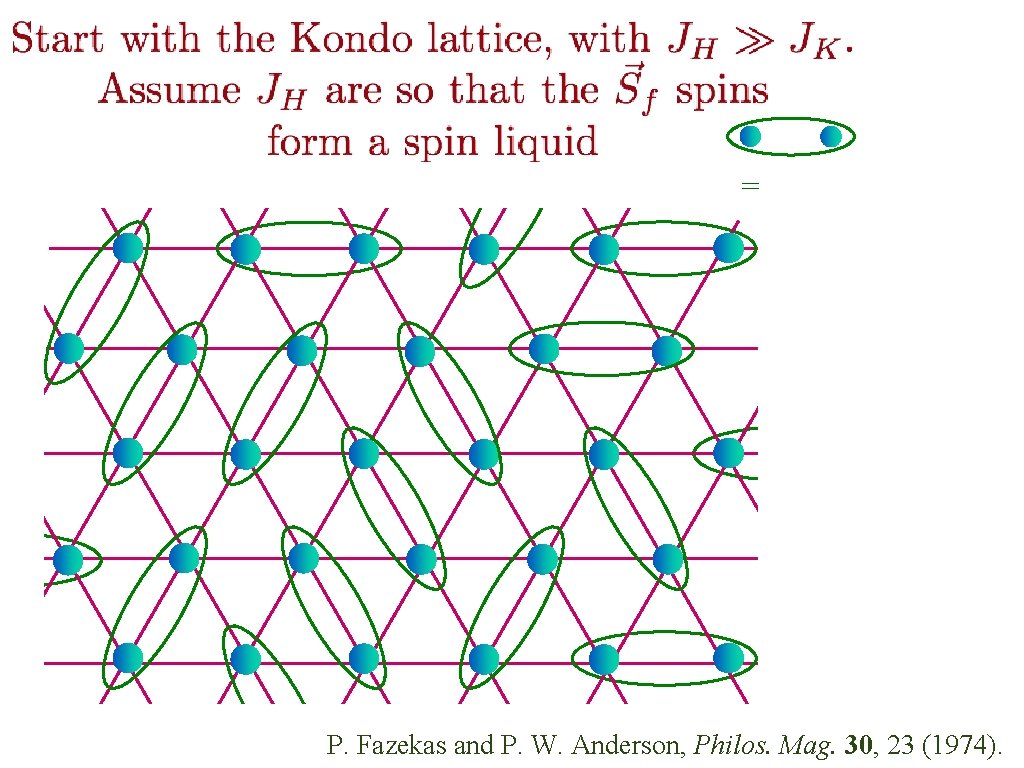
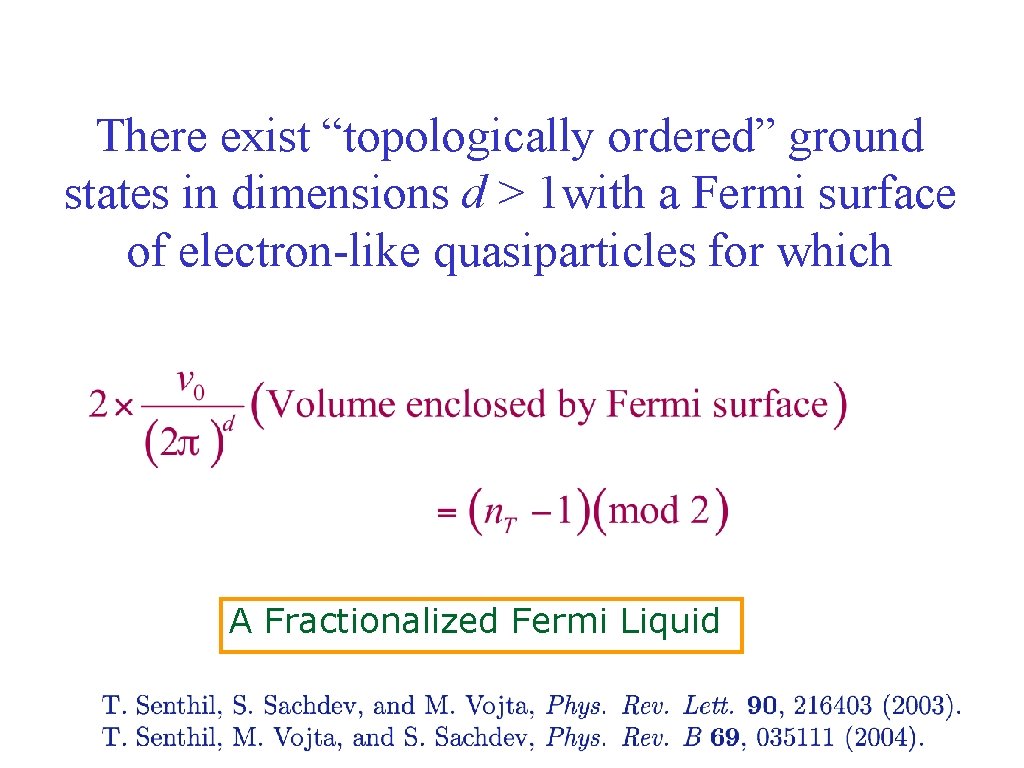
There exist “topologically ordered” ground states in dimensions d > 1 with a Fermi surface of electron-like quasiparticles for which A Fractionalized Fermi Liquid
= P. Fazekas and P. W. Anderson, Philos. Mag. 30, 23 (1974).
= P. Fazekas and P. W. Anderson, Philos. Mag. 30, 23 (1974).
= P. Fazekas and P. W. Anderson, Philos. Mag. 30, 23 (1974).
= P. Fazekas and P. W. Anderson, Philos. Mag. 30, 23 (1974).
= P. Fazekas and P. W. Anderson, Philos. Mag. 30, 23 (1974).
= P. Fazekas and P. W. Anderson, Philos. Mag. 30, 23 (1974).
Effect of flux-piercing on a spin liquid N. E. Bonesteel, Phys. Rev. B 40, 8954 (1989). G. Misguich, C. Lhuillier, M. Mambrini, and P. Sindzingre, Eur. Phys. J. B 26, 167 (2002). Φ Ly Lx-2 Lx-1 Lx 1 2 3
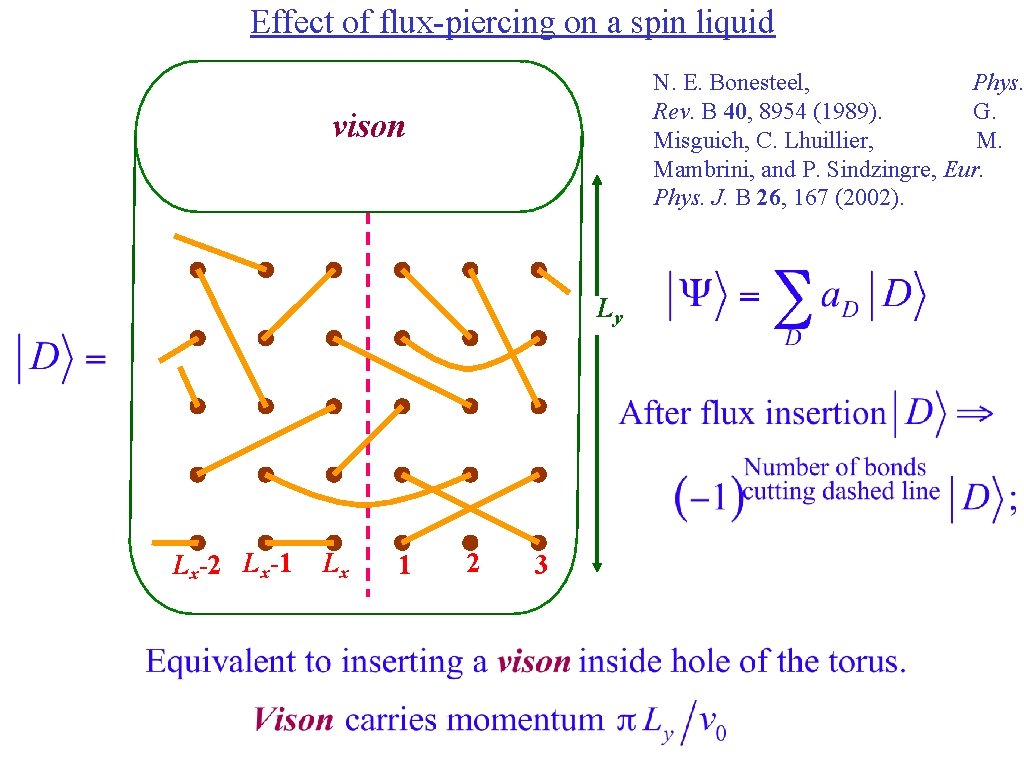
Effect of flux-piercing on a spin liquid N. E. Bonesteel, Phys. Rev. B 40, 8954 (1989). G. Misguich, C. Lhuillier, M. Mambrini, and P. Sindzingre, Eur. Phys. J. B 26, 167 (2002). vison Ly Lx-2 Lx-1 Lx 1 2 3
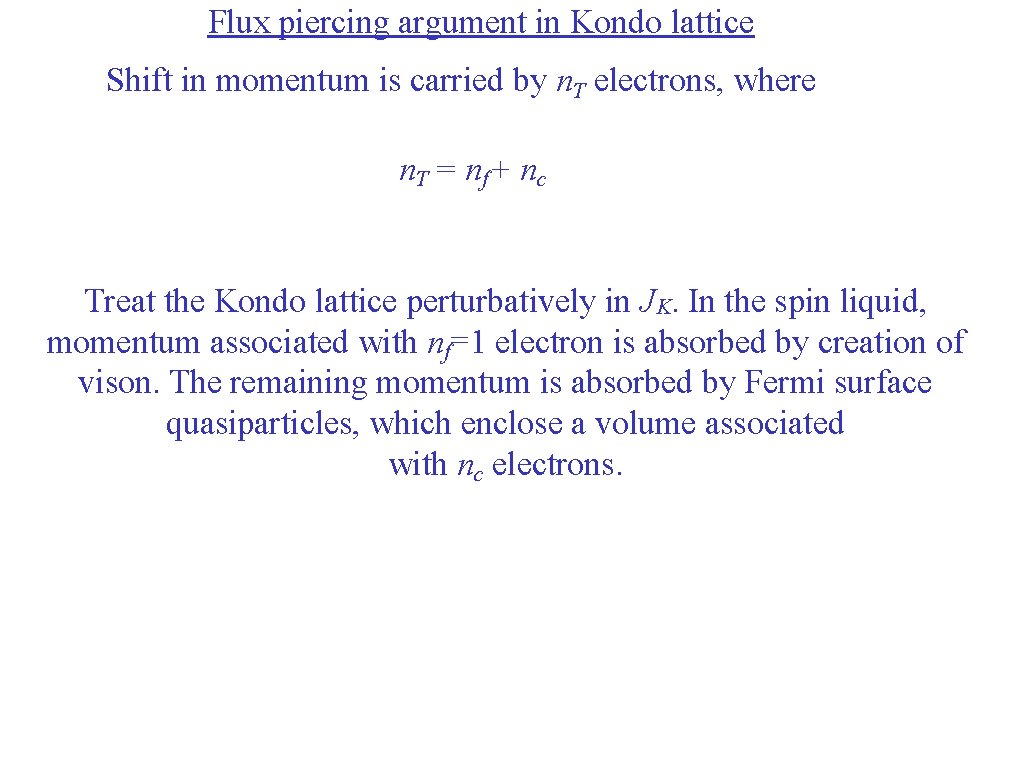
Flux piercing argument in Kondo lattice Shift in momentum is carried by n. T electrons, where n. T = nf+ nc Treat the Kondo lattice perturbatively in JK. In the spin liquid, momentum associated with nf=1 electron is absorbed by creation of vison. The remaining momentum is absorbed by Fermi surface quasiparticles, which enclose a volume associated with nc electrons.
There exist “topologically ordered” ground states in dimensions d > 1 with a Fermi surface of electron-like quasiparticles for which A Fractionalized Fermi Liquid
Outline 1. The Anderson/Kondo lattice models Luttinger’s theorem 2. Fractionalized Fermi liquids Metallic spin-liquid states 3. A mean field theory of a fractionalized Fermi liquid Marginal Fermi liquid physics 4. An Ad. S/CFT perspective Holographic metals as fractionalized Fermi liquids
Outline 1. The Anderson/Kondo lattice models Luttinger’s theorem 2. Fractionalized Fermi liquids Metallic spin-liquid states 3. A mean field theory of a fractionalized Fermi liquid Marginal Fermi liquid physics 4. An Ad. S/CFT perspective Holographic metals as fractionalized Fermi liquids
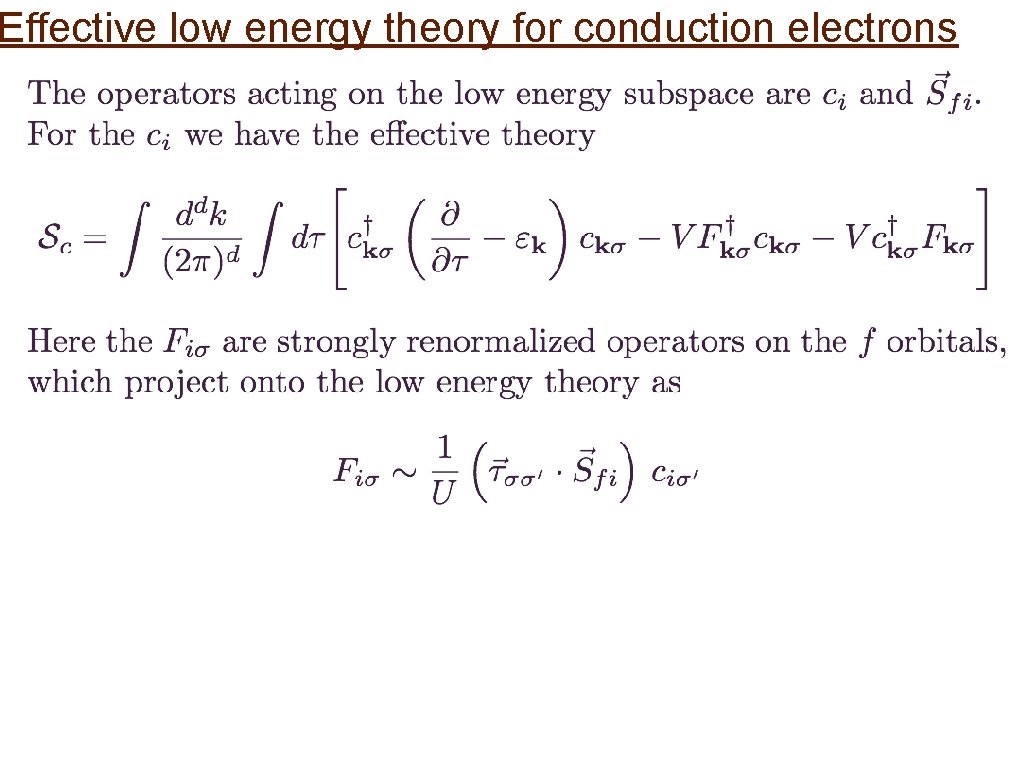
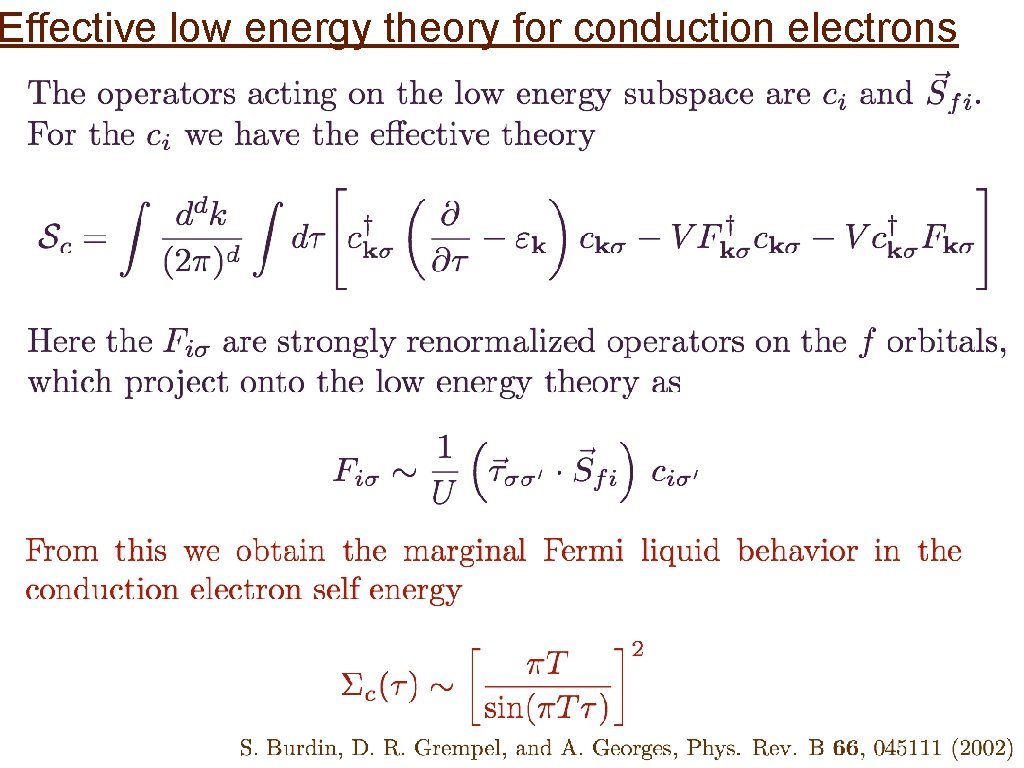
Effective low energy theory for conduction electrons
Effective low energy theory for conduction electrons
Outline 1. The Anderson/Kondo lattice models Luttinger’s theorem 2. Fractionalized Fermi liquids Metallic spin-liquid states 3. A mean field theory of a fractionalized Fermi liquid Marginal Fermi liquid physics 4. An Ad. S/CFT perspective Holographic metals as fractionalized Fermi liquids
Outline 1. The Anderson/Kondo lattice models Luttinger’s theorem 2. Fractionalized Fermi liquids Metallic spin-liquid states 3. A mean field theory of a fractionalized Fermi liquid Marginal Fermi liquid physics 4. An Ad. S/CFT perspective Holographic metals as fractionalized Fermi liquids
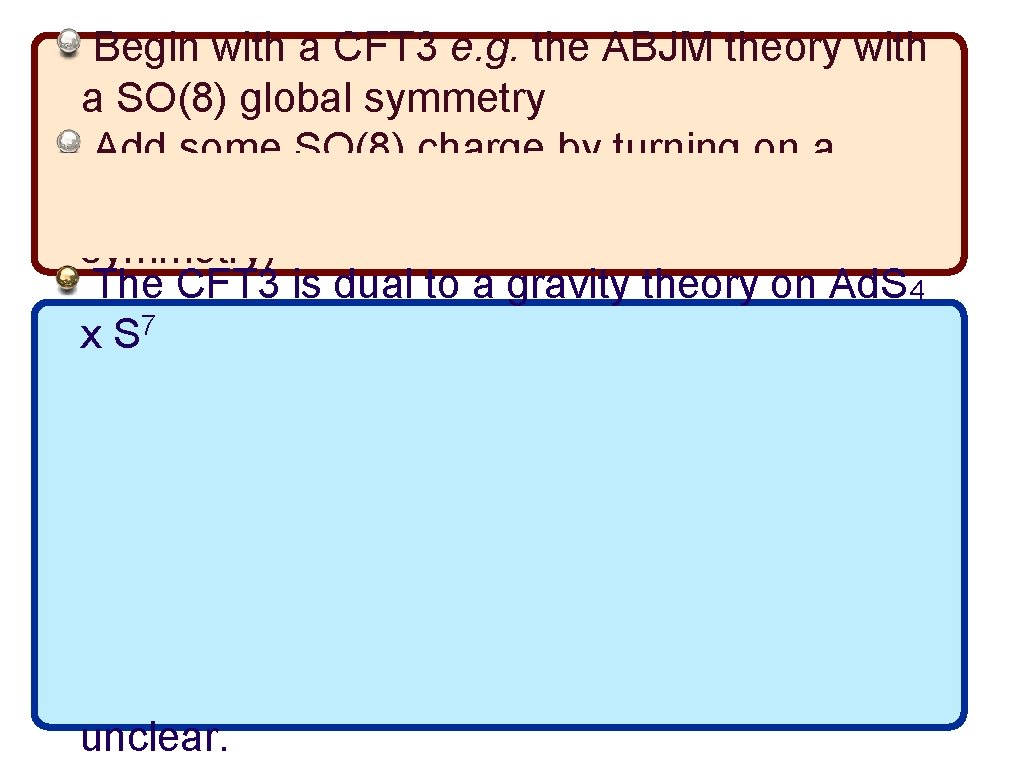
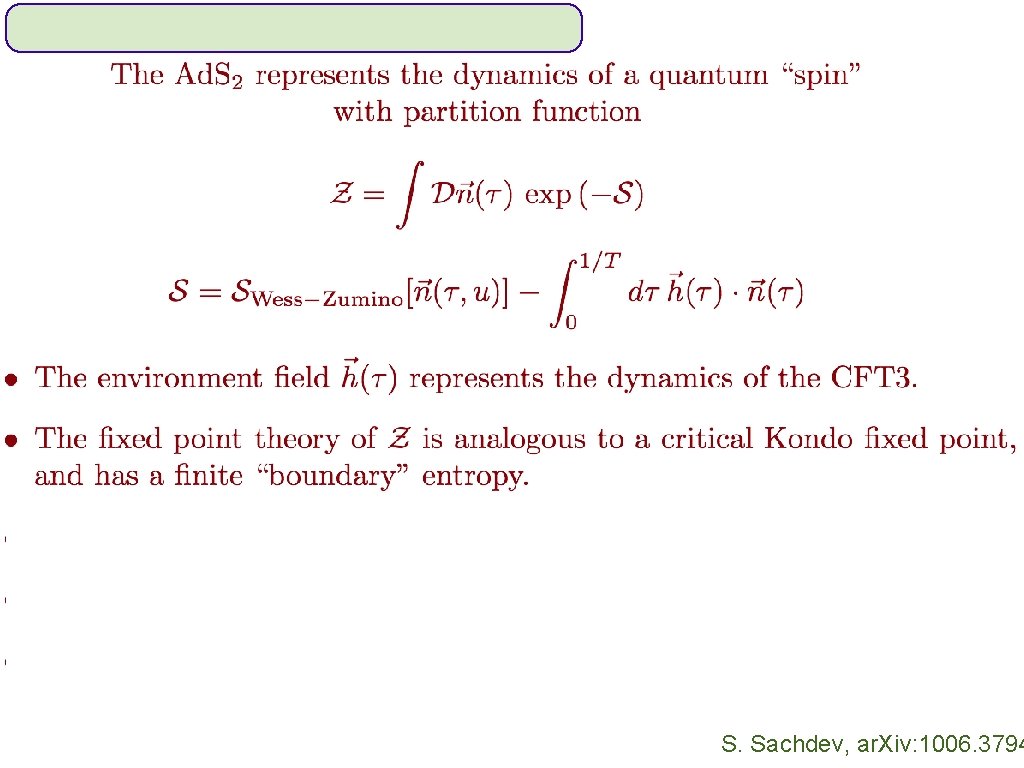
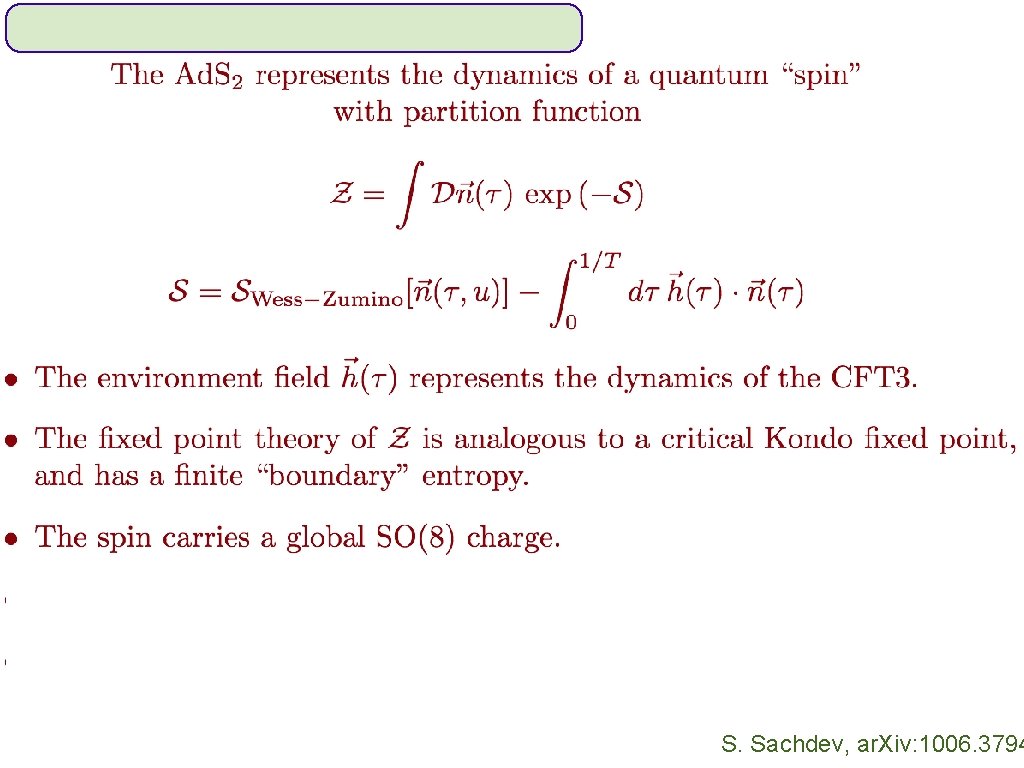
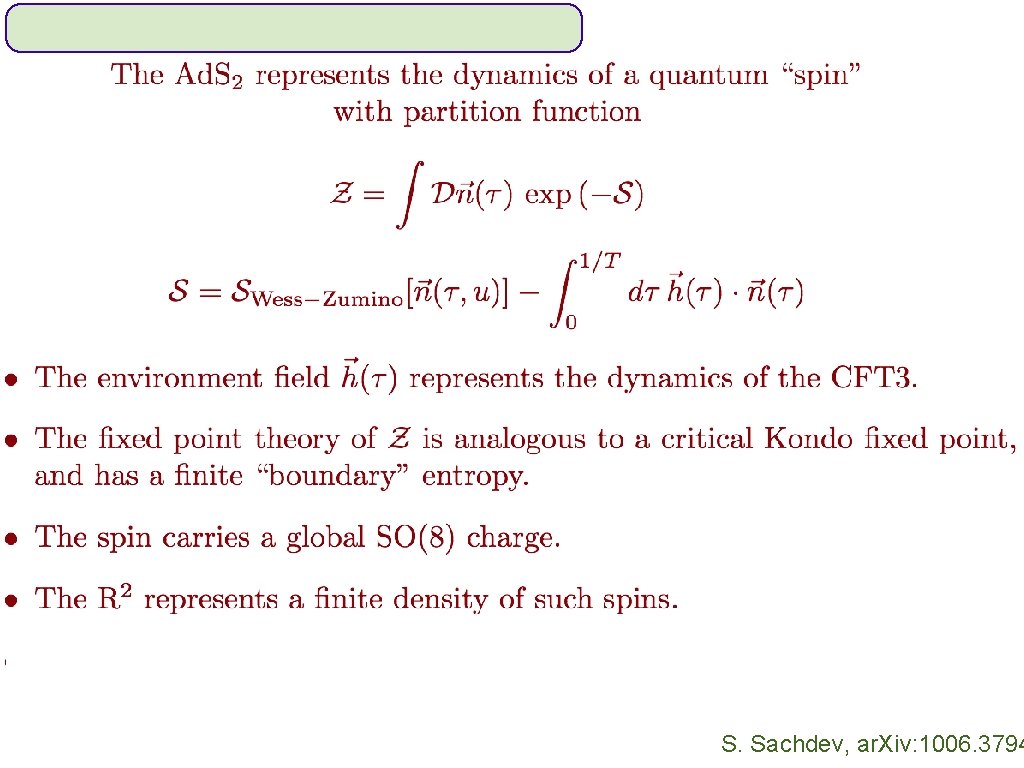
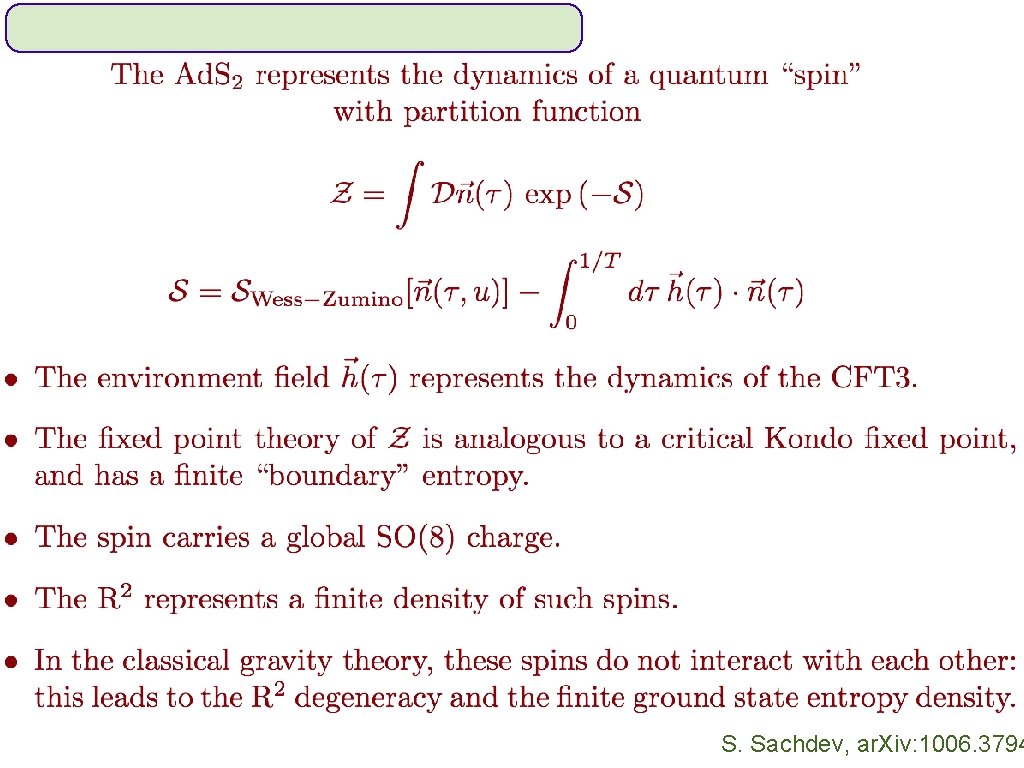
Begin with a CFT 3 e. g. the ABJM theory with a SO(8) global symmetry Add some SO(8) charge by turning on a chemical potential (this will break the SO(8) symmetry) The CFT 3 is dual to a gravity theory on Ad. S 4 7 x. S In the Einstein-Maxwell theory, the chemical potential leads to an extremal Reissner. Nordtrom black hole in the Ad. S 4 spacetime. The near-horizon geometry of the RN black 2 hole is Ad. S 2 x R. The interpretation of the Ad. S 2 theory, the R 2 degeneracy, the finite ground state entropy density have remained unclear.
Begin with a CFT 3 e. g. the ABJM theory with a SO(8) global symmetry Add some SO(8) charge by turning on a chemical potential (this will break the SO(8) symmetry) The CFT 3 is dual to a gravity theory on Ad. S 4 7 x. S In the Einstein-Maxwell theory, the chemical potential leads to an extremal Reissner. Nordtrom black hole in the Ad. S 4 spacetime. The near-horizon geometry of the RN black 2 hole is Ad. S 2 x R. The interpretation of the Ad. S 2 theory, the R 2 degeneracy, the finite ground state entropy density have remained unclear.
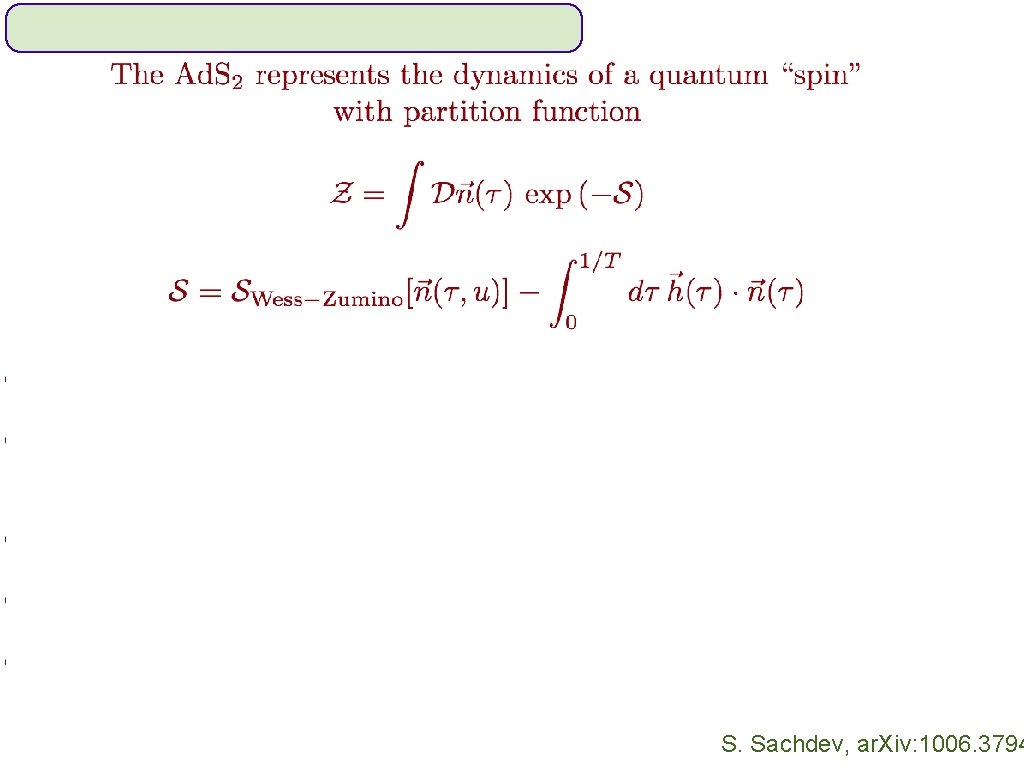
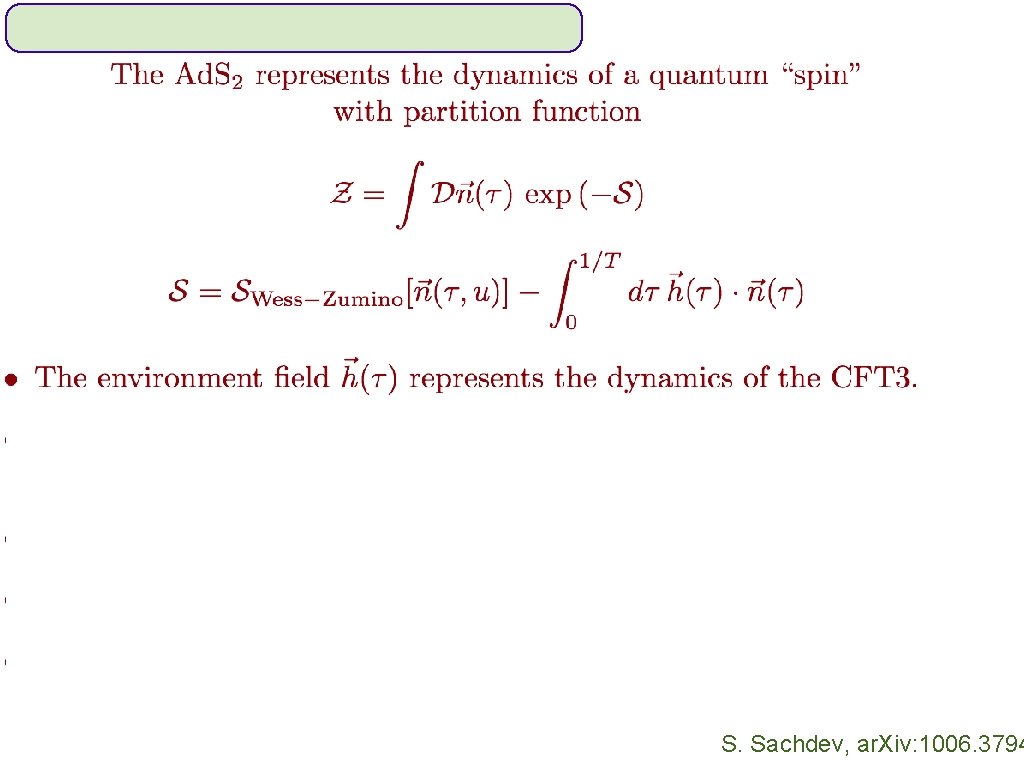
Begin with a CFT 3 e. g. the ABJM theory with a SO(8) global symmetry Add some SO(8) charge by turning on a chemical potential (this will break the SO(8) symmetry) The CFT 3 is dual to a gravity theory on Ad. S 4 7 x. S In the Einstein-Maxwell theory, the chemical potential leads to an extremal Reissner. Nordtrom black hole in the Ad. S 4 spacetime. The near-horizon geometry of the RN black 2 hole is Ad. S 2 x R. There has been no clear inter-pretation of the Ad. S 2 theory, the R 2 degeneracy, and the finite ground state entropy density
S. Sachdev, ar. Xiv: 1006. 3794
S. Sachdev, ar. Xiv: 1006. 3794
S. Sachdev, ar. Xiv: 1006. 3794
S. Sachdev, ar. Xiv: 1006. 3794
S. Sachdev, ar. Xiv: 1006. 3794
S. Sachdev, ar. Xiv: 1006. 3794
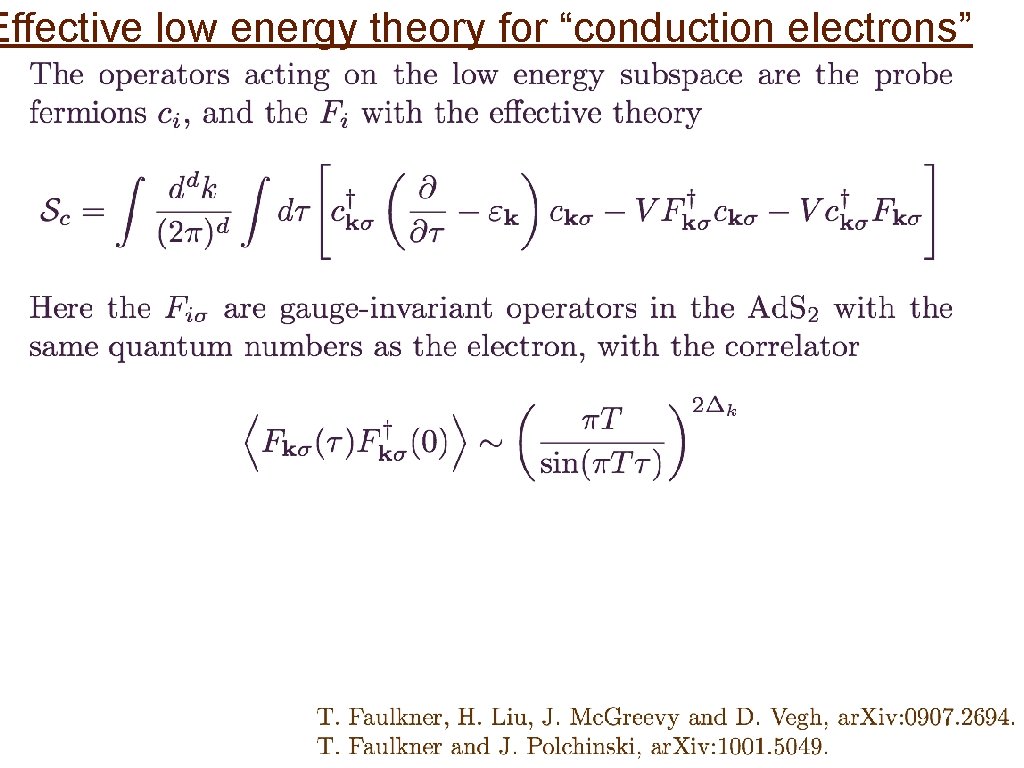
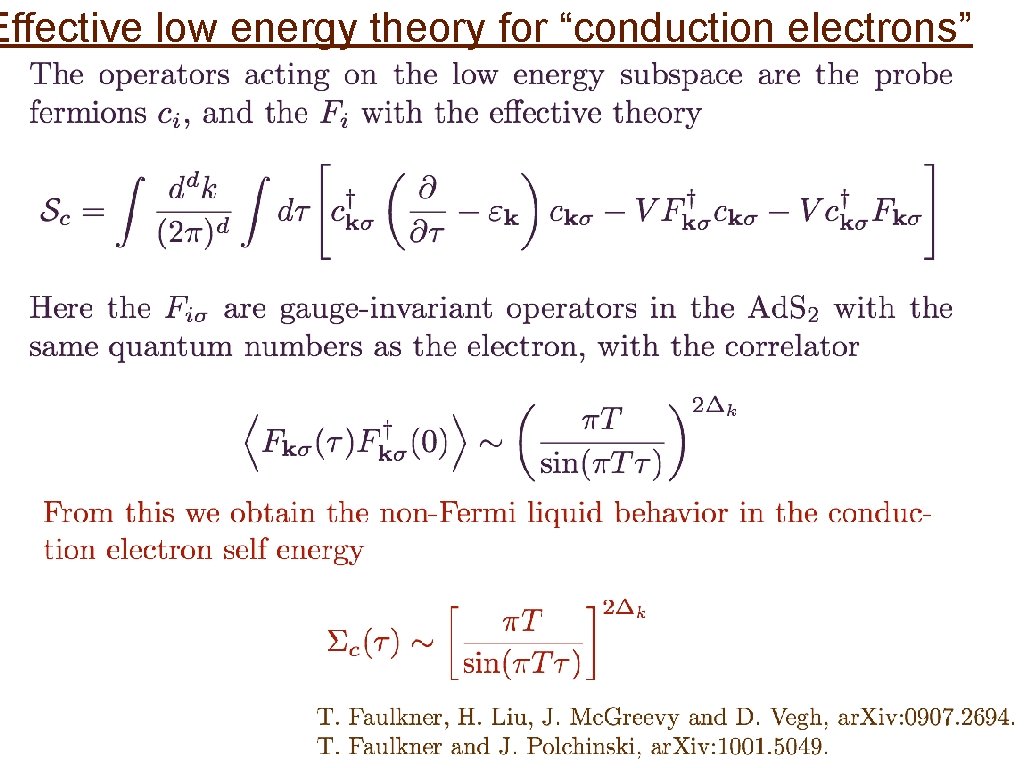
Effective low energy theory for “conduction electrons”
Effective low energy theory for “conduction electrons”
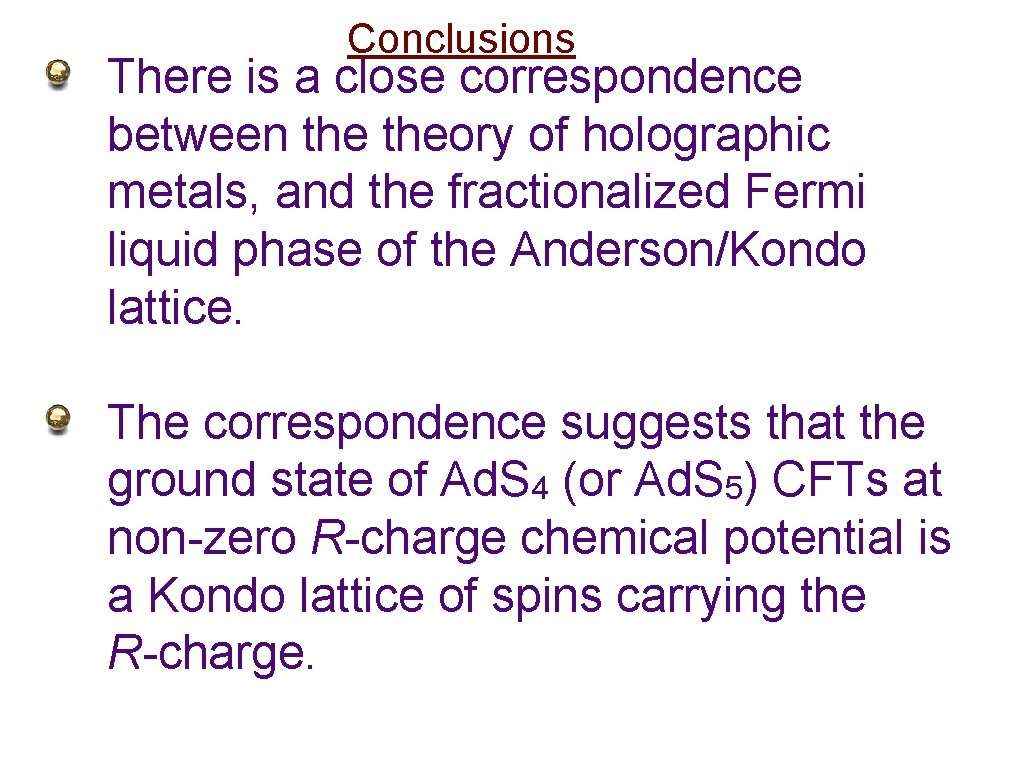
Conclusions There is a close correspondence between theory of holographic metals, and the fractionalized Fermi liquid phase of the Anderson/Kondo lattice. The correspondence suggests that the ground state of Ad. S 4 (or Ad. S 5) CFTs at non-zero R-charge chemical potential is a Kondo lattice of spins carrying the R-charge.
Conclusions There is a close correspondence between theory of holographic metals, and the fractionalized Fermi liquid phase of the Anderson/Kondo lattice. The correspondence suggests that the ground state of Ad. S 4 (or Ad. S 5) CFTs at non-zero R-charge chemical potential is a Kondo lattice of spins carrying the R-charge.
Conclusions There is a close correspondence between theory of holographic metals, and the fractionalized Fermi liquid phase of the Anderson/Kondo lattice. The correspondence suggests that the ground state of Ad. S 4 (or Ad. S 5) CFTs at non-zero R-charge chemical potential is a Kondo lattice of spins carrying the R-charge.