
Exotic hadronhadron Swave Interaction Bingsong Zou IHEP Beijing
“Exotic” hadron-hadron S-wave Interaction Bing-song Zou IHEP, Beijing
Outline 1. “Exotic” pp S-wave Interaction Why interested ? How “exotic” ? Similarity between pp, p. K and p. N s-wave scattering What’s the nature of the broad s ? Why it appears narrower in production processes ? Why f 0(980)’s peak width is so narrow ? 2. I=0 1 S 0`pp & I=1 1 S 0 pp near threshold enhancement 3. KL S-wave near threshold enhancement in J/y p K-`L vs p p p K+ L
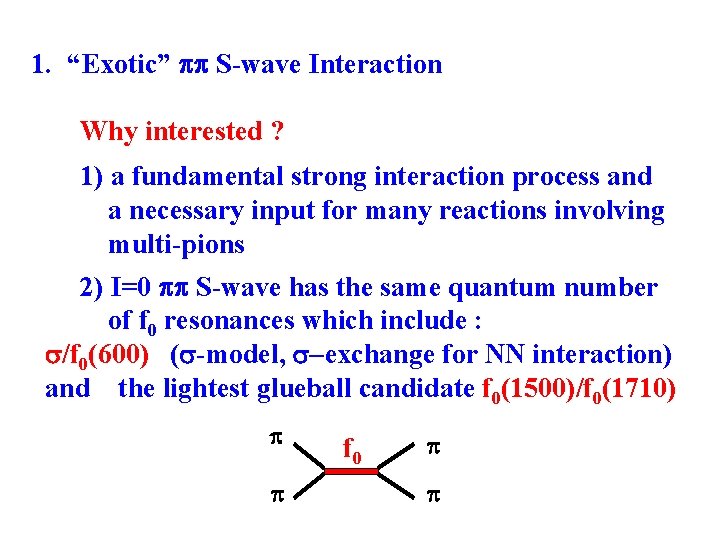
1. “Exotic” pp S-wave Interaction Why interested ? 1) a fundamental strong interaction process and a necessary input for many reactions involving multi-pions 2) I=0 pp S-wave has the same quantum number of f 0 resonances which include : s/f 0(600) (s-model, s-exchange for NN interaction) and the lightest glueball candidate f 0(1500)/f 0(1710) p p f 0 p p
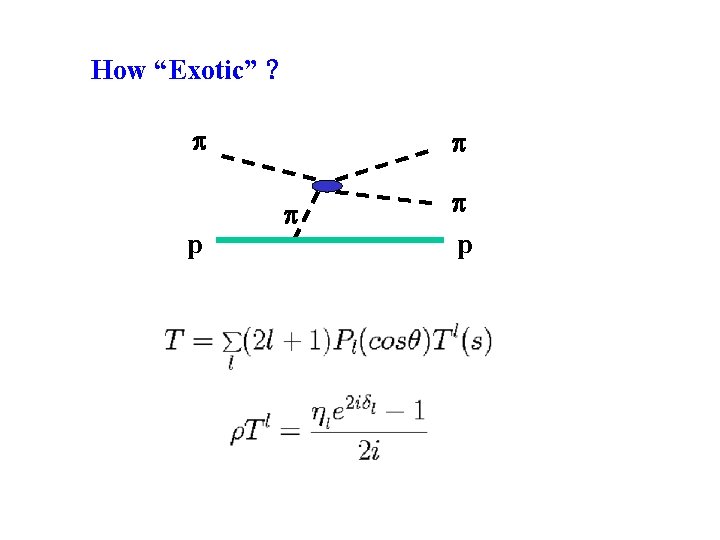
How “Exotic” ? p p p
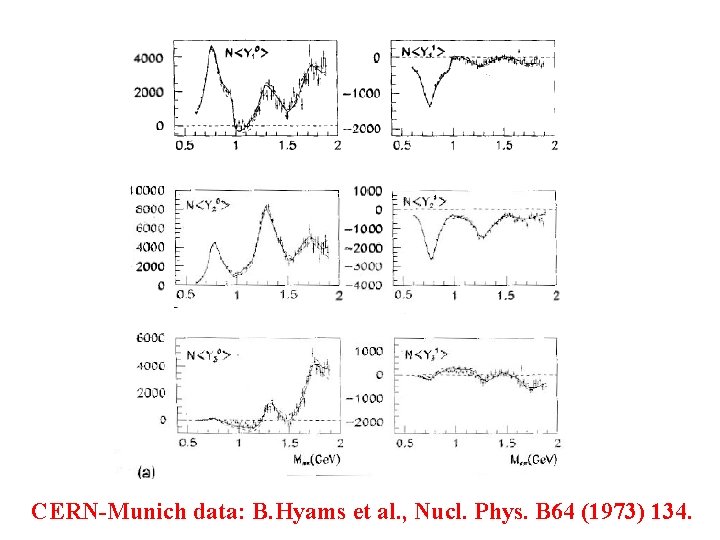
CERN-Munich data: B. Hyams et al. , Nucl. Phys. B 64 (1973) 134.
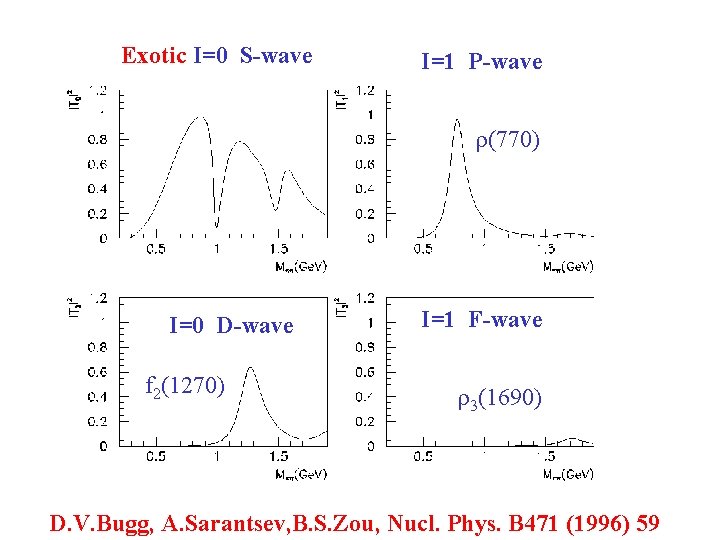
Exotic I=0 S-wave I=1 P-wave r(770) I=0 D-wave f 2(1270) I=1 F-wave r 3(1690) D. V. Bugg, A. Sarantsev, B. S. Zou, Nucl. Phys. B 471 (1996) 59
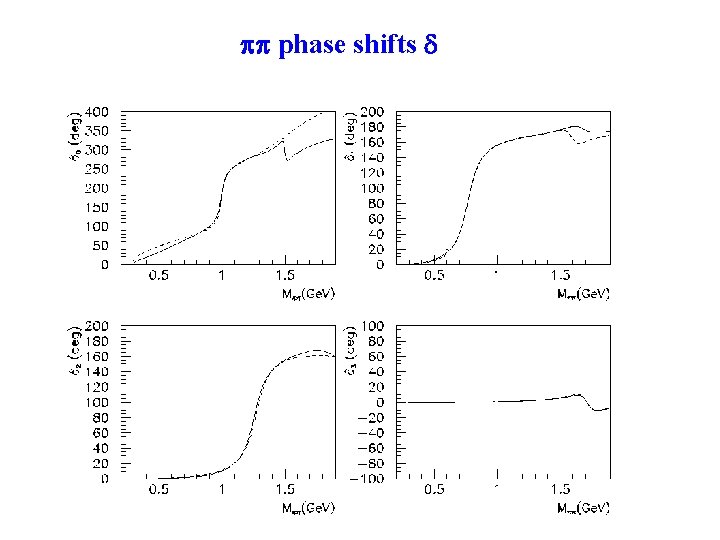
pp phase shifts d
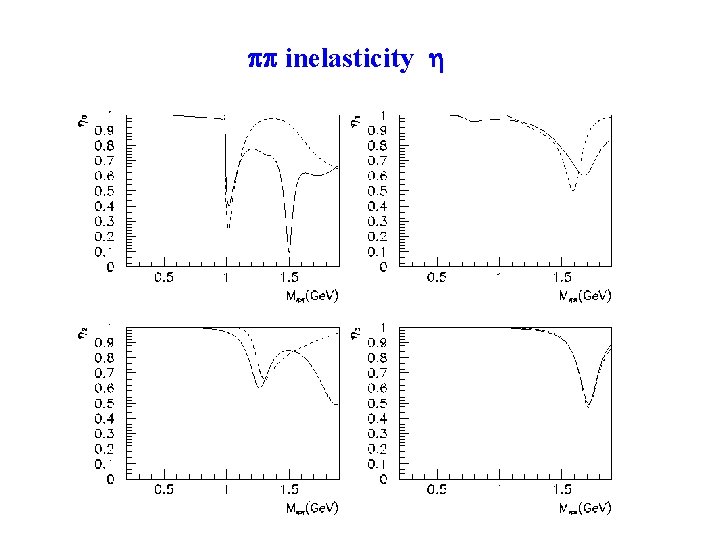
pp inelasticity h
“Exotic” pp S-wave interaction : broad s-background with narrow resonances as dips instead of peaks
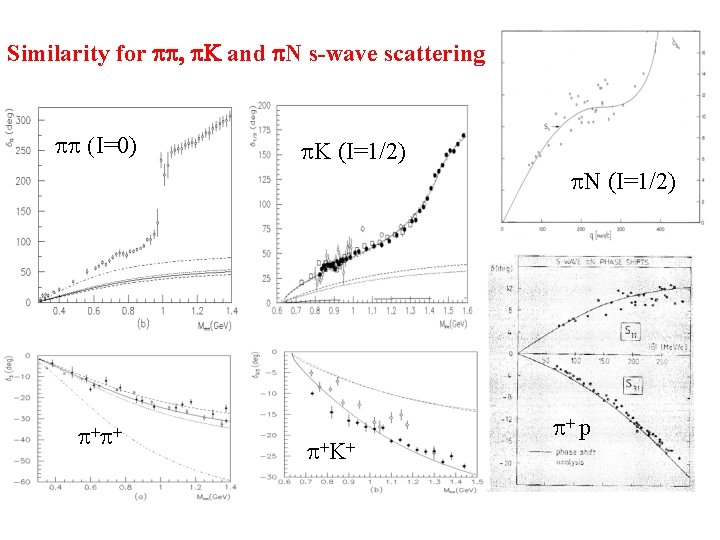
Similarity for pp, p. K and p. N s-wave scattering pp (I=0) p. K (I=1/2) p. N (I=1/2) p +p + K+ p+ p
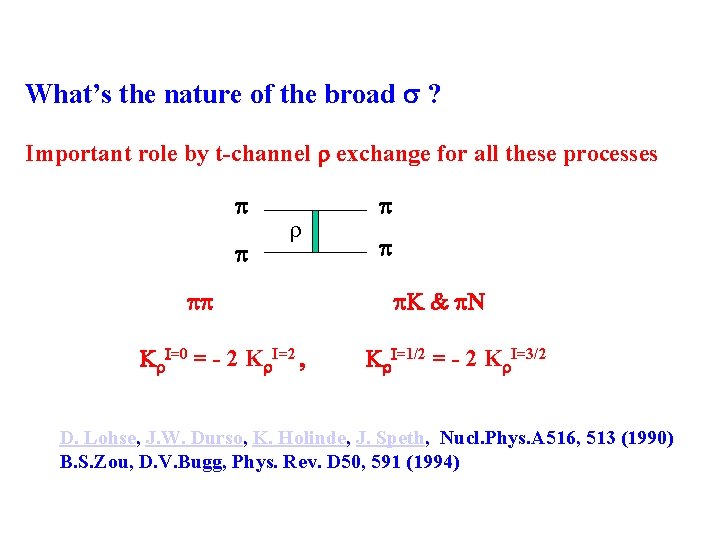
What’s the nature of the broad s ? Important role by t-channel r exchange for all these processes p p r pp Kr. I=0 = - 2 Kr. I=2 , p p p. K & p. N Kr. I=1/2 = - 2 Kr. I=3/2 D. Lohse, J. W. Durso, K. Holinde, J. Speth, Nucl. Phys. A 516, 513 (1990) B. S. Zou, D. V. Bugg, Phys. Rev. D 50, 591 (1994)
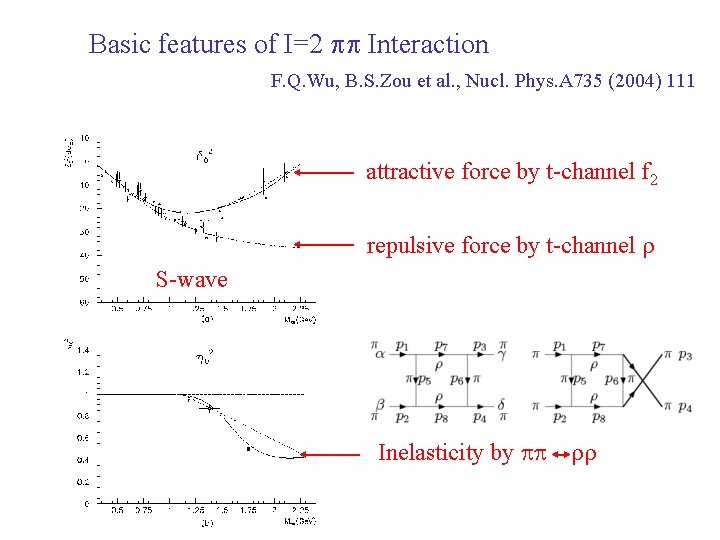
Basic features of I=2 pp Interaction F. Q. Wu, B. S. Zou et al. , Nucl. Phys. A 735 (2004) 111 attractive force by t-channel f 2 repulsive force by t-channel r S-wave Inelasticity by pp rr
An important cause for hadron-hadron S-wave interactions appearing “exotic” is t-channel meson-exchange amplitude has a comparable strength as s-channel resonance contribution for S-waves. For higher partial waves, s-channel resonance contribution dominates.
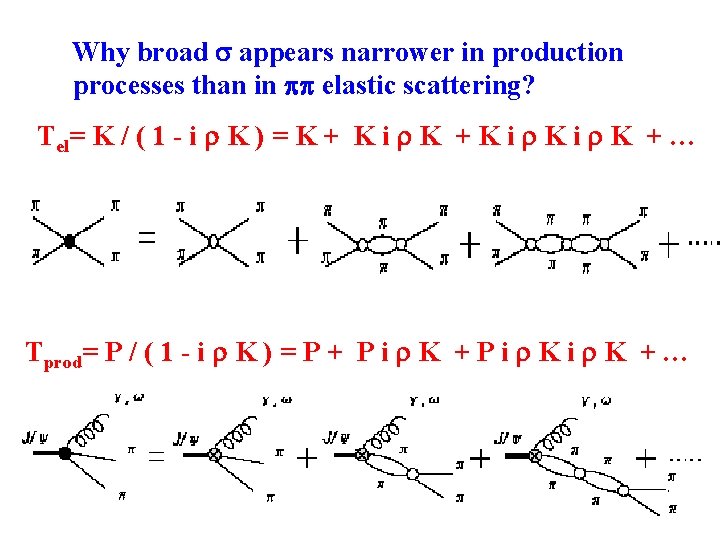
Why broad s appears narrower in production processes than in pp elastic scattering? Tel= K / ( 1 - i r K ) = K + K i r K + … Tprod= P / ( 1 - i r K ) = P + P i r K + …
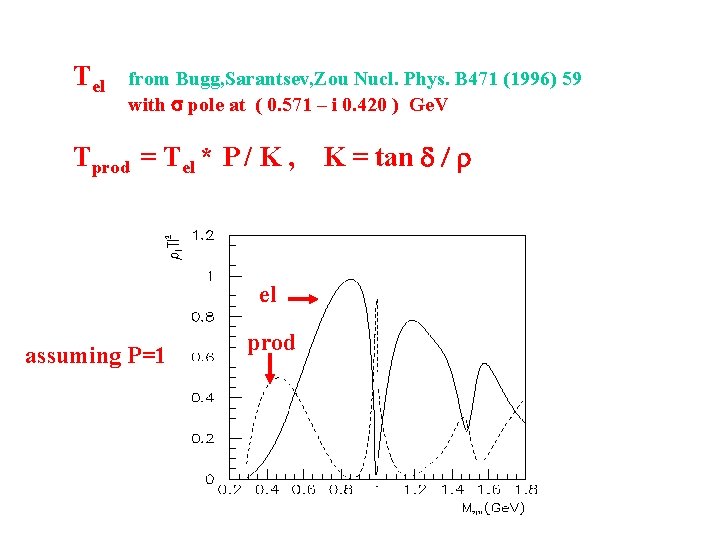
Tel from Bugg, Sarantsev, Zou Nucl. Phys. B 471 (1996) 59 with s pole at ( 0. 571 – i 0. 420 ) Ge. V Tprod = Tel * P / K , el assuming P=1 prod K = tan d / r

How about production vertex P ? P(V’ Vp+p-) T. Mannel, R. Urech, Z. Phys. C 73, 541 (1997); Ulf-G. Meißner, J. Oller, Nucl. Phys. A 679 (2001) 671; L. Roca, J. Palomar, E. Oset, H. C. Chiang, Nucl. Phys. A 744 (2004) 127 F. K. Guo, P. N. Shen, H. C. Chiang, R. G. Ping, Nucl. Phys. A 761 (2005) 269 For y’ J/y p+p- , Ep small, 1 st term dominates higher s peak For y w p+p- , Ep large, 2 nd term dominates lower s peak position is process dependent ! P ~ c 1 + c 2 s
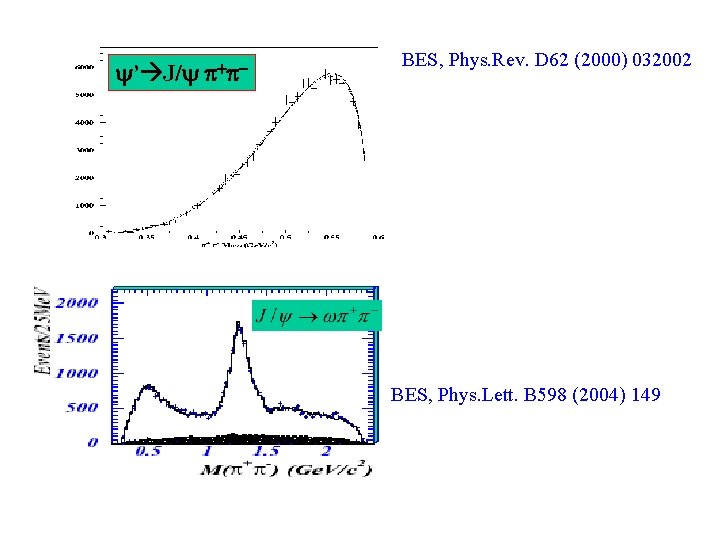
y’ J/y p +p - BES, Phys. Rev. D 62 (2000) 032002 BES, Phys. Lett. B 598 (2004) 149
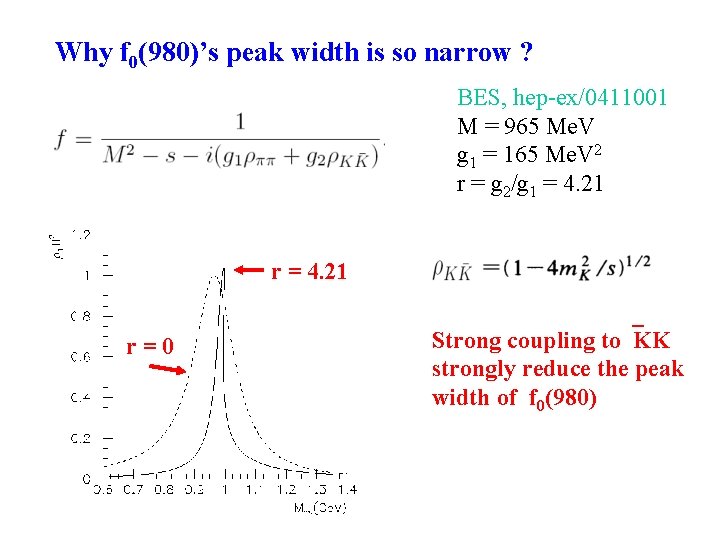
Why f 0(980)’s peak width is so narrow ? BES, hep-ex/0411001 M = 965 Me. V g 1 = 165 Me. V 2 r = g 2/g 1 = 4. 21 r=0 Strong coupling to`KK strongly reduce the peak width of f 0(980)
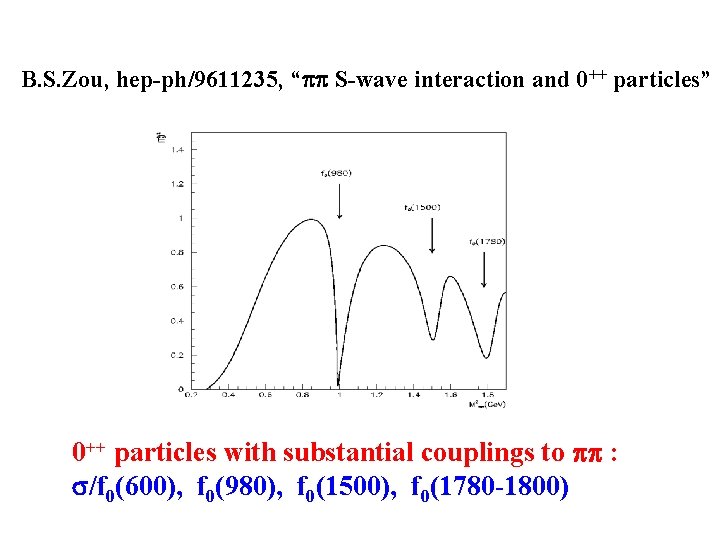
B. S. Zou, hep-ph/9611235, “pp S-wave interaction and 0++ particles” 0++ particles with substantial couplings to pp : s/f 0(600), f 0(980), f 0(1500), f 0(1780 -1800)
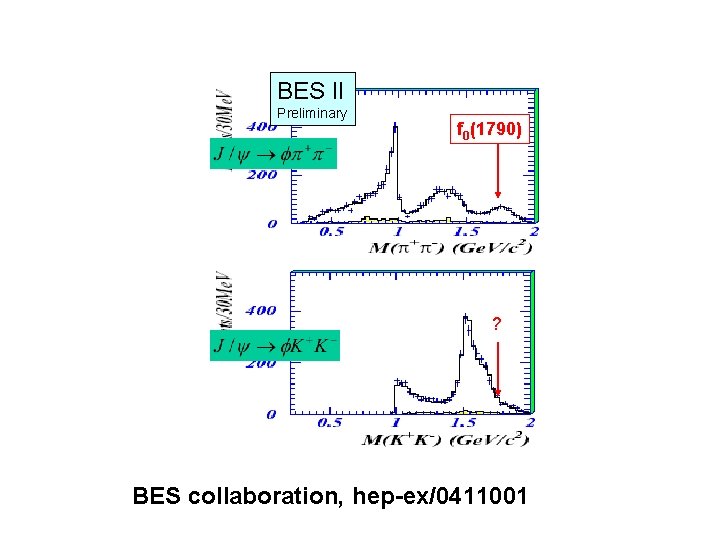
BES II Preliminary f 0(1790) ? BES collaboration, hep-ex/0411001
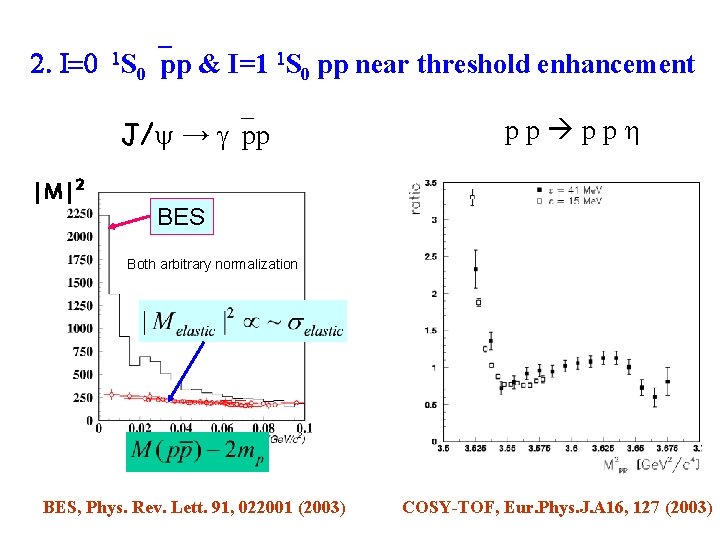
2. I=0 1 S 0`pp & I=1 1 S 0 pp near threshold enhancement J/ → `pp |M|2 pp pph BES Both arbitrary normalization BES, Phys. Rev. Lett. 91, 022001 (2003) COSY-TOF, Eur. Phys. J. A 16, 127 (2003)
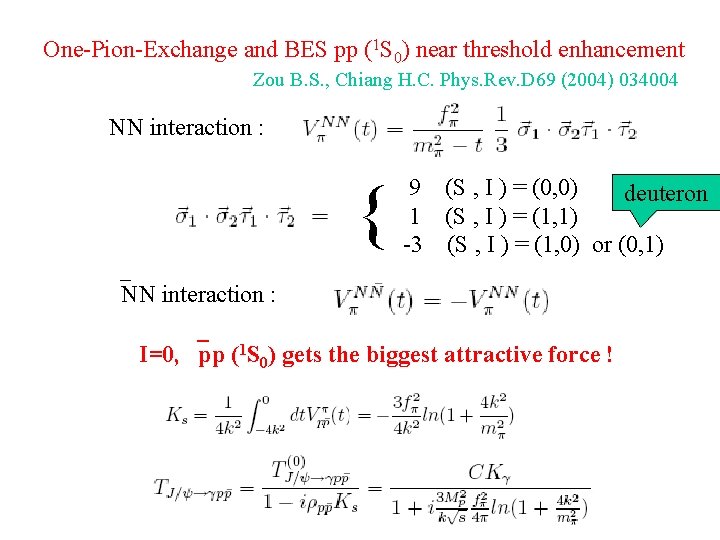
One-Pion-Exchange and BES pp (1 S 0) near threshold enhancement Zou B. S. , Chiang H. C. Phys. Rev. D 69 (2004) 034004 NN interaction : { 9 (S , I ) = (0, 0) deuteron 1 (S , I ) = (1, 1) -3 (S , I ) = (1, 0) or (0, 1) `NN interaction : I=0, `pp (1 S 0) gets the biggest attractive force !
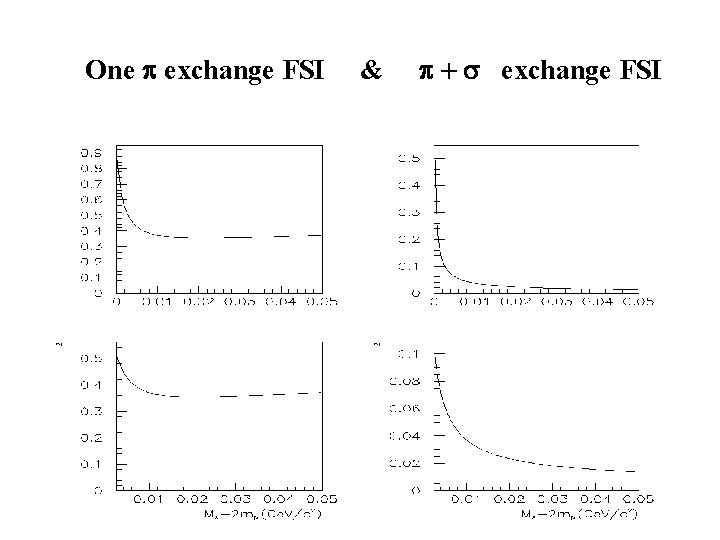
One p exchange FSI & p + s exchange FSI
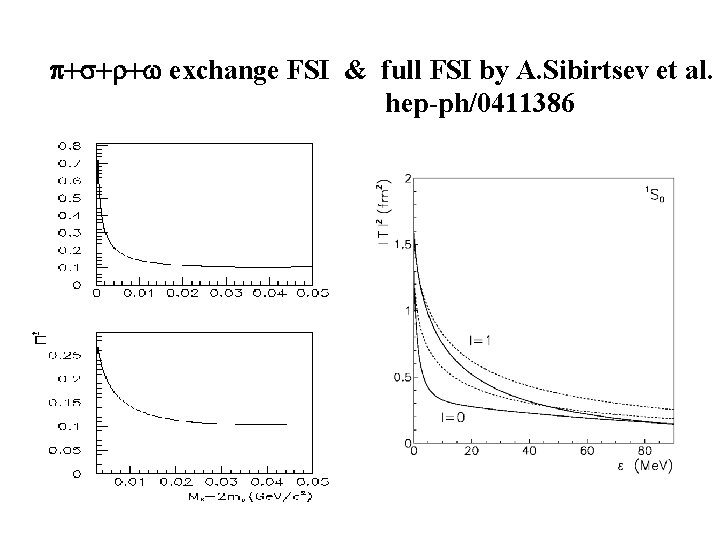
p+s+r+w exchange FSI & full FSI by A. Sibirtsev et al. hep-ph/0411386
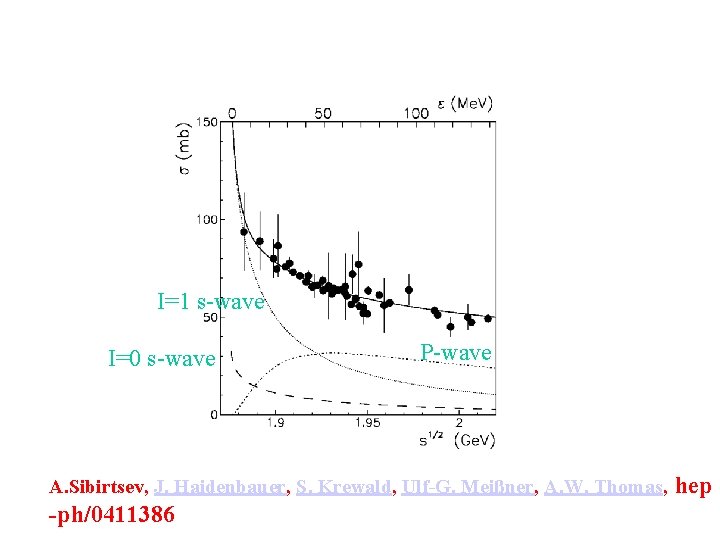
I=1 s-wave I=0 s-wave P-wave A. Sibirtsev, J. Haidenbauer, S. Krewald, Ulf-G. Meißner, A. W. Thomas, -ph/0411386 hep
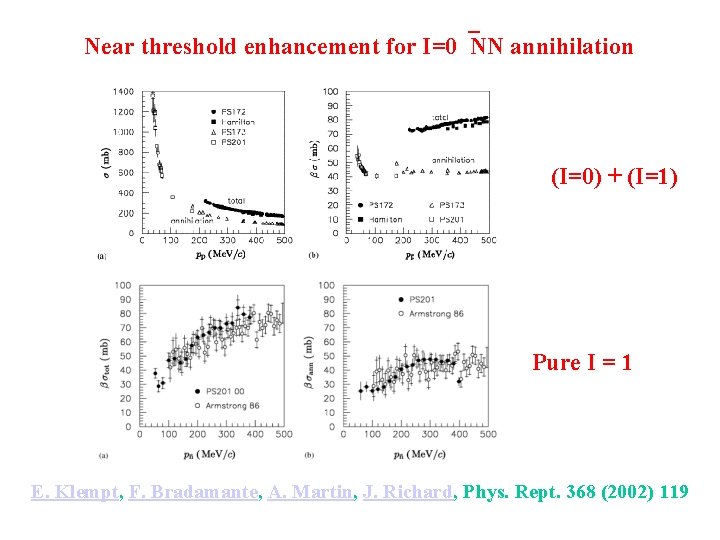
Near threshold enhancement for I=0`NN annihilation (I=0) + (I=1) Pure I = 1 E. Klempt, F. Bradamante, A. Martin, J. Richard, Phys. Rept. 368 (2002) 119
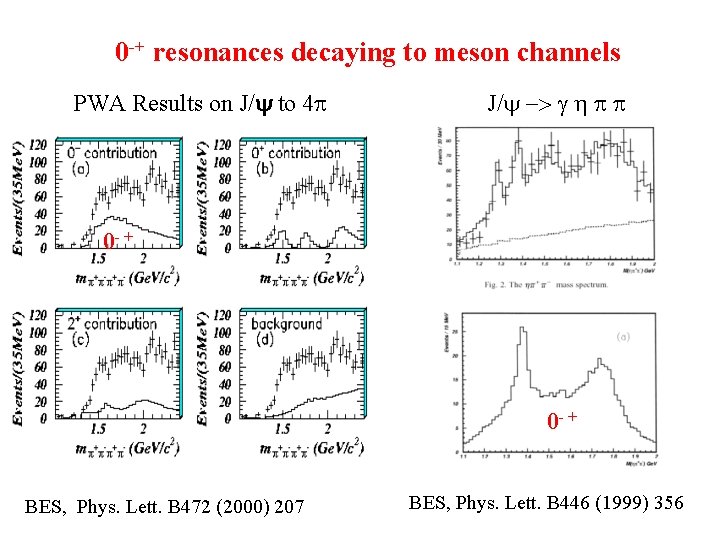
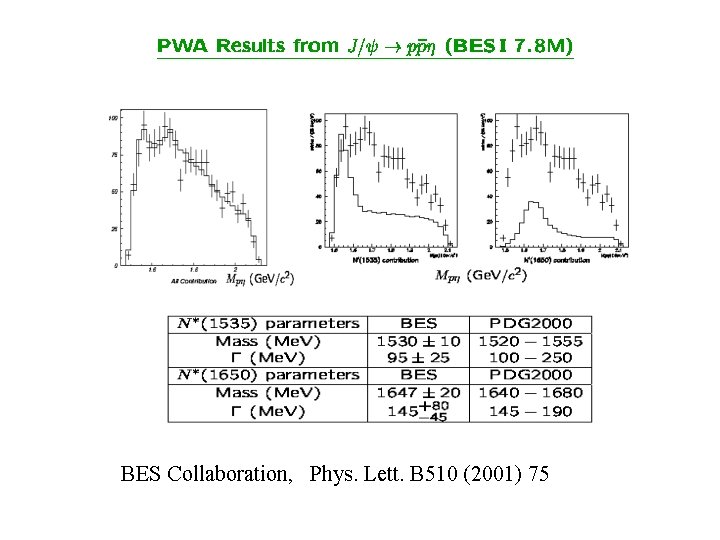
0 -+ resonances decaying to meson channels PWA Results on J/y to 4 p J/ -> h p p 0 - + BES, Phys. Lett. B 472 (2000) 207 BES, Phys. Lett. B 446 (1999) 356
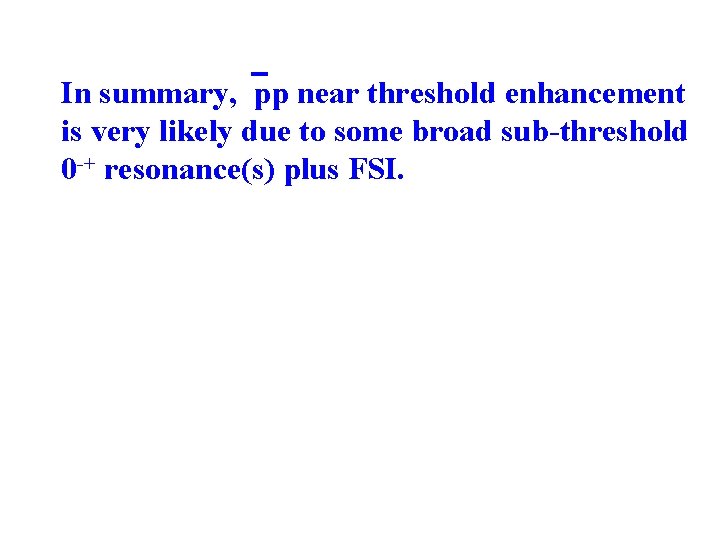
In summary, `pp near threshold enhancement is very likely due to some broad sub-threshold 0 -+ resonance(s) plus FSI.
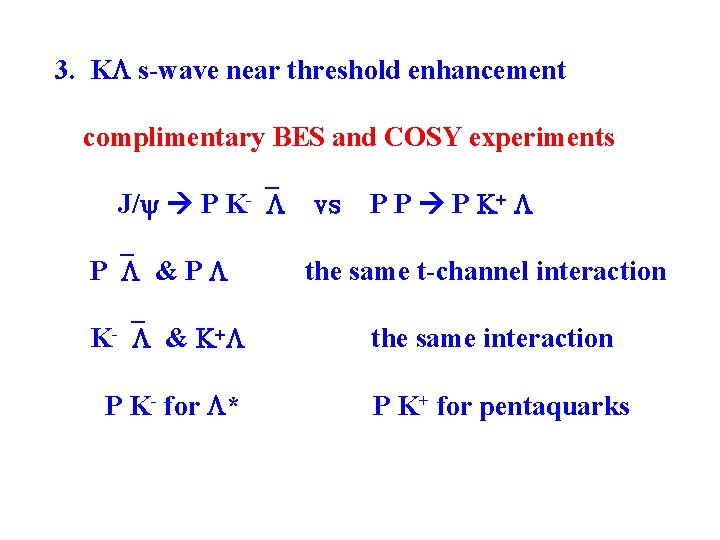
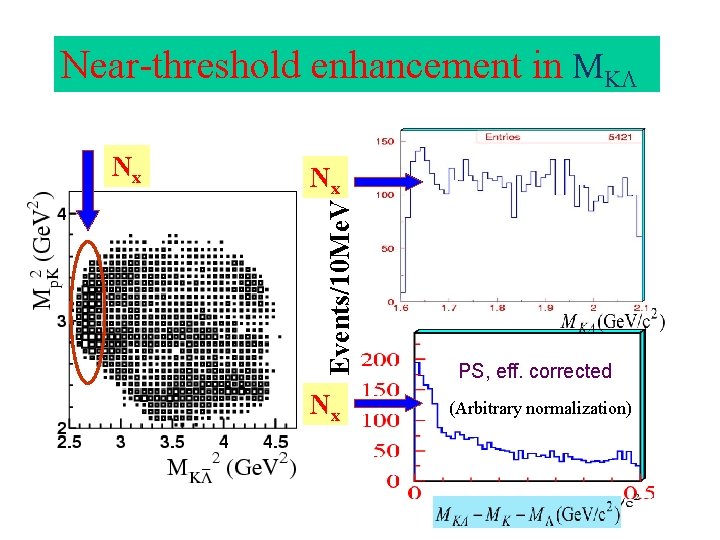
3. KL s-wave near threshold enhancement complimentary BES and COSY experiments J/y P K-`L P`L & P L K-`L & K+L P K- for L* vs P P P K+ L the same t-channel interaction the same interaction P K+ for pentaquarks
Near-threshold enhancement in MK Nx Events/10 Me. V Nx Nx PS, eff. corrected (Arbitrary normalization)
BES Collaboration, Phys. Lett. B 510 (2001) 75
B. C. Liu and B. S. Zou, Phys. Rev. Lett. 96 (2006) 042002 From relative branching ratios of J/y p`N* p (K-`L) / p (`ph) g. N*KL /g. N*ph /g. N*pp ~ 1. 3 : 1 : 0. 6 Smaller N*(1535) BW mass previous results 0 ~ 2. 6 from p. N and g. N data
P P P K+ L with g. N*KL /g. N*ph = 1. 3 with N*(1535) without N*(1535) K. Tsushima, A. Sibirtsev, A. Thomas, Phys. Rev. C 59 (1999) 369
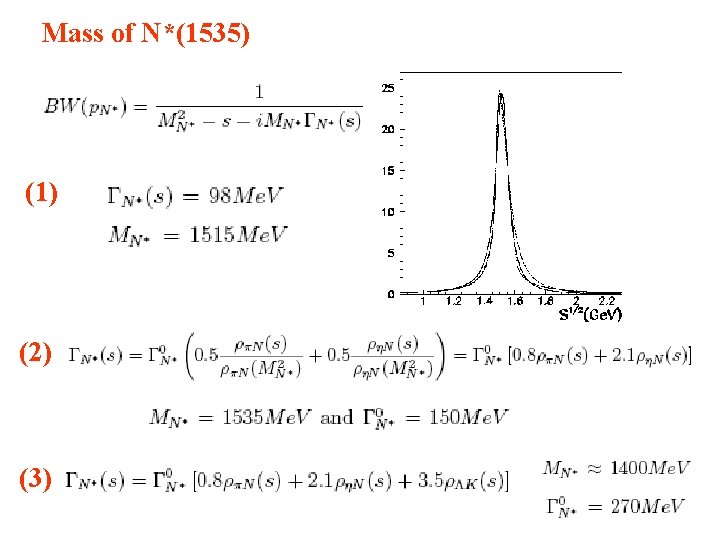
Mass of N*(1535) (1) (2) (3)
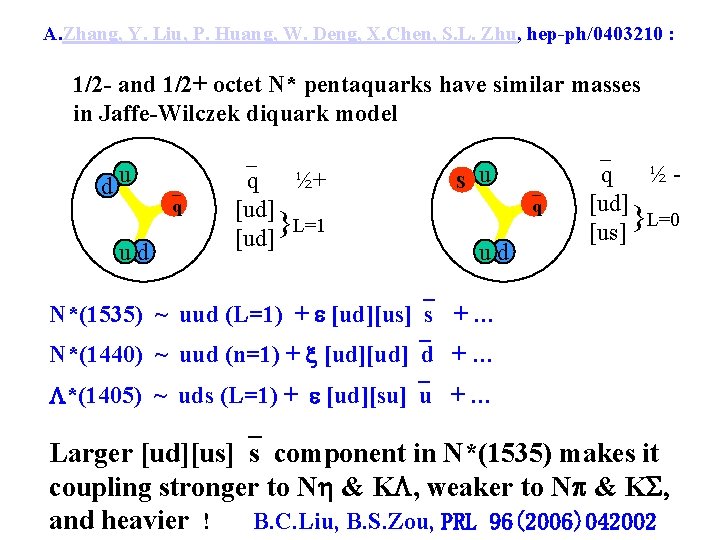
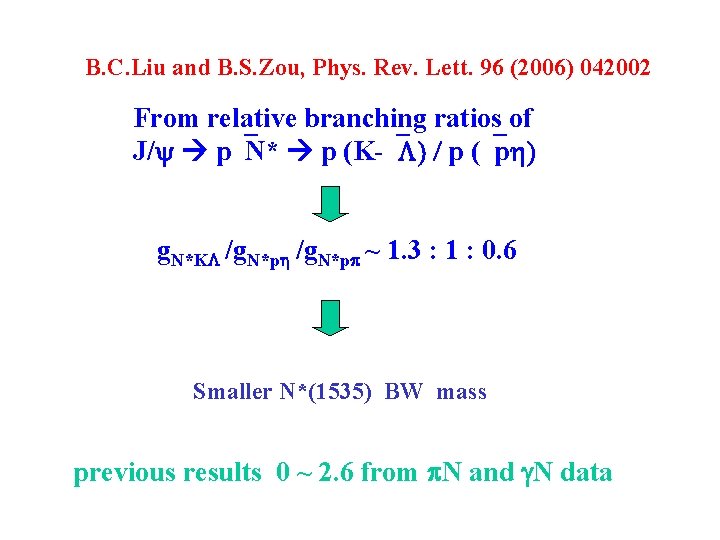
A. Zhang, Y. Liu, P. Huang, W. Deng, X. Chen, S. L. Zhu, hep-ph/0403210 : 1/2 - and 1/2+ octet N* pentaquarks have similar masses in Jaffe-Wilczek diquark model du ud `q `q ½+ [ud] } L=1 [ud] S u `q ud `q ½[ud] }L=0 [us] N*(1535) ~ uud (L=1) + e [ud][us]`s + … N*(1440) ~ uud (n=1) + x [ud]`d + … L*(1405) ~ uds (L=1) + e [ud][su]`u + … Larger [ud][us]`s component in N*(1535) makes it coupling stronger to Nh & KL, weaker to Np & KS, and heavier ! B. C. Liu, B. S. Zou, PRL 96(2006)042002
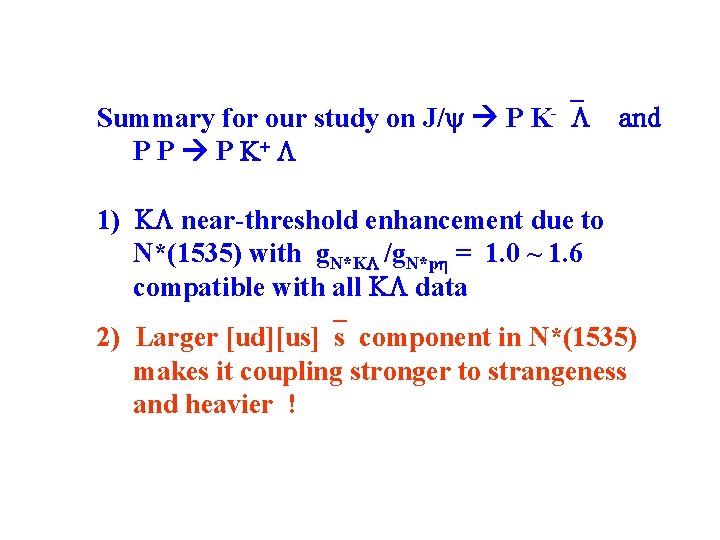
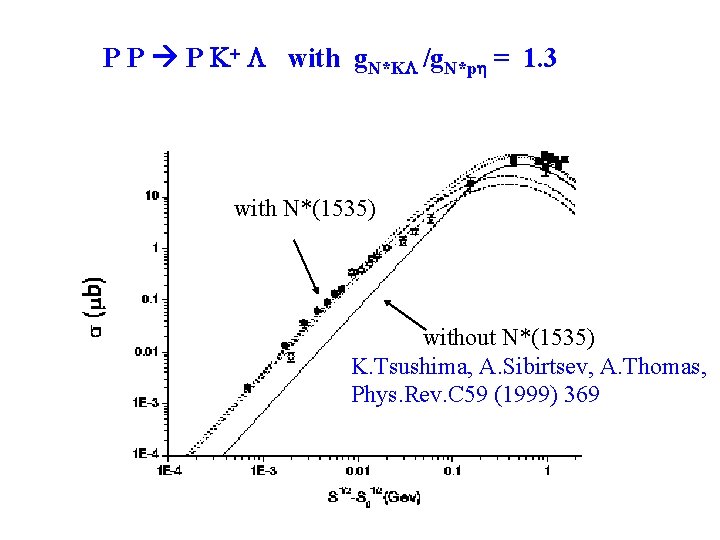
Summary for our study on J/y P K-`L P P P K+ L and 1) KL near-threshold enhancement due to N*(1535) with g. N*KL /g. N*ph = 1. 0 ~ 1. 6 compatible with all KL data 2) Larger [ud][us]`s component in N*(1535) makes it coupling stronger to strangeness and heavier !

- Slides: 37