
Exotic baryon resonances in the chiral dynamics Tetsuo
Exotic baryon resonances in the chiral dynamics Tetsuo Hyodoa A. Hosakaa, D. Jidob, S. I. Nama, E. Osetc, B. A. Ramosd and M. J. Vicente Vacasc a RCNP, Osaka b ECT* c IFIC, Valencia d Barcelona Univ. 2003, December 9 th
Contents 1. Structure of L(1405) 1. Motivation : Two poles? 2. Chiral unitary model 3. Pole structure of L(1405) 4. Photo-production of K*L(1405) 2. Quantum numbers of Q+ 1. Present status of theoretical studies 2. Chiral model for K+p -> p+KN 3. Results 4. Polarization test
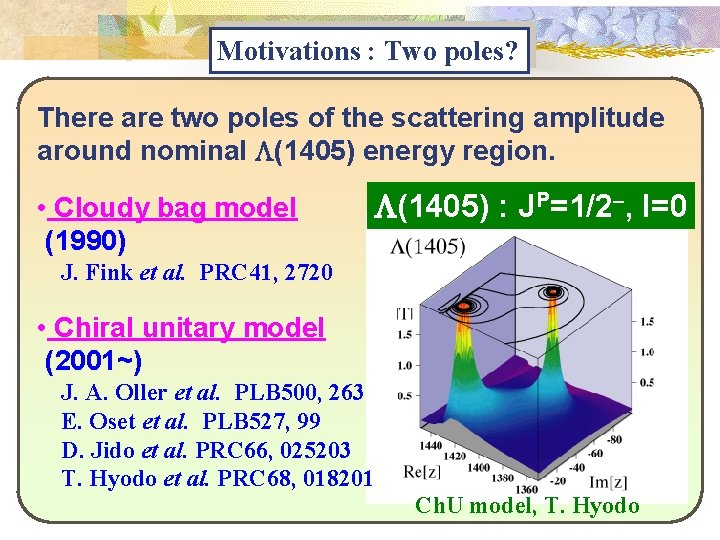
Motivations : Two poles? There are two poles of the scattering amplitude around nominal L(1405) energy region. • Cloudy bag model (1990) L(1405) : JP=1/2 -, I=0 J. Fink et al. PRC 41, 2720 • Chiral unitary model (2001~) J. A. Oller et al. PLB 500, 263 E. Oset et al. PLB 527, 99 D. Jido et al. PRC 66, 025203 T. Hyodo et al. PRC 68, 018201 Ch. U model, T. Hyodo
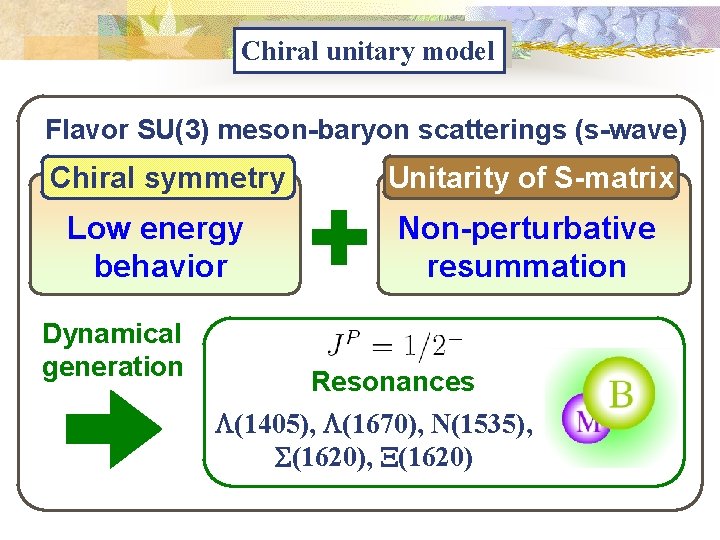
Chiral unitary model Flavor SU(3) meson-baryon scatterings (s-wave) Chiral symmetry Low energy behavior Dynamical generation Unitarity of S-matrix Non-perturbative resummation Resonances L(1405), L(1670), N(1535), S(1620), X(1620)
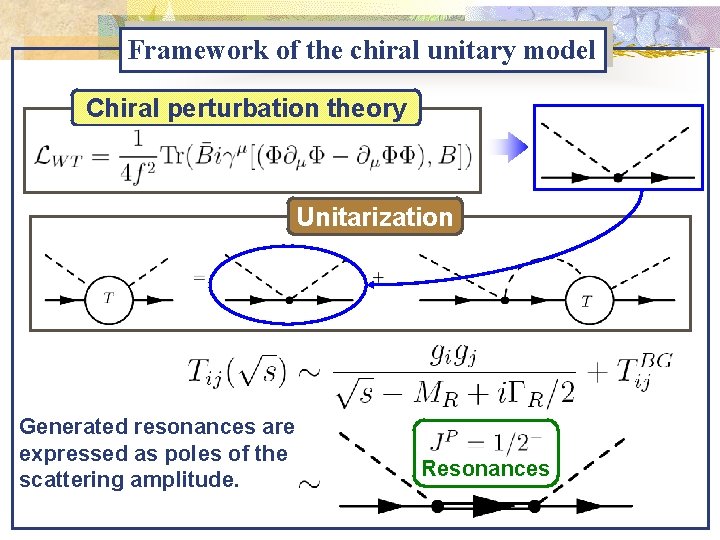
Framework of the chiral unitary model Chiral perturbation theory Unitarization Generated resonances are expressed as poles of the scattering amplitude. Resonances
Total cross sections of K-p scatterings T. Hyodo, et al. , Phys. Rev. C 68, 018201 (2003)
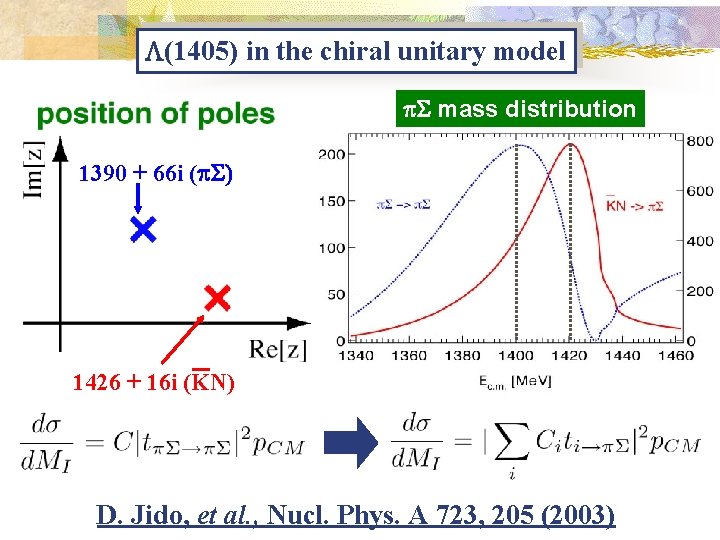
L(1405) in the chiral unitary model p. S mass distribution 1390 + 66 i (p. S) 1426 + 16 i (KN) D. Jido, et al. , Nucl. Phys. A 723, 205 (2003)
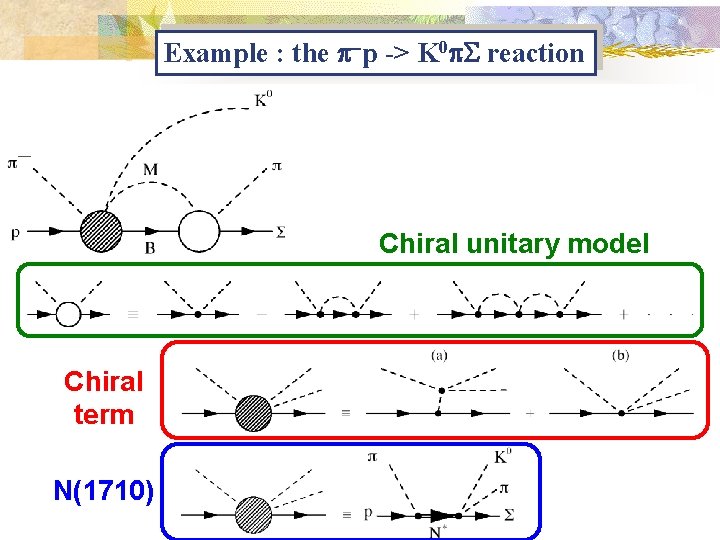
Example : the p-p -> K 0 p. S reaction Chiral unitary model Chiral term N(1710)
![Results for p-p -> K 0 p. S Mass distribution Total cross sections [mb]](http://slidetodoc.com/presentation_image/4a93a6bae6fe1cff039662964340274a/image-9.jpg "Results for p-p -> K 0 p. S Mass distribution Total cross sections [mb]")
Results for p-p -> K 0 p. S Mass distribution Total cross sections [mb] S(1385) effect Good agreement �There are two mechanisms in the initial stage interaction, which filter each one of the resonances. T. Hyodo, et al. , nucl-th/0307005, Phys. Rev. C, in press
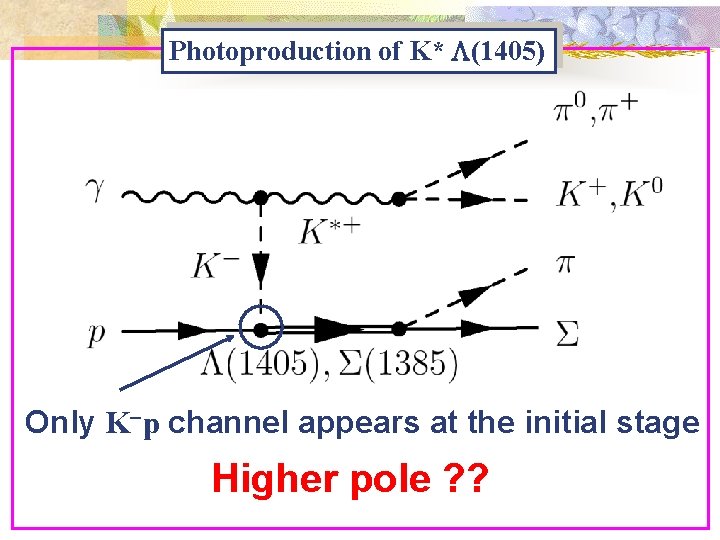
Photoproduction of K* L(1405) Only K-p channel appears at the initial stage Higher pole ? ?
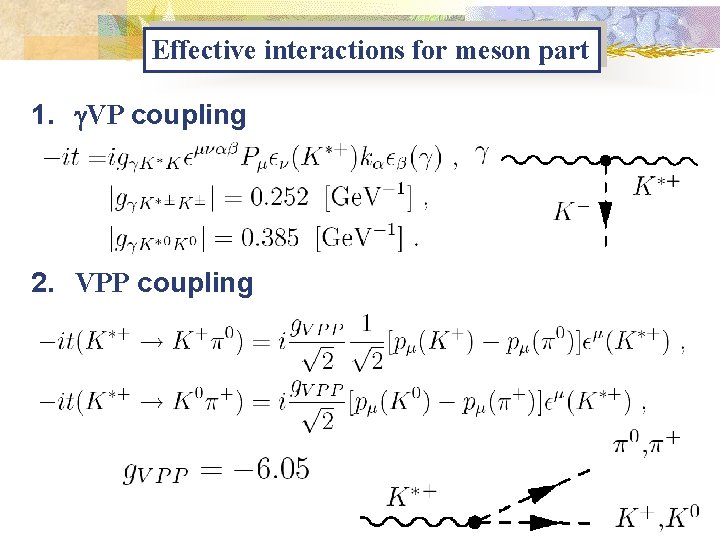
Effective interactions for meson part 1. g. VP coupling 2. VPP coupling
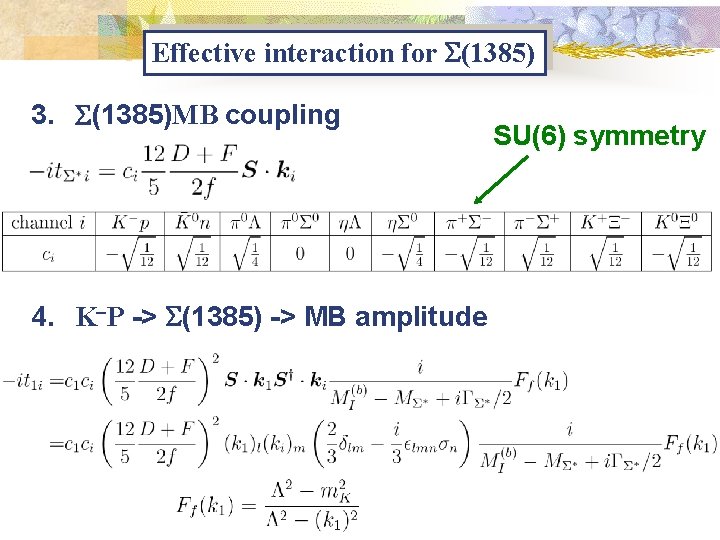
Effective interaction for S(1385) 3. S(1385)MB coupling 4. K-P -> S(1385) -> MB amplitude SU(6) symmetry
p. S invariant mass distribution Plab = 2. 5 Ge. V/c sqrt s ~ 2. 35 Ge. V Preliminary
Result : Total cross section Preliminary
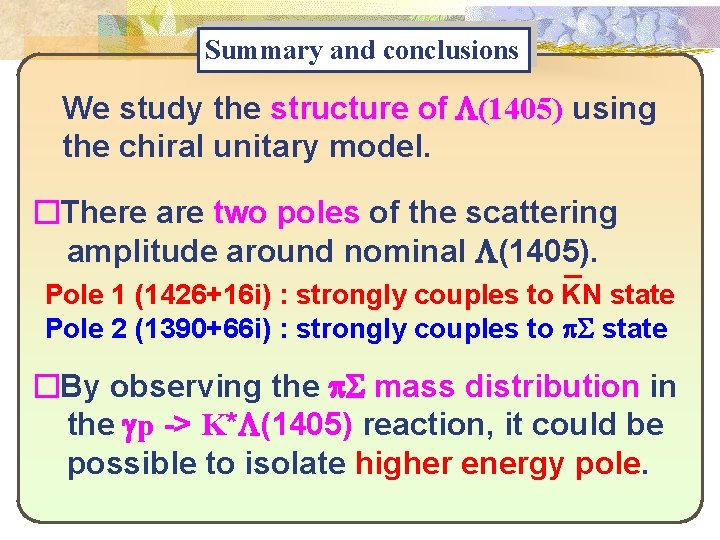
Summary and conclusions We study the structure of L(1405) using the chiral unitary model. �There are two poles of the scattering amplitude around nominal L(1405). Pole 1 (1426+16 i) : strongly couples to KN state Pole 2 (1390+66 i) : strongly couples to p. S state �By observing the p. S mass distribution in the gp -> K*L(1405) reaction, it could be possible to isolate higher energy pole.
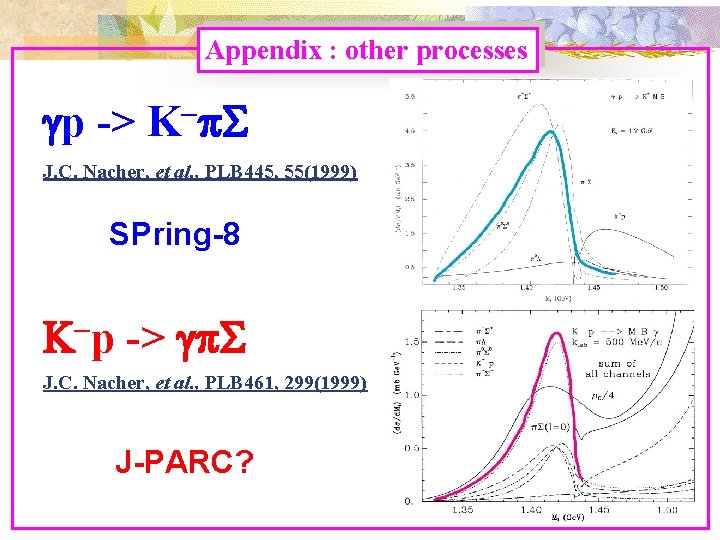
Appendix : other processes gp -> K p. S J. C. Nacher, et al. , PLB 445, 55(1999) SPring-8 Kp -> gp. S J. C. Nacher, et al. , PLB 461, 299(1999) J-PARC?
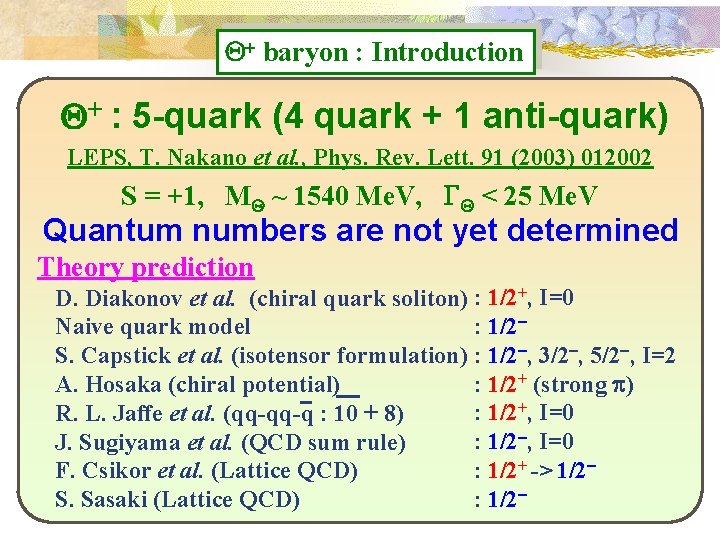
Q+ baryon : Introduction Q+ : 5 -quark (4 quark + 1 anti-quark) LEPS, T. Nakano et al. , Phys. Rev. Lett. 91 (2003) 012002 S = +1, MQ ~ 1540 Me. V, GQ < 25 Me. V Quantum numbers are not yet determined Theory prediction D. Diakonov et al. (chiral quark soliton) : 1/2+, I=0 : 1/2 Naive quark model S. Capstick et al. (isotensor formulation) : 1/2 -, 3/2 -, 5/2 -, I=2 : 1/2+ (strong p) A. Hosaka (chiral potential) : 1/2+, I=0 R. L. Jaffe et al. (qq-qq-q : 10 + 8) : 1/2 -, I=0 J. Sugiyama et al. (QCD sum rule) : 1/2+ -> 1/2 F. Csikor et al. (Lattice QCD) : 1/2 S. Sasaki (Lattice QCD)
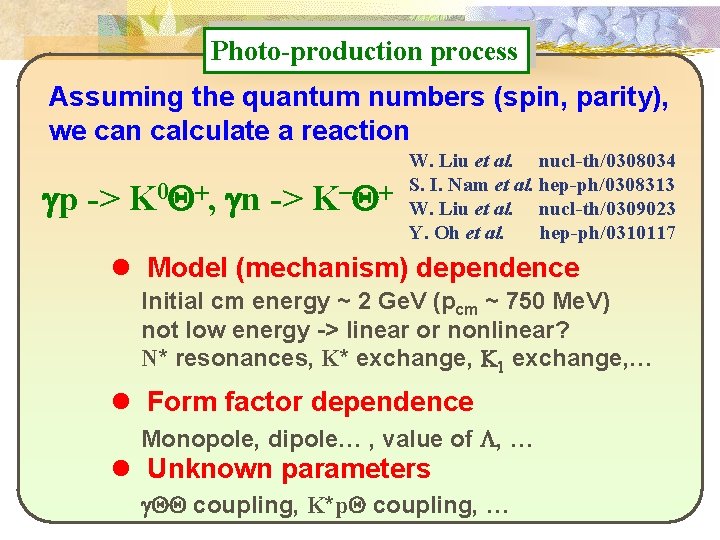
Photo-production process Assuming the quantum numbers (spin, parity), we can calculate a reaction gp -> K 0 Q+, gn -> K-Q W. Liu et al. nucl-th/0308034 + S. I. Nam et al. hep-ph/0308313 W. Liu et al. nucl-th/0309023 Y. Oh et al. hep-ph/0310117 l Model (mechanism) dependence Initial cm energy ~ 2 Ge. V (pcm ~ 750 Me. V) not low energy -> linear or nonlinear? N* resonances, K* exchange, K 1 exchange, … l Form factor dependence Monopole, dipole… , value of L, … l Unknown parameters g. QQ coupling, K*p. Q coupling, …
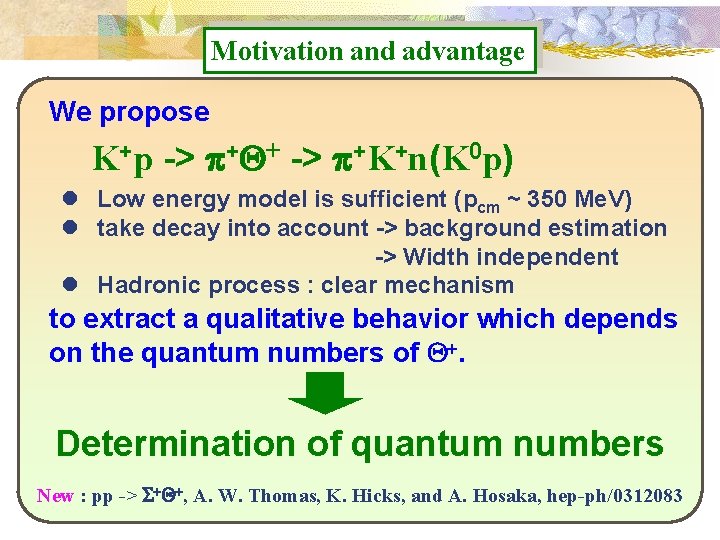
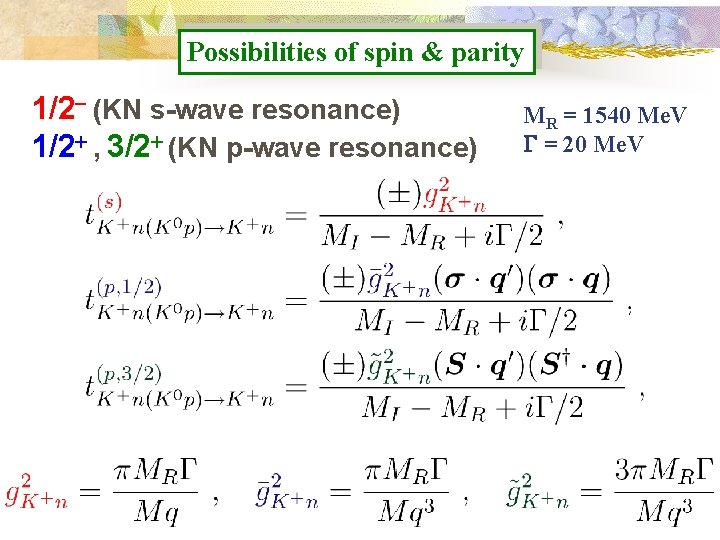
Motivation and advantage We propose K+p -> p+Q+ -> p+K+n(K 0 p) l Low energy model is sufficient (pcm ~ 350 Me. V) l take decay into account -> background estimation -> Width independent l Hadronic process : clear mechanism to extract a qualitative behavior which depends on the quantum numbers of Q+. Determination of quantum numbers New : pp -> S+Q+, A. W. Thomas, K. Hicks, and A. Hosaka, hep-ph/0312083
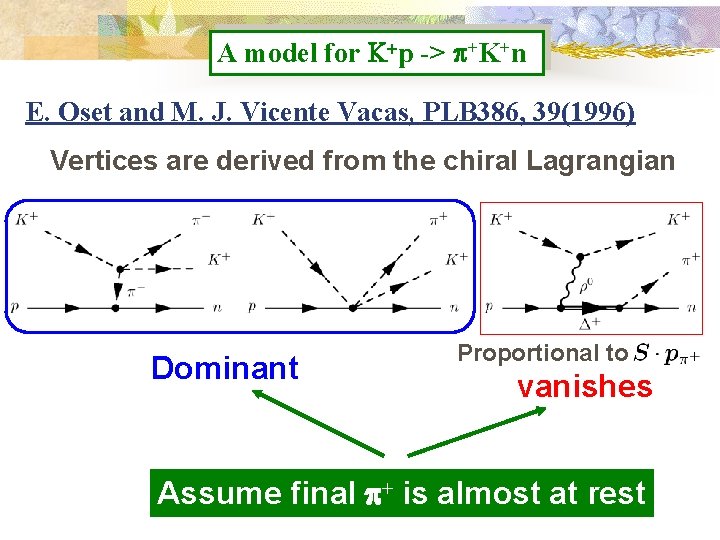
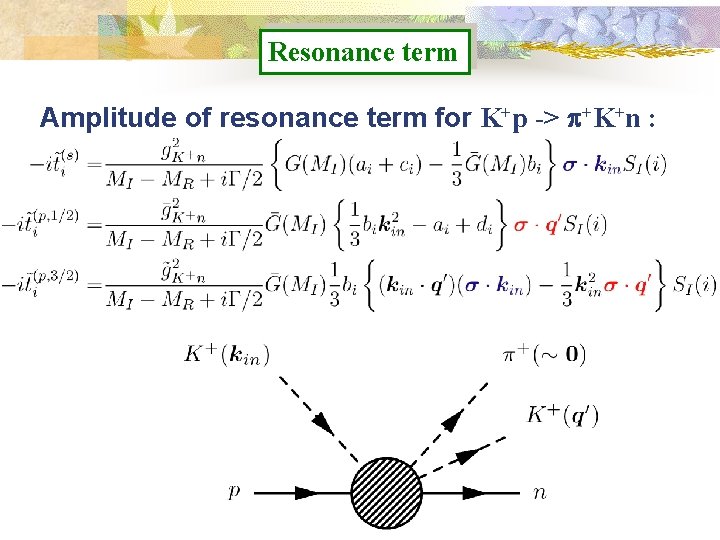
A model for K+p -> p+K+n E. Oset and M. J. Vicente Vacas, PLB 386, 39(1996) Vertices are derived from the chiral Lagrangian Dominant Proportional to vanishes Assume final p+ is almost at rest
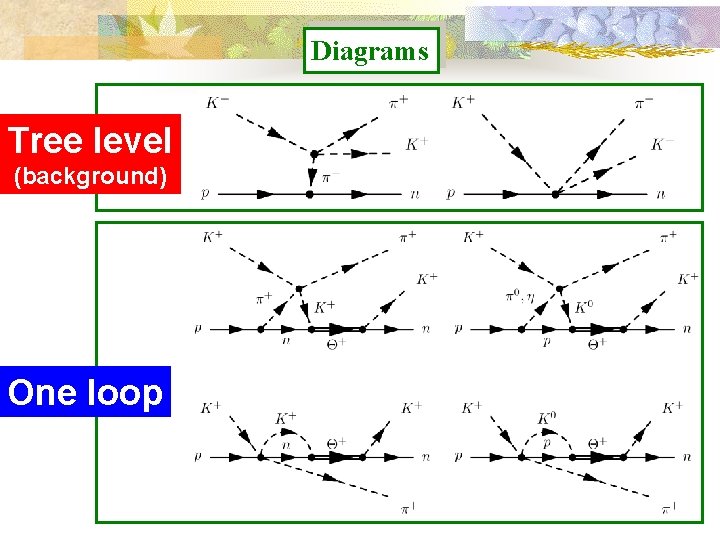
Diagrams Tree level (background) One loop
Possibilities of spin & parity 1/2 - (KN s-wave resonance) 1/2+ , 3/2+ (KN p-wave resonance) MR = 1540 Me. V G = 20 Me. V
Resonance term Amplitude of resonance term for K+p -> p+K+n :

Angular dependence

Mass distributions
Polarization test # Same result is obtained for final p. K 0
Angular dependence : polarization test
Mass distributions : polarization test
Incomplete polarization 80 % 0% 100 %
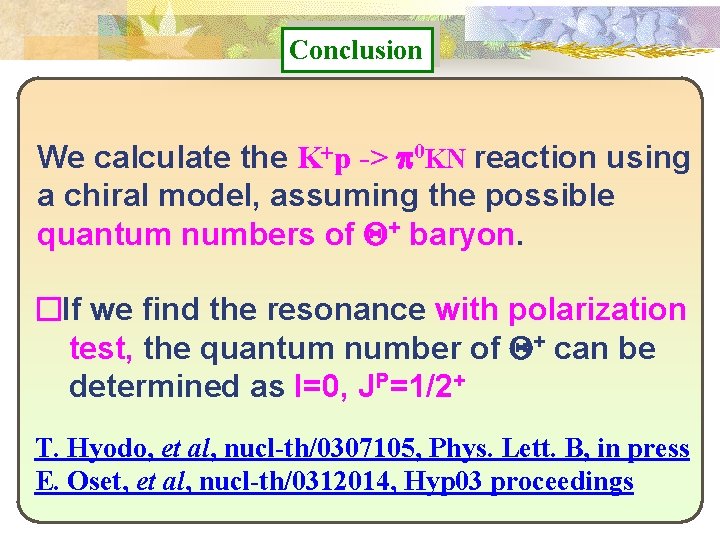
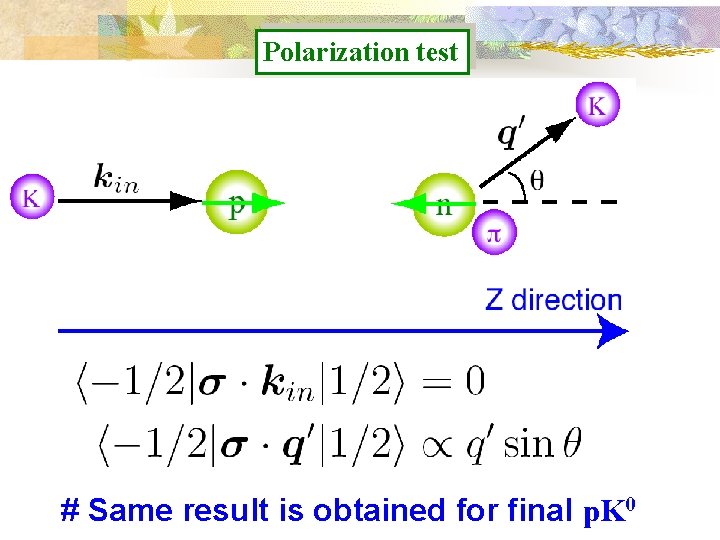
Conclusion We calculate the K+p -> p 0 KN reaction using a chiral model, assuming the possible quantum numbers of Q+ baryon. �If we find the resonance with polarization test, the quantum number of Q+ can be determined as I=0, JP=1/2+ T. Hyodo, et al, nucl-th/0307105, Phys. Lett. B, in press E. Oset, et al, nucl-th/0312014, Hyp 03 proceedings
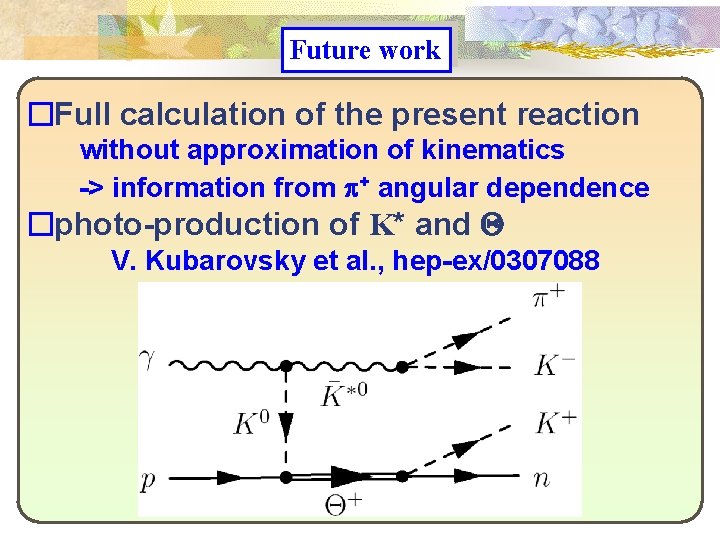
Future work �Full calculation of the present reaction without approximation of kinematics -> information from p+ angular dependence �photo-production of K* and Q V. Kubarovsky et al. , hep-ex/0307088
- Slides: 31