
Exokernel An Operating System Architecture for ApplicationLevel Resource

- Slides: 20
Exokernel: An Operating System Architecture for Application-Level Resource Management Dawson R. Engler, M. Frans Kaashoek, and James O’Toole Jr [SOSP’ 97] Presented by Hyun. Jong (Joseph) Lee
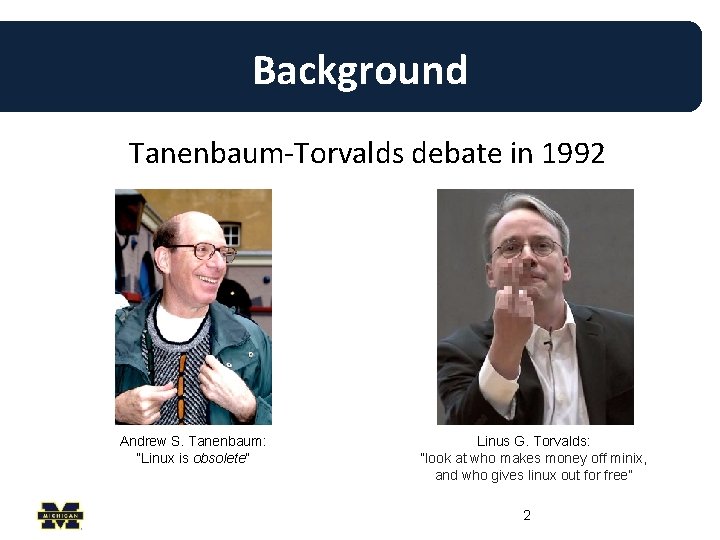
Background Tanenbaum-Torvalds debate in 1992 Andrew S. Tanenbaum: “Linux is obsolete” Linus G. Torvalds: “look at who makes money off minix, and who gives linux out for free” 2
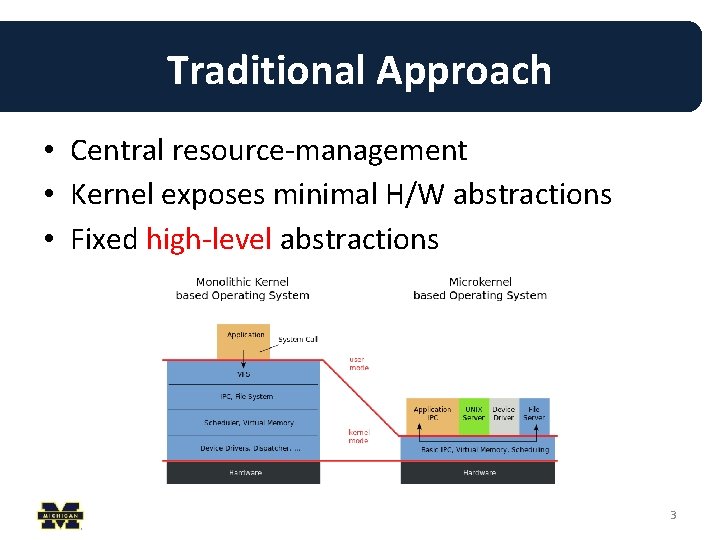
Traditional Approach • Central resource-management • Kernel exposes minimal H/W abstractions • Fixed high-level abstractions 3
Problem w/ high-level abst. • Hurts app. performance • no single fixed abstraction is good for all apps. • Hides information from OS – lack of app. specific resource-management • Limits functionality of apps. • use only fixed high-level abstraction 4
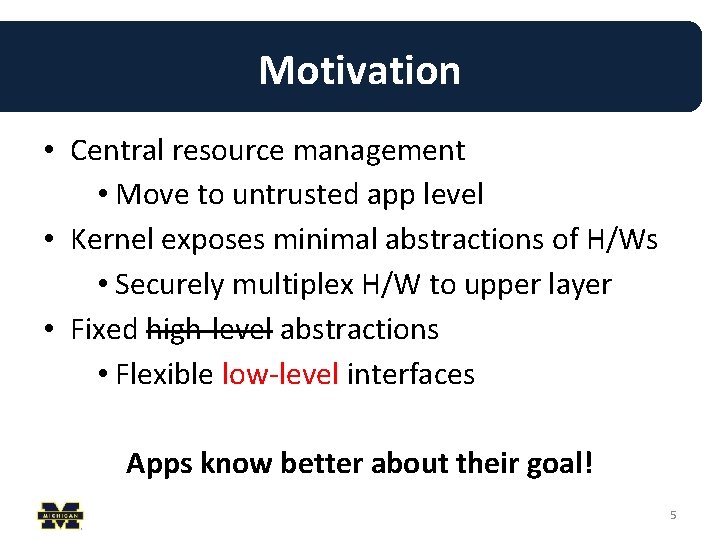
Motivation • Central resource management • Move to untrusted app level • Kernel exposes minimal abstractions of H/Ws • Securely multiplex H/W to upper layer • Fixed high-level abstractions • Flexible low-level interfaces Apps know better about their goal! 5
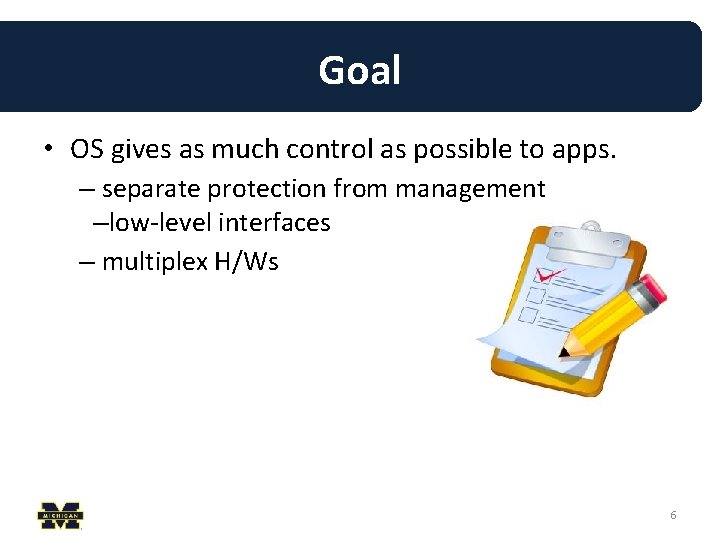
Goal • OS gives as much control as possible to apps. – separate protection from management –low-level interfaces – multiplex H/Ws 6
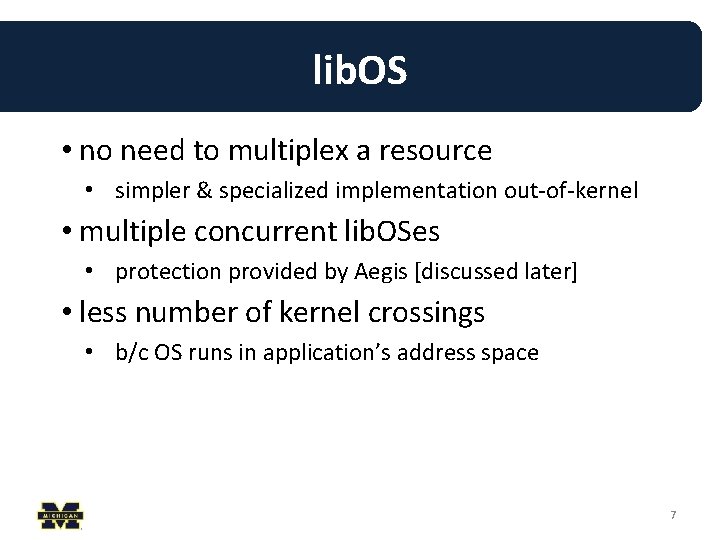
lib. OS • no need to multiplex a resource • simpler & specialized implementation out-of-kernel • multiple concurrent lib. OSes • protection provided by Aegis [discussed later] • less number of kernel crossings • b/c OS runs in application’s address space 7
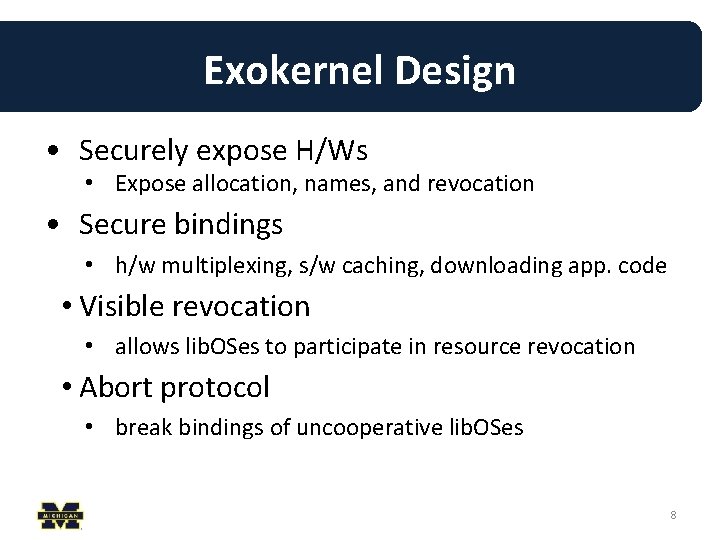
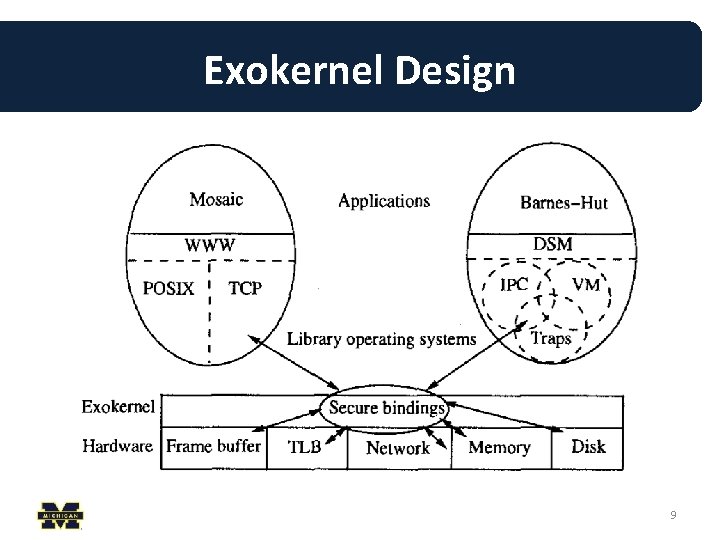
Exokernel Design • Securely expose H/Ws • Expose allocation, names, and revocation • Secure bindings • h/w multiplexing, s/w caching, downloading app. code • Visible revocation • allows lib. OSes to participate in resource revocation • Abort protocol • break bindings of uncooperative lib. OSes 8
Exokernel Design 9
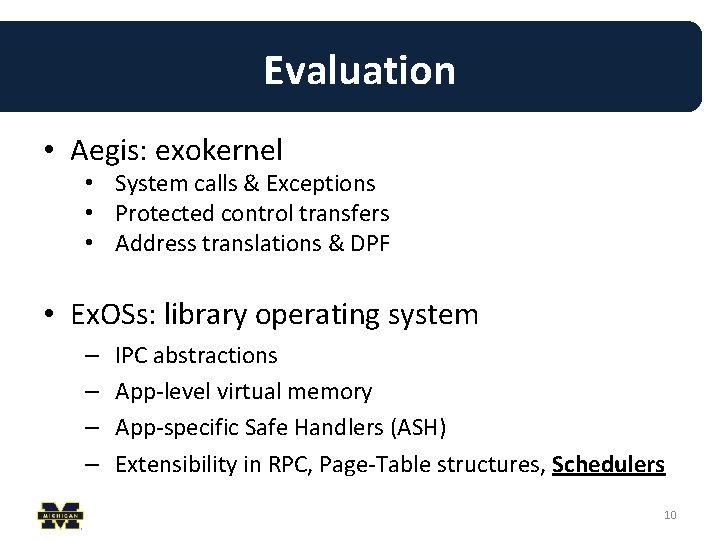
Evaluation • Aegis: exokernel • System calls & Exceptions • Protected control transfers • Address translations & DPF • Ex. OSs: library operating system – – IPC abstractions App-level virtual memory App-specific Safe Handlers (ASH) Extensibility in RPC, Page-Table structures, Schedulers 10
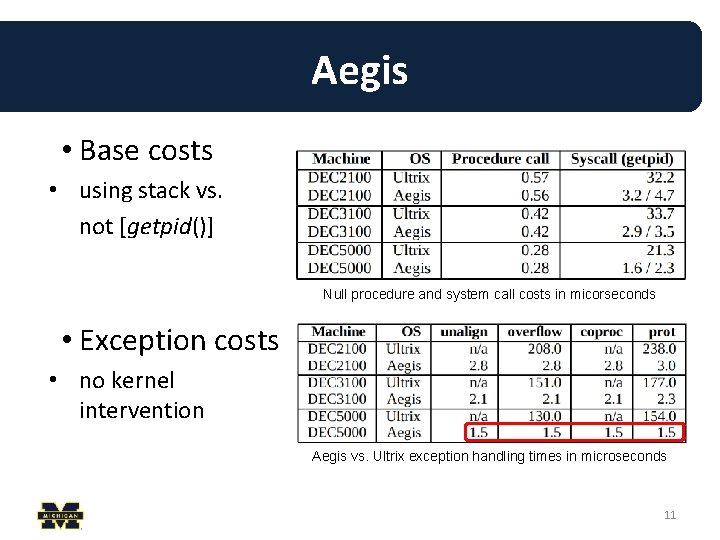
Aegis • Base costs • using stack vs. not [getpid()] Null procedure and system call costs in micorseconds • Exception costs • no kernel intervention Aegis vs. Ultrix exception handling times in microseconds 11
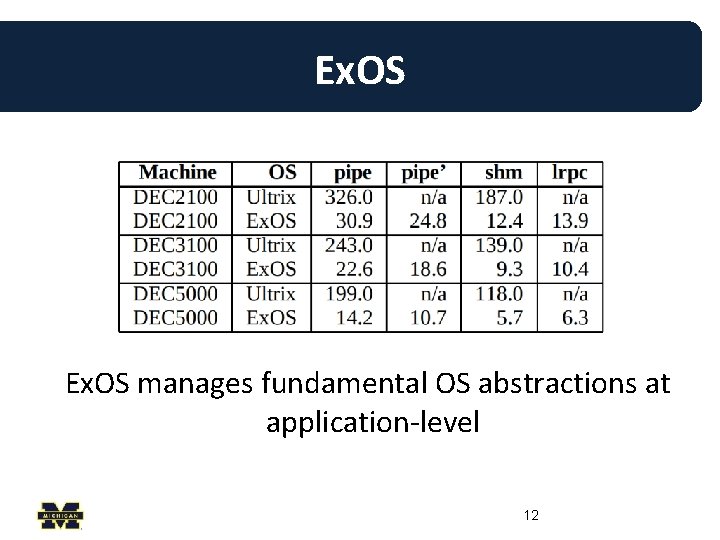
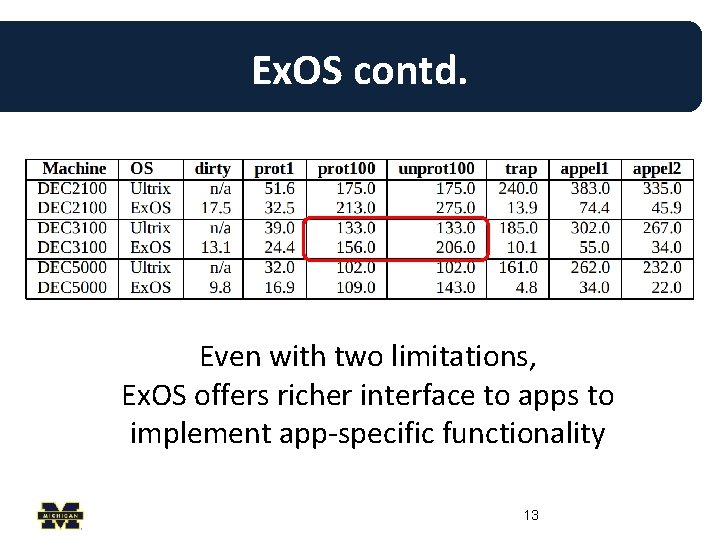
Ex. OS manages fundamental OS abstractions at application-level 12
Ex. OS contd. Even with two limitations, Ex. OS offers richer interface to apps to implement app-specific functionality 13
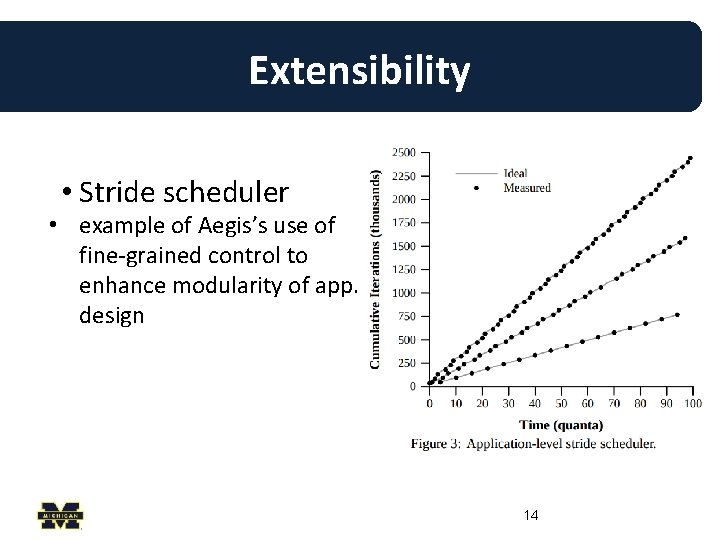
Extensibility • Stride scheduler • example of Aegis’s use of fine-grained control to enhance modularity of app. design 14
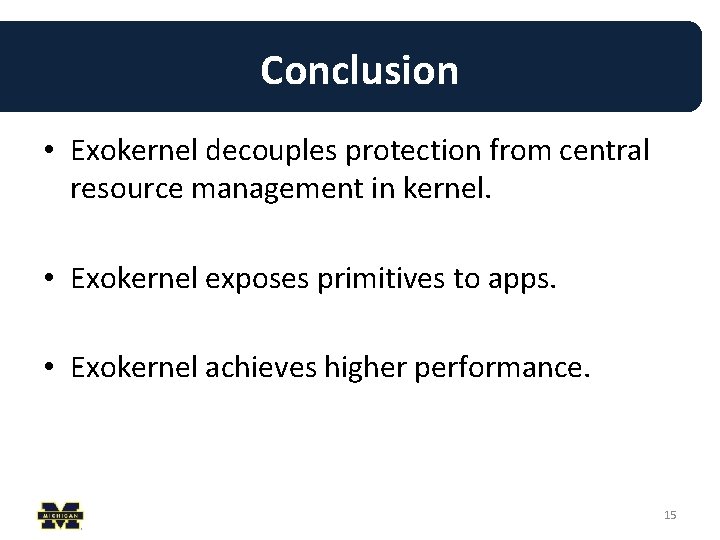
Conclusion • Exokernel decouples protection from central resource management in kernel. • Exokernel exposes primitives to apps. • Exokernel achieves higher performance. 15
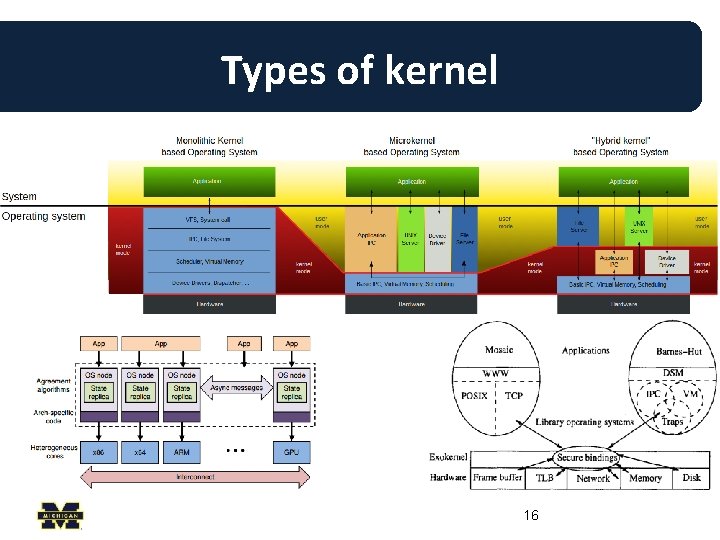
Types of kernel 16
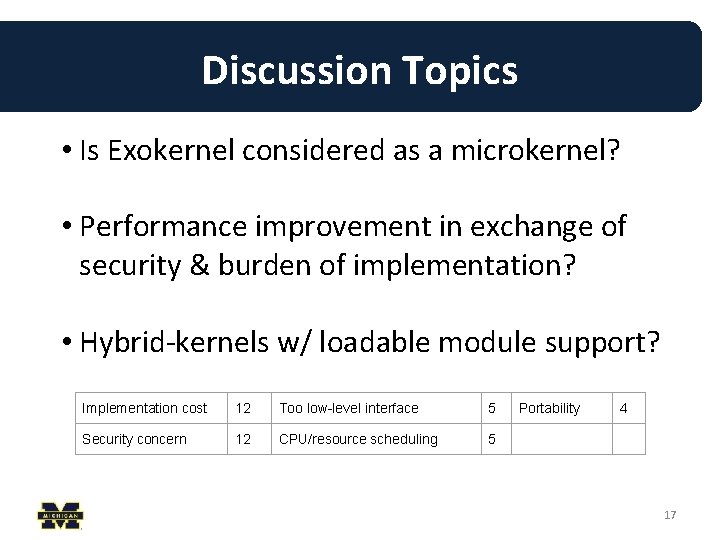
Discussion Topics • Is Exokernel considered as a microkernel? • Performance improvement in exchange of security & burden of implementation? • Hybrid-kernels w/ loadable module support? Implementation cost 12 Too low-level interface 5 Security concern 12 CPU/resource scheduling 5 Portability 4 17
Happy Ending 18
Except Prof. Engler 19
20