
Existing Replacements for CFC HCFC Refrigerants and Future
- Slides: 19
Existing Replacements for CFC & HCFC Refrigerants and Future Low GWP Alternatives Dr. Frank Rinne Technical Programmes Manager Du. Pont Fluoroproducts
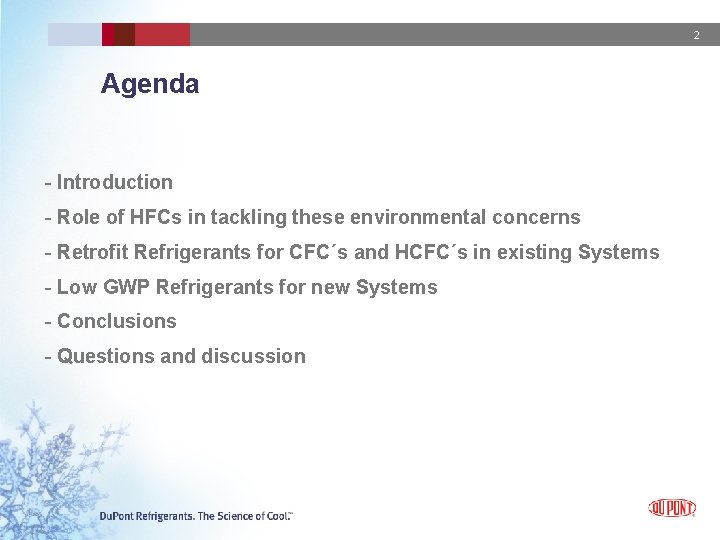
2 Agenda - Introduction - Role of HFCs in tackling these environmental concerns - Retrofit Refrigerants for CFC´s and HCFC´s in existing Systems - Low GWP Refrigerants for new Systems - Conclusions - Questions and discussion
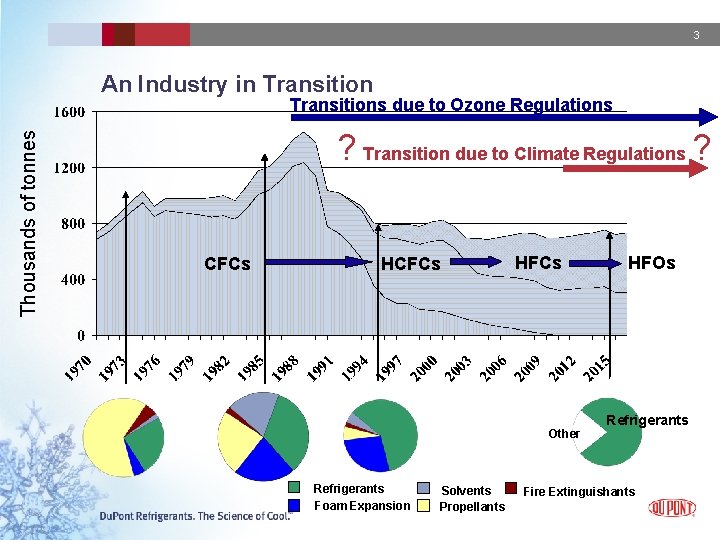
3 An Industry in Transition Thousands of tonnes Transitions due to Ozone Regulations ? Transition due to Climate Regulations ? CFCs HFCs Other Refrigerants Foam Expansion Solvents Propellants HFOs Refrigerants Fire Extinguishants
4 Climate Change HFCs: A Small but Very Visible Part of Global Warming Globally HFCs are responsible for only a few percent of the total contribution to global warming (2 -3 %) But there are several factors that make them a target: • Nationally, HFCs can represent several percent of total contribution to global warming • The CFC legacy: regulate and industry will innovate • Refrigerant emissions can be reduced • HFCs are included in the “basket” of gases under the Kyoto Protocol • HFCs are considered “high GWP” gases with perceived low reduction costs Energy efficiency is considered a separate issue Bottom line – HFCs are a target for global warming regulations
5 Ozone Depletion: Du. Pont Position on HCFC Phase-out Acceleration • Despite remarkable success, the ozone layer still requires action. • Du. Pont supports the accelerated phase-out schedules for HCFCs as an encouraging sign that developed and developing nations can reach consensus on actions to protect the global climate system • The new schedule will allow for an orderly transition to alternative products and technologies through: • Good conservation practices to reduce emissions of refrigerants to the environment • Adoption of alternative non-ozone depleting products and technologies.
6 ISCEON® Refrigerants to replace CFCs and HCFCs Benefits: § provides easy, quick, cost-effective retrofit § non-ozone-depleting HFC § in most cases no change of lubricant type during retrofit is required -compatible with traditional and new lubricants § avoids expensive engineering changes to existing equipment § enables cost-effective continued use of existing equipment § can be topped off during service without removing the entire refrigerant charge Performance: § provides required cooling capacity and comparable energy efficiency vs. R-12 and R-22 § similar discharge temperature and pressure vs. R-12 and R 22
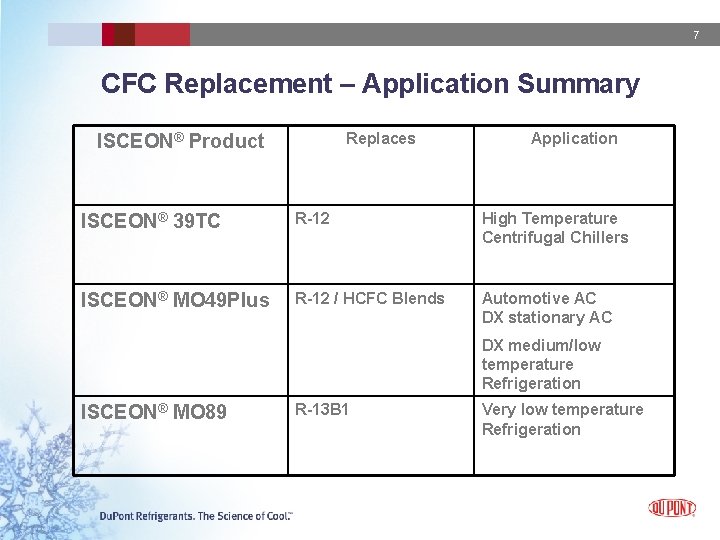
7 CFC Replacement – Application Summary Replaces ISCEON® Product Application ISCEON® 39 TC R-12 High Temperature Centrifugal Chillers ISCEON® MO 49 Plus R-12 / HCFC Blends Automotive AC DX stationary AC DX medium/low temperature Refrigeration ISCEON® MO 89 R-13 B 1 Very low temperature Refrigeration
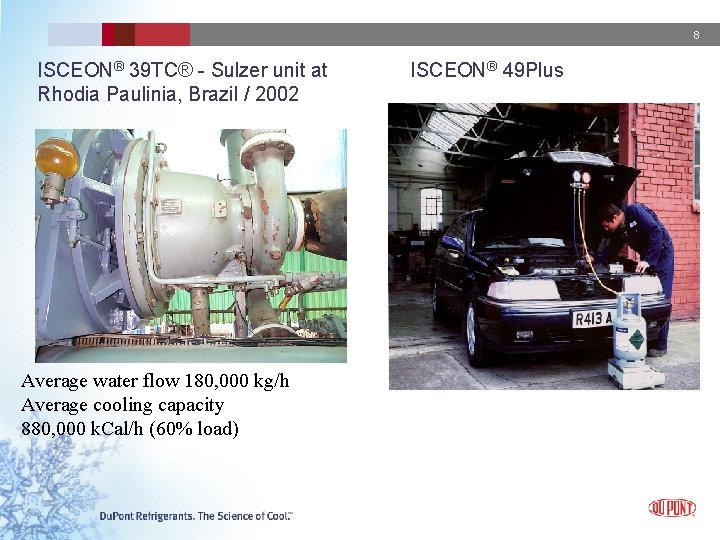
8 ISCEON® 39 TC® - Sulzer unit at Rhodia Paulinia, Brazil / 2002 Average water flow 180, 000 kg/h Average cooling capacity 880, 000 k. Cal/h (60% load) ISCEON® 49 Plus
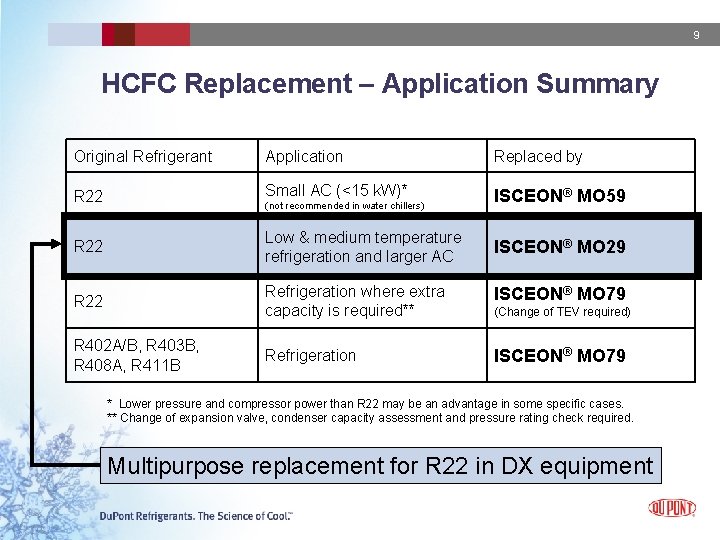
9 HCFC Replacement – Application Summary Original Refrigerant Application Replaced by R 22 Small AC (<15 k. W)* ISCEON® MO 59 R 22 Low & medium temperature refrigeration and larger AC ISCEON® MO 29 R 22 Refrigeration where extra capacity is required** ISCEON® MO 79 R 402 A/B, R 403 B, R 408 A, R 411 B Refrigeration ISCEON® MO 79 (not recommended in water chillers) (Change of TEV required) * Lower pressure and compressor power than R 22 may be an advantage in some specific cases. ** Change of expansion valve, condenser capacity assessment and pressure rating check required. Multipurpose replacement for R 22 in DX equipment
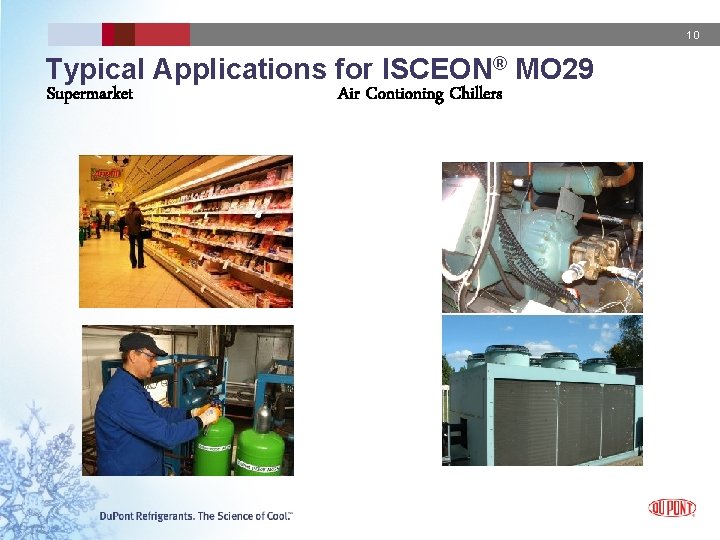
10 Typical Applications for ISCEON® MO 29 Supermarket Air Contioning Chillers
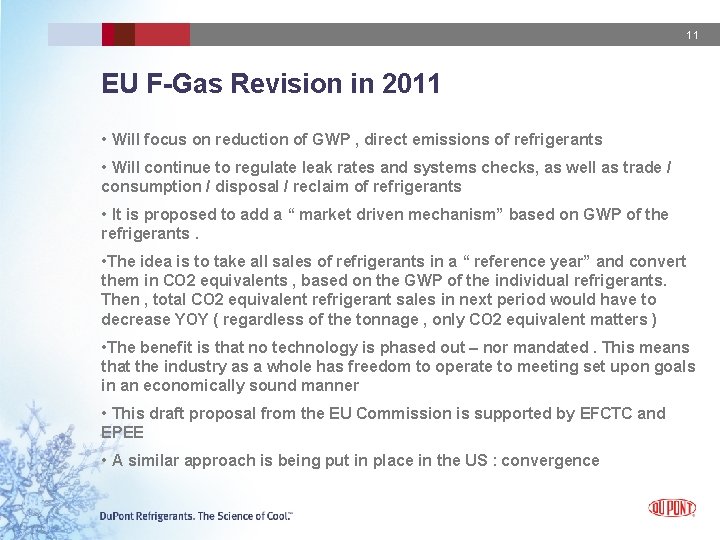
11 EU F-Gas Revision in 2011 • Will focus on reduction of GWP , direct emissions of refrigerants • Will continue to regulate leak rates and systems checks, as well as trade / consumption / disposal / reclaim of refrigerants • It is proposed to add a “ market driven mechanism” based on GWP of the refrigerants. • The idea is to take all sales of refrigerants in a “ reference year” and convert them in CO 2 equivalents , based on the GWP of the individual refrigerants. Then , total CO 2 equivalent refrigerant sales in next period would have to decrease YOY ( regardless of the tonnage , only CO 2 equivalent matters ) • The benefit is that no technology is phased out – nor mandated. This means that the industry as a whole has freedom to operate to meeting set upon goals in an economically sound manner • This draft proposal from the EU Commission is supported by EFCTC and EPEE • A similar approach is being put in place in the US : convergence
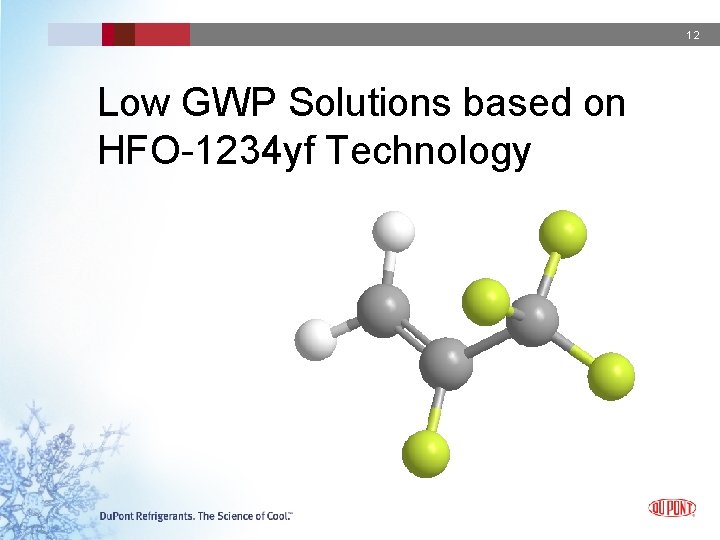
12 Low GWP Solutions based on HFO-1234 yf Technology A Low GWP Refrigerant For MAC
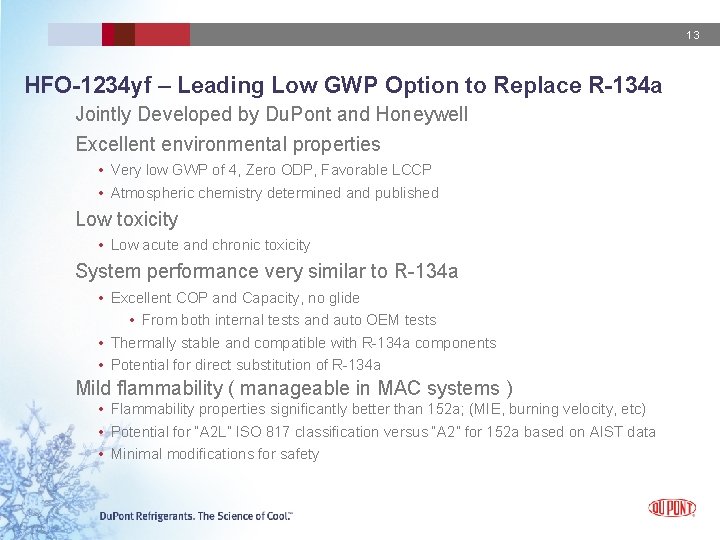
13 HFO-1234 yf – Leading Low GWP Option to Replace R-134 a Jointly Developed by Du. Pont and Honeywell Excellent environmental properties • Very low GWP of 4, Zero ODP, Favorable LCCP • Atmospheric chemistry determined and published Low toxicity • Low acute and chronic toxicity System performance very similar to R-134 a • Excellent COP and Capacity, no glide • From both internal tests and auto OEM tests • Thermally stable and compatible with R-134 a components • Potential for direct substitution of R-134 a Mild flammability ( manageable in MAC systems ) • Flammability properties significantly better than 152 a; (MIE, burning velocity, etc) • Potential for “A 2 L” ISO 817 classification versus “A 2” for 152 a based on AIST data • Minimal modifications for safety
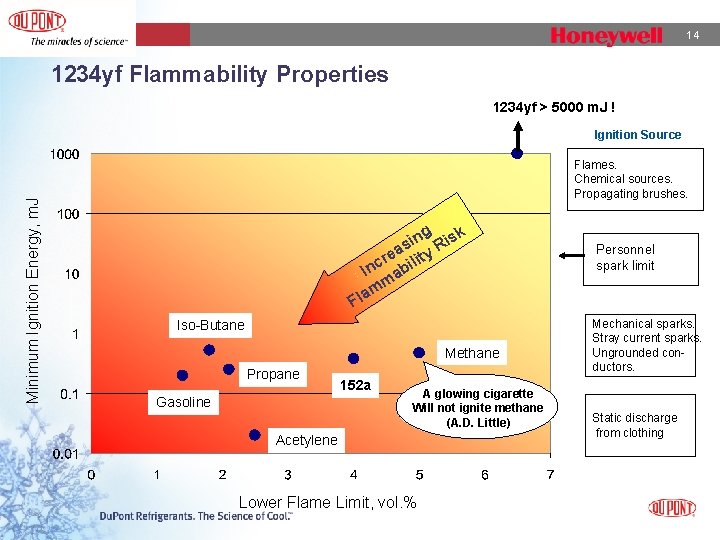
14 1234 yf Flammability Properties 1234 yf > 5000 m. J ! Minimum Ignition Energy, m. J Ignition Source Flames. Chemical sources. Propagating brushes. ing Risk s ea lity r Inc abi m m Fla Iso-Butane Methane Propane Gasoline 152 a A glowing cigarette Will not ignite methane (A. D. Little) Acetylene Lower Flame Limit, vol. % Personnel spark limit Mechanical sparks. Stray current sparks. Ungrounded conductors. Static discharge from clothing
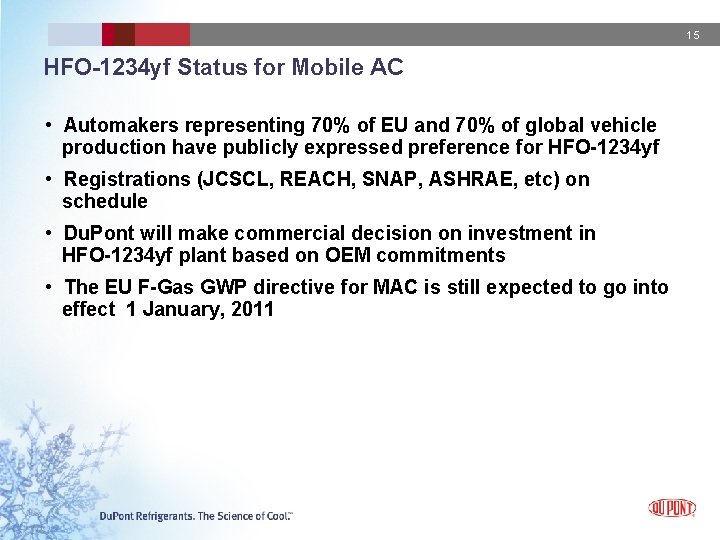
15 HFO-1234 yf Status for Mobile AC • Automakers representing 70% of EU and 70% of global vehicle production have publicly expressed preference for HFO-1234 yf • Registrations (JCSCL, REACH, SNAP, ASHRAE, etc) on schedule • Du. Pont will make commercial decision on investment in HFO-1234 yf plant based on OEM commitments • The EU F-Gas GWP directive for MAC is still expected to go into effect 1 January, 2011
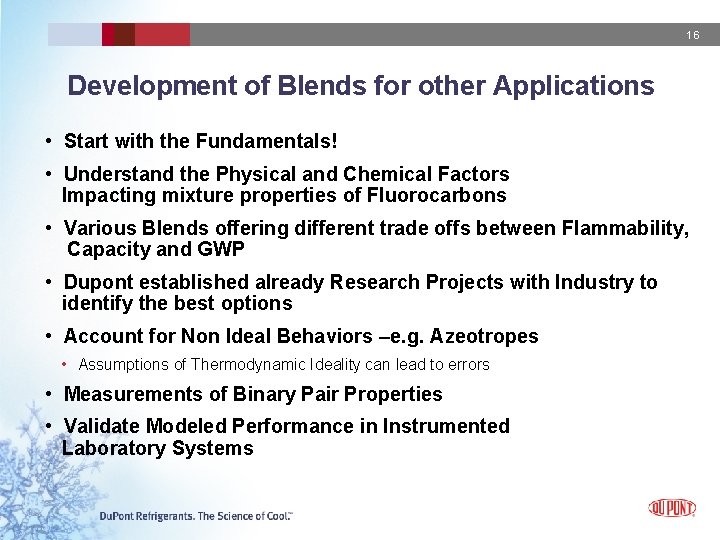
16 Development of Blends for other Applications • Start with the Fundamentals! • Understand the Physical and Chemical Factors Impacting mixture properties of Fluorocarbons • Various Blends offering different trade offs between Flammability, Capacity and GWP • Dupont established already Research Projects with Industry to identify the best options • Account for Non Ideal Behaviors –e. g. Azeotropes • Assumptions of Thermodynamic Ideality can lead to errors • Measurements of Binary Pair Properties • Validate Modeled Performance in Instrumented Laboratory Systems
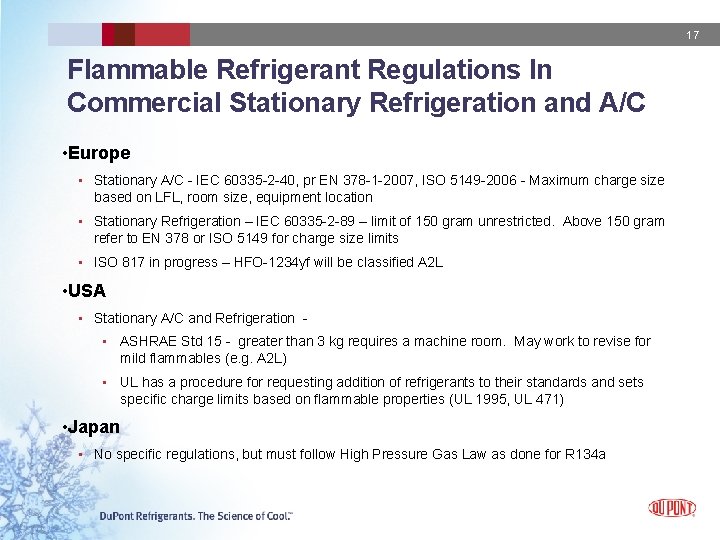
17 Flammable Refrigerant Regulations In Commercial Stationary Refrigeration and A/C • Europe • Stationary A/C - IEC 60335 -2 -40, pr EN 378 -1 -2007, ISO 5149 -2006 - Maximum charge size based on LFL, room size, equipment location • Stationary Refrigeration – IEC 60335 -2 -89 – limit of 150 gram unrestricted. Above 150 gram refer to EN 378 or ISO 5149 for charge size limits • ISO 817 in progress – HFO-1234 yf will be classified A 2 L • USA • Stationary A/C and Refrigeration • ASHRAE Std 15 - greater than 3 kg requires a machine room. May work to revise for mild flammables (e. g. A 2 L) • UL has a procedure for requesting addition of refrigerants to their standards and sets specific charge limits based on flammable properties (UL 1995, UL 471) • Japan • No specific regulations, but must follow High Pressure Gas Law as done for R 134 a
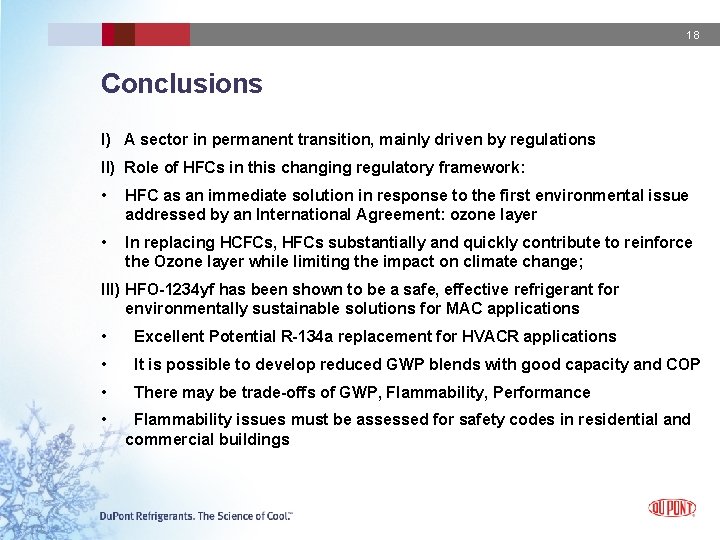
18 Conclusions I) A sector in permanent transition, mainly driven by regulations II) Role of HFCs in this changing regulatory framework: • HFC as an immediate solution in response to the first environmental issue addressed by an International Agreement: ozone layer • In replacing HCFCs, HFCs substantially and quickly contribute to reinforce the Ozone layer while limiting the impact on climate change; III) HFO-1234 yf has been shown to be a safe, effective refrigerant for environmentally sustainable solutions for MAC applications • Excellent Potential R-134 a replacement for HVACR applications • It is possible to develop reduced GWP blends with good capacity and COP • There may be trade-offs of GWP, Flammability, Performance • Flammability issues must be assessed for safety codes in residential and commercial buildings
19